

This thread is for discussion of the article:
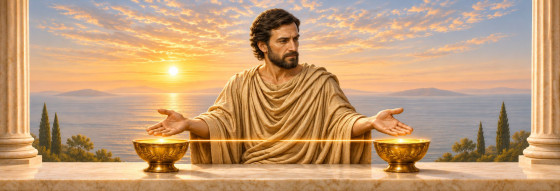
One Wise Man Is Not Wiser Than Another: What Epicurus' Saying Tells Us About Pleasure, Happiness, And How We Know What Is Real

This thread is for discussion of the article:
One Wise Man Is Not Wiser Than Another: What Epicurus' Saying Tells Us About Pleasure, Happiness, And How We Know What Is Real
From Facebook:
I don't get it
Cassius:
What part do you not get? As Cicero showed in On Ends, the Socrates and the Stoics argued that virtue (any good) is all or nothing. If you are not completely virtuous, you are not virtuous. They thought this was compelled by the argument that if something can be made better, then it isn't the best it can be, so it isn't fully and completely good. The good is all or nothing, ***therefore pleasure cannot be THE good because it can always be better, which means you don't have it all.*** Epicurus said no Socrates, you are wrong to think that pleasure cannot be complete. Because pleasure and pain are the only possible experiences, pleasure is complete when it is not accompanied in your experience by any pain. Therefore just like all wise men are equally wise (they are completely wise), all who are experiencing no pain are experiencing complete pleasure.
What does this get you? It allows you to see pleasure as your goal, because pleasure can be complete - all who reach complete pleasure are in the same state of pleasure, just as all wise men are equally wise. One many who is in complete pleasure is experiencing no more pleasure than another man who experiences complete pleasure, just as one wise man is no wiser than another.
This gives you a logical framework, but are two wise men completely the same in every respect? Are two people in complete pleasure necessarily experiencing exactly the same thing? The answer to both is "of course not." One many can no more or less than another, and one man can experience more or less pleasure than another too.
You navigate by goals, and this gives you a target to aim for. The Stoics and Socrates are trapped by "all or nothing" and said that no matter how close your goal you get it doesn't matter unless you get 100% of the way there. You can drown an inch below the surface as well as you can a mile below the surface. Epicurus is not trapped by that way of looking at things because he doesn't insist on all or nothing. Epicurus is still happy even though he is in severe pain of kidney disease. A wise man is still happy even while under torture. It DOES matter how much pleasure or pain you are experiencing at any moment because you are confident what the goal is, and you try your best to get as close as possible.
If you don't look at this problem the way Epicurus does, you are trapped by the Stoics and Socrates / Plato into thinking that Pleasure should not be your goal in the first place.
(Again on Facebook)
Also, in addition to what I just wrote - here 's another way of looking at it: My article suggests a way to interpret what Epicurus said by referring to statements made by Cicero and Plato. Suppose you had never read my article. Would the statement "one wise man is not wiser than another" have seemed right to you? How would you have interpreted it?
This issue (are Plato and the Stoics correct in viewing concepts as all-or-nothing, or should we view them as limits in which it matters whether we are more or less close to that limit?) almost certainly is relevant to PD09:
PD09. If every pleasure could be intensified so that it lasted, and influenced the whole organism or the most essential parts of our nature, pleasures would never differ from one another. (Bailey)
The same issue is at stake in the "heap" problem. One heap can be taller or heavier or wider than another heap, but nevertheless regardless of change in these dimensions every heap is still a heap. Pleasures can and do differ in length, intensity, and parts of the body affected, and only a fool would fail to recognize that. But every pleasure is pleasing, no matter the length, intensity, or duration, so every pleasure is still a pleasure.
I am glad we have something preserved on this topic rather than nothing, but PD09 and Diogenes Laertius saying one wise man is not wiser than another are both clipped and largely out-of-context statements that have been removed from their context of the "all or nothing" / "being vs becoming" / "more or less vs limit" discussion.
When you are aware of the discussion - which is clearly there in Philebus and "On Ends" and Seneca - and would have been known to every educated philosopher in the ancient world, then you see how important it is to swat down the ridiculous assertion that the Platonists were making. You would know that it is important to point out that there is a difference between gods and men, and you have to be clear whether you are talking about happiness (or wisdom or pleasure) appropriate to gods, or the same things as possible to men. You would know that all faults are faults, but some are worse than others. You wouldn't be confused by "being" vs. "becoming," but rather you would see that courage grows through calculation of advantage, just like friendship grows from the same motive.
From this perspective this is also the unifying theme between what Diogenes gathered together to place in 122.
122
They hold that faults are not all of equal gravity, that health is a blessing to some, but indifferent to others, that courage does not come by nature, but by a calculation of advantage. That friendship too has practical needs as its motive: one must indeed lay its foundations (for we sow the ground too for the sake of crops), but it is formed and maintained by means of community of life among those who have reached the fullness of pleasure. They say also that there are two ideas of happiness, complete happiness, such as belongs to a god, which admits of no increase, and the happiness which is concerned with the addition and subtraction of pleasures. Now we must proceed to the letter.
None of these individual issues mean a great deal standing alone -- without context they are mere assertions which Skeptics will dismiss as unproveable and unknowable. In the absence of context people today will take this as outmoded, archaic, replaced by modern science - something to be moved on through quickly so we can discuss how much cake to eat before we get sick.
But if you do that, you end up being unable to see why a lifetime of work in building a philosophic school that stands up to false religions and philosophies would be any more preferable than a lifetime of sitting on the floor of a cave nibbling on bread and water. In fact, you would think that the latter would be far preferable, because it would not involved nearly as much pain!
Similarly what would Epicurus say about whether a man can step into the same river twice?
Isn't that impossible because the second time around it's not the same river nor is it the same man?
What would Epicurus say to that in this context?
I'd expect Epicurus to say that of course it's possible for (as an example) Tom Sawyer to bathe in the Mississippi twice - or any number of times.
Epicureans aren't radical reductionists - atoms and void are not the only reality that exists, just like there's no magic grain that makes a heap a heap. The fact that atoms don't stay in the same place for more than an instant doesn't make the real Tom Sawyer any less able to bathe many times in the real Mississippi river.
And it's important to recognize that Heraclitus wasn't trying to be an atomic scientist. He was trying to argue that human knowledge and human reality aren't really "true." To people like him our reality is an illusion, and that's a very damaging argument to buy.
But a lot of people think Heraclitus was cool and that it's cool to deny human reality in favor of some non-human perspective, and as a philosopher if we are going to be of help to people in living happier lives, we have to deal with arguments like can't step into the same river twice and being is true but becoming is an illusion. These aren't innocent word games.
Another point:
No one familiar with basic philosophy would be so stupid as to say that all pleasures are the same in every respect and equally interchangeable.
Why?
Because philosophers know that the great Socrates had said so himself through Plato's Philebus. Onn this point Socrates and Philebus and Plato were all correct - in the real world, pleasure and pain do belong to the class of things that can be more or less:
SOCRATES: Have pleasure and pain a limit, or do they belong to the class which admits of more and less?
PHILEBUS: They belong to the class which admits of more, Socrates; for pleasure would not be perfectly good if she were not infinite in quantity and degree.
SOCRATES: Nor would pain, Philebus, be perfectly evil. And therefore the infinite cannot be that element which imparts to pleasure some degree of good. But now—admitting, if you like, that pleasure is of the nature of the infinite—in which of the aforesaid classes, O Protarchus and Philebus, can we without irreverence place wisdom and knowledge and mind? And let us be careful, for I think that the danger will be very serious if we err on this point.
It wasn't necessary for Epicurus to say what everyone knew - pleasures and pains differ and individual experiences of pleasure and pain can be more or less pleasurable and painful.
What was necessary for a philosopher to do was to establish that pursuit of pleasure or avoidance of pain are not illogical to target, as Socrates alleged when he said that such a goal is illusory as it can never be reached.
We show Socrates was wrong, and that the goal of a life of pleasure can be reached - by observing that pure pleasure cannot be made better by adding more pleasure.
Pure pleasure and is the limit of pleasure and pain, but this certainly does not mean that all pleasure and all pain are the same. Your starting point for the whole analysis was realizing that all pleasures and all pains are NOT the same!
Now you may not be able to experience pure pleasure in every moment of your life any more than Epicurus could escape his kidney disease. But you can still be HAPPY if you realize that happiness is not all or nothing and it's not worthless because it's not complete. Only a god might be able to control his experience well enough to live a life of complete and total pleasure, but by aiming to experience more pleasure than pain we can life more happily than if we target virtue or piety.
It does matter whether we are an inch away from the goal of pure happiness or a mile away from it. It does matter whether pleasure and pain are intense, and long lasting, and what part of the body they effect. Only a Platonist/Stoic, who lives in an idealistic dream world, or a Skeptic, who lives denying that anything in this world is real, would argue otherwise.
Thanks to Bryan for providing the following on Epicurus' terms for increasing levels of advancement in philosophy.
As you can see, although the translations require several words, each term is a single word in Greek.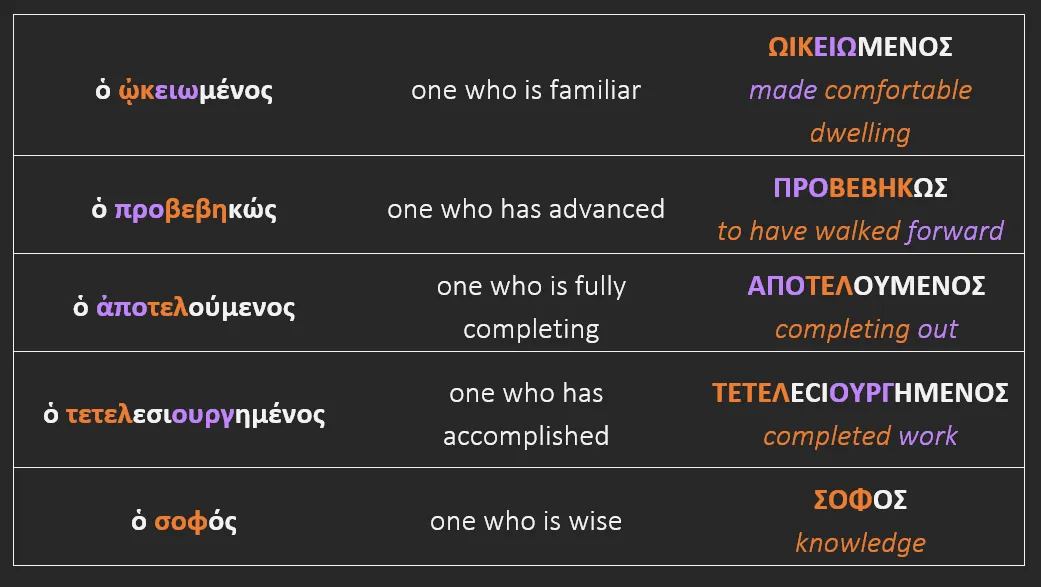
The following poll link is another way to get at the issues in this article: