


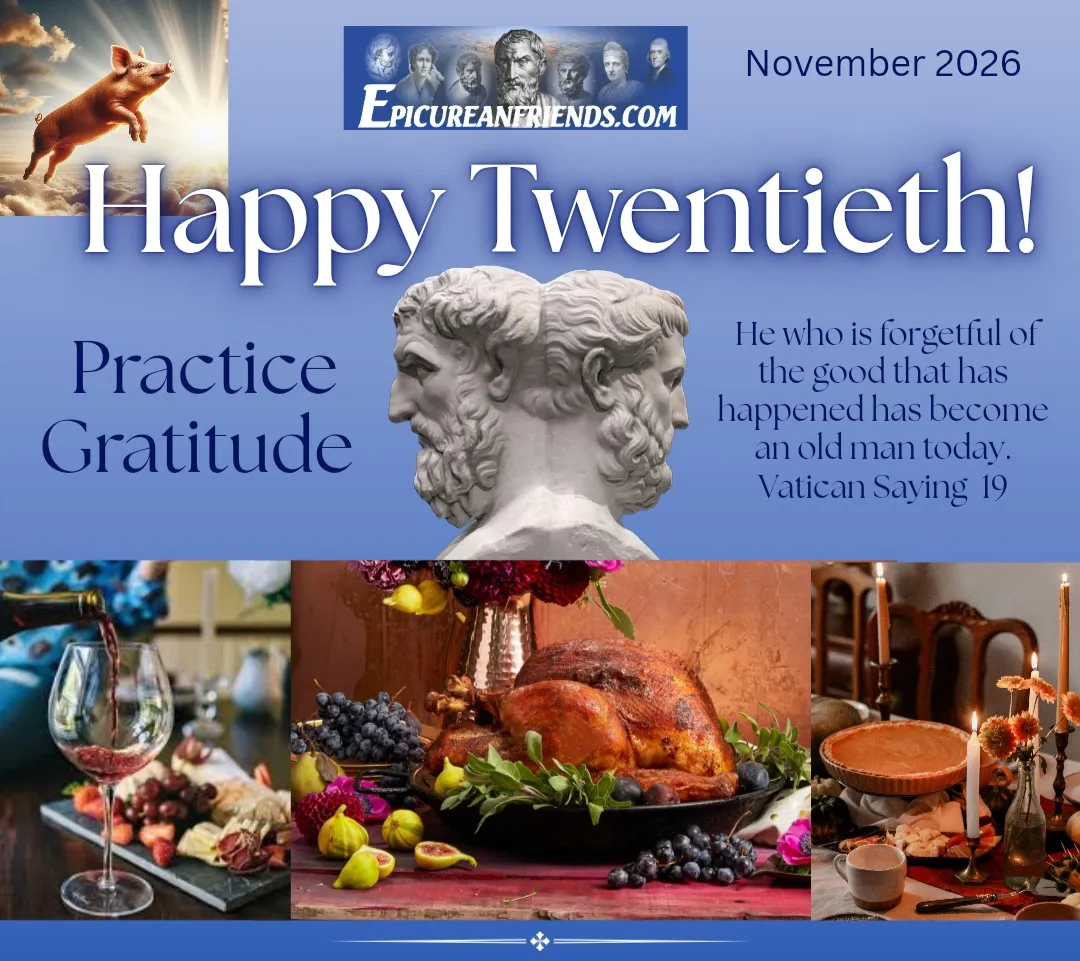
Happy Twentieth Everyone!
The Philosophy of Memory and Gratitude in Epicurus's Vatican Saying 19
In Vatican Saying 19, the ancient Greek philosopher Epicurus offers a profound observation about the relationship between memory, gratitude, and happiness. The original Greek reads: Τοῦ γεγονότος ἀμνήμων ἀγαθοῦ γέρων τήμερον γεγένηται. A close English translation is: "He who is forgetful of the good that has happened has become an old man today." Although brief, this statement expresses an important principle of Epicurean philosophy: remembering and appreciating past goodness is essential to a happy life.
The Greek word ἀμνήμων (amnēmōn), meaning "forgetful" or "unmindful," is particularly significant. It describes someone who has lost awareness of the good experiences of the past. The expression τοῦ γεγονότος ἀγαθοῦ refers to the good that has happened or come to pass, while γεγένηται (gegenētai), meaning "has become," emphasizes a condition that has come about in the present. The word γέρων (gerōn), meaning "old man," provides the central metaphor of the saying.
Epicurus's reference to old age is not necessarily a criticism of chronological aging. Rather, it suggests that someone who forgets past goodness has lost an important source of happiness. Such a person may become dissatisfied with the present because they no longer recognize or appreciate what life has already provided. In this sense, growing old represents a loss of gratitude and the ability to draw happiness from past experiences.
For Epicurus, happiness was not dependent exclusively on present pleasures. The recollection of past pleasures, friendships, and meaningful experiences could provide comfort and satisfaction even during difficult circumstances. Remembering these experiences allows their goodness to continue contributing to present happiness. Forgetting them, by contrast, deprives us of a valuable source of contentment.
Ultimately, Vatican Saying 19 reminds us that happiness depends not only on what we experience today or hope to acquire tomorrow, but also on our ability to appreciate what we have already experienced. Its deeper message is that growing old is not merely a matter of chronological age. A person may become old in spirit by forgetting life's past blessings, while someone who remembers them with gratitude can preserve a sense of richness and contentment throughout life. For Epicurus, the practice of recollection and gratitude becomes more than a quick flashback to a memory of the past; it is itself an enduring source of present moment happiness. This gratitude completes a full circle: we both live life to the fullest and also take time to remember the good with gratitude.
***********
(Source: "Collective Consciousness" with additional words added by Kalosyni in the last paragraph.)