

1. Home
    1. Start Here: Study Guide
    2. Community Standards And Posting Policies
    3. Terms of Use
    4. Moderator Team
    5. Website Overview
    6. Site Map
    7. Quizzes
    8. Articles
      1. Featured Articles
    9. All Blog Posts
      1. Elli's Blog / Articles
      2. Kalosyni's Blog
  2. Wiki
    1. Wiki Home
    2. FAQ
    3. Classical Epicureanism
    4. Files
    5. Search Assistance
    6. Not NeoEpicurean
    7. Foundations
    8. Navigation Outlines
    9. Reading List
    10. Key Pages
  3. Forum
    1. Full Forum List
    2. Welcome Threads
    3. Physics
    4. Canonics
    5. Ethics
    6. Forum Shortcuts
    7. Forum Navigation Map
    8. Featured
    9. Most Discussed
  4. Latest
    1. New Activity
    2. Latest Threads
    3. Dashboard
    4. Search By Tag
    5. Complete Tag List
  5. Podcast
    1. Lucretius Today Podcast
    2. Episode Guide
    3. Lucretius Today At Youtube
    4. EpicureanFriends Youtube Page
  6. Texts
    1. Overview
    2. Diogenes Laertius
    3. Principal Doctrines
    4. Vatican Collection
    5. Lucretius
    6. Herodotus
    7. Pythocles
    8. Menoeceus
    9. Fragments - Usener Collection
    10. Torquatus On Ethics
    11. Velleius On Gods
    12. Greek/Latin Help
  7. Gallery
    1. Featured images
    2. Albums
    3. Latest Images
    4. Latest Comments
  8. More
    1. Featured Content
    2. Calendar
      1. Upcoming Events List
      2. Zooms - General Info
      3. Fourth Sunday Meet-&-Greet
      4. Sunday Weekly Zoom
      5. Wednesday Zoom Meeting
    3. Logbook
    4. EF ToDo List
    5. Link-Database
  • Login
  • Register
  • Search
This Thread
  • Everywhere
  • This Thread
  • This Forum
  • Forum
  • Articles
  • Blog Articles
  • Files
  • Gallery
  • Events
  • Pages
  • Wiki
  • Help
  • FAQ
  • More Options

Welcome To EpicureanFriends.com!

EpicureanFriends is a community of real people dedicated to the study and promotion of Classical Epicurean Philosophy. We offer what no encyclopedia, AI chatbot, textbook, or general philosophy forum can provide — genuine teamwork among people committed to rediscovering and restoring the actual teachings of Epicurus, unadulterated by Stoicism, Skepticism, Supernatural Religion, Humanism, or other incompatible philosophies.

Sign In Now
or
Register a new account
  1. Home
    1. Start Here: Study Guide
    2. Community Standards And Posting Policies
    3. Terms of Use
    4. Moderator Team
    5. Website Overview
    6. Site Map
    7. Quizzes
    8. Articles
      1. Featured Articles
    9. All Blog Posts
      1. Elli's Blog / Articles
      2. Kalosyni's Blog
  2. Wiki
    1. Wiki Home
    2. FAQ
    3. Classical Epicureanism
    4. Files
    5. Search Assistance
    6. Not NeoEpicurean
    7. Foundations
    8. Navigation Outlines
    9. Reading List
    10. Key Pages
  3. Forum
    1. Full Forum List
    2. Welcome Threads
    3. Physics
    4. Canonics
    5. Ethics
    6. Forum Shortcuts
    7. Forum Navigation Map
    8. Featured
    9. Most Discussed
  4. Latest
    1. New Activity
    2. Latest Threads
    3. Dashboard
    4. Search By Tag
    5. Complete Tag List
  5. Podcast
    1. Lucretius Today Podcast
    2. Episode Guide
    3. Lucretius Today At Youtube
    4. EpicureanFriends Youtube Page
  6. Texts
    1. Overview
    2. Diogenes Laertius
    3. Principal Doctrines
    4. Vatican Collection
    5. Lucretius
    6. Herodotus
    7. Pythocles
    8. Menoeceus
    9. Fragments - Usener Collection
    10. Torquatus On Ethics
    11. Velleius On Gods
    12. Greek/Latin Help
  7. Gallery
    1. Featured images
    2. Albums
    3. Latest Images
    4. Latest Comments
  8. More
    1. Featured Content
    2. Calendar
      1. Upcoming Events List
      2. Zooms - General Info
      3. Fourth Sunday Meet-&-Greet
      4. Sunday Weekly Zoom
      5. Wednesday Zoom Meeting
    3. Logbook
    4. EF ToDo List
    5. Link-Database
  1. Home
    1. Start Here: Study Guide
    2. Community Standards And Posting Policies
    3. Terms of Use
    4. Moderator Team
    5. Website Overview
    6. Site Map
    7. Quizzes
    8. Articles
      1. Featured Articles
    9. All Blog Posts
      1. Elli's Blog / Articles
      2. Kalosyni's Blog
  2. Wiki
    1. Wiki Home
    2. FAQ
    3. Classical Epicureanism
    4. Files
    5. Search Assistance
    6. Not NeoEpicurean
    7. Foundations
    8. Navigation Outlines
    9. Reading List
    10. Key Pages
  3. Forum
    1. Full Forum List
    2. Welcome Threads
    3. Physics
    4. Canonics
    5. Ethics
    6. Forum Shortcuts
    7. Forum Navigation Map
    8. Featured
    9. Most Discussed
  4. Latest
    1. New Activity
    2. Latest Threads
    3. Dashboard
    4. Search By Tag
    5. Complete Tag List
  5. Podcast
    1. Lucretius Today Podcast
    2. Episode Guide
    3. Lucretius Today At Youtube
    4. EpicureanFriends Youtube Page
  6. Texts
    1. Overview
    2. Diogenes Laertius
    3. Principal Doctrines
    4. Vatican Collection
    5. Lucretius
    6. Herodotus
    7. Pythocles
    8. Menoeceus
    9. Fragments - Usener Collection
    10. Torquatus On Ethics
    11. Velleius On Gods
    12. Greek/Latin Help
  7. Gallery
    1. Featured images
    2. Albums
    3. Latest Images
    4. Latest Comments
  8. More
    1. Featured Content
    2. Calendar
      1. Upcoming Events List
      2. Zooms - General Info
      3. Fourth Sunday Meet-&-Greet
      4. Sunday Weekly Zoom
      5. Wednesday Zoom Meeting
    3. Logbook
    4. EF ToDo List
    5. Link-Database
  1. EpicureanFriends - Classical Epicurean Philosophy
  2. Forum
  3. Ancient Texts Relevant To Epicurus
  4. Epicurus - Letters And Works
  5. The Letter to Menoeceus
  • Sidebar
  • Sidebar

Eudaimonia and Makariotēs in the Letter to Menoeceus

  • Kalosyni
  • May 30, 2026 at 5:24 PM
  • Go to last post

New Graphics: Are You On Team Epicurus? | Comparison Chart: Epicurus vs. Other Philosophies | Chart Of Key Epicurean Quotations | Accelerating Study Of Canonics Through Philodemus' "On Methods Of Inference" | Note to all users: If you have a problem posting in any forum, please message Cassius  

PDF
  • Kalosyni
    Student of the Kepos
    Points
    21,128
    Posts
    2,581
    Quizzes
    2
    Quiz rate
    90.9 %
    • May 30, 2026 at 5:24 PM
    • New
    • #1

    This thread is for cross-referencing and further discussion on the blog article:
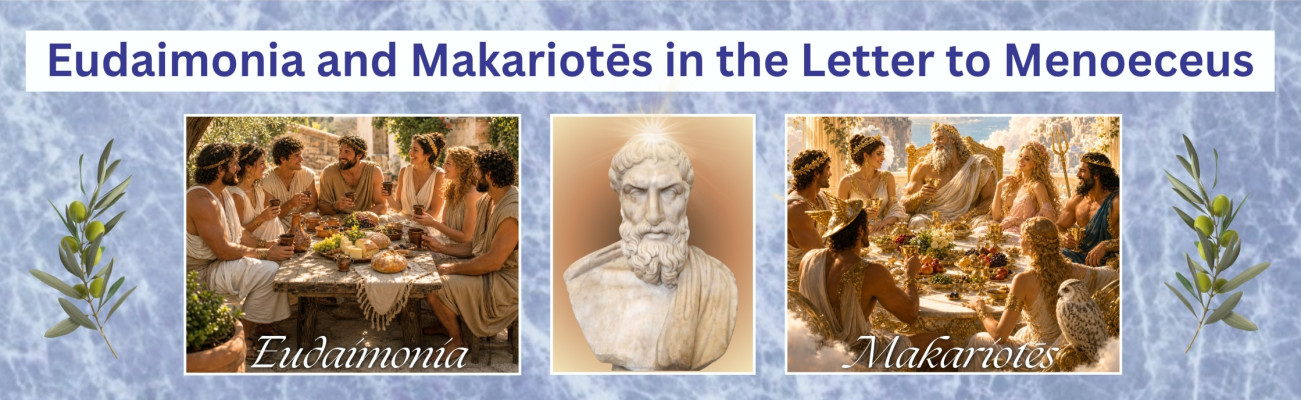
    Blog Article

    Eudaimonia and Makariotēs in the Letter to Menoeceus

    Eudaimonia and Makariotēs in the Letter to Menoeceus

    Blog article by Kalosyni - The following is based on material developed for the Epicurean Ethics study group

    1.1 Eudaimonia (εὐδαιμονία): Happiness and Well-being

    Among the surviving writings of Epicurus, the Letter to Menoeceus provides a summary of his ethical philosophy. At the heart of the letter stands the Greek word eudaimonia (εὐδαιμονία), commonly translated as "happiness," "well-being," or "human flourishing." The Greek term eudaimonia…

    Kalosyni

    May 30, 2026 at 4:11 PM
    • PDF
  • Online
    Cassius
    05 - Administrator
    Points
    113,933
    Posts
    15,679
    Quizzes
    9
    Quiz rate
    100.0 %
    • May 30, 2026 at 5:28 PM
    • New
    • #2
    Quote from Kalosyni

    For Epicurus, happiness is not a temporary feeling of pleasure or excitement but a stable condition of living well. In Epicurean thought, it refers to a life that is complete, satisfying, and free from suffering. It is not merely an emotion but an enduring state of flourishing.

    In regard to "free from suffering" that does not mean totally free, right, because we have the example of Epicurus bring happy on his last days while still under great pain?

    • PDF
  • Kalosyni
    Student of the Kepos
    Points
    21,128
    Posts
    2,581
    Quizzes
    2
    Quiz rate
    90.9 %
    • May 30, 2026 at 5:40 PM
    • New
    • #3
    Quote from Cassius

    In regard to "free from suffering" that does not mean totally free, right, because we have the example of Epicurus bring happy on his last days while still under great pain?

    I just now added in the word "mental"...so now it reads: free from mental suffering.

    • PDF
  • Online
    Cassius
    05 - Administrator
    Points
    113,933
    Posts
    15,679
    Quizzes
    9
    Quiz rate
    100.0 %
    • May 30, 2026 at 5:51 PM
    • New
    • #4

    Same question - must one be totally free of mental suffering in order to be happy?

    • PDF
  • Kalosyni
    Student of the Kepos
    Points
    21,128
    Posts
    2,581
    Quizzes
    2
    Quiz rate
    90.9 %
    • May 30, 2026 at 6:30 PM
    • New
    • #5
    Quote from Cassius

    Same question - must one be totally free of mental suffering in order to be happy?

    Thanks for asking...

    No, but free from unnecessary mental suffering.

    • PDF
  • Online
    Don
    ΕΠΙΚΟΥΡΕΙΟΣ (Epicurist)
    Points
    43,108
    Posts
    5,987
    Quizzes
    9
    Quiz rate
    92.8 %
    • May 30, 2026 at 6:53 PM
    • New
    • #6
    Quote from Kalosyni
    Quote from Cassius

    Same question - must one be totally free of mental suffering in order to be happy?

    Thanks for asking...

    No, but free from unnecessary mental suffering.

    Agreed. Once the false beliefs of the gods, death, and similar ones, we can have a firm foundation free from unnecessary mental pain, fear, and anxiety.

    • PDF
  • Online
    Don
    ΕΠΙΚΟΥΡΕΙΟΣ (Epicurist)
    Points
    43,108
    Posts
    5,987
    Quizzes
    9
    Quiz rate
    92.8 %
    • May 30, 2026 at 7:01 PM
    • New
    • #7

    FWIW (from my Menoikeus commentary)

    μακάριον

    This word is often translated as "blessed, fortunate, wealthy, 'well-off.'" There appears to be no certain etymology of the root [makar] or the longer form [makarios/on]. It appears to possibly have something to do with being wealthy, either literally or figuratively. Taking Ancient Mythology Economically by Morris Silver has a very interesting section on the origins of the word. This is yet another example of the inadequacy of using one word to translate from one language to another.

    See also

    Taking Ancient Mythology Economically
    books.google.com
    • PDF
  • Online
    Cassius
    05 - Administrator
    Points
    113,933
    Posts
    15,679
    Quizzes
    9
    Quiz rate
    100.0 %
    • May 31, 2026 at 3:03 AM
    • New
    • #8

    I just noticed something about this article that should have jumped out at me from the beginning. My failure to notice it reinforces to me that there's a test that above all others ought to be applied in evaluating any discussion of Epicurean ethics.

    The test is: "How often and how clearly and how strongly does the discussion mention pleasure?"

    So let me apply that test here, just as I hope people will apply that to my own articles on these subjects.

    In this case, the first mention of pleasure occurs in the second paragraph, but only to exclude "temporary pleasure" from the meaning of Epicurean happiness.

    The next mention of pleasure does not occur until the table near the end of the article, where the fourth of six items under happiness is stated to be "A stable life with many more pleasures than pains."

    The only other and final mention is in the next-to-last paragraph, where "enjoys prudent pleasures" is the third of three items listed as allowing one to obtain happiness.

    -----

    Apparently even in the ancient world Diogenes of Oinoanda felt it necessary to "shout loudly" about this issue:

    But since, as I say, the issue is not «what is the means of happiness?» but «what is happiness and what is the ultimate goal of our nature?», I say both now and always, shouting out loudly to all Greeks and non-Greeks, that pleasure is the end of the best mode of life....

    And nothing could be more clear than the way Torquatus expressed it:

    [54] But if the encomium passed even on the virtues themselves, over which the eloquence of all other philosophers especially runs riot, can find no vent unless it be referred to pleasure, and pleasure is the only thing which invites us to the pursuit of itself, and attracts us by reason of its own nature, then there can be no doubt that of all things good it is the supreme and ultimate good, and that a life of happiness means nothing else but a life attended by pleasure.

    In other contexts here on the forum we are discussing the problem of the rhetorical choice to portray Epicurus as a philosopher of withdrawal, resignation, and primarily relief from pain, rather than as the philosopher whose ethics focuses on a life of pleasure and who said that:

    [129] And for this cause we call pleasure the beginning and end of the blessed life. For we recognize pleasure as the first good innate in us, and from pleasure we begin every act of choice and avoidance, and to pleasure we return again, using the feeling as the standard by which we judge every good.

    Note that pleasure is the standard by which we judge every good. That means that pleasure is the standard by which we judge the existence and desirability of both happiness and blessedness - not the other way around.

    The letter to Menoeceus itself provides more than a few opportunities to stress the primary place of pleasure in Epicurean philosophy. When that doesn't happen, it's an important reminder to all of us that there are powerful pressures at work -- even among those of us who admire Epicurus -- that cause us to downplay the role of pleasure in discussing ethics.

    At least here at EpicureanFriends, those pressures need to be called out and "shouted" down, just as Epicurus himself in writing to Menoeceus pointed out that he himself was being misrepresented and misunderstood.

    Certainly happiness and blessedness are important and useful terms, and it is helpful to talk about them. But we should never let pleasure lose its central focus. It's the means without which we would never even recognize happiness and blessedness as desirable in the first place.

    • PDF
  • Kalosyni
    Student of the Kepos
    Points
    21,128
    Posts
    2,581
    Quizzes
    2
    Quiz rate
    90.9 %
    • May 31, 2026 at 6:41 AM
    • New
    • #9
    Quote from Cassius

    The test is: "How often and how clearly and how strongly does the discussion mention pleasure?"

    Cassius I wonder if you somehow conceive of happiness being an unpleasant state??

    • PDF
  • Online
    Cassius
    05 - Administrator
    Points
    113,933
    Posts
    15,679
    Quizzes
    9
    Quiz rate
    100.0 %
    • May 31, 2026 at 6:58 AM
    • New
    • #10
    Quote from Kalosyni

    Cassius I wonder if you somehow conceive of happiness being an unpleasant state??

    I don't think I understand the question. The only reason why happiness or blessedness or anything else is desirable in the first place is BECAUSE is is a state or condition of pleasure.

    That's what the "war of words" with rest of the world is all about.

    • PDF
  • Kalosyni
    Student of the Kepos
    Points
    21,128
    Posts
    2,581
    Quizzes
    2
    Quiz rate
    90.9 %
    • May 31, 2026 at 7:57 AM
    • New
    • #11
    Quote from Cassius

    That's what the "war of words" with rest of the world is all about.

    There are past ancient "wars of words", and there are current modern "wars of words".

    I really think that in modern times pleasure is much more tied to "happiness" and "well-being", where as in ancient times "well-being" was thought to be tied solely to being virtuous.

    One specific "war of words" which still continues from ancient times into current times, is with the word "pleasure"...as when you say the word "on the street" it seems to automatically point to excess and debauchery without regard for the consequences. This is one reason why I don't like including the word without a complete explanation of what is meant by it (according to Epicureans).

    • PDF
  • Online
    Don
    ΕΠΙΚΟΥΡΕΙΟΣ (Epicurist)
    Points
    43,108
    Posts
    5,987
    Quizzes
    9
    Quiz rate
    92.8 %
    • May 31, 2026 at 8:43 AM
    • New
    • #12

    I will be among the first to advocate for the word "pleasure" to be foremost in a description of Epicurus' philosophy, but I have come around to seeing this "war of words," among those sincerely trying to incorporate Epicurean philosophy into their lives, to be more divisive (on both sides) than it needs to be. Sure, the "bread and water" crowd need to be addressed, but...

    From my perspective after reading and commenting and responding to Jack Gedney on Substack, I don't believe his view and mine (I am speaking ONLY for me here!) are really that far apart. To use an analogy I used over there, we're two blind men describing the elephant by focusing on the trunk and tusks respectively. Even Epicurus felt the need to explain what he meant by pleasure: "whenever we say repeatedly that "pleasure is the τέλος," we do not say..." Within "pleasure" there is tranquility, blessedness, painlessness, joy, delight, happiness. They're all related, because "the feelings are two." To give the "camp" that emphasizes the absence or removal of pain their due, Epicurus does teach us to work to remove the pain of fear of gods, death; remove the pain from empty desires. Why? To live a pleasant, happy, blessed life, but that also means a life free from unnecessary pain, fear, and anxiety. That "freedom from pain" doesn't necessarily equate immediately hyperbolically to asceticism or "living in a cave." The absence of pain IS pleasure, and the absence of pleasure IS pain. We can't have one of those without the other. Do I personally prefer focusing on the pleasure? Yes. Is there an insurmountable problem with focusing on the philosophy as giving one a life free from pain? No, I don't think so. But BOTH those positions require explanation. From my perspective, it's not enough to use "pleasure" as a shibboleth to identify the "real" Epicureans. All that said, I do not agree with those who say "Epicureans lived on bread, water, and the occasional cheese." I'll push against that all day long. But I'm tiring of the fortified camps on both sides of this "war of words." Do misconceptions still exist out there? Absolutely. However, in the end, for those sincerely trying to incorporate Epicurean philosophy into their lives, I believe there is much more that unites us than divides us. I would much rather see a dialogue than a war.

    • PDF
  • Pacatus
    03 - Level Three
    Points
    6,771
    Posts
    853
    Quizzes
    5
    Quiz rate
    92.3 %
    • May 31, 2026 at 11:49 AM
    • New
    • #13

    The question (or at least a question), I think, is the purpose of engaging, philosophically, with “the rest of the world” – or anyone for that matter. Perhaps some hints (and recognition of limits) –

    As Epicurus has been said to have put it: "Vain is the word of that philosopher by which no malady of mankind is healed. For just as there is no profit in medicine unless it expels the diseases of the body, so there is none in philosophy either, unless it expels the suffering of the soul." [My italics. I think there is some question as to that attribution, though DeWitt accepts it?] That seems to me to be a pretty clear expression of purpose and intention, beyond just defending a particular philosophical corpus (“beyond,” not “to the exclusion of”) …

    That does not mean compromise, as per VS29: “For I would certainly prefer, as I study Nature, to announce frankly what is beneficial to all people, even if none agrees with me, rather than to compromise with common opinions …”

    And VS79: “The man who is serene causes no disturbance to himself or to another.” I know that I need to strive for a more “contagious” serenity in philosophical (and other) discourse – something that I have failed at too many times in the past, as my old argumentative tendencies rear their heads ;( (from some self-defensive fear?).

    And from MFS’s translation of Diogenes of Oinoanda:

    “Moreover, we have set up this inscription not for our own sake, but for your sake, citizens, as a means of salvation for you, as we announced at the opening of the whole discourse. And we do not consider that it (i.e. the inscription) will be useful to certain people and not useful to certain people, but that it will be useful to all. … [A]nd we contrived this in order that, even while [sitting] at home, [we might be able to exhibit the] goods of philosophy, not to all people here [indeed], but to those of them who are civil-spoken; and not least we did [this] for those who are called foreigners, although they are not really so.” [My bolds and italics]

    And MFS in the preface: “Diogenes, with his philanthropic and cosmopolitan attitudes and motives and his evident tranquillity in the face of illness, old age, and death, is himself a fine advertisement for the efficacy of the “medicines” he prescribes, and we should do well to pay attention to his message at this time when the pursuit of wealth and power is rampant in many quarters, while philanthropy and cosmopolitanism often seem in short supply.” [My italics]

    "We must try to make the end of the journey better than the beginning, as long as we are journeying; but when we come to the end, we must be happy and content." (Vatican Saying 48)

    • PDF
  • Kalosyni
    Student of the Kepos
    Points
    21,128
    Posts
    2,581
    Quizzes
    2
    Quiz rate
    90.9 %
    • May 31, 2026 at 12:11 PM
    • New
    • #14
    Quote from Don

    Within "pleasure" there is tranquility, blessedness, painlessness, joy, delight, happiness. They're all related, because "the feelings are two." To give the "camp" that emphasizes the absence or removal of pain their due, Epicurus does teach us to work to remove the pain of fear of gods, death; remove the pain from empty desires.

    Don Your post got me thinking...perhaps we need to consider that there are "four feelings"...

    1. Feelings of mental pleasure

    2. Feelings of mental pain

    3. Feelings of bodily pleasure

    4. Feelings of bodily pain

    So, if you remove mental pains, it doesn't necessarily add in bodily pleasure. Just like if you add in bodily pleasure, it doesn't necessary remove mental pains.

    • PDF
  • Pacatus
    03 - Level Three
    Points
    6,771
    Posts
    853
    Quizzes
    5
    Quiz rate
    92.3 %
    • May 31, 2026 at 12:19 PM
    • New
    • #15
    Quote from Cassius

    The only reason why happiness or blessedness or anything else is desirable in the first place is BECAUSE is is a state or condition of pleasure.

    I associate happiness exactly with pleasurableness/pleasantness (kinetic or katastematic experience). And I suspect most people really do, though they might not use those words. In philosophical discussion, I think it’s not difficult to point that out to them – unless they have some stubborn objection (is that not what even most Christians think they will experience in heaven?)

    "We must try to make the end of the journey better than the beginning, as long as we are journeying; but when we come to the end, we must be happy and content." (Vatican Saying 48)

    • PDF
  • Online
    Don
    ΕΠΙΚΟΥΡΕΙΟΣ (Epicurist)
    Points
    43,108
    Posts
    5,987
    Quizzes
    9
    Quiz rate
    92.8 %
    • May 31, 2026 at 12:30 PM
    • New
    • #16
    Quote from Kalosyni

    Don Your post got me thinking...perhaps we need to consider that there are "four feelings"...

    1. Feelings of mental pleasure

    2. Feelings of mental pain

    3. Feelings of bodily pleasure

    4. Feelings of bodily pain

    I see where you're going. I would say more like:

    1. Feelings
      1. Pleasure
        1. Mental
        2. Bodily
      2. Pain
        1. Mental
        2. Bodily

    The words Epicurus used can sometimes cover all pain, both physical and mental. But there is still only pain and pleasure as ways to experience the world, with innumerable ways within those two.

    • PDF
  • Godfrey
    Epicurist
    Points
    12,544
    Posts
    1,758
    Quizzes
    3
    Quiz rate
    85.0 %
    Bookmarks
    1
    • May 31, 2026 at 3:25 PM
    • New
    • #17
    Quote from Kalosyni

    So, if you remove mental pains, it doesn't necessarily add in bodily pleasure. Just like if you add in bodily pleasure, it doesn't necessary remove mental pains.

    At some point separating the mind from the body makes no sense to me. The mind and body are intricately interwoven and continuously interact. If you have a lousy night's sleep (physical? mental?) both your mind and body can feel out of sorts. "Hangry" is another example: hungry (body) and angry (mind) together.

    Separating "pain" from "suffering" is a common way to prevent your thoughts from increasing your pain, whether the pain is mental or physical. So I think the word necessarily is important in the above quote. There's a whole spectrum of interaction between what we consider to be mental or physical, a fact that to my layman's understanding is being emphasized by current neuroscience.

    As a practical matter it's useful to be able to understand the location, duration and intensity of your feelings in order to better pursue pleasure. But at some level separating mental and physical is the same as separating pleasure from absence of pain. But maybe I'm just a curmudgeon :rolleyes:

    • PDF
  • Online
    Don
    ΕΠΙΚΟΥΡΕΙΟΣ (Epicurist)
    Points
    43,108
    Posts
    5,987
    Quizzes
    9
    Quiz rate
    92.8 %
    • May 31, 2026 at 4:12 PM
    • New
    • #18

    I see where you're going, but to my mind there are strictly "mental" pains and pleasures, like:

    • Dreading a public speaking engagement
    • Anticipating a vacation
    • Obsessing over an interaction you think went poorly
    • Remembering a conversation with a friend

    And similar mental thoughts that at least start in the mind. The dread can make you nauseous physically. The memory can feel "warm." But I would categorize these primarily as mental pleasure and pain.

    • PDF

Finding Things At EpicureanFriends.com

Here is a list of suggested search strategies:

  • Website Overview page - clickable links arrranged by cards.
  • Forum Main Page - list of forums and subforums arranged by topic. Threads are posted according to relevant topics. The "Uncategorized subforum" contains threads which do not fall into any existing topic (also contains older "unfiled" threads which will soon be moved).
  • Search Tool - icon is located on the top right of every page. Note that the search box asks you what section of the forum you'd like to search. If you don't know, select "Everywhere."
  • Search By Key Tags - curated to show frequently-searched topics.
  • Full Tag List - an alphabetical list of all tags.

Resources

  1. Getting Started At EpicureanFriends
  2. Community Standards And Posting Policies
  3. The Major Doctrines of Classical Epicurean Philosophy
  4. Introductory Videos
  5. Wiki
  6. Lucretius Today Podcast
    1. Podcast Episode Guide
  7. Key Epicurean Texts
    1. Chart Of Key Quotes
    2. Outline Of Key Quotes
    3. Side-By-Side Diogenes Laertius X (Bio And All Key Writings of Epicurus)
    4. Side-By-Side Lucretius - On The Nature Of Things
    5. Side-By-Side Torquatus On Ethics
    6. Side-By-Side Velleius on Divinity
    7. Lucretius Topical Outline
    8. Usener Fragment Collection
  8. Frequently Asked Questions
    1. FAQ Discussions
  9. Full List of Forums
    1. Physics Discussions
    2. Canonics Discussions
    3. Ethics Discussions
    4. All Recent Forum Activities
  10. Image Gallery
  11. Featured Articles
  12. Featured Blog Posts
  13. Quiz Section
  14. Activities Calendar
  15. Special Resource Pages
  16. File Database
  17. Site Map
    1. Home

Frequently Used Forums

  • Frequently Asked / Introductory Questions
  • News And Announcements
  • Lucretius Today Podcast
  • Physics (The Nature of the Universe)
  • Canonics (The Tests Of Truth)
  • Ethics (How To Live)
  • Against Determinism
  • Against Skepticism
  • The "Meaning of Life" Question
  • Uncategorized Discussion
  • Comparisons With Other Philosophies
  • Historical Figures
  • Ancient Texts
  • Decline of The Ancient Epicurean Age
  • Unsolved Questions of Epicurean History
  • Welcome New Participants
  • Events - Activism - Outreach
  • Full Forum List

Latest Posts

  • Bryan Harris Interlinear Translation Of Lucretius

    Bryan May 31, 2026 at 4:54 PM
  • Eudaimonia and Makariotēs in the Letter to Menoeceus

    Don May 31, 2026 at 4:12 PM
  • Ongoing Discussion of Jack Gedney's "Untroubled" Substack Blog

    Cassius May 31, 2026 at 1:47 PM
  • Episode 336 - EATAQ18 - Not Yet Recorded

    Cassius May 31, 2026 at 9:55 AM
  • On Epicurean Text Study and Contemplation - Blog Article by Kalosyni

    Kalosyni May 30, 2026 at 5:18 PM
  • Sunday May 31, 2026 - Zoom Discussion 12:30 PM EST - Lucretius Book Review - Lucretius Book 1 - 483 et seq

    Cassius May 30, 2026 at 3:38 PM
  • Sunday May 24, 2026 - Zoom Discussion 12:30 PM EST - Lucretius Book Review - Lucretius Book 1 - 483 - Bodies

    Cassius May 30, 2026 at 3:37 PM
  • Is Education a "pastime" or a "way of life"?

    Bryan May 30, 2026 at 2:12 PM
  • Using Google AI to generate translation of ancient Greek words

    Pacatus May 30, 2026 at 12:11 PM
  • Happy Birthday General Thread

    Cassius May 30, 2026 at 4:05 AM

Frequently Used Tags

In addition to posting in the appropriate forums, participants are encouraged to reference the following tags in their posts:

  • #Physics
    • #Atomism
    • #Gods
    • #Images
    • #Infinity
    • #Eternity
    • #Life
    • #Death
  • #Canonics
    • #Knowledge
    • #Scepticism
  • #Ethics

    • #Pleasure
    • #Pain
    • #Engagement
    • #EpicureanLiving
    • #Happiness
    • #Virtue
      • #Wisdom
      • #Temperance
      • #Courage
      • #Justice
      • #Honesty
      • #Faith (Confidence)
      • #Suavity
      • #Consideration
      • #Hope
      • #Gratitude
      • #Friendship


Click Here To Search All Tags

To Suggest Additions To This List Click Here

EpicureanFriends - Classical Epicurean Philosophy

  1. Home
    1. About Us
    2. Classical Epicurean Philosophy
  2. Wiki
    1. Getting Started
  3. Frequently Asked Questions
    1. Site Map
  4. Forum
    1. Latest Threads
    2. Featured Threads
    3. Unread Posts
  5. Texts
    1. Core Texts
    2. Biography of Epicurus
    3. Lucretius
  6. Articles
    1. Latest Articles
  7. Gallery
    1. Featured Images
  8. Calendar
    1. This Month At EpicureanFriends
Powered by WoltLab Suite™ 6.0.25
Style: Inspire by cls-design
Stylename
Inspire
Manufacturer
cls-design
Licence
Commercial styles
Help
Supportforum
Visit cls-design
