


1. Home
    1. Start Here: Study Guide
    2. Community Standards And Posting Policies
    3. Terms of Use
    4. Moderator Team
    5. Website Overview
    6. Site Map
    7. Quizzes
    8. Articles
      1. Featured Articles
    9. All Blog Posts
      1. Elli's Blog / Articles
  2. Wiki
    1. Wiki Home
    2. FAQ
    3. Classical Epicureanism
    4. Files
    5. Search Assistance
    6. Not NeoEpicurean
    7. Foundations
    8. Navigation Outlines
    9. Reading List
    10. Key Pages
  3. Forum
    1. Full Forum List
    2. Welcome Threads
    3. Physics
    4. Canonics
    5. Ethics
    6. Forum Shortcuts
    7. Forum Navigation Map
    8. Featured
    9. Most Discussed
  4. Latest
    1. New Activity
    2. Latest Threads
    3. Dashboard
    4. Search By Tag
    5. Complete Tag List
  5. Podcast
    1. Lucretius Today Podcast
    2. Episode Guide
    3. Lucretius Today At Youtube
    4. EpicureanFriends Youtube Page
  6. Texts
    1. Overview
    2. Diogenes Laertius
    3. Principal Doctrines
    4. Vatican Collection
    5. Lucretius
    6. Herodotus
    7. Pythocles
    8. Menoeceus
    9. Fragments - Usener Collection
    10. Torquatus On Ethics
    11. Velleius On Gods
    12. Greek/Latin Help
  7. Gallery
    1. Featured images
    2. Albums
    3. Latest Images
    4. Latest Comments
  8. More
    1. Featured Content
    2. Calendar
      1. Upcoming Events List
      2. Zooms - General Info
      3. Fourth Sunday Meet-&-Greet
      4. Sunday Weekly Zoom
      5. Wednesday Zoom Meeting
    3. Logbook
    4. EF ToDo List
    5. Link-Database
  • Login
  • Register
  • Search
Blog Articles
  • Everywhere
  • Forum
  • Articles
  • Blog Articles
  • Files
  • Gallery
  • Events
  • Pages
  • Wiki
  • Help
  • FAQ
  • More Options

Welcome To EpicureanFriends.com!

EpicureanFriends is a community of real people dedicated to the study and promotion of Classical Epicurean Philosophy. We offer what no encyclopedia, AI chatbot, textbook, or general philosophy forum can provide — genuine teamwork among people committed to rediscovering and restoring the actual teachings of Epicurus, unadulterated by Stoicism, Skepticism, Supernatural Religion, Humanism, or other incompatible philosophies.

Sign In Now
or
Register a new account
  1. Home
    1. Start Here: Study Guide
    2. Community Standards And Posting Policies
    3. Terms of Use
    4. Moderator Team
    5. Website Overview
    6. Site Map
    7. Quizzes
    8. Articles
      1. Featured Articles
    9. All Blog Posts
      1. Elli's Blog / Articles
  2. Wiki
    1. Wiki Home
    2. FAQ
    3. Classical Epicureanism
    4. Files
    5. Search Assistance
    6. Not NeoEpicurean
    7. Foundations
    8. Navigation Outlines
    9. Reading List
    10. Key Pages
  3. Forum
    1. Full Forum List
    2. Welcome Threads
    3. Physics
    4. Canonics
    5. Ethics
    6. Forum Shortcuts
    7. Forum Navigation Map
    8. Featured
    9. Most Discussed
  4. Latest
    1. New Activity
    2. Latest Threads
    3. Dashboard
    4. Search By Tag
    5. Complete Tag List
  5. Podcast
    1. Lucretius Today Podcast
    2. Episode Guide
    3. Lucretius Today At Youtube
    4. EpicureanFriends Youtube Page
  6. Texts
    1. Overview
    2. Diogenes Laertius
    3. Principal Doctrines
    4. Vatican Collection
    5. Lucretius
    6. Herodotus
    7. Pythocles
    8. Menoeceus
    9. Fragments - Usener Collection
    10. Torquatus On Ethics
    11. Velleius On Gods
    12. Greek/Latin Help
  7. Gallery
    1. Featured images
    2. Albums
    3. Latest Images
    4. Latest Comments
  8. More
    1. Featured Content
    2. Calendar
      1. Upcoming Events List
      2. Zooms - General Info
      3. Fourth Sunday Meet-&-Greet
      4. Sunday Weekly Zoom
      5. Wednesday Zoom Meeting
    3. Logbook
    4. EF ToDo List
    5. Link-Database
  1. Home
    1. Start Here: Study Guide
    2. Community Standards And Posting Policies
    3. Terms of Use
    4. Moderator Team
    5. Website Overview
    6. Site Map
    7. Quizzes
    8. Articles
      1. Featured Articles
    9. All Blog Posts
      1. Elli's Blog / Articles
  2. Wiki
    1. Wiki Home
    2. FAQ
    3. Classical Epicureanism
    4. Files
    5. Search Assistance
    6. Not NeoEpicurean
    7. Foundations
    8. Navigation Outlines
    9. Reading List
    10. Key Pages
  3. Forum
    1. Full Forum List
    2. Welcome Threads
    3. Physics
    4. Canonics
    5. Ethics
    6. Forum Shortcuts
    7. Forum Navigation Map
    8. Featured
    9. Most Discussed
  4. Latest
    1. New Activity
    2. Latest Threads
    3. Dashboard
    4. Search By Tag
    5. Complete Tag List
  5. Podcast
    1. Lucretius Today Podcast
    2. Episode Guide
    3. Lucretius Today At Youtube
    4. EpicureanFriends Youtube Page
  6. Texts
    1. Overview
    2. Diogenes Laertius
    3. Principal Doctrines
    4. Vatican Collection
    5. Lucretius
    6. Herodotus
    7. Pythocles
    8. Menoeceus
    9. Fragments - Usener Collection
    10. Torquatus On Ethics
    11. Velleius On Gods
    12. Greek/Latin Help
  7. Gallery
    1. Featured images
    2. Albums
    3. Latest Images
    4. Latest Comments
  8. More
    1. Featured Content
    2. Calendar
      1. Upcoming Events List
      2. Zooms - General Info
      3. Fourth Sunday Meet-&-Greet
      4. Sunday Weekly Zoom
      5. Wednesday Zoom Meeting
    3. Logbook
    4. EF ToDo List
    5. Link-Database
  1. EpicureanFriends - Classical Epicurean Philosophy
  2. Blogs At EpicureanFriends.com
  3. Kalosyni's Epicurean Philosophy Blog
  • Sidebar
  • Sidebar

Featured New Eudaimonia and Makariotēs in the Letter to Menoeceus

  • Kalosyni
  • May 30, 2026 at 4:11 PM
  • 11 times read

New Graphics: Are You On Team Epicurus? | Comparison Chart: Epicurus vs. Other Philosophies | Chart Of Key Epicurean Quotations | Accelerating Study Of Canonics Through Philodemus' "On Methods Of Inference" | Note to all users: If you have a problem posting in any forum, please message Cassius  

Eudaimonia and Makariotēs in the Letter to Menoeceus

Blog article by Kalosyni - The following is based on material developed for the Epicurean Ethics study group

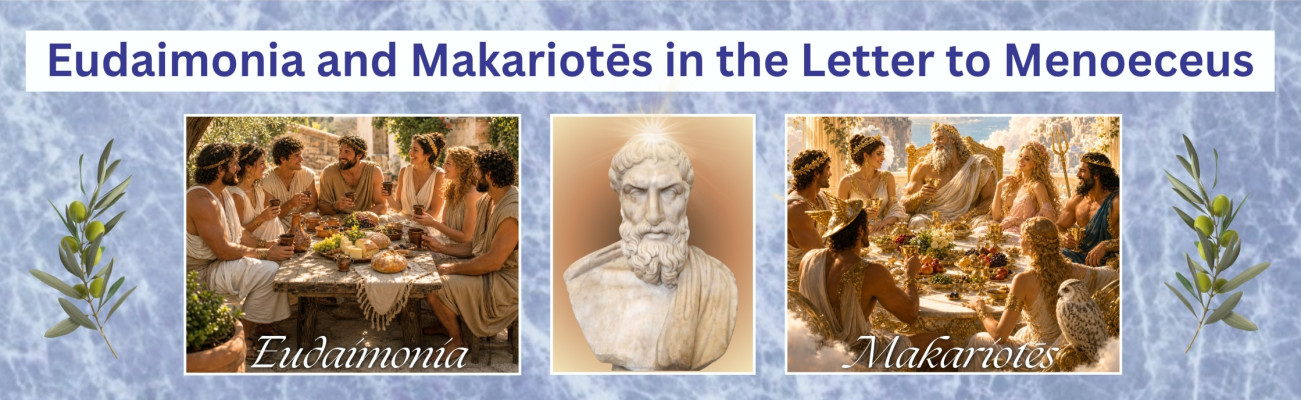
1.1 Eudaimonia (εὐδαιμονία): Happiness and Well-being

Among the surviving writings of Epicurus, the Letter to Menoeceus provides a summary of his ethical philosophy. At the heart of the letter stands the Greek word eudaimonia (εὐδαιμονία), commonly translated as "happiness," "well-being," or "human flourishing." The Greek term eudaimonia literally combines eu ("good" or "well") and daimōn ("spirit" or "guiding power"), though its philosophical meaning is determined by usage rather than etymology.

For Epicurus, happiness is not a temporary feeling of pleasure or excitement but a stable condition of living well. In Epicurean thought, it refers to a life that is complete, satisfying, and free from suffering. It is not merely an emotion but an enduring state of flourishing.

Epicurus opens the letter by encouraging people of every age to pursue philosophy because philosophy is the path to happiness:

"We must then meditate on the things that make our happiness, seeing that when that is with us we have all, but when it is absent we do all to win it."

This statement establishes eudaimonia as the ultimate goal of human life and philosophy serves as a method for achieving it. Through philosophy individuals learn to overcome fear of the gods and death, understand their desires and the limits of desire, and make choices that lead to a life of happiness and well-being.

Epicurus teaches that happiness is available to anyone who learns to live wisely. Neither youth nor old age is a barrier. Through philosophical reflection, a person can free themselves from anxiety about death, fear of divine punishment, and the endless pursuit of unnecessary desires. Happiness is therefore practical and attainable.

1.2 Makariotēs (μακαριότης): Blessedness and Divine Perfection

While eudaimonia describes human flourishing, Epicurus also employs the use of language based on the root word makarios (μακάριος), meaning "blessed," "blissful," or "supremely fortunate." The related form which is used in the Letter to Menoeceus is makariotēs (μακαριότης) -- pronounced mak-ar-ee'-ot-ace, meaning "blessedness." In Epicurean texts these terms are most often applied to the gods and to the highest ideal of existence.

In ancient Greek culture, the gods were frequently described as makarioi ("the blessed ones"). They were considered immortal, self-sufficient, and untouched by the struggles that define human life. Because they were free from fear, labor, suffering, and death, they existed in a state of complete fulfillment.

In the Letter to Menoeceus, Epicurus insists that nothing should be attributed to the gods that is inconsistent with their immortality or blessedness.

Epicurus adopts this understanding of the nature of the gods and then gives it a philosophical interpretation useful for the development of human well-being. The gods are blessed and immortal because they live in perfect tranquility and are not troubled by human affairs. Consequently, humans should not fear divine wrath or intervention.

This idea also appears clearly in Principal Doctrine 1: "The blessed and imperishable nature neither has trouble itself nor causes trouble to anyone else."

The word makariotēs also suggests further ideas such as freedom from mortal concerns, an unchanging serenity and joy, self-sufficiency and independence, immunity from suffering and death, and a state beyond ordinary human experience.

2.1 Comparing Eudaimonia and Makariotēs

Although both terms are associated with the ultimate good life, they are not identical.

Eudaimonia (εὐδαιμονία)Makariotēs (μακαριότης)
Usually translated as happiness, well-being, or flourishing.Usually translated as blessedness, bliss, or supreme fulfillment.
Primarily describes the goal of human life.Primarily describes the condition of the gods and the highest ideal.
Achieved through wise living, friendship, prudence, and freedom from fear.Characterized by complete self-sufficiency and undisturbed tranquility.
A stable life with many more pleasures than pains.A perfected state beyond vulnerability, disturbance, and pain.
Humanly attainable.Fully exemplified by the gods, though humans may approximate it.
Focuses on living well.Focuses on complete blessedness.


A helpful way to understand the distinction is to view eudaimonia as the human experience of flourishing and makariotēs as the highest expression of that flourishing.
• Happiness (eudaimonia) answers the question: What does it mean for a human being to live well?
• Blessedness (makariotēs) answers the question: What does perfect and undisturbed fulfillment look like?

For Epicurus, a wise person who lives free from fear, cultivates friendship, and enjoys prudent pleasures, thereby attains eudaimonia. Yet when such a life becomes deeply tranquil, self-sufficient, and completely blessed, it approaches the condition described by makariotēs. In this sense, blessedness is not a different goal from happiness but the fullest realization of it.

This explains Epicurus' famous conclusion that the philosopher may live "like a god among men”, which we see written in the closing paragraph of the Letter to Menoecues. The wise individual remains mortal, but through wisdom and tranquility participates in a manner of life resembling divine blessedness – living not merely happily, but blessedly.

  • Share
  • Previous Article On Epicurean Text Study and Contemplation

Epicurean Philosophy
A Navigation Chart
Epicurean Philosophy...
ATOMICS
Nothing Except Atoms And Void Have Eternal and Unchanging Properties. The Atoms Are Constantly In Motion, But Not So Fast That We Cannot Comprehend Truth As To The Nature Of The Universe, Knowledge, and How To Live
ATOMICS...
PHYSICS
Nature of The Universe
PHYSICS...
Nothing From Nothing Or To Nothing
Nothing From N...
Atomic Swerve and Rejection of Determinism
Atomic Swerve...
CANONICS
Nature of Knowledge
CANONICS...
Senses, Feelings, and Anticipations, Are Criteria of Knowledge
Senses, Feelin...
Priority of Nature Over Reason
Priority of Na...
Eternal - Boundless - Life-Filled Universe
Eternal and Bo...
All Sensations Are "True"
All Sensations...
Embrace of Practical Reason
Nothing Is Supernatural - No Gods Over Nature
Nothing Is Supernatural - No G...
Nothing But Atoms Are Eternal - No Immortal Soul
Nothing But At...
Knowledge Is Possible
Knowledge Is P...
Rejection of Platonic Idealism and Aristotelian Essences
Rejection of Platonic Idealism...
Rejection of Dialectical Logic and Skepticism
Rejection of Dialectical Logic...
Pain Is Manageable - It Is Short If Intense, Endurable If Long, And Terminable By Death.
Pain Is Managea...
Mental Pleasures And Pains Can Be More Significant Than Bodily Pleasures And Pains
Mental Pleasure...
Pain is Undesirable - But Pain Should Be Chosen When Greater Pleasure Or Lesser Pain Results
Pain is Undesira...
Pleasure Is Desirable - Pleasure Is The Alpha and Omega And Guide Of Life
Pleasure Is Desi...
Pleasure Includes All Bodily And Mental Experiences Which Are Not Painful - There Is No Pain Where Pleasure Is Present - and Thus Pleasure Is Present Where Pain Is Absent
Pleasure Includes All...
There Are Only Two Categories of Feelings - Pleasure and Pain - And Nature Gives Nothing Else By Which To Determine What to Choose and What to Avoid
There Are Only Two Ca...
Pleasure Has A Limit In Quantity That Can Be Experienced, And That Limit Is Reached When All Bodily And Mental Experiences Are Filled With Pleasure And No Pain Is Present
Pleasure Has A Limit In...
Rejection Of Absolute Virtue, But Embrace Of Practical Virtue As Instrumental For Achieving A Life of Pleasure
Rejection Of Absolute Virtue, But Embrace Of Practical Virtue As Inst...
Personal Freedom, Responsibility, And Proper Attitude Toward "The Gods" and "Fate"
Personal Freedom, Responsibility,...
Only This Life And This World - No Other World Or Reward Or Punishment After Death
Only This Life And This World - N...
Friendship
Friendship
Prudence
Prudence
Justice
Justice
Courage
Courage
Confidence
Confidence
Honesty
Honesty
Temperance
Temperance
Beneficence
Beneficence
Hope
Hope
Considerateness
Considerateness
Living In Present
Living In Present
Gratitude
Gratitude
ETHICS - Nature of How To Live
Rejection of Reductionist Atomism
Rejection of...
Text is not SVG - cannot display

If you are viewing this on a wide-screen format, click over to a landscape version here or on the graphic below. Both formats can be zoomed to whatever resolution is desired.


For a work-in-progress text version of this navigation outline click here.

Finding Things At EpicureanFriends.com

Here is a list of suggested search strategies:

  • Website Overview page - clickable links arrranged by cards.
  • Forum Main Page - list of forums and subforums arranged by topic. Threads are posted according to relevant topics. The "Uncategorized subforum" contains threads which do not fall into any existing topic (also contains older "unfiled" threads which will soon be moved).
  • Search Tool - icon is located on the top right of every page. Note that the search box asks you what section of the forum you'd like to search. If you don't know, select "Everywhere."
  • Search By Key Tags - curated to show frequently-searched topics.
  • Full Tag List - an alphabetical list of all tags.

Categories

  • Epicurean Ethics
  • Featured

Archive

  1. 2026 (2)
    1. May (2)
      • Eudaimonia and Makariotēs in the Letter to Menoeceus
      • On Epicurean Text Study and Contemplation

Resources

  1. Getting Started At EpicureanFriends
  2. Community Standards And Posting Policies
  3. The Major Doctrines of Classical Epicurean Philosophy
  4. Introductory Videos
  5. Wiki
  6. Lucretius Today Podcast
    1. Podcast Episode Guide
  7. Key Epicurean Texts
    1. Chart Of Key Quotes
    2. Outline Of Key Quotes
    3. Side-By-Side Diogenes Laertius X (Bio And All Key Writings of Epicurus)
    4. Side-By-Side Lucretius - On The Nature Of Things
    5. Side-By-Side Torquatus On Ethics
    6. Side-By-Side Velleius on Divinity
    7. Lucretius Topical Outline
    8. Usener Fragment Collection
  8. Frequently Asked Questions
    1. FAQ Discussions
  9. Full List of Forums
    1. Physics Discussions
    2. Canonics Discussions
    3. Ethics Discussions
    4. All Recent Forum Activities
  10. Image Gallery
  11. Featured Articles
  12. Featured Blog Posts
  13. Quiz Section
  14. Activities Calendar
  15. Special Resource Pages
  16. File Database
  17. Site Map
    1. Home

Frequently Used Forums

  • Frequently Asked / Introductory Questions
  • News And Announcements
  • Lucretius Today Podcast
  • Physics (The Nature of the Universe)
  • Canonics (The Tests Of Truth)
  • Ethics (How To Live)
  • Against Determinism
  • Against Skepticism
  • The "Meaning of Life" Question
  • Uncategorized Discussion
  • Comparisons With Other Philosophies
  • Historical Figures
  • Ancient Texts
  • Decline of The Ancient Epicurean Age
  • Unsolved Questions of Epicurean History
  • Welcome New Participants
  • Events - Activism - Outreach
  • Full Forum List

Frequently Used Tags

In addition to posting in the appropriate forums, participants are encouraged to reference the following tags in their posts:

  • #Physics
    • #Atomism
    • #Gods
    • #Images
    • #Infinity
    • #Eternity
    • #Life
    • #Death
  • #Canonics
    • #Knowledge
    • #Scepticism
  • #Ethics

    • #Pleasure
    • #Pain
    • #Engagement
    • #EpicureanLiving
    • #Happiness
    • #Virtue
      • #Wisdom
      • #Temperance
      • #Courage
      • #Justice
      • #Honesty
      • #Faith (Confidence)
      • #Suavity
      • #Consideration
      • #Hope
      • #Gratitude
      • #Friendship


Click Here To Search All Tags

To Suggest Additions To This List Click Here

EpicureanFriends - Classical Epicurean Philosophy

  1. Home
    1. About Us
    2. Classical Epicurean Philosophy
  2. Wiki
    1. Getting Started
  3. Frequently Asked Questions
    1. Site Map
  4. Forum
    1. Latest Threads
    2. Featured Threads
    3. Unread Posts
  5. Texts
    1. Core Texts
    2. Biography of Epicurus
    3. Lucretius
  6. Articles
    1. Latest Articles
  7. Gallery
    1. Featured Images
  8. Calendar
    1. This Month At EpicureanFriends
Powered by WoltLab Suite™ 6.0.25
Style: Inspire by cls-design
Stylename
Inspire
Manufacturer
cls-design
Licence
Commercial styles
Help
Supportforum
Visit cls-design