

1. Home
    1. Start Here: Study Guide
    2. Community Standards And Posting Policies
    3. Terms of Use
    4. Moderator Team
    5. Website Overview
    6. Site Map
    7. Quizzes
    8. Articles
      1. Featured Articles
    9. All Blog Posts
      1. Elli's Blog / Articles
      2. Kalosyni's Blog
  2. Wiki
    1. Wiki Home
    2. FAQ
    3. Classical Epicureanism
    4. Files
    5. Search Assistance
    6. Not NeoEpicurean
    7. Foundations
    8. Navigation Outlines
    9. Reading List
    10. Key Pages
  3. Forum
    1. Full Forum List
    2. Welcome Threads
    3. Physics
    4. Canonics
    5. Ethics
    6. Forum Shortcuts
    7. Forum Navigation Map
    8. Featured
    9. Most Discussed
  4. Latest
    1. New Activity
    2. Latest Threads
    3. Dashboard
    4. Search By Tag
    5. Complete Tag List
  5. Podcast
    1. Lucretius Today Podcast
    2. Episode Guide
    3. Lucretius Today At Youtube
    4. EpicureanFriends Youtube Page
  6. Texts
    1. Overview
    2. Diogenes Laertius
    3. Principal Doctrines
    4. Vatican Collection
    5. Lucretius
    6. Herodotus
    7. Pythocles
    8. Menoeceus
    9. Fragments - Usener Collection
    10. Torquatus On Ethics
    11. Velleius On Gods
    12. Greek/Latin Help
  7. Gallery
    1. Featured images
    2. Albums
    3. Latest Images
    4. Latest Comments
  8. More
    1. Featured Content
    2. Calendar
      1. Upcoming Events List
      2. Zooms - General Info
      3. Fourth Sunday Meet-&-Greet
      4. Sunday Weekly Zoom
      5. Wednesday Zoom Meeting
    3. Logbook
    4. EF ToDo List
    5. Link-Database
  • Login
  • Register
  • Search
Blog Articles
  • Everywhere
  • Forum
  • Articles
  • Blog Articles
  • Files
  • Gallery
  • Events
  • Pages
  • Wiki
  • Help
  • FAQ
  • More Options

Welcome To EpicureanFriends.com!

EpicureanFriends is a community of real people dedicated to the study and promotion of Classical Epicurean Philosophy. We offer what no encyclopedia, AI chatbot, textbook, or general philosophy forum can provide — genuine teamwork among people committed to rediscovering and restoring the actual teachings of Epicurus, unadulterated by Stoicism, Skepticism, Supernatural Religion, Humanism, or other incompatible philosophies.

Sign In Now
or
Register a new account
  1. Home
    1. Start Here: Study Guide
    2. Community Standards And Posting Policies
    3. Terms of Use
    4. Moderator Team
    5. Website Overview
    6. Site Map
    7. Quizzes
    8. Articles
      1. Featured Articles
    9. All Blog Posts
      1. Elli's Blog / Articles
      2. Kalosyni's Blog
  2. Wiki
    1. Wiki Home
    2. FAQ
    3. Classical Epicureanism
    4. Files
    5. Search Assistance
    6. Not NeoEpicurean
    7. Foundations
    8. Navigation Outlines
    9. Reading List
    10. Key Pages
  3. Forum
    1. Full Forum List
    2. Welcome Threads
    3. Physics
    4. Canonics
    5. Ethics
    6. Forum Shortcuts
    7. Forum Navigation Map
    8. Featured
    9. Most Discussed
  4. Latest
    1. New Activity
    2. Latest Threads
    3. Dashboard
    4. Search By Tag
    5. Complete Tag List
  5. Podcast
    1. Lucretius Today Podcast
    2. Episode Guide
    3. Lucretius Today At Youtube
    4. EpicureanFriends Youtube Page
  6. Texts
    1. Overview
    2. Diogenes Laertius
    3. Principal Doctrines
    4. Vatican Collection
    5. Lucretius
    6. Herodotus
    7. Pythocles
    8. Menoeceus
    9. Fragments - Usener Collection
    10. Torquatus On Ethics
    11. Velleius On Gods
    12. Greek/Latin Help
  7. Gallery
    1. Featured images
    2. Albums
    3. Latest Images
    4. Latest Comments
  8. More
    1. Featured Content
    2. Calendar
      1. Upcoming Events List
      2. Zooms - General Info
      3. Fourth Sunday Meet-&-Greet
      4. Sunday Weekly Zoom
      5. Wednesday Zoom Meeting
    3. Logbook
    4. EF ToDo List
    5. Link-Database
  1. Home
    1. Start Here: Study Guide
    2. Community Standards And Posting Policies
    3. Terms of Use
    4. Moderator Team
    5. Website Overview
    6. Site Map
    7. Quizzes
    8. Articles
      1. Featured Articles
    9. All Blog Posts
      1. Elli's Blog / Articles
      2. Kalosyni's Blog
  2. Wiki
    1. Wiki Home
    2. FAQ
    3. Classical Epicureanism
    4. Files
    5. Search Assistance
    6. Not NeoEpicurean
    7. Foundations
    8. Navigation Outlines
    9. Reading List
    10. Key Pages
  3. Forum
    1. Full Forum List
    2. Welcome Threads
    3. Physics
    4. Canonics
    5. Ethics
    6. Forum Shortcuts
    7. Forum Navigation Map
    8. Featured
    9. Most Discussed
  4. Latest
    1. New Activity
    2. Latest Threads
    3. Dashboard
    4. Search By Tag
    5. Complete Tag List
  5. Podcast
    1. Lucretius Today Podcast
    2. Episode Guide
    3. Lucretius Today At Youtube
    4. EpicureanFriends Youtube Page
  6. Texts
    1. Overview
    2. Diogenes Laertius
    3. Principal Doctrines
    4. Vatican Collection
    5. Lucretius
    6. Herodotus
    7. Pythocles
    8. Menoeceus
    9. Fragments - Usener Collection
    10. Torquatus On Ethics
    11. Velleius On Gods
    12. Greek/Latin Help
  7. Gallery
    1. Featured images
    2. Albums
    3. Latest Images
    4. Latest Comments
  8. More
    1. Featured Content
    2. Calendar
      1. Upcoming Events List
      2. Zooms - General Info
      3. Fourth Sunday Meet-&-Greet
      4. Sunday Weekly Zoom
      5. Wednesday Zoom Meeting
    3. Logbook
    4. EF ToDo List
    5. Link-Database
  1. EpicureanFriends - Classical Epicurean Philosophy
  2. Blogs At EpicureanFriends.com
  3. Kalosyni's Epicurean Philosophy Blog
  • Sidebar
  • Sidebar

Featured New The Nature of the Soul According to Epicurus

  • Kalosyni
  • June 6, 2026 at 9:01 AM
  • 24 times read

New Graphics: Are You On Team Epicurus? | Comparison Chart: Epicurus vs. Other Philosophies | Chart Of Key Epicurean Quotations | Accelerating Study Of Canonics Through Philodemus' "On Methods Of Inference" | Note to all users: If you have a problem posting in any forum, please message Cassius  

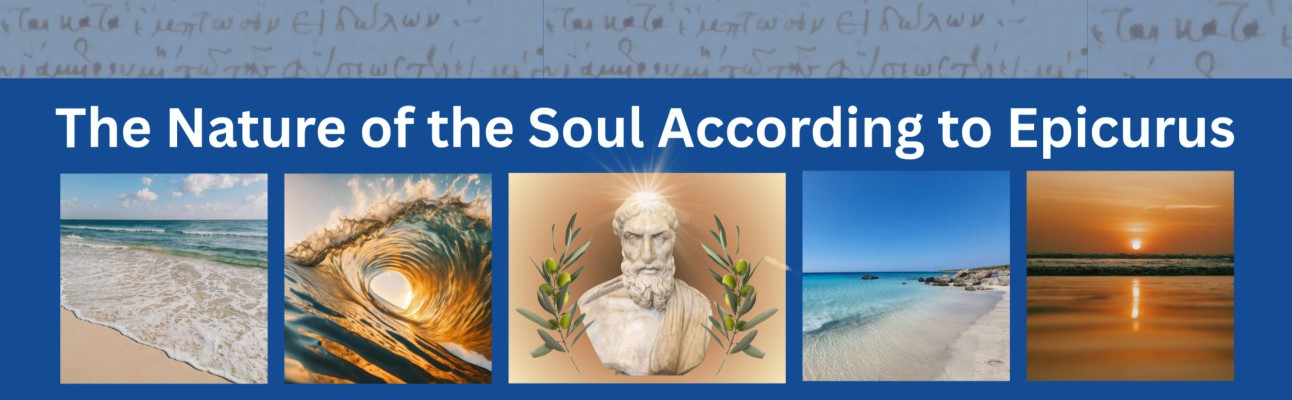
The Nature of the Soul According to Epicurus

Blog article by Kalosyni (based on material created for the Epicurean Ethics study group)

1. Introduction and Overview: Ancient Greek Thought on the Soul

The concept of the soul occupied a central place in ancient Greek philosophy. The Greek word for soul, ψυχή (psychē), referred not merely to a religious or spiritual entity but to the principle of life itself—the source of thought, sensation, emotion, and vitality.

Philosophers disagreed profoundly about its nature. Some regarded the soul as a material substance composed of physical elements, while others considered it an immortal and immaterial reality distinct from the body.

Epicurus (341–270 BCE) inherited this long philosophical tradition but developed a distinctive understanding of the soul grounded in atomism and empirical observation. His concern was not merely theoretical. Philosophy, for Epicurus, was intended to secure the health of the soul and free human beings from anxiety and fear.

As he wrote in the Letter to Menoeceus:
“Let no one when young delay to study philosophy, nor when he is old grow weary of his study. For no one can come too early or too late to secure the health of his soul.” (Section 122, Bailey translation).

Ancient Greek and Roman philosophers generally viewed the soul as the animating principle of living beings. It was understood as the source of movement, perception, thought, and life itself. However, significant differences emerged concerning its composition, permanence, and relationship to the body.

1.1 Pre-Socratic Materialist Views
Many of the earliest Greek philosophers explained the soul in physical terms. Thales suggested that the soul was a moving force, comparable to the power by which a magnet moves iron. Anaximenes identified the soul with air, arguing that just as breath sustains life, air holds the cosmos together. Heraclitus regarded the soul as a fiery substance characterized by perpetual change and transformation. Democritus, whose atomism would later influence Epicurus, maintained that the soul consists of fine, smooth, and highly mobile atoms distributed throughout the body. These thinkers generally rejected the notion of an immaterial soul and sought natural explanations for life and consciousness.

1.2 Pythagoras and Empedocles
A different tradition emerged with Pythagoras and Empedocles. They taught that the soul is immortal and survives bodily death. According to their doctrine of transmigration, the soul passes through a succession of human and animal bodies over multiple lifetimes. This view introduced the idea that the soul possesses an existence independent of the body and that moral conduct may affect its future incarnations.

1.3 Plato's Immortal Soul
The most influential ancient defense of an immaterial soul was developed by Plato. For Plato, the soul is immortal, simple, and fundamentally distinct from the body. The body is temporary and imperfect, while the soul belongs to a higher realm of eternal truths. Human beings are therefore essentially souls temporarily confined within physical bodies. In the Phaedrus, Plato famously compares the soul to a chariot: the charioteer represents reason, one horse represents noble and spirited impulses, the other horse represents appetites and desires. The task of philosophy is to bring these competing forces into harmony under the guidance of reason.

1.4 Aristotle's Hylomorphic Theory
Aristotle rejected Plato's strict separation of soul and body. Instead, he argued that the soul is the "form" or organizing principle of a living body. According to Aristotle, soul and body are inseparable aspects of a single living organism. He distinguished three levels of soul:
• Vegetative Soul – responsible for growth, nutrition, and reproduction.
• Sensitive Soul – responsible for perception, movement, and sensation.
• Rational Soul – responsible for reasoning and intellectual activity.
Plants possess only the vegetative soul, animals possess both vegetative and sensitive souls, and human beings possess all three. Aristotle left open the possibility that aspects of rational thought may be immortal, but his account remains significantly less dualistic than Plato's.

1.5 Hellenistic Philosophies
The Hellenistic period witnessed a return to more materialistic interpretations of the soul. Epicureans, following Democritus, argued that the soul consists of atoms and perishes when the body dies. Stoics maintained that the soul is composed of a physical, rational breath known as pneuma. Although they considered the soul highly refined and divine in character, they generally held that it does not survive indefinitely after death. Thus, ancient philosophy offered a wide spectrum of views, ranging from materialism to dualism, but all sought to understand the soul as the fundamental principle of life and consciousness.

2. The Nature of the Soul as a Physical Entity, According to Epicurus

According to Epicurus, the soul is composed entirely of atoms. Nothing exists except atoms and void, and the soul is no exception. The soul contains extremely fine and mobile atoms distributed throughout the body. These atomic structures account for sensation, movement, emotion, and thought. Epicurus appears to have believed that the soul is composed of several different kinds of atomic material, including fire-like and air-like substances. In addition, he posited a unique and unnamed type of atom specifically responsible for sense-perception. This special component was necessary because Epicurus believed that ordinary physical elements alone could not adequately explain the phenomenon of sensation.

2.1 Sense-Perception and Knowledge
Sense-perception occupies a foundational role in Epicurean philosophy. Epicurus held that all knowledge ultimately originates in sensory experience. Repeated perceptions produce memories, and memories generate concepts or "preconceptions" (prolepseis).
As summarized by Diogenes Laertius:
"As soon as the word 'man' is uttered, immediately its impression also comes to mind by means of preconception, as a result of antecedent sense-perceptions."
Concepts therefore arise from accumulated sensory experience rather than innate ideas or transcendent realities. From experience, human beings form judgments not only about observable facts but also about broader truths concerning the world.

2.2 Rational and Nonrational Parts of the Soul
Epicurean psychology distinguishes between two aspects of the soul. The nonrational soul receives sense-impressions and performs vital functions. According to Epicurus, these impressions are always true in themselves. The rational soul interprets these impressions, forms beliefs, recalls memories, and makes judgments. Error does not arise from sensation itself but from mistaken interpretations made by the rational part of the soul. This distinction allowed Epicurus to explain both reliable perception and human error without abandoning confidence in sensory experience.

2.3 Mortality of the Soul
Unlike Plato, Epicurus denied the immortality of the soul. Because the soul is material, it dissolves when the body dies. The atomic structure necessary for consciousness disperses and can no longer sustain sensation or thought. For Epicurus, this conclusion carried profound ethical significance. If the soul perishes with the body, then there can be no experience after death, no punishment in an afterlife, and no reason to fear death. The recognition of the soul's mortality was therefore intended not to produce despair but to liberate individuals from anxiety and superstition.

3. The Health of the Soul

Epicurus did not study the soul merely to understand its nature. In the Letter to Menoeceus, he uses the Greek word ὑγίεια (hygieia), meaning health, when urging his readers to pursue philosophy throughout life:

“For no one can come too early or too late to secure the health of his soul.”

The metaphor of health was central to ancient philosophy. Just as medicine heals the body, philosophy heals the soul.

Epicurus emphasized this practical purpose in Vatican Saying 54:
“We must not pretend to study philosophy, but study it in reality, for it is not the appearance of health that we need, but real health.”

Similarly, the later philosopher Porphyry preserved an Epicurean sentiment in his Letter to Marcella:

“Vain is the word of a philosopher which does not heal any suffering of man. For just as there is no profit in medicine if it does not expel the diseases of the body, so there is no profit in philosophy either, if it does not expel the suffering of the mind.”

3.1 Philosophy as Therapy
Epicurus understood philosophy as a therapeutic practice. The greatest obstacles to happiness, he believed, were irrational fears—especially fear of death, fear of divine punishment, and the mental frustration created by a sense of unlimited desires. By understanding nature correctly, individuals could free themselves from these sources of fear and anxiety.

A central element of the health of the soul is overcoming the fear of death. Epicurus argued that death is nothing to us because when we exist, death is absent, and when death arrives, we no longer exist. Since sensation ends with the dissolution of the soul, death cannot be experienced as a harm. This insight was intended to remove one of humanity's deepest anxieties and thereby promote tranquility.

The healthy soul is characterized by a condition of mental balance and calm. According to Epicurus, happiness is achieved not through luxury or excess but through prudent living, wise choices, friendship, and the satisfaction of natural and necessary desires. Mental peace results when irrational fears are removed and empty desires are no longer pestering the mind.

The first four principals found in the Principal Doctrines (Κύριαι δόξαι, Kyriai doxai) were intended as practical exercises for daily reflection rather than merely theoretical doctrines. For Epicurus, the soul is a natural, physical phenomenon composed of atoms, and its well-being depends not upon religious rituals or metaphysical speculation but upon understanding nature and living wisely. Through philosophical reflection, individuals can overcome fear, moderate desire, and attain a state of well-being. In this way, philosophy becomes a form of medicine—one that heals the disturbances of the mind and enables a happy, flourishing human life.
________________________________________________________________

Source citation: https://plato.stanford.edu/archives/fall2…s/ancient-soul/

***************

For discussion on this blog, please visit this thread.

  • Share
  • Previous Article Eudaimonia and Makariotēs in the Letter to Menoeceus

Epicurean Philosophy
A Navigation Chart
Epicurean Philosophy...
ATOMICS
Nothing Except Atoms And Void Have Eternal and Unchanging Properties. The Atoms Are Constantly In Motion, But Not So Fast That We Cannot Comprehend Truth As To The Nature Of The Universe, Knowledge, and How To Live
ATOMICS...
PHYSICS
Nature of The Universe
PHYSICS...
Nothing From Nothing Or To Nothing
Nothing From N...
Atomic Swerve and Rejection of Determinism
Atomic Swerve...
CANONICS
Nature of Knowledge
CANONICS...
Senses, Feelings, and Anticipations, Are Criteria of Knowledge
Senses, Feelin...
Priority of Nature Over Reason
Priority of Na...
Eternal - Boundless - Life-Filled Universe
Eternal and Bo...
All Sensations Are "True"
All Sensations...
Embrace of Practical Reason
Nothing Is Supernatural - No Gods Over Nature
Nothing Is Supernatural - No G...
Nothing But Atoms Are Eternal - No Immortal Soul
Nothing But At...
Knowledge Is Possible
Knowledge Is P...
Rejection of Platonic Idealism and Aristotelian Essences
Rejection of Platonic Idealism...
Rejection of Dialectical Logic and Skepticism
Rejection of Dialectical Logic...
Pain Is Manageable - It Is Short If Intense, Endurable If Long, And Terminable By Death.
Pain Is Managea...
Mental Pleasures And Pains Can Be More Significant Than Bodily Pleasures And Pains
Mental Pleasure...
Pain is Undesirable - But Pain Should Be Chosen When Greater Pleasure Or Lesser Pain Results
Pain is Undesira...
Pleasure Is Desirable - Pleasure Is The Alpha and Omega And Guide Of Life
Pleasure Is Desi...
Pleasure Includes All Bodily And Mental Experiences Which Are Not Painful - There Is No Pain Where Pleasure Is Present - and Thus Pleasure Is Present Where Pain Is Absent
Pleasure Includes All...
There Are Only Two Categories of Feelings - Pleasure and Pain - And Nature Gives Nothing Else By Which To Determine What to Choose and What to Avoid
There Are Only Two Ca...
Pleasure Has A Limit In Quantity That Can Be Experienced, And That Limit Is Reached When All Bodily And Mental Experiences Are Filled With Pleasure And No Pain Is Present
Pleasure Has A Limit In...
Rejection Of Absolute Virtue, But Embrace Of Practical Virtue As Instrumental For Achieving A Life of Pleasure
Rejection Of Absolute Virtue, But Embrace Of Practical Virtue As Inst...
Personal Freedom, Responsibility, And Proper Attitude Toward "The Gods" and "Fate"
Personal Freedom, Responsibility,...
Only This Life And This World - No Other World Or Reward Or Punishment After Death
Only This Life And This World - N...
Friendship
Friendship
Prudence
Prudence
Justice
Justice
Courage
Courage
Confidence
Confidence
Honesty
Honesty
Temperance
Temperance
Beneficence
Beneficence
Hope
Hope
Considerateness
Considerateness
Living In Present
Living In Present
Gratitude
Gratitude
ETHICS - Nature of How To Live
Rejection of Reductionist Atomism
Rejection of...
Text is not SVG - cannot display

If you are viewing this on a wide-screen format, click over to a landscape version here or on the graphic below. Both formats can be zoomed to whatever resolution is desired.


For a work-in-progress text version of this navigation outline click here.

Finding Things At EpicureanFriends.com

Here is a list of suggested search strategies:

  • Website Overview page - clickable links arrranged by cards.
  • Forum Main Page - list of forums and subforums arranged by topic. Threads are posted according to relevant topics. The "Uncategorized subforum" contains threads which do not fall into any existing topic (also contains older "unfiled" threads which will soon be moved).
  • Search Tool - icon is located on the top right of every page. Note that the search box asks you what section of the forum you'd like to search. If you don't know, select "Everywhere."
  • Search By Key Tags - curated to show frequently-searched topics.
  • Full Tag List - an alphabetical list of all tags.

Categories

  • Epicurean Ethics
  • Featured

Archive

  1. 2026 (3)
    1. June (1)
      • The Nature of the Soul According to Epicurus
    2. May (2)

Resources

  1. Getting Started At EpicureanFriends
  2. Community Standards And Posting Policies
  3. The Major Doctrines of Classical Epicurean Philosophy
  4. Introductory Videos
  5. Wiki
  6. Lucretius Today Podcast
    1. Podcast Episode Guide
  7. Key Epicurean Texts
    1. Chart Of Key Quotes
    2. Outline Of Key Quotes
    3. Side-By-Side Diogenes Laertius X (Bio And All Key Writings of Epicurus)
    4. Side-By-Side Lucretius - On The Nature Of Things
    5. Side-By-Side Torquatus On Ethics
    6. Side-By-Side Velleius on Divinity
    7. Lucretius Topical Outline
    8. Usener Fragment Collection
  8. Frequently Asked Questions
    1. FAQ Discussions
  9. Full List of Forums
    1. Physics Discussions
    2. Canonics Discussions
    3. Ethics Discussions
    4. All Recent Forum Activities
  10. Image Gallery
  11. Featured Articles
  12. Featured Blog Posts
  13. Quiz Section
  14. Activities Calendar
  15. Special Resource Pages
  16. File Database
  17. Site Map
    1. Home

Frequently Used Forums

  • Frequently Asked / Introductory Questions
  • News And Announcements
  • Lucretius Today Podcast
  • Physics (The Nature of the Universe)
  • Canonics (The Tests Of Truth)
  • Ethics (How To Live)
  • Against Determinism
  • Against Skepticism
  • The "Meaning of Life" Question
  • Uncategorized Discussion
  • Comparisons With Other Philosophies
  • Historical Figures
  • Ancient Texts
  • Decline of The Ancient Epicurean Age
  • Unsolved Questions of Epicurean History
  • Welcome New Participants
  • Events - Activism - Outreach
  • Full Forum List

Frequently Used Tags

In addition to posting in the appropriate forums, participants are encouraged to reference the following tags in their posts:

  • #Physics
    • #Atomism
    • #Gods
    • #Images
    • #Infinity
    • #Eternity
    • #Life
    • #Death
  • #Canonics
    • #Knowledge
    • #Scepticism
  • #Ethics

    • #Pleasure
    • #Pain
    • #Engagement
    • #EpicureanLiving
    • #Happiness
    • #Virtue
      • #Wisdom
      • #Temperance
      • #Courage
      • #Justice
      • #Honesty
      • #Faith (Confidence)
      • #Suavity
      • #Consideration
      • #Hope
      • #Gratitude
      • #Friendship


Click Here To Search All Tags

To Suggest Additions To This List Click Here

EpicureanFriends - Classical Epicurean Philosophy

  1. Home
    1. About Us
    2. Classical Epicurean Philosophy
  2. Wiki
    1. Getting Started
  3. Frequently Asked Questions
    1. Site Map
  4. Forum
    1. Latest Threads
    2. Featured Threads
    3. Unread Posts
  5. Texts
    1. Core Texts
    2. Biography of Epicurus
    3. Lucretius
  6. Articles
    1. Latest Articles
  7. Gallery
    1. Featured Images
  8. Calendar
    1. This Month At EpicureanFriends
Powered by WoltLab Suite™ 6.0.25
Style: Inspire by cls-design
Stylename
Inspire
Manufacturer
cls-design
Licence
Commercial styles
Help
Supportforum
Visit cls-design