


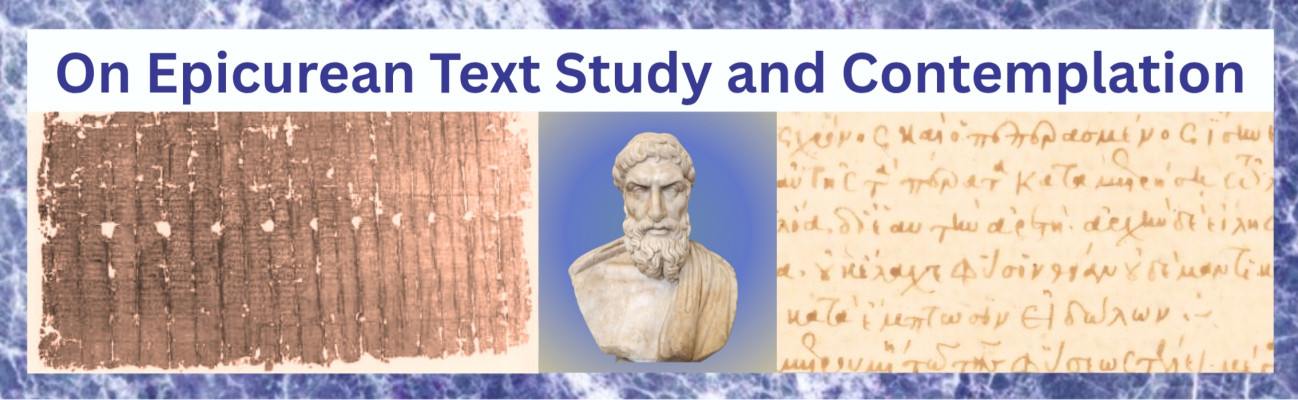
On Epicurean Text Study and Contemplation
Blog article by Kalosyni
(The following is based on material previously given out for an Epicurean Ethics study group.)
When studying Epicurean philosophy, it is important for dedicated students of Epicurus to approach the study of ethics in a manner that facilitates an accurate understanding of what the key texts truly say. At the same time, a core goal is to seek not only intellectual understanding but also a personal and practical application of the philosophy to daily life. Human beings are not only rational thinkers; we are also emotional and intuitive creatures who seek meaning, fulfillment, and inner stability. Students of Epicurus should consider how to create a bridge between the analytical mind and the feeling heart in order to truly understand and live Epicurean philosophy.
Epicurus himself presents philosophy not as dry abstraction, but as a living practice connected to joy and friendship. Vatican Saying 41 captures this balance beautifully: “We must laugh and philosophize at the same time, and do our household duties, and employ our other faculties, and never cease proclaiming the sayings of the true philosophy.” Philosophy is therefore not separated from life; it is woven into ordinary living, conversation, pleasure, and reflection.
As students read Epicurean texts, there is also a need to distinguish between two types of approaches: 1) drawing meaning out of the text through careful observation (exegesis); and 2) reading meaning into the text with presuppositions (eisegesis). There are many ways to approach the study of texts. The dedicated student may have questions such as: “How did Epicurus live?” or “What did Epicurus recommend for his students?” Diogenes Laertius says that Epicurus wrote over 300 books, but only a small portion of Epicurean texts have survived. Conclusions must therefore be modest and also evidence-based. In many cases the texts support multiple dimensions of the good life — happiness, pleasure, freedom from mental distress, friendship, and tranquility — rather than a single rigid formula.
The fragmentary condition of many surviving works, especially those of Philodemus, further complicates interpretation. Missing words and damaged passages can easily lead to speculative conclusions or exegetical fallacies. Students should therefore cultivate intellectual humility and acknowledge when evidence is uncertain.
Translation and Interpretation in Text Study
Students of Epicurus depend on the efforts of various translators of ancient Greek and Latin Epicurean texts. Students may choose to work with a single translation, compare several translations side-by-side, study specific Greek words in depth, or even attempt to learn ancient Greek for themselves. Learning ancient Greek can be a fun endeavor, but is itself a lengthy process.
Literal word-for-word translation often fails to capture the tone, nuance, and spirit of the original language. Translators must balance accuracy with readability, choosing words that communicate the intended meaning in natural language. Most students of Epicurus will remain dependent on translators unless they acquire the linguistic skills to engage directly with the original texts.
Interpretation itself also requires careful methodology. Hermeneutics, the theory and methodology of interpretation, reminds us that the meaning of individual passages must be understood within the context of the whole work, while the whole work is illuminated through its details. Exegesis attempts to draw meaning out of the text itself, whereas eisegesis introduces personal assumptions and biases into the text.
Many students of Epicurus approach the writings with deep admiration and devotion, much like religious readers approach sacred scripture. While such enthusiasm can inspire dedication, it also increases the danger of reading personal beliefs into the texts. For this reason, students should strive to distinguish clearly between what the texts explicitly support and what remains personal speculation or interpretation.
Several common exegetical fallacies can distort interpretation. Semantic anachronism occurs when modern definitions are imposed on ancient words. Hasty generalization arises when broad conclusions are drawn from isolated passages. False dichotomies force “either/or” interpretations where the text may support “both/and.” Another danger is argument from silence — assuming that because the text does not mention something, it therefore did not exist or was not intended.
Students can reduce these risks through contextualization, awareness of personal bias, and attention to historical and literary context. Interpretation should allow the text to speak on its own terms rather than forcing it into a modern ideological framework. Maintaining some distance from the text can help preserve clarity and reduce the temptation toward projection.
Contemplation and Personal Practice
After studying and interpreting the texts carefully, students may then ask how Epicurean philosophy applies to their own lives. This movement from interpretation to inspiration can become a valuable contemplative practice.
One approach is to study a passage carefully and reflect on what the text literally says before drawing practical lessons from it. Another approach is to ask: “What is this teaching encouraging me to do in my own life?” Such contemplation allows philosophy to become personal without necessarily distorting the original meaning of the text.
Another useful exercise is to consider what a text may have meant to its original audience. What concerns motivated Epicurus or Lucretius? What social or philosophical problems were they addressing? Such questions help students appreciate the historical context while also drawing timeless insights from the writings.
Students may also engage in broader forms of contemplation inspired by various Epicurean themes such as friendship, mortality, gratitude, pleasure, or freedom from fear. Walking outdoors, sitting quietly, journaling, or reflecting on memorable passages can all deepen one’s connection to the philosophy.
Journaling can be especially valuable because it preserves reflections over time, and provides a place for recording personal inspirations and imaginative reflections. A student might record both textual observations and personal reactions while also noting when a thought represents personal inspiration rather than textual evidence. This practice encourages intellectual honesty while still allowing creative and emotional engagement.
When studying Epicurean philosophy, a student may sometimes see parallels between Epicureanism and Buddhism, Daoism, or modern psychology. While such reflections can be personally meaningful, they should be identified honestly as modern interpretations rather than framed as definitive teachings of Epicurus himself. Students of Epicurus ought to strive to be clear and keep track of the difference between what is truly indicated by the texts, and what is a personal inspiration not connected to the actual texts of Epicurus.
Ultimately, the student of Epicurus can endeavor to create a path from knowledge of Epicurean texts toward a deeper, personal understanding of the philosophy. Contemplation is the activity that moves a student from mere knowledge of texts toward self-transformation. The goal is to cultivate a life of pleasure, wisdom, happiness, friendship, gratitude, and freedom from fear. Through careful study, thoughtful interpretation, and sincere reflection, students may gradually bridge the distance between philosophical understanding and lived experience.
For further discussion on this, please post over in his thread.