

Welcome to Episode 336 of Lucretius Today. This is a podcast dedicated to the poet Lucretius, who wrote "On The Nature of Things," the most complete presentation of Epicurean philosophy left to us from the ancient world. Each week we walk you through the Epicurean texts, and we discuss how Epicurean philosophy can apply to you today. If you find the Epicurean worldview attractive, we invite you to join us in the study of Epicurus at EpicureanFriends.com, where we discuss this and all of our podcast episodes.
This week we start are continuing our series reviewing Cicero's "Academic Questions" from an Epicurean perspective, which gives us an overview of the issues that split Plato's Academy and helps us understand Epicurus' position on the same issues. This week will continue in Book Two, where we will continue our discussion of Section 8
Our text will come from
Cicero - Academic Questions - Yonge We'll likely stick with Yonge primarily, but we'll also refer to the Rackham translation here:
[media]
Notes for today: On Natue of the Gods Book 1
15 ” ‘Yes, but Epicurus actually wrote books about holiness43 and piety.’ But what is the language of these books? Such that you think you are listening to a Coruncanius or a Scaevola, high priests, not to the man who destroyed the very foundations of religion, and overthrew — not by main force like Xerxes, but by argument — the temples and the altars of the immortal gods. Why, what reason have you for maintaining that men owe worship to the gods, if the gods not only pay no respect to men,44 but care for nothing and do nothing at all? 116 ‘But deity possesses an excellence and pre‑eminence which must of its own nature attract the worship of the wise.’ Now how can there be any excellence in a being so p113 engrossed in the delights of his own pleasure that he always has been, is, and will continue to be entirely idle and inactive? Furthermore how can you owe piety to a person who has bestowed nothing upon you? or how can you owe anything at all to one who has done you no service? Piety is justice towards the gods; but how can any claims of justice exist between us and them, if god and man have nothing in common? Holiness is the science of divine worship; but I fail to see why the gods should be worshipped if we neither have received nor hope to receive benefit from them. 42 117 On the other hand what reason is there for adoring the gods on the ground of our admiration for the divine nature, if we cannot see that that nature possesses any special excellence?
One of the clearest statements comes in On the Nature of the Gods 1.51–52, where Velleius explains that the gods are perfectly happy and immortal and therefore undertake no labor, administration, or governance of the world. The Epicurean gods:
are not burdened with any occupation,
have no business to perform,
enjoy their own wisdom and virtue,
and live in complete happiness.
Cotta then repeatedly ridicules this position. In 1.93–124 he argues that the Epicurean gods are practically useless because they neither create the world, govern it, care for mankind, punish the wicked, nor reward the good.
One of Cicero's most famous formulations occurs in On the Nature of the Gods 1.121, where Cotta essentially asks what sort of deity can be imagined that:
does nothing, undertakes nothing, cares about nothing.
The Latin often quoted is:
nihil agit, nihil molitur, nulla re occupatur
("does nothing, undertakes nothing, is occupied with nothing").
This is probably the passage most often cited when people say that Cicero accused the Epicureans of believing that the gods "do nothing."
There are also related criticisms in On the Nature of the Gods 1.115–124, where Cotta argues that a god who neither acts nor governs is little different from a decorative figure.
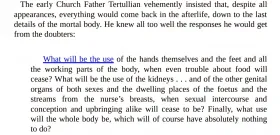
We didn't get very far into this yesterday, but a passage from Tertullian quoted by Stephen Greenblatt raises a similar problem of inactivity:

Cassius June 2, 2026 at 2:53 PM
Episode 336 of the Lucretius Today Podcast is now available. This week our episode is entitled: A Coherent Whole Or An Arbitrary Mess - The Necessity of The Study of Nature and Knowledge In Addition To Ethics"
[media]
Great episode -- it’s nice to have Cicero fighting with us, to some degree, against the Stoics.
Thank you both for your encouraging words!
it’s nice to have Cicero fighting with us, to some degree, against the Stoics.

Using this thread to keep everything together:
XXXVII. “They have nothing to do,” your teacher says. Epicurus truly, like indolent boys, thinks nothing preferable to idleness; yet those very boys, when they have a holiday, entertain themselves in some sportive exercise. But we are to suppose the Deity in such an inactive state that if he should move we may justly fear he would be no longer happy. This doctrine divests the Gods of motion and operation; besides, it encourages men to be lazy, as they are by this taught to believe that the least labor is incompatible even with divine felicity.
But let it be as you would have it, that the Deity is in the form and image of a man. Where is his abode? Where is his habitation? Where is the place where he is to be found? What is his course of life? And what is it that constitutes the happiness which you assert that he enjoys? For it seems necessary that a being who is to be happy must use and enjoy what belongs to him. And with regard to place, even those natures which are inanimate have each their proper stations assigned to them: so that the earth is the lowest; then water is next above the earth; the air is above the water; and fire has the highest situation of all allotted to it. Some creatures inhabit the earth, some the water, and some, of an amphibious nature, live in both. There are some, also, which are thought to be born in fire, and which often appear fluttering in burning furnaces.
In the first place, therefore, I ask you, Where is the habitation of your Deity? Secondly, What motive is it that stirs him from his place, supposing he ever moves? And, lastly, since it is peculiar to animated beings to have an inclination to something that is agreeable to their several natures, what is it that the Deity affects, and to what purpose does he exert the motion of his mind and reason? In short, how is he happy? how eternal? Whichever of these points you touch upon, I am afraid you will come lamely off. For there is never a proper end to reasoning which proceeds on a false foundation; for you asserted likewise that the form of the Deity is perceptible by the mind, but not by sense; that it is neither solid, nor invariable in number; that it is to be discerned by similitude and transition, and that a constant supply of images is perpetually flowing on from innumerable atoms, on which our minds are intent; so that we from that conclude that divine nature to be happy and everlasting.
-Cicero, Tusculan Disputations
Finding Things At EpicureanFriends.com
Here is a list of suggested search strategies:
- Website Overview page - clickable links arrranged by cards.
- Forum Main Page - list of forums and subforums arranged by topic. Threads are posted according to relevant topics. The "Uncategorized subforum" contains threads which do not fall into any existing topic (also contains older "unfiled" threads which will soon be moved).
- Search Tool - icon is located on the top right of every page. Note that the search box asks you what section of the forum you'd like to search. If you don't know, select "Everywhere."
- Search By Key Tags - curated to show frequently-searched topics.
- Full Tag List - an alphabetical list of all tags.