1. Home
    1. Study Guide
    2. Community Standards
    3. Site Map
    4. Quizzes
    5. Articles On Physics
    6. Articles On Canonics
    7. Articles On Ethics
    8. All Articles
    9. Elli's Blog Posts
    10. Kalosyni's Blog
    11. All Blog Posts
  2. Lexicon
    1. Lexicon Home
    2. FAQ
    3. Files
    4. Search Assistance
    5. Foundations
    6. Navigation Outlines
    7. Reading List
    8. Key Pages
    9. Last Changes
  3. Forum
    1. Full Forum List
    2. Welcome Threads
    3. Ancient Texts Forum
    4. Physics
    5. Canonics
    6. Ethics
    7. Forum Shortcuts
    8. Forum Navigation Map
    9. Featured
    10. Most Discussed
  4. Latest
    1. New Activity
    2. Latest Threads
    3. Dashboard
    4. Search By Tag
    5. Complete Tag List
  5. Podcast
    1. Lucretius Today Podcast
    2. Episode Guide
    3. Lucretius Today At Youtube
    4. EpicureanFriends Youtube Page
  6. Texts
    1. Overview
    2. Torquatus On Ethics
    3. Velleius On Divinity
    4. Diogenes Laertius
    5. Principal Doctrines
    6. Vatican Collection
    7. Lucretius
    8. Herodotus
    9. Pythocles
    10. Menoeceus
    11. Fragments - Usener Collection
    12. Greek/Latin Help
  7. Gallery
    1. Latest Images
    2. Featured images
    3. Latest Comments
  8. More
    1. Featured Content
    2. Logbook
    3. EF ToDo List
  • Login
  • Register
  • Search
This Thread
  • Everywhere
  • This Thread
  • This Forum
  • Forum
  • Articles
  • Blog Articles
  • Files
  • Gallery
  • Pages
  • Wiki
  • FAQ
  • More Options
  1. EpicureanFriends - Classical Epicurean Philosophy
  2. Forum
  3. The Lucretius Today Podcast and EpicureanFriends Videos
  4. The Lucretius Today Podcast

Episode 290 - TD20 - TipToeing Around All Disturbance Is Not Living

  • Cassius
  • July 11, 2025 at 7:55 PM
  • Go to last post
  • Cassius
    5 - Administrator
    • I Too Am An Epicurean
    • Advocate
    • Lucretius Today Podcast Co-Host
    • 2025 Contributor
    • Active Member 5 Years or more
    Points
    115,668
    Posts
    15,932
    Quizzes
    9
    Quiz rate
    100.0 %
    • July 11, 2025 at 7:55 PM
    • #1

    Welcome to Episode 290 of Lucretius Today. This is a podcast dedicated to the poet Lucretius, who wrote "On The Nature of Things," the most complete presentation of Epicurean philosophy left to us from the ancient world.

    Each week we walk you through the Epicurean texts, and we discuss how Epicurean philosophy can apply to you today. If you find the Epicurean worldview attractive, we invite you to join us in the study of Epicurus at EpicureanFriends.com, where we discuss this and all of our podcast episodes.

    This week we continue our series covering Cicero's "Tusculan Disputations" from an Epicurean viewpoint.

    Today we continue in Part 3, which addresses anger, pity, envy, and other strong emotions. Today we'll continued where we ended last week in Section X.


    [media]

  • Cassius
    5 - Administrator
    • I Too Am An Epicurean
    • Advocate
    • Lucretius Today Podcast Co-Host
    • 2025 Contributor
    • Active Member 5 Years or more
    Points
    115,668
    Posts
    15,932
    Quizzes
    9
    Quiz rate
    100.0 %
    • July 11, 2025 at 7:59 PM
    • #2

    When we get to section XIII we'll get to our first direct information about Epicurus and how he difffered from the Cyreniacs:

    Quote

    Epicurus is of opinion, that grief arises naturally from the imagination of any evil; so that whosoever is eye-witness of any great misfortune, if he conceives that the like may possibly befal himself, becomes sad instantly from such an idea. The Cyrenaics think that grief is not engendered by every kind of evil, but only by unexpected, unforeseen evil; and that circumstance is, indeed, of no small effect on the heightening of grief; for whatsoever comes of a sudden appears more formidable.

  • Online
    Joshua
    5 - Administrator
    • Advocate
    • Lucretius Today Podcast Co-Host
    • 2025 Contributor
    • Active Member 5 Years or more
    Points
    15,615
    Posts
    2,011
    Quizzes
    3
    Quiz rate
    95.8 %
    • July 12, 2025 at 1:32 AM
    • #3

    Cicero develops an argument around this claim in Book 2 of On Ends, we'll need to find that section. The basic argument he makes is something like this;

    • Epicurus holds that pain/fear/mental disturbance is an evil.
    • It is not possible to be confident that one will avoid this evil in perpetuity.
    • If the Epicurean cannot be confident of this, he cannot guarantee his continuing happiness, and as a result present happiness will be impossible.
    • The Epicurean can never be happy.
  • Cassius
    5 - Administrator
    • I Too Am An Epicurean
    • Advocate
    • Lucretius Today Podcast Co-Host
    • 2025 Contributor
    • Active Member 5 Years or more
    Points
    115,668
    Posts
    15,932
    Quizzes
    9
    Quiz rate
    100.0 %
    • July 12, 2025 at 6:55 AM
    • #4

    Good point Joshua. Bringing out how this sparring was being conducted on both sides is very helpful for understanding why Epicurus phrased things he way he did, and why a basic formulation such as "...we call pleasure the beginning and end of the happy life) might occur in the letter to Menoeceus, but "the limit of quantity of pleasure...." occurs at the top of the principal doctrines. In an outline for a young friend you might use a simple step by step series of reminders, while in listing key points of differences between schools it's more appropriate to first confront well-known and well-defined disputes. And what you're talking about was a well known and defined dispute arising from definition and use of words like "evil" and "happy."

  • Kalosyni
    Student of the Kepos
    • Advocate
    • Lucretius Today Podcast Co-Host
    • 2025 Contributor
    • Active Member 5 Years or more
    Points
    22,096
    Posts
    2,684
    Quizzes
    2
    Quiz rate
    90.9 %
    • July 12, 2025 at 10:49 AM
    • #5
    Quote from Cassius

    helpful for understanding why Epicurus phrased things he way he did, and why a basic formulation such as "...we call pleasure the beginning and end of the happy life)

    This may be pedantic, but to be precise in current meaning and clarity:

    ..."the start and the goal" ...and not: "the start and the cessation".

    (After having studied Buddhism "the end" meant "cessation").

  • Don
    ΕΠΙΚΟΥΡΕΙΟΣ (Epicurist)
    • I Too Am An Epicurean
    • Advocate
    • Lucretius Today Podcast Co-Host
    • 2025 Contributor
    • Active Member 5 Years or more
    Points
    42,956
    Posts
    6,053
    Quizzes
    9
    Quiz rate
    92.8 %
    • July 13, 2025 at 12:15 AM
    • #6
    Quote from Cassius

    why a basic formulation such as "...we call pleasure the beginning and end of the happy life) might occur in the letter to Menoeceus

    From my Menoikeus paper:

    A short digression is now in order to examine that phrase ἀρχὴν καὶ τέλος "the foundation and fulfillment, the beginning and end." Often, this is simply translated as "the beginning and the end" as if there's a starting line and a finish line. This is much deeper than that, although the running of a race could be one metaphor that could used. Let's first look at the word ἀρχὴν (accusative of ἀρχή).

    ἀρχή (arkhē)

    English archeology "study of beginnings/origins" but also the -archy in monarchy, patriarchy, etc.

    ᾰ̓ρχή carries the meaning of beginning, origin, foundation, the farthest point. It even took on the meaning of "the corners of a sheet" by the time the New Testament was being written (Acts 10:11). It also had the connotation of the "beginning of power" residing in a ruler, the "most important person" in a kingdom. It carries the idea of a foundational element or first principle. The alpha (first letter of the Greek alphabet) to τέλος's omega (the last letter of the Greek alphabet) which is how Hicks translated them.

    τέλος (telos) carries the meaning of endings, the goal, completion, maturity, result, fulfillment, consummation. Where αρχή is the foundation, τέλος is the highest point. The definition of τέλος in LSJ is extensive!

    Αρχή is not quite as long but gives the nuance we're working with.

    Therefore, to translate ἀρχὴν καὶ τέλος as "beginning and end" (every other translation I've seen except Hicks) misses a lot of deeper meaning. This phrase is one that I highly recommend giving more attention to in one's personal translation or at least being aware of when reading. We miss so much by not examining Epicurus's words. Always go back to the texts!

  • Cassius July 16, 2025 at 3:17 PM

    Changed the title of the thread from “Episode 290 - TD20 - TipToeing Around All Disturbance Is Not Really Living” to “Episode 290 - TD20 - TipToeing Around All Disturbance Is Not Living”.
  • Cassius
    5 - Administrator
    • I Too Am An Epicurean
    • Advocate
    • Lucretius Today Podcast Co-Host
    • 2025 Contributor
    • Active Member 5 Years or more
    Points
    115,668
    Posts
    15,932
    Quizzes
    9
    Quiz rate
    100.0 %
    • July 16, 2025 at 3:25 PM
    • #7

    Episode 290 of the Lucretius Today Podcast is now available. Today our episode is entitled: "Tiptoeing Around All Disturbance Is Not Living"

    [media]

  • Adrastus
    3 - Friend
    Points
    382
    Posts
    48
    • July 17, 2025 at 7:02 AM
    • #8

    Brings me so much joy hearing this episode. I feel like the ataraxic mind guards against the perils and pains of life, but I think Epicurus redeems the somewhat listless ataraxic state by arguing that emotions are there to guide us towards a sagely life where pleasure and the pleasant life is the teleological goal of life. Emotions are likely not overwhelming to the ataraxic mind, but with the humanizing Epicurean philosophy create that acceptance of nature yet still feeling deep connection to the self and others. If even a wise and intelligent person experiences despair, then that simply means that their arrangement of social and perhaps material reality is not pleasant or comporting to ideal hedonic or Epicurean meleta or advice. It makes so much sense to me at least that the highest expression of a wise life is in community with like minds and alike in their piety, and that even a wise soul can be stuck in social situation; or worse, that will cause them to be unassuagedly disturbed.

  • Don
    ΕΠΙΚΟΥΡΕΙΟΣ (Epicurist)
    • I Too Am An Epicurean
    • Advocate
    • Lucretius Today Podcast Co-Host
    • 2025 Contributor
    • Active Member 5 Years or more
    Points
    42,956
    Posts
    6,053
    Quizzes
    9
    Quiz rate
    92.8 %
    • July 17, 2025 at 7:23 AM
    • #9

    Fwiw...

    Epicurean Sage - Once the sage has become wise... affected by emotions
    Hicks: Moreover, he who has once become wise never more assumes the opposite habit, not even in semblance, if he can help it. Yonge: Also, that a man who has…
    sites.google.com
  • Cassius
    5 - Administrator
    • I Too Am An Epicurean
    • Advocate
    • Lucretius Today Podcast Co-Host
    • 2025 Contributor
    • Active Member 5 Years or more
    Points
    115,668
    Posts
    15,932
    Quizzes
    9
    Quiz rate
    100.0 %
    • July 17, 2025 at 8:08 AM
    • #10
    Quote from Adrastus

    Emotions are likely not overwhelming to the ataraxic mind, but with the humanizing Epicurean philosophy create that acceptance of nature yet still feeling deep connection to the self and others. If even a wise and intelligent person experiences despair, then that simply means that their arrangement of social and perhaps material reality is not pleasant or comporting to ideal hedonic or Epicurean meleta or advice. It makes so much sense to me at least that the highest expression of a wise life is in community with like minds and alike in their piety, and that even a wise soul can be stuck in social situation; or worse, that will cause them to be unassuagedly disturbed.

    Good post Adrastas and I agree with it, but it might be worth discussing the two words I underlined there, "despair" and "unassuagedly disturbed." I don't think Joshua or I used those words in the podcast, and this would be worth discussing.

    All these synonyms for "grief" or strongly negative feelings have lots of different connotations, and I suspect to the extent that these two imply that the wise man would "give up" in the face of that kind of emotion, I doubt Epicurus would go that far. I doubt he considered himself to be "giving up" or "despairing" on his last day -- I'd say it is more like the Vatican sayings. I think you yourself quoted in our zoom meeting:

    VS14. We are born once and cannot be born twice, but for all time must be no more. But you, who are not master of tomorrow, postpone your happiness. Life is wasted in procrastination, and each one of us dies while occupied.

    And even more to the point:

    VS47. I have anticipated thee, Fortune, and entrenched myself against all thy secret attacks. And I will not give myself up as captive to thee or to any other circumstance; but when it is time for me to go, spitting contempt on life and on those who vainly cling to it, I will leave life crying aloud a glorious triumph-song that I have lived well.

    I think the attitude of VS47 probably rules out at least some versions of "despair" or being "unassuagedly disturbed."

    This might be worth discussing further to see if anyone disagrees, or at least to hit home the importance of the strong attitude referenced in VS47.

  • Kalosyni
    Student of the Kepos
    • Advocate
    • Lucretius Today Podcast Co-Host
    • 2025 Contributor
    • Active Member 5 Years or more
    Points
    22,096
    Posts
    2,684
    Quizzes
    2
    Quiz rate
    90.9 %
    • July 17, 2025 at 8:55 AM
    • #11

    I have some questions about the wording of VS47 and will ask over in this thread for examining the translation:

    Thread

    VS47 - Source in Vat.gr.1950 and elsewhere

    This saying is attributed to Metrodorus .

    Here is the manuscript of VS47


    (Source: Vat.gr.1950, part 2, 403verso)

    And here is the text in Metrodori Epicurei Fragmenta collegit scriptoris incerti Epicurei Commentarium moralem, subiecit Alfredus Koerte (p.561)
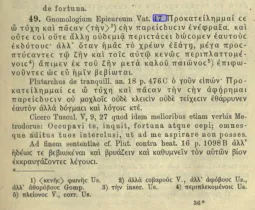


    That famous word "triumph-song" does not appear in the manuscript! It is a "correction" by Usener, clearly shown in the manuscript itself and in Note (5) in Metrodori...: 5) πλειονος V[atican]., corr[ected by] Us[ener]. Usener…

    Don
    May 23, 2024 at 6:46 AM
  • Adrastus
    3 - Friend
    Points
    382
    Posts
    48
    • July 17, 2025 at 11:18 AM
    • #12

    I sometimes like to use some strange phrasings for fun, and to a lesser extent, to demonstrate in some way I didn't use any A.I. to write. :D

    Yes, I see Epicurus' last day as a preparation for death. An acceptance but relishing in the memories of close friendships, relaying his affection for those present and thinking fondly of the future lives of some of the children of the garden he would be securing with his will. I too could see Vatican saying 47 (I love that one) being an insight into the ancient Epicureans' attitude towards dying.

    Another quote that capitvated me in my early reading of Epicurus and still does; is in the letter to Menoceus:

    "The art of living well, and dying well are one."

  • Cassius
    5 - Administrator
    • I Too Am An Epicurean
    • Advocate
    • Lucretius Today Podcast Co-Host
    • 2025 Contributor
    • Active Member 5 Years or more
    Points
    115,668
    Posts
    15,932
    Quizzes
    9
    Quiz rate
    100.0 %
    • July 17, 2025 at 12:37 PM
    • #13
    Quote from Adrastus

    and to a lesser extent, to demonstrate in some way I didn't use any A.I. to write.

    You have passed all applicable tests! :)

    In fact in the future we may have to come up with a new award for future use: "Users who no one would ever dream are using AI!" ;)

Resources

  1. Getting Started At EpicureanFriends
  2. Community Standards And Posting Policies
  3. The Major Doctrines of Classical Epicurean Philosophy
  4. Introductory Videos
  5. Lexicon
  6. Lucretius Today Podcast
    1. Podcast Episode Guide
  7. Key Epicurean Texts
    1. Chart Of Key Quotes
    2. Outline Of Key Quotes
    3. Side-By-Side Diogenes Laertius X (Bio And All Key Writings of Epicurus)
    4. Side-By-Side Lucretius - On The Nature Of Things
    5. Side-By-Side Torquatus On Ethics
    6. Side-By-Side Velleius on Divinity
    7. Lucretius Topical Outline
    8. Usener Fragment Collection
  8. Frequently Asked Questions
    1. FAQ Discussions
  9. Full List of Forums
    1. Physics Discussions
    2. Canonics Discussions
    3. Ethics Discussions
    4. All Recent Forum Activities
  10. Image Gallery
  11. Featured Articles
  12. Featured Blog Posts
  13. Quiz Section
  14. Special Resource Pages
  15. File Database
  16. Site Map
    1. Home

Frequently Used Forums

  • Frequently Asked / Introductory Questions
  • News And Announcements
  • Lucretius Today Podcast
  • Physics (The Nature of the Universe)
  • Canonics (The Tests Of Truth)
  • Ethics (How To Live)
  • Against Determinism
  • Against Skepticism
  • The "Meaning of Life" Question
  • Uncategorized Discussion
  • Comparisons With Other Philosophies
  • Historical Figures
  • Ancient Writers and Texts
  • Decline of The Ancient Epicurean Age
  • Unsolved Questions of Epicurean History
  • Welcome New Participants
  • Events - Activism - Outreach
  • Full Forum List

Latest Posts

  1. Using AI to create flow charts of Lucretius' De Rerum Natura

    Kalosyni
    November 1, 2026 at 7:09 PM
  2. Happy Halloween 2026 - Death is Nothing to Us!

    Joshua
    November 1, 2026 at 11:42 AM
  3. Episode 358 - EATAQ40 - Continuing in Part 18 of Book 2 of Academic Questions

    Cassius
    November 1, 2026 at 6:14 AM
  4. Episode 357 - EATAQ39 - A Brief Word On Sextus Empiricus And The Goal of Skepticism

    Cassius
    October 31, 2026 at 3:46 PM
  5. Welcome Thomas Karion!

    Cassius
    October 31, 2026 at 10:04 AM
  6. Discussion of Article - "Aristotle - Introduction From An Epicurean Perspective"

    Cassius
    October 28, 2026 at 7:49 PM
  7. Discussion of Article - "Sextus Empiricus - Introduction From An Epicurean Perspective"

    Pacatus
    October 26, 2026 at 6:06 PM
  8. Heads up: New Book Coming in 2027

    Cassius
    October 26, 2026 at 4:29 PM
  9. Do some people still believe in fate?

    Kalosyni
    October 26, 2026 at 9:27 AM
  10. David Sedley - "Creationism And Its Critics In Antiquity"

    Cassius
    October 26, 2026 at 6:24 AM

Frequently Used Tags

In addition to posting in the appropriate forums, participants are encouraged to reference the following tags in their posts:

  • #Physics
    • #Atomism
    • #Gods
    • #Images
    • #Infinity
    • #Eternity
    • #Life
    • #Death
  • #Canonics
    • #Knowledge
    • #Scepticism
  • #Ethics

    • #Pleasure
    • #Pain
    • #Engagement
    • #EpicureanLiving
    • #Happiness
    • #Virtue
      • #Wisdom
      • #Temperance
      • #Courage
      • #Justice
      • #Honesty
      • #Faith (Confidence)
      • #Suavity
      • #Consideration
      • #Hope
      • #Gratitude
      • #Friendship


Click Here To Search All Tags

To Suggest Additions To This List Click Here

EpicureanFriends - Classical Epicurean Philosophy

  1. Home
    1. About Us
    2. Classical Epicurean Philosophy
    3. Rules, Terms & Policies
  2. Lexicon
    1. Getting Started
  3. Frequently Asked Questions
    1. Site Map
  4. Forum
    1. Latest Threads
    2. Featured Threads
    3. Unread Posts
  5. Texts
    1. Core Texts
    2. Biography of Epicurus
    3. Lucretius
  6. Articles
    1. Latest Articles
  7. Gallery
    1. Featured Images
  8. Calendar
    1. This Month At EpicureanFriends
Powered by WoltLab Suite™ 6.2.8
Style: Inspire by cls-design
Stylename
Inspire
Manufacturer
cls-design
Licence
Commercial styles
Help
Supportforum
Visit cls-design