

1. Home
    1. Study Guide
    2. Community Standards
    3. Site Map
    4. Quizzes
    5. Articles On Physics
    6. Articles On Canonics
    7. Articles On Ethics
    8. All Articles
    9. Elli's Blog Posts
    10. Kalosyni's Blog
    11. All Blog Posts
  2. Lexicon
    1. Lexicon Home
    2. FAQ
    3. Files
    4. Search Assistance
    5. Foundations
    6. Navigation Outlines
    7. Reading List
    8. Key Pages
    9. Last Changes
  3. Forum
    1. Full Forum List
    2. Welcome Threads
    3. Ancient Texts Forum
    4. Physics
    5. Canonics
    6. Ethics
    7. Forum Shortcuts
    8. Forum Navigation Map
    9. Featured
    10. Most Discussed
  4. Latest
    1. New Activity
    2. Latest Threads
    3. Dashboard
    4. Search By Tag
    5. Complete Tag List
  5. Podcast
    1. Lucretius Today Podcast
    2. Episode Guide
    3. Lucretius Today At Youtube
    4. EpicureanFriends Youtube Page
  6. Texts
    1. Overview
    2. Torquatus On Ethics
    3. Velleius On Divinity
    4. Diogenes Laertius
    5. Principal Doctrines
    6. Vatican Collection
    7. Lucretius
    8. Herodotus
    9. Pythocles
    10. Menoeceus
    11. Fragments - Usener Collection
    12. Greek/Latin Help
  7. Gallery
    1. Latest Images
    2. Featured images
    3. Latest Comments
  8. More
    1. Featured Content
    2. Logbook
    3. EF ToDo List
  • Login
  • Register
  • Search
Everywhere
  • Everywhere
  • Forum
  • Articles
  • Blog Articles
  • Files
  • Gallery
  • Pages
  • Wiki
  • FAQ
  • More Options
  1. EpicureanFriends - Classical Epicurean Philosophy

Frequently Asked Questions

Our FAQ is in a stage of on-going renovation and improvement. Each FAQ answer has a link to a discussion thread where the topic can be discussed. Please use those links for specific topics but also feel free to make general suggestions in the general FAQ thread here.

Introductory Questions

What is Epicurean Philosophy All About?

The key points of Classical Epicurean Philosophy include:

  1.  Nothing Can Be Created From Nothing.
  2. Nature Has No Gods Over Her.
  3. Do Not Assign To The Gods Anything That Is Inconsistent With Incorruption And Blessedness
  4. Death Is Nothing To Us.
  5. There Is No Necessity To Live Under The Control Of Necessity.
  6. He Who Says "Nothing Can Be Known" Knows Nothing.
  7. All Sensations Are "True."
  8. Virtue Is Not  Absolute Or An End In Itself - All Good And Evil Consists In Sensation.
  9. Pleasure is The Guide of Life.
  10. By "Pleasure" We Mean All Experience That Is Not Painful
  11. Life Is Desirable, But Unlimited Time Contains No Greater Pleasure Than Limited Time.

For further detail, see our WIki entry on this topic as well as the dsicussion provided in this thread.

After I Identify Pleasure As The Guide of Life, Which Pleasures Should I Pursue?
  • 1. We will generally focus on Epicurus' division of the desires into natural and necessary classifications, but first, before anything else, we have to realize that these categories are contextual and cannot be described or implemented in absolute terms.
    • 1.1. "And since pleasure is the first good and natural to us, for this very reason we do not choose every pleasure, but sometimes we pass over many pleasures, when greater discomfort accrues to us as the result of them: and similarly we think many pains better than pleasures, since a greater pleasure comes to us when we have endured pains for a long time. Every pleasure then because of its natural kinship to us is good, yet not every pleasure is to be chosen: even as every pain also is an evil, yet not all are always of a nature to be avoided." Yet by a scale of comparison and by the consideration of advantages and disadvantages we must form our judgment on all these matters. For the good on certain occasions we treat as bad, and conversely the bad as good. "[Epicurus Letter to Menoeceus 129]
  • 2. Generally we will prioritize pursuing pleasures that are necessary for life. Therefore the first step at any particular moment of life is to confirm that you can expect your future life to be more pleasurable than painful. In almost every instance this is true, and in general it is a very small person who has more reasons for ending his life than living it. But this is not always true, as sometimes you will choose death, when the alternative of living on would be worse
    • 2.1. "[The lofty spirit] is schooled to encounter pain by recollecting that pains of great severity are ended by death, and slight ones have frequent intervals of respite; while those of medium intensity lie within our own control: we can bear them if they are endurable, or if they are not, we may serenely quit life's theater, when the play has ceased to please us."[ Torquatus in Cicero's On Ends, I:XV]
  • 3. After confirming that it makes sense to live on, first obtain those pleasures which are necessary for continued life. These are presumably the basics of life such as air, food, water, shelter, and the like.
  • 4. After obtaining the pleasures necessary for life, and after confirming that you can expect your remaining time of life to make available more pleasure than pain, consider whether the additional pleasures you choose to pursue are natural, in that they have a limit, or are unnatural, in that by their very nature you can never achieve them (such as unlimited amounts of time, fame, power, riches). This analysis allows you to forecast whether the pursuit of a pleasure is likely to lead to more pain than pleasure.
    • 4.1. The principle of the natural and necessary classification is as follows: "Nothing could be more useful or more conducive to well-being than Epicurus's doctrine as to the different classes of the desires. One kind he classified as both natural and necessary, a second as natural without being necessary, and a third as neither natural nor necessary; the principle of classification being that the necessary desires are gratified with little trouble or expense; the natural desires also require but little, since nature's own riches, which suffice to content her, are both easily procured and limited in amount; but for the imaginary desires no bound or limit can be discovered."
  • 5. At this point when you know that it makes sense to continue to live, and you secure the pleasures that are necessary to life, and you identify what will likely be many options for pursuing desires that will lead to more pleasure than pain, you choose from among those options to pursue the most pleasant life according to the following considerations:
    • 5.1. Remember that the "most pleasant" does not equate either to the largest quantity or the longest time.
      • 5.1.1. "And just as with food he does not seek simply the larger share and nothing else, but rather the most pleasant, so he seeks to enjoy not the longest period of time, but the most pleasant."[Epicurus Letter to Menoeceus 126
    • 5.2. Remember that all pleasures are not identical and interchangeable, because they do not all have the same intensity, last the same period of time, or affect the same aras of the body and mind.
      • 5.2.1. "PD09. If every pleasure could be intensified so that it lasted, and influenced the whole organism or the most essential parts of our nature, pleasures would never differ from one another."
    • 5.3. Remember that what others tell you is the most desirable or undesirable life is not the ultimate test of what is in fact most pleasant to you.
      • 5.3.1. PD10. If the things that produce the pleasures of profligates could dispel the fears of the mind about the phenomena of the sky, and death, and its pains, and also teach the limits of desires (and of pains), we should never have cause to blame them: for they would be filling themselves full, with pleasures from every source, and never have pain of body or mind, which is the evil of life.
    • 5.4. The ultimate test of what to pleasure pursue is reality - whether it in fact leads to the most pleasant life.
      • 5.4.1. VS71. Every desire must be confronted by this question: What will happen to me if the object of my desire is accomplished, and what if it is not?
  • 6. Other Reference Material:
    • 6.1. EpicureanFriends Forum On Pleasure As The Guide of Life
    • 6.2. EpicureanFriends Forum on Natural and Necessary Desires
Is Epicurean Philosophy Purely a Matter of Personal Self-Improvement, or Does It Have a Missionary / Outreach Aspect?

The short answer is emphatically the latter: Epicurean philosophy has a strong and explicit outreach mission built into it from the very beginning. The common modern image of the Epicurean as a quietly self-satisfied person who has retired from the world to cultivate private pleasures is a serious distortion -- one rooted largely in centuries of hostile characterization by Stoic and Christian opponents who preferred to paint Epicureans as self-indulgent recluses rather than acknowledge what they actually were: tireless evangelists for a philosophy they believed could heal the suffering of all mankind.

The Misconception: "Live Unknown"

Some cite the Epicurean saying lathe biosas -- "live unknown" -- as evidence that Epicurean philosophy counsels withdrawal from public life and indifference to others. But this saying refers specifically to the avoidance of political ambition and the pursuit of fame and power -- not to any withdrawal from human contact or any indifference to sharing the philosophy. As the record of Epicurus's own life and the lives of his successors makes abundantly clear, no leading Epicurean ever came close to living unknown as a philosopher. They were among the most prolific writers and active recruiters in the ancient world.

Epicurus Himself: Three Hundred Books and a Self-Propagating School

Epicurus was one of the most productive writers in all of antiquity. Diogenes Laertius records that he authored approximately three hundred books -- all in his own words, without citing other authors -- surpassing even Aristotle in sheer volume. Epictetus, a Stoic opponent, gives involuntary testimony to Epicurus's outreach mission when he writes with evident sarcasm: "Why do you even light a lamp and labor for our sake, and write so many books?" The very question acknowledges that Epicurus labored for the sake of others -- it was his opponents who found this embarrassing, not the Epicureans themselves.

Norman DeWitt, in his article "Epicurus: Philosophy for the Millions" (The Classical Journal, 1947), describes in detail how Epicurus deliberately organized his school as what DeWitt calls a "self-propagating sect." After being expelled from Mytilene by hostile Platonists and eventually settling in Athens, Epicurus developed a systematic program of outreach. As DeWitt explains in his own words from that article:

Quote

Quote

Outside of the school he instituted a method of disseminating his new doctrine by personal contacts. Each convert was urged to win over the members of his own household, his friends and neighbors, "never slackening in spreading by every means the doctrines of the true philosophy." Prospective converts were plied with books and tracts. Epicurus himself, like John Wesley, became a busy compiler of textbooks, and specific instructions were written for the proper use of them. He made outlines of doctrine for those who were unable to live in residence. The allegiance of disciples living in other cities was retained by epistles painstakingly composed.

DeWitt captures the spirit of this mission by describing Epicurean philosophy as having the color of a gospel. He contrasts this explicitly with the elitism of Platonism and Stoicism, which catered to aristocratic courts and the socially ambitious. The Epicurean philosophy, by contrast, was designed to be accessible to anyone: men, women, slaves, and free citizens alike, "never slackening in spreading by every means the doctrines of the true philosophy."

Within two centuries, as DeWitt notes, this program had spread throughout the Graeco-Roman world. Even Cicero, who despised Epicureanism, was forced to acknowledge that it had "taken Italy by storm."

The Ancient Sources: "Never Cease Proclaiming"

The outreach character of Epicurean philosophy is not just a feature of Epicurus's personal practice -- it is directly affirmed in the preserved sayings of the school. Vatican Saying 41 is among the most explicit:

Quote

Quote

"We must laugh and philosophize at the same time and do our household duties and employ our other faculties, and never cease proclaiming the sayings of the true philosophy."

This is not a counsel of private self-improvement. The command to "never cease proclaiming" is as direct a missionary instruction as one finds in any philosophical or religious tradition. And Vatican Saying 52 gives this outreach mission a cosmic scope:

Quote

Quote

"Friendship dances around the world bidding us all to awaken to the recognition of happiness."

DeWitt identifies this saying with the Hippocratic tradition of philanthropia -- the love of humanity -- and observes that it describes a personified Love going "dancing round and round the inhabited earth, crying to all men to awake to the blessedness of the happy life." The whole world, in Epicurus's view, was a single parish in need of the same healing.

Cicero's Testimony: Epicureans as Pamphleteers

Among the charges Cicero leveled at Epicureans -- and Cicero was one of the most hostile witnesses available -- was that they were too eager to make their philosophy accessible to the masses. He complained that Epicureans had begun writing in Latin for general audiences, deliberately bypassing the educated elites to reach ordinary people. This was, in Cicero's view, beneath the dignity of true philosophy. From the Epicurean perspective, it was the whole point. The record of Cicero's own era confirms that Epicurean books, summaries, and epitomes circulated so widely that they constituted what we would today recognize as a publishing campaign targeting the broadest possible readership.

Diogenes of Oinoanda: The Inscription as Missionary Monument

Perhaps the most dramatic single example of Epicurean outreach in all of antiquity is the great inscription of Diogenes of Oinoanda. In the second century AD, an elderly Epicurean named Diogenes caused a philosophical treatise to be carved in stone on a public stoa in the city of Oinoanda in what is now Turkey -- a monument running to hundreds of fragments, intended to bring Epicurean teachings to all who passed by, including future generations and foreign visitors.

Diogenes states his rationale explicitly in Fragment 3 of the inscription:

Quote

Quote

"Now, since the remedies of the inscription reach a larger number of people, I wished to use this stoa to advertise publicly the medicines that bring salvation... Having already reached the sunset of my life (being almost on the verge of departure from the world on account of old age), I wanted, before being overtaken by death, to compose a fine anthem to celebrate the fullness of pleasure... as I have said before, the majority of people suffer from a common disease, as in a plague, with their false notions about things, and their number is increasing (for in mutual emulation they catch the disease from one another, like sheep); moreover, it is right to help also generations to come (for they too belong to us, though they are still unborn) and, besides, love of humanity prompts us to aid also the foreigners who come here."

This is one of the most explicit statements of a philosophical outreach mission in all of classical antiquity. Diogenes uses the language of medicine -- the philosophy as healing remedy, the world as suffering from a plague of false beliefs -- and extends his concern not merely to his fellow citizens but to foreigners, future generations, and indeed all of humanity. The inscription was not a private monument but a public one, deliberately placed where it could reach the widest possible audience. Nothing about it resembles the behavior of a person counseled to "live unknown."

Lucretius: Bringing Light to Hearts in Darkness

The Roman poet Lucretius, writing in the first century BC, gives perhaps the most vivid literary expression to the Epicurean sense of philosophical mission. The opening of On the Nature of Things frames the entire poem as an act of rescue: Lucretius writes to carry the light of Epicurean understanding into the darkness where human beings wander in fear. The famous lines from Book 1 announce that the "terror and darkness of mind" tormenting humanity must be dispelled not by the rays of the sun but by the rational account of nature:

Quote

Quote

"This terror then and darkness of the mind must be dispelled, not by the rays of the sun and the gleaming shafts of day, but by the aspect and the law of nature."

And in Book 2, Lucretius describes himself as following in the footsteps of Epicurus across untrodden fields, gathering flowers to weave a garland that no one has yet placed on any head -- imagery of discovery combined with the desire to share what has been found. Throughout the poem, the driving energy is not the contentment of a philosopher who has found his own peace, but the urgency of someone who wants to bring that peace to others.

Lucretius describes Epicurus himself in terms of heroic mission: a man who "first dared to raise mortal eyes against" the oppressive weight of superstition and "burst out beyond the flaming walls of the world" to bring back the knowledge that frees humanity. This is the language of a founder whose achievement was understood by his followers as a gift to all mankind -- not a private discovery to be quietly enjoyed.

The Conclusion: Outreach Is Not Optional, It Is Intrinsic

The evidence, from Epicurus's own practices down through Lucretius and Diogenes of Oinoanda, points in a single direction: outreach and the desire to share the philosophy with others is not a peripheral feature of Epicureanism. It is built into the philosophical core. The philosophy is rooted in a conviction that the happiness it describes is genuinely available to all people -- not just the educated, not just the wealthy, not just men, not just citizens -- and that conviction generates a natural and powerful impulse to communicate it as widely as possible. Epicurus himself described the good as something which, once found, cries out to be shared. His followers took that seriously across five centuries of the ancient world, and the same impulse is alive in the Epicurean community today.

Which Is It? Is "Ataraxia" Or "Pleasure" Or "Tranquility" The Ultimate Epicurean Goal?

The Epicurean Goal is "Pleasure" - not "Ataraxia."

Questions frequently arise as to the role of “Tranquility” in Epicurean philosophy, and whether in the form of “Ataraxia” or “Aponia” Epicurus was advocating these terms as either some special and highest form of pleasure, or something higher than pleasure itself, to be pursued as the ultimate goal of life.

Difficulties arise in defining what these terms mean, how Epicurus was referring to them, and where they stand in relation to “Pleasure” - the term that Epicurus generally employs in describing the guide or goal of life. While there is no doubt that tranquility and concepts such as “Absence of pain” and “absence of disturbance” are important aspects of the best life, the Epicureans made clear that their primary focus was on “Pleasure” and how best to obtain it.

Edit

1. Philosophically speaking there can be only one ultimate goal, and Epicurus finds that in "Pleasure" rather than "Tranquility," or "Absence of Pain," or "Absence of Disturbance."

  1. Cicero: On Ends Book One - [29] IX. “‘First, then,’ said he, ‘I shall plead my case on the lines laid down by the founder of our school himself: I shall define the essence and features of the problem before us, not because I imagine you to be unacquainted with them, but with a view to the methodical progress of my speech. The problem before us then is, what is the climax and standard of things good, and this in the opinion of all philosophers must needs be such that we are bound to test all things by it, but the standard itself by nothing. Epicurus places this standard in pleasure, which he lays down to be the supreme good, while pain is the supreme evil; and he founds his proof of this on the following considerations. [30] Every creature, as soon as it is born, seeks after pleasure and delights therein as in its supreme good, while it recoils from pain as its supreme evil, and banishes that, so far as it can, from its own presence, and this it does while still uncorrupted, and while nature herself prompts unbiased and unaffected decisions. So he says we need no reasoning or debate to shew why pleasure is matter for desire, pain for aversion. These facts he thinks are simply perceived, just as the fact that fire is hot, snow is white, and honey sweet, no one of which facts are we bound to support by elaborate arguments; it is enough merely to draw attention to the fact; and there is a difference between proof and formal argument on the one hand and a slight hint and direction of the attention on the other; the one process reveals to us mysteries and things under a veil, so to speak; the other enables us to pronounce upon patent and evident facts. Moreover, seeing that if you deprive a man of his senses there is nothing left to him, it is inevitable that nature herself should be the arbiter of what is in accord with or opposed to nature. Now what facts does she grasp or with what facts is her decision to seek or avoid any particular thing concerned, unless the facts of pleasure and pain?”
  2. Cicero:: On Ends Book One “Nor indeed can our mind find any other ground whereon to take its stand as though already at the goal; and all its fears and sorrows are comprised under the term pain, nor is there any other thing besides which is able merely by its own character to cause us vexation or pangs In addition to this the germs of desire and aversion and generally of action originate either in pleasure or in pain.” [42] This being so, it is plain that all right and praiseworthy action has the life of pleasure for its aim. Now inasmuch as the climax or goal or limit of things good (which the Greeks term telos) is that object which is not a means to the attainment of any thing else, while all other things are a means to its attainment, we must allow that the climax of things good is to live agreeably.“
  3. Diogenes of Oinoanda, Fragment 32: “I shall discuss folly shortly, the virtues and pleasure now. If, gentlemen, the point at issue between these people and us involved inquiry into «what is the means of happiness?» and they wanted to say «the virtues» (which would actually be true), it would be unnecessary to take any other step than to agree with them about this, without more ado. But since, as I say, the issue is not «what is the means of happiness?» but «what is happiness and what is the ultimate goal of our nature?», I say both now and always, shouting out loudly to all Greeks and non-Greeks, that pleasure is the end of the best mode of life, while the virtues, which are inopportunely messed about by these people (being transferred from the place of the means to that of the end), are in no way an end, but the means to the end. Let us therefore now state that this is true, making it our starting-point.”

Edit

2. Epicurus never states that "Pleasure" and "Tranquility" are the same thing.

  1. Common understanding of the terms indicates that “Pleasure” is the wider term: all Tranquility is Pleasure, but all Pleasure is not Tranquility. Epicurus nowhere in any text states that Tranquility is not a pleasure or that Tranquility is something superior to Pleasure. There are no cites under this point because such cites (to “Tranquility” having exactly the same meaning as “Pleasure” or being something other than a type of pleasure) do not exist. The instance used primarily to argue this from the letter to Menoeceus is a small part of a much larger discussion in which the intent is not to identify the two as equal but to explain how to pursue pleasure without encountering pains worse than those pleasures.” (“When we say, then, that pleasure is the end and aim, we do not mean the pleasures of the prodigal or the pleasures of sensuality, as we are understood to do by some through ignorance, prejudice, or willful misrepresentation. By pleasure we mean the absence of pain in the body and of trouble in the soul. [132] It is not an unbroken succession of drinking-bouts and of revelry, not sexual love, not the enjoyment of the fish and other delicacies of a luxurious table, which produce a pleasant life; it is sober reasoning, searching out the grounds of every choice and avoidance, and banishing those beliefs through which the greatest tumults take possession of the soul.”)
  2. Diogenes Laertius, Biography of Epicurus: Epicurus differs from the Cyrenaics about pleasure. For they do not admit static pleasure, but only that which consists in motion. But Epicurus admits both kinds both in the soul and in the body, as he says in the work on Choice and Avoidance and in the book on The Ends of Life and in the first book On Lives and in the letter to his friends in Mytilene. Similarly, Diogenes in the 17th book of Miscellanies and Metrodorus in the Timocrates speak thus: ‘Pleasure can be thought of both as consisting in motion and as static.’ And Epicurus in the work on Choice speaks as follows: ‘Freedom from trouble in the mind and from pain in the body are static pleasures, but Joy and exultation are considered as active pleasures involving motion. '
  3. Diogenes Laertius, Biography of Epicurus: A further difference from the Cyrenaics: they thought that bodily pains were worse than those of the soul, and pointed out that offenses are visited by bodily punishment. But Epicurus held that the pains of the soul are worse, for the flesh is only troubled for the moment, but the soul for past, present, and future. In the same way the pleasures of the soul are greater. As proof that pleasure is the end, he points out that all living creatures as soon as they are born take delight in pleasure, but resist pain by a natural impulse apart from reason. Therefore we avoid pain by instinct, just as Heracles, when he is being devoured by the shirt of Nessus, cries aloud, With tears and groans: the rocks re-echoed far from Locris' mountain peaks, Euboea’s hills.“

Edit

3. Reading the philosophy as a whole there are overwhelming numbers of references identifying "Pleasure" (rather than "Tranquility") as the Goal / Ultimate Good of life.

  1. Letter to Menoeceus: “And just as with food he does not seek simply the larger share and nothing else, but rather the most pleasant, so he seeks to enjoy not the longest period of time, but the most pleasant.”
  2. Letter to Menoeceus: ”[129] And for this cause we call pleasure the beginning and end of the blessed life. For we recognize pleasure as the first good innate in us, and from pleasure we begin every act of choice and avoidance, and to pleasure we return again, using the feeling as the standard by which we judge every good.“
  3. Diogenes Laertius Biography of Epicurus: ” They say that he wrote to many other women of pleasure and particularly to Leontion, with whom Metrodorus was also in love; and that in the treatise On the End of Life he wrote, ‘I know not how I can conceive the good, if I withdraw the pleasures of taste and withdraw the pleasures of love and those of hearing and sight.’
  4. Diogenes Laertius Biography of Epicurus: “They hold that faults are not all of equal gravity, that health is a blessing to some, but indifferent to others, that courage does not come by nature, but by a calculation of advantage. That friendship too has practical needs as its motive: one must indeed lay its foundations (for we sow the ground too for the sake of crops), but it is formed and maintained by means of community of life among those who have reached the fullness of pleasure. They say also that there are two ideas of happiness, complete happiness, such as belongs to a god, which admits of no increase, and the happiness which is concerned with the addition and subtraction of pleasures.”
  5. Lucretius On The Nature of Things: Book 2 Line 1 "O miserable minds of men! O blinded breasts! In what darkness of life and in how great dangers is passed this term of life whatever its duration! Not choose to see that nature craves for herself no more than this, that pain hold aloof from the body, and she in mind enjoy a feeling of pleasure exempt from care and fear?

Edit

4. Epicurus never identified any pleasure as intrinsically "better" than another pleasure.

  1. There is no hierarchy of pleasures in Epicurean philosophy which would justify identifying any single type of pleasure as a “best” pleasure. Therefore it would have made no sense for him to say that Tranquility or “Absence of Pain” or “Absence of Disturbance” are a “best” pleasure or “highest” pleasure.
  2. Epicurus listed a number of pleasures “by which he was able to determine the good” but he did not list “Tranquility” among them, nor did he rank his list in order of importance. Diogenes Laertius, Lives of Philosophers, X.6: “It is observed too that in his treatise On the End-Goal, he writes in these terms: “I know not how to conceive the good, apart from the pleasures of taste, sexual pleasures, the pleasures of sound, and the pleasures of beautiful form.”

Edit

5. Although Epicurus had no reason to identify a "best" or "highest" type of pleasure, Epicurus had a very strong reason for discussing and identifying a "limit" of pleasure.

  1. A “best” Pleasure has no necessary connection with a “limit of pleasure” but it is the desire to equate these terms that generates confusion, such as Cicero employed in arguing that “absence of pain” is not the way normal people discuss pleasure.”
  2. Epicurus was a philosopher teaching in Greece and so it is logical to presume that he would have wished to respond not only to the errors of religion but also to the errors of other philosophers.
  3. One of the primary, and perhaps most important, arguments of the Established Philosophy at the time of Epicurus was Plato's “Philebus.” In “Philebus” Plato argues that the nature of a highest good requires that it must have “a limit.” Socrates asks “SOCRATES: Have pleasure and pain a limit, or do they belong to the class which admits of more and less?” Socrates explains that “SOCRATES: … should we not be wise in adopting the other view and maintaining that there is in the universe a mighty infinite and an adequate limit, of which we have often spoken, as well as a presiding cause of no mean power, which orders and arranges years and seasons and months, and may be justly called wisdom and mind?”
  4. This argument is more explicit in the form it is recorded by Seneca in his Letter To Lucilius – 66.45: “What can be added to that which is perfect? Nothing otherwise that was not perfect to which something has been added. Nor can anything be added to virtue, either, for if anything can be added thereto, it must have contained a defect. Honor, also, permits of no addition; for it is honorable because of the very qualities which I have mentioned.[5] What then? Do you think that propriety, justice, lawfulness, do not also belong to the same type, and that they are kept within fixed limits? The ability to increase is proof that a thing is still imperfect.”
  5. Seneca repeats the argument in another form in Book I – Letter XVI: “This also is a saying of Epicurus: “If you live according to nature, you will never be poor; if you live according to opinion, you will never be rich.” Nature’s wants are slight; the demands of opinion are boundless. Suppose that the property of many millionaires is heaped up in your possession. Assume that fortune carries you far beyond the limits of a private income, decks you with gold, clothes you in purple, and brings you to such a degree of luxury and wealth that you can bury the earth under your marble floors; that you may not only possess, but tread upon, riches. Add statues, paintings, and whatever any art has devised for the luxury; you will only learn from such things to crave still greater. Natural desires are limited; but those which spring from false opinion can have no stopping point. The false has no limits.
  6. Epicurus explicitly and near the top of his principle doctrines identified not a “best” pleasure but a “Limit of Quantity” of pleasure: “PD03. The limit of quantity in pleasures is the removal of all that is painful. Wherever pleasure is present, as long as it is there, there is neither pain of body, nor of mind, nor of both at once.” If Epicurus had wished to say that “Absence of pain is the very best pleasure and is the ultimate goal of life” he could clearly have done so, but he did not.

Edit

6. Numerous Other Ancient Texts Make Clear That Epicurus Held "Pleasure" as the term to use to describe the ultimate goal of life:

  1. Cicero, In Defense of Publius Sestius, 10.23: “He {Publius Clodius} praised those most who are said to be above all others the teachers and eulogists of pleasure {the Epicureans}. … He added that these same men were quite right in saying that the wise do everything for their own interests; that no sane man should engage in public affairs; that nothing was preferable to a life of tranquility crammed full of pleasures. But those who said that men should aim at an honorable position, should consult the public interest, should think of duty throughout life not of self-interest, should face danger for their country, receive wounds, welcome death – these he called visionaries and madmen.” Note: Here is a link to Perseus where the Latin and translation of this can be compared. The Latin is: “nihil esse praestabilius otiosa vita, plena et conferta voluptatibus.” See also here for word translations.
  2. Plutarch, That Epicurus actually makes a pleasant life impossible, 3, p. 1088C: “Epicurus has imposed a limit on pleasures that applies to all of them alike: the removal of all pain. For he believes that our nature adds to pleasure only up to the point where pain is abolished and does not allow it any further increase in magnitude (although the pleasure, when the state of painlessness is reached, admits of certain unessential variations). But to proceed to this point, accompanied by desire, is our stint of pleasure, and the journey is indeed short and quick. Hence it is that becoming aware of the poverty here they transfer their final good from the body, as from an unproductive piece of land, to the soul, persuaded that there they will find pastures and meadows lush with pleasures.”
  3. Plutarch, That Epicurus actually makes a pleasant life impossible, 7, p. 1091A: Not only is the basis that they assume for the pleasurable life untrustworthy and insecure, it is quite trivial and paltry as well, inasmuch as their “thing delighted” – their good – is an escape from ills, and they say that they can conceive of no other, and indeed that our nature has no place at all in which to put its good except the place left when its evil is expelled. … Epicurus too makes a similar statement to the effect that the good is a thing that arises out of your very escape from evil and from your memory and reflection and gratitude that this has happened to you. His words are these: “That which produces a jubilation unsurpassed is the nature of good, if you apply your mind rightly and then stand firm and do not stroll about {a jibe at the Peripatetics}, prating meaninglessly about the good.”
  4. Athenaeus, Deipnosophists, XII p. 546E: Not only Aristippus and his followers, but also Epicurus and his welcomed kinetic pleasure; I will mention what follows, to avoid speaking of the “storms” {of passion} and the “delicacies” which Epicurus often cites, and the “stimuli” which he mentions in his On the End-Goal. For he says “For I at least do not even know what I should conceive the good to be, if I eliminate the pleasures of taste, and eliminate the pleasures of sex, and eliminate the pleasures of listening, and eliminate the pleasant motions caused in our vision by a visible form.
  5. Cicero, Tusculan Disputations, III.18.41: Why do we shirk the question, Epicurus, and why do we not confess that we mean by pleasure what you habitually say it is, when you have thrown off all sense of shame? Are these your words or not? For instance, in that book which embraces all your teaching (for I shall now play the part of translator, so no one may think I am inventing) you say this: “For my part I find no meaning which I can attach to what is termed good, if I take away from it the pleasures obtained by taste, if I take away the pleasures which come from listening to music, if I take away too the charm derived by the eyes from the sight of figures in movement, or other pleasures by any of the senses in the whole man. Nor indeed is it possible to make such a statement as this – that it is joy of the mind which is alone to be reckoned as a good; for I understand by a mind in a state of joy, that it is so, when it has the hope of all the pleasures I have named – that is to say the hope that nature will be free to enjoy them without any blending of pain.” And this much he says in the words I have quoted, so that anyone you please may realize what Epicurus understands by pleasure.
  6. Cicero, Tusculan Disputations, III.20.46: For he has not only used the term pleasure, but stated clearly what he meant by it. “Taste,” he says, “and embraces and spectacles and music and the shapes of objects fitted to give a pleasant impression to the eyes.”
  7. Cicero, On End-Goals, Good and Bad, II.3.7 (Torquatus to Cicero): “Does not Epicurus recognize pleasure in your sense?” (Cicero): “Not always,” said I, “now and then, I admit, he recognizes it only too fully, for he solemnly avows that he cannot even understand what good there can be or where it can be found, apart form that which is derived from food and drink, the delight of the ears, and the grosser forms of gratification. Do I misrepresent his words?” Ibid., II.7.20: In a number of passages where he is commending that real pleasure which all of us call by the same name, he goes so far as to say that he cannot even imagine any Good that is not connected with pleasure of the kind intended by Aristippus. Such is the language that he uses in the lecture dealing solely with the topic of the Chief Good. II.8.23: Men of taste and refinement, with first-rate chefs… the accompaniment of dramatic performances and their usual sequel – these are pleasures without which Epicurus, as he loudly proclaims, does not know what Good is. II.10.29: But fancy his failing to see how strong a proof it is that the sort of pleasure, without which he declares he has no idea at all what Good means (and he defines it in detail as the pleasure of the palate, of the ears, and subjoins the other kinds of pleasure, which cannot be specified without an apology). I.10.30: the kinetic sort of pleasure … he extols it so much that he tells us he is incapable even of imagining what other good there can be. II.20:64: … Nor did he forgo those other indulgences in the absence of which Epicurus declares that he cannot understand what good is.
  8. Cicero, On End-Goals, Good and Bad: The truth of the position that pleasure is the ultimate good will most readily appear from the following illustration. Let us imagine a man living in the continuous enjoyment of numerous and vivid pleasures alike of body and of mind, undisturbed either by the presence or by the prospect of pain: what possible state of existence could we describe as being more excellent or more desirable? One so situated must possess in the first place a strength of mind that is proof against all fear of death or of pain; he will know that death means complete unconsciousness, and that pain is generally light if long and short if strong, so that its intensity is compensated by brief duration and its continuance by diminishing severity. Let such a man moreover have no dread of any supernatural power; let him never suffer the pleasures of the past to fade away, but constantly renew their enjoyment in recollection, and his lot will be one which will not admit of further improvement.
  9. Plotinus, Dissertations, 30 (Aeneids, II.9), 15: “For there are two schools of thought about attaining the [ethical] end. One which puts forward the pleasure of the body as the end, and another which chooses nobility and virtue … Epicurus, who abolishes providence, exhorts to pursue all that remains: pleasure and its enjoyment.”
  10. Antiochus of Ascalon, by way of Clement of Alexandria, Miscellanies II.21 p. 178.43: “For of those that are ruled by pleasure are the Cyrenaics and Epicurus; for these expressly said that to live pleasantly was the chief end, and that pleasure was the only perfect good. Epicurus also says that the removal of pain is pleasure.”
  11. Lactantius, Divine Institutes, III.7.7: “Epicurus thinks that the highest good is in the pleasure of the mind. Aristippus holds that it is in the pleasure of the body.”
  12. Lactantius, Divine Institutes, III.17.38: [Epicurus says, in effect:] “Let us serve pleasure, then, in whatever way we can, for in a short time we will be nothing whatsoever. Let us suffer no day, therefore, no point of time to flow by for us without pleasure, lest, since we ourselves are at sometime to perish, the very fact that we live may perish.” Although he does not say this in so many words, however, he teaches this is fact.”
  13. Plutarch, On Peace of Mind, 2 p. 465F (Johannes Stobaeus, Anthology, 29.79): For this reason not even Epicurus believes that men who are eager for honor and glory should lead an inactive life, but that they should fulfill their natures by engaging in politics and entering public life, on the ground that, because of their natural dispositions, they are more likely to be disturbed and harmed by inactivity if they do not obtain what they desire.
Are Stoics, Buddhists, Judeo-Christians, Humanists, Minimalists, et al. Welcome At EpicureanFriends?

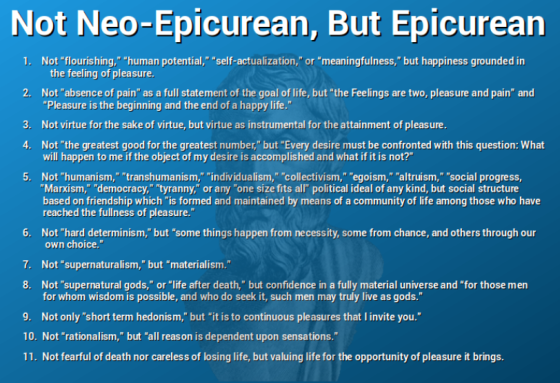
EpicureanFriends.com welcomes all who are sincerely interested in Epicurean Philosophy to read our public forums and make use of our public resources. We have extensive public discussion threads and resources explicitly for the purpose of allowing people who do not consider themselves fully Epicurean to read and learn about the philosophy of Epicurus. However, as an explicitly pro-Epicurean forum, our goal is to provide a place for those who do consider themselves to be primarily Epicurean to communicate productively with each other about Classical Epicurean Philosophy. For that reason, regular posting privileges and attendance at our online Zoom meetings are reserved only to those who agree to our Community Standards, our Not Neo-Epicurean, But Epicurean statement, and our Key Posting Policy statement.

Please see in particular our "Not Neo-Epicurean But Epicurean" Statement:

For the full text and supporting citations, see here.

For more information, as well as links to discussions on how Epicurus compares to other philosophies, see here:

EpicureanFriends Wiki - Epicureanfriends.com
www.epicureanfriends.com
Can You Suggest A Reading List For Learning About Epicurus?

This is a question that comes up frequently. See our full list and discussion here:

Reading Recommendations - Epicureanfriends.com
www.epicureanfriends.com
What Did Epicurus Mean When He Spoke of "Pleasure?"

Answer:

See the discussion of this question in our Wiki here:

General Principles of Epicurean Ethics - Epicureanfriends.com
www.epicureanfriends.com


What Are The Most Important Principles Of The Epicurean System?

The principles of Classical Epicurean Philosophy are set forth here.

Discussion of this FAQ Entry is here.

What Would Epicurus Say About The Search For "Meaning" in Life?

We don't have record of Epicurus addressing questions about "meaning" using that term. We do, however, have a great deal of information about Epicurus' view of "virtue" and the claim that there are higher and nobler callings in life beyond "pleasure." Calls to "meaningfulness" often seem to come from a similar perspective as "virtue," and so the Epicurean analysis of virtue is helpful in assessing "meaningfulness." The heart of that analysis is:

Quote from On Ends Book One

XIII. Those who place the Chief Good in virtue alone are beguiled by the glamour of a name, and do not understand the true demands of nature. If they will consent to listen to Epicurus, they will be delivered from the grossest error. Your school dilates on the transcendent beauty of the virtues; but were they not productive of pleasure, who would deem them either praiseworthy or desirable? We esteem the art of medicine not for its interest as a science, but for its conduciveness to health; the art of navigation is commended for its practical and not its scientific value, because it conveys the rules for sailing a ship with success. So also Wisdom, which must be considered as the art of living, if it effected no result would not be desired; but as it is, it is desired, because it is the artificer that procures and produces pleasure.

A subforum for discussion this issue is here: Answering the "Quest For Meaning" In Epicurean Terms

The most extensive surviving Epicurean argument illustrating how Epicurus dealt with calls to "virtue" is contained in Cicero's On Ends Book One.

Why Does Epicurus Reject Determinism And Fatalism?

Epicurean philosophy takes a strong stand against both determinism and fatalism, and it does so on the basis of physics, not mere assertion. The Epicurean position is that human beings possess genuine agency — the power to shape their own lives — and that this fact is incompatible with any doctrine that holds all events, including all human choices, to be necessitated by prior causes stretching back through an infinite chain. This argument involves physics, logical self-refutation, and practical experience.

What Epicurus Was Arguing Against

Epicurus inherited the atomic theory from Democritus, who held that all events are the inevitable result of atomic collisions following fixed mechanical laws. On Democritus's view, every human judgment, impulse, and emotion is simply the result of atomic motions in the mind — there is no room for individual self-determination or responsibility. This is what David Sedley, in his article "Epicurus' Refutation of Determinism," identifies as "mechanistic" or "reductionist" determinism: the position that human behavior can be exhaustively accounted for in terms of material changes at the atomic level, making talk of intention, desire, and genuine choice superfluous.

Epicurus recognized that determinism also came in a closely related logical form — the thesis associated with Diodorus Cronus that future events are necessitated by their already being true that they will come about. Both physical and logical determinism pointed to the same conclusion: that nothing is genuinely "up to us." The practical consequence of accepting these arguments is devastating: if all human behavior is fully determined by prior atomic configurations, there is no such thing as responsibility, no basis for praise or blame, no genuine choice — and therefore no real foundation for the Epicurean project of learning to live well.

The Epicurean Distinction: Necessity, Chance, and What Depends on Us

The starting point of Epicurus's response is a distinction drawn in the Letter to Menoeceus (133–5) among three categories:

  1. Necessity — what happens by fixed causal determination
  2. Chance — what happens accidentally, without reliable pattern
  3. What depends on us (to par' hēmas) — what results from our own agency, what we are genuinely responsible for

The third category is the crucial one. What characterizes it is that it has no master: praise and blame attach to it naturally because the outcome genuinely depends on the agent's own choices. Epicurus states directly: it is better to accept the myths about the gods than to be enslaved to the fate of the natural philosophers — because the myths at least leave open the possibility of divine concession, while necessity leaves open nothing at all.

The Self-Refutation Argument

The most powerful argument Epicurus deployed against determinism is the self-refutation argument. Its starting point is that the determinist cannot consistently argue his case. When the determinist attempts to persuade his opponent, he attributes the credit for reasoning correctly to himself and the fault of reasoning incorrectly to his opponent. But this is precisely the behavior of someone who treats both parties as autonomous agents capable of making up their own minds. By apportioning philosophical credit and blame, he adopts exactly the attitude that leads us to conceive of the self as responsible — and thereby undermines his own thesis at every step. Epicurus extends this argument backward in time. The determinist, when caught in this contradiction, tries to explain away his own act of arguing as itself causally necessitated. But this explanation is itself an act for which he is either taking credit or not — and so on without end. The determinist's position may seem logically airtight but it is self-defeating in practice: it cannot be consistently maintained while actually arguing, because arguing presupposes genuine autonomous agency.

The Linguistic Argument

Epicurus's second main argument attacks the determinist's claim to be making a substantive point rather than merely changing names. If the determinist says that what we ordinarily call "our own agency" is really necessity operating through us, he is not showing that our experience of genuine choice is illusory — he is simply proposing to rename it.

But our preconception of our own agency is of something with its own genuine causal efficacy, distinct from external compulsion. To make his claim substantive, the determinist would have to show that this preconception is faulty -- that our ordinary sense of genuine choice systematically misleads us. Epicurus argues that the determinist has no independent grip on "necessity" that does not simply rename what we already experience as agency. The practical distinction between being pushed off a cliff and choosing to jump is one we recognize and act on constantly. The determinist would have to eliminate this distinction but he has no resources to do so.

The Non-Reductionist Argument: The Self Is Not Its Atoms

Epicurus also rejected what Sedley calls "reductionist atomism" — the assumption that phenomenal properties such as consciousness, judgment, and the sense of self are nothing but patterns of atomic motion, with no independent reality of their own.

As Sedley writes, Epicurus was almost unique among ancient philosophers in recognizing (1) that there are truths at the microscopic level of elementary particles, but also (2) very different truths at the phenomenal level, and that neither level of description has a monopoly of truth. The truth that sugar is sweet is not straightforwardly reducible to the molecular truth about its structure, even though the latter may be required to explain the former.

Applied to the self, this means the self that acts, judges, and chooses is a real entity (which can be called "emergent") not identical with its constituent atoms. A person's atomic make-up shapes his natural temperament — the natural coward has more atomic makeup that tends toward timidity, the courageous man has more atomic makeup that tends toward boldness — but the self that develops through experience and rational reflection is not simply the plaything of those initial configurations. It has its own causal reality. And once the agent has achieved genuine self-determination through development, his rational choices can actually leave their mark on his constituent atoms and stabilize future behavior.

This is precisely the argument Lucretius makes at De Rerum Natura Book Three, lines 288–322. Different animal natures are governed by the mix of atoms in their souls: lions are fierce, deer timid, oxen placid. But humans are not simply the expression of their atomic constitution. Through reason a man can learn to overcome his natural tendencies. Even the natural coward can learn courage. The atomic composition is a constraint on temperament, not a complete determination of behavior — and what is "up to us" is precisely the rational self-cultivation that operates on, rather than being exhausted by, the atomic substrate.

The Physical Argument: The Swerve

Against the background of this non-reductionist psychology, the role of the atomic swerve becomes clear. The swerve is a minimal, spontaneous, unpredictable deviation in the path of a falling atom, occurring at no fixed time or place. It is not described in Epicurus's surviving letters but is attested at length by Lucretius (De Rerum Natura II 216–93) and is consistent with everything Epicurus says about agency.

As Sedley has shown, the swerve is not itself the cause of volitions — the Epicureans made no attempt to explain how a particular atomic motion produces choices in conscious beings. Rather, the function of the swerve is negative and enabling: it prevents the laws of physics from preempting the self's decisions. Were a strictly deterministic atomic physics true, the trajectory of every atom in a person's mind-body would be fixed by the prior state of the universe, leaving no opening for volition to have any effect. The swerve introduces genuine physical indeterminacy — a proliferating tree of possible atomic trajectories — into which the self's volition can then intervene, directing which of the physically available trajectories is actually followed.

Volitions are never listed alongside blows, weight, or atomic impacts as causes of atomic motion in Epicurean sources. The self, as an entity emerging from the atoms and void, can exercise influence over its atoms without violating the laws of physics. Once the swerve has erased the deterministic grooves, physics alone does not uniquely specify which trajectory follows. That choice, at the phenomenal level, is made by the self

Lucretius states the argument in Book Two (251–93): if all atomic motion were linked in a fixed deterministic sequence, nothing would ever be "up to us" — volition would be a fiction, and the visible power of animals to initiate unpredetermined courses of action would be inexplicable. The swerve breaks the "decrees of destiny" not by overriding physics but by ensuring that physics alone does not determine outcomes, leaving room for the genuine agency which our experience plainly shows.

Why This Matters for Living Well

The practical consequence of rejecting determinism is the foundation of the entire Epicurean project. If determinism were true, there would be no point in studying philosophy, no genuine choice between better and worse ways of living, no real responsibility for the condition of one's own soul. A person who understands the proper limits of necessity, chance, and what depends on him can act accordingly — pursuing what lies within his power without complaining about what does not. The Epicurean life — the active, chosen, reason-guided life of a person who takes responsibility for his own happiness — is only possible if the third category is real: if there truly are things that depend on us.

Epicurus's most significant contribution to the debate over determinism was not the swerve itself but the perspective of identifying the self as a genuine emergent causal factor over and above its constituent atoms. The swerve makes that causation physically possible, and the rejection of atomic reductionism makes it philosophically consistent.


This question is discussed here.

What Does Epicurean Philosophy Say About Engagement With Society?

This question is discussed here.

How Does Epicurean Philosophy Differ From Stoicism?

Short Answer: The differences between Stoicism and Epicurean philosophy are deep and profound. Modern advocates of variations of Stoicism tend to blur the differences, but the ancient authorities who knew both systems well considered them to be totally incompatible, especially in terms of the goal of life and the role of reason in the determination of truth.

For a detailed treatment of many aspects of the differences, see this section of our wiki. 

Discussion of this question is here.

How Does Epicurean Philosophy Differ From Buddhism?

This question is answered here:

How Can I Implement Epicurean Principles As Quickly As Possible?

First and foremost, make sure you understand the fundamentals of what Epicurean philosophy really means before you attempt to implement anything. There are major controversies between modern commentators as to what Epicurus meant in important areas of his philosophy. For example, did Epicurus advocate any form of asceticism? What is the meaning of the "natural and necessary" classification of desires? What is the meaning of "pleasure" and how does it relate to "absence of pain?" What did Epicurus advocate as to the goal of living? What role does "simplicity" have in Epicurean living? What is the meaning and use of "virtue" in Epicurean philosophy? What was Epicurus talking about when he referred to "gods"? A chart of some of these issues and the divergent opinions is here.

Until you understand these and other fundamental points, it is a major mistake to think that you can implement what Epicurus taught on the question of how to live.


Discussion of this FAQ Entry is here.

What Is The Epicurean Definition Of A God?

Epicurus held that gods are totally natural. They are in no way supernatural, in no way omnipotent, in no way omnipresent. They are totally incapable of creating something from nothing. This is very different from modern use of the term.

The subject of whether these Epicurean gods really exist in physical form in a far-off location, or whether they are simply constructions of the human mind which we conceive based on prolepsis arising through nature, is a very complex subject so please see additional discussion here and throughout this website.


Nature Has No Gods Over Her

  1. Epicurus To Herodotus, line 77
    1. Bailey: Furthermore, the motions of the heavenly bodies and their turnings and eclipses and risings and settings, and kindred phenomena to these, must not be thought to be due to any being who controls and ordains or has ordained them and at the same time enjoys perfect bliss together with immortality (for trouble and care and anger and kindness are not consistent with a life of blessedness, but these things come to pass where there is weakness and fear and dependence on neighbors).
  2. Epicurus to Pythocles, line 97
    1. Bailey: Next the regularity of the periods of the heavenly bodies must be understood in the same way as such regularity is seen in some of the events that happen on earth. And do not let the divine nature be introduced at any point into these considerations, but let it be preserved free from burdensome duties and in entire blessedness.
  3. Lucretius Book 2 - 1090
    1. Bailey - "And if you learn this surely, and cling to it, nature is seen, free at once, and quit of her proud rulers, doing all things of her own accord alone, without control of gods."
    2. Humphries - Holding this knowledge, you can't help but see, That nature has no tyrants over her, But always acts of her own will; she has no part of any godhead whatsoever."
    3. Brown 1743 - "These things, if you rightly apprehend, Nature will appear free in her operations, wholly from under the power of domineering deities, and to act all things voluntarily, and of herself, without the assistance of gods."
    4. Munro - "If you well apprehend and keep in mind these things, nature free at once and rid of her haughty lords is seen to do all things spontaneously of herself without the meddling of the gods. "
    5. M.F. Smith - "Once you obtain a firm grasp of these facts, you see that nature is her own mistress and is exempt from the oppression of arrogant despots, accomplishing everything by herself spontaneously and independently and free from the jurisdiction of the gods. "
  4. Notes: Alternate ways to consider this would include: "There are no supernatural causes," or "The gods, however they are defined, have no impact on the cosmos," or "If gods exist, they don't control the universe nor do they bestow blessings or curses on humans." The point is that there are no supernatural, divine, or mystical forces that intervene in or create the universe.
  5. Discussion Forum
What Is The Epicurean Definition Of "Anticipations" ("Prolepsis")?

The Epicurean terms "anticipations" is much-discussed and much disputed. Please see the discussions here.

What is the Epicurean Definition of Happiness?

Go here for our Wiki entry on this topic.

For an article on this issue check here, and to discuss this FAQ response go here.

Does Epicurean Philosophy Remove the Magic and Mystery of Life?

Does Epicurean Philosophy Remove the Magic and Mystery of Life?

No -- and the accusation rests on a confusion between two very different sources of wonder. Epicurean philosophy removes superstition and fear-based awe -- the kind that sees lightning as divine punishment, or that requires belief in an intervening deity to feel reverence for existence. What it does not remove, and actively encourages, is the genuine astonishment and delight that come from seeing the natural world clearly.

Lucretius addresses this directly in Book Two of De Rerum Natura, in a passage that illustrates why understanding nature deepens rather than diminishes wonder. In the Humphries translation:

Quote

"Direct your mind To a true system. Here is something new For ear and eye. Nothing is ever so easy But what, at first, it is difficult to trust. Nothing is great and marvelous, but what All men, a little at a time, begin To mitigate their sense of awe. Look up, Look up at the pure bright color of the sky, The wheeling stars, the moon, the shining sun! If all these, all of a sudden, should arise For the first time before our mortal sight, What could be called more wonderful, more beyond The heights to which aspiring mind might dare? Nothing, I think. And yet, a sight like this, Marvelous as it is, now draws no man To lift his gaze to heaven's bright areas. We are a jaded lot. But even so Don't be too shocked by something new, too scared To use your reasoning sense, to weigh and balance, So that if in the end a thing seems true, You welcome it with open arms; if false, You do your very best to strike it down." -- Lucretius, De Rerum Natura, Book II (Humphries translation)

Lucretius's point is that familiarity, not Epicurean philosophy, is the thief of wonder. The heavens are astonishing -- the problem is that most people have grown too accustomed to them to feel it. Epicurean philosophy does not suppress this awe; it recovers and deepens it by teaching us to see what we have stopped noticing. The prescription is not less engagement with the world but more attentive and honest engagement with it.

This connects directly to one of the less well-known teachings about the Epicurean wise man. Diogenes Laertius records (DL 10.117–118) that the Epicurean sage, far from being emotionally flattened by philosophical understanding, is capable of feeling pleasure and gratitude more intensely than those who have not examined their lives. The wise man, freed from the anxieties of superstition and the constant background fear of death that dull others' experience, is more fully present to the actual goods life offers -- and thus more genuinely and deeply moved by them.

A related point concerns the Epicurean attitude toward poetry. Epicurus's caution about certain poets -- Homer in particular -- is sometimes misread as hostility to the pleasures of literature, or as a general suspicion of imagination, beauty, and emotional engagement with art. This is wrong. The specific Epicurean objection to Homeric poetry was not that it gave pleasure, but that it gave false representations of the gods: portraying them as quarreling, vengeful, lustful, and arbitrary -- exactly the kind of divine beings whose existence would justify the fear and servitude that Epicurus spent his career working to dissolve. It was the theological content, not the aesthetic experience, that Epicurus found damaging. Poetry that does not distort the nature of the divine, or that makes no theological claims at all, falls entirely outside that objection.

In short: Epicurean philosophy does not drain the color from life. It removes the particular fears and confusions that prevent people from seeing and feeling what is actually there. The wonder available to someone who grasps that the cosmos is vast, natural, eternal, and without supernatural masters -- and who meets that cosmos with gratitude for the pleasures of friendship, beauty, conversation, and the sheer fact of being alive -- is, if anything, richer and more firmly grounded than the wonder of someone whose sense of awe is mediated by fear of invisible powers.

What Was Epicurus' Position On Skepticism and Dogmatism?

Epicurus taught that not everything can be known, and that we do not have freedom of choice in all things (we have no choice about death) but Epicurus held that some things can be known, and some things are under our control, so Epicurus was strongly against what is termed today both radical Skepticism and hard Determinism.

Epicurus taught that it was important to have confidence in conclusions about matters which are clear. He advised "waiting" to form opinions about things which are not clear. Much of Epicurean doctrine is a reaction against radical skepticism, and in fact one of Epicurus' sayings was "The wise man will teach things that are definite, rather than doubtful musings." (Bailey translation of passage from the Biography of Epicurus by Diogenes Laertius.")


Further examples are: Book Four of Lucretius (Bailey): [469] Again, if any one thinks that nothing is known, he knows not whether that can be known either, since he admits that he knows nothing. Against him then I will refrain from joining issue, who plants himself with his head in the place of his feet. And yet were I to grant that he knows this too, yet I would ask this one question; since he has never before seen any truth in things, whence does he know what is knowing, and not knowing each in turn, what thing has begotten the concept of the true and the false, what thing has proved that the doubtful differs from the certain? [478] You will find that the concept of the true is begotten first from the senses, and that the senses cannot be gainsaid. For something must be found with a greater surety, which can of its own authority refute the false by the true. Diogenes of Oinoanda (Smith): Fragment 5 - Now Aristotle and those who hold the same Peripatetic views as Aristotle say that nothing is scientifically knowable, because things are continually in flux and, on account of the rapidity of the flux, evade our apprehension. We on the other hand acknowledge their flux, but not its being so rapid that the nature of each thing [is] at no time apprehensible by sense-perception. And indeed [in no way would the upholders of] the view under discussion have been able to say (and this is just what they do [maintain] that [at one time] this is [white] and this black, while [at another time] neither this is [white nor] that black, [if] they had not had [previous] knowledge of the nature of both white and black. Thread for discussion of this topic is here.

What did Epicurus say about Desire? Is All Desire Bad and To Be Minimized?

The answer to this question requires parsing the exact meaning of the word "desire" and examining the context in which the desire occurs. As with everything else, it's not like there's some ideal form labelled "desire" floating out there in the atmosphere somewhere with a "good" or "bad" label attached to it.

Related to that, one should ask how the following was answered by Epicurus:

Is there anything that is ALWAYS Pleasurable except PLEASURE? The texts would indicated that the answer is no.

Is there anything that is ALWAYS painful except PAIN? Again, the texts indicate that Epicurus would say no.

At this very high philosophic level everything, including desire, is contextual and needs to be evaluated according to whether it is in fact in a particular person's experience something that leads to pleasure or to pain.

And if that is the case, then any particular desire, and in fact desire in general, must be seen as something that has to be judged contextually.

From this perspective, too little desire can be every bit as bad a thing as too much desire.

As to the major textual references not to pursue politics, riches, fame, or similar activities, the common thread of this advice is that you cannot be happy if you are going to depend on other people to provide your happiness.

But there is another sense of "excelling" that most people also associate with the word, and that is the important sense of not passively "accepting one’s lot in life," and working hard to succeed in taking advantage of those natural and proper pleasures that are within your power to achieve without violating some rule of nature. Phrases such as "accepting one’s lot in life" connotes idea that are fatalistic, religious, and go against the central theme of Epicureanism, which is the pursuit of a pleasurable life.

For a few of the significant references to this issue, see the following:

PD 5. It is impossible to live a pleasant life without living wisely and honorably and justly, and it is impossible to live wisely and honorably and justly without living pleasantly. Whenever any one of these is lacking, when, for instance, the man is not able to live wisely, though he lives honorably and justly, it is impossible for him to live a pleasant life. <<<< One CANNOT live happily unless one diligently pursues wisdom, honor, and justice.

VS 5. We place a high value on our characters as if they were our own possessions whether or not we are virtuous and praised by other men. So, too, we must regard the characters of those around us if they are our friends. <<< It DOES matter what we think of ourselves, and what others think of us.

PD 29. Of our desires some are natural and necessary, others are natural but not necessary; and others are neither natural nor necessary, but are due to groundless opinion. << And thus we diligently pursue those that are natural and necessary, and we judge and act wisely in pursuit of those that are only natural (but we do not ignore them).

VS 33. The cry of the flesh is not to be hungry, thirsty, or cold; for he who is free of these and is confident of remain so might vie even with Zeus for happiness. << And thus we pursue diligently the goal of avoiding hunger, thirst, and cold.

VS 36. Epicurus’s life when compared to that of other men with respect to gentleness and self-sufficiency might be thought a mere legend. << Epicurus EXCELLED in gentleness and self-sufficiency.

VS 41. At one and the same time we must philosophize, laugh, and manage our household and other business, while never ceasing to proclaim the words of true philosophy. << We do NOT ignore or deprecate the value of the management of our household business.

VS 45. The study of nature does not create men who are fond of boasting and chattering or who show off the culture that impresses the many, but rather men who are strong and self-sufficient, and who take pride in their own personal qualities not in those that depend on external circumstances. << This one is VERY clear. We are to excel in our strength, our self-sufficiency, and our personal qualities that do not depend upon others.

VS 58. We must free ourselves from the prison of public education and politics. << This is very close to the key issue, for it is freedom from these that we require in order to secure our own happiness.

And for a reference that me be the most direct of all on this point:

VS 63. There is also a limit in simple living, and he who fails to understand this falls into an error as great as that of the man who gives way to extravagance.

Discussion about this question is here.

What Is The Epicurean Definition of "Virtue"?
  1. Epicurus held that It is not possible to live pleasantly without living prudently, honorably, and justly, [nor again to live a life of prudence, honor, and justice] without living pleasantly. And the man who does not possess the pleasant life is not living prudently, honorably, and justly, [and the man who does not possess the virtuous life] cannot possibly live pleasantly. PD05
  2. However those who place the chief good in Virtue are beguiled by the glamour of a name, and do not understand the true demands of Nature. If they will simply listen to Epicurus, they will be delivered from the grossest error. (Torquatus - Cicero's On Ends 1:IX)
  3. These men speak grandly about the transcendent beauty of the virtues; but were they not productive of pleasure, who would deem them either praiseworthy or desirable? (Torquatus - Cicero's On Ends 1:XIII)
  4. We esteem the art of medicine not for its interest as a science, but for its conduciveness to health; the art of navigation is commended for its practical and not its scientific value, because it conveys the rules for sailing a ship with success. (Torquatus - Cicero's On Ends 1:XIII)
  5. So also Wisdom, which must be considered as the art of living, if it effected no result would not be desired. But as it is, wisdom is desired, because it is the artificer that procures and produces pleasure. (Torquatus - Cicero's On Ends 1:XIII)
  6. We must therefore act to pursue those things which bring happiness, not virtue, since, if happiness be present, we have everything, and, if that be absent, all our actions are directed towards attaining it. (Epicurus to Menoeceus - Diogenes Laertius 10:122)
  7. If the point at issue here involved only the means of obtaining happiness, and our enemies wanted to say "the virtues" - which would actually be true - we would simply agree without more ado. (Diogenes of Oinoanda Fragment 32 )
  8. But the issue is not "what is the means of happiness," but "what is happiness itself and what is the ultimate goal of our nature." (Diogenes of Oinoanda Fragment 32)
  9. To this we say both now and always, shouting out loudly to all Greeks and non-Greeks, that Pleasure is the end of the best way of life, while the virtues, which are messed about by our enemies and transferred from the place of the means to that of the end, are in no way the end in themselves, but the means to the end. (Diogenes of Oinoanda Fragment 32)

Forum discussion: The Virtue Of Nature - No Absolute Virtue

What Did Epicurus Say About the Relationship Between Good and Evil?

What Was Epicurus' View Of The Nature of Good And Evil?

In the Epicurean system there is no such thing as a separate force or absolute nature of good and evil. Good exists only through the feeling of pleasure and evil only through the feeling of pain. Citations:

  1. Letter to Menoeceus [124]
    1. Bailey: "Become accustomed to the belief that death is nothing to us. For all good and evil consists in sensation, but death is deprivation of sensation. And therefore a right understanding that death is nothing to us makes the mortality of life enjoyable, not because it adds to it an infinite span of time, but because it takes away the craving for immortality."
  2. As Epicurus stated in his letter to Menoeceus:
    1. [129] And for this cause we call pleasure the beginning and end of the blessed life. For we recognize pleasure as the first good innate in us, and from pleasure we begin every act of choice and avoidance, and to pleasure we return again, using the feeling as the standard by which we judge every good. And since pleasure is the first good and natural to us, for this very reason we do not choose every pleasure, but sometimes we pass over many pleasures, when greater discomfort accrues to us as the result of them: and similarly we think many pains better than pleasures, since a greater pleasure comes to us when we have endured pains for a long time. Every pleasure then because of its natural kinship to us is good, yet not every pleasure is to be chosen: even as every pain also is an evil, yet not all are always of a nature to be avoided. [130] Yet by a scale of comparison and by the consideration of advantages and disadvantages we must form our judgment on all these matters. For the good on certain occasions we treat as bad, and conversely the bad as good.
  3. U423 Plutarch, That Epicurus actually makes a pleasant life impossible, 7, p. 1091A:
    1. Not only is the basis that they assume for the pleasurable life untrustworthy and insecure, it is quite trivial and paltry as well, inasmuch as their “thing delighted” – their good – is an escape from ills, and they say that they can conceive of no other, and indeed that our nature has no place at all in which to put its good except the place left when its evil is expelled. … Epicurus too makes a similar statement to the effect that the good is a thing that arises out of your very escape from evil and from your memory and reflection and gratitude that this has happened to you. His words are these: “That which produces a jubilation unsurpassed is the nature of good, if you apply your mind rightly and then stand firm and do not stroll about {a jibe at the Peripatetics}, prating meaninglessly about the good.”
  4. Yonge Translation of Principal Doctrine 6:
    1. For the sake of feeling confidence and security with regard to men, and not with reference to the nature of government and kingly power being a good, some men have wished to be eminent and powerful, in order that others might attain this feeling by their means; thinking that so they would secure safety as far as men are concerned. So that, if the life of such men is safe, they have attained to the nature of good; but if it is not safe, then they have failed in obtaining that for the sake of which they originally desired power according to the order of nature.
  5. As Torquatus states in On Ends Book 1:
    1. [[29] … "Epicurus places this standard in pleasure, which he lays down to be the supreme good, while pain is the supreme evil; and he founds his proof of this on the following considerations. [30] Every creature, as soon as it is born, seeks after pleasure and delights therein as in its supreme good, while it recoils from pain as its supreme evil, and banishes that, so far as it can, from its own presence, and this it does while still uncorrupted, and while nature herself prompts unbiased and unaffected decisions. So he says we need no reasoning or debate to shew why pleasure is matter for desire, pain for aversion. These facts he thinks are simply perceived, just as the fact that fire is hot, snow is white, and honey sweet, no one of which facts are we bound to support by elaborate arguments; it is enough merely to draw attention to the fact; and there is a difference between proof and formal argument on the one hand and a slight hint and direction of the attention on the other; the one process reveals to us mysteries and things under a veil, so to speak; the other enables us to pronounce upon patent and evident facts. Moreover, seeing that if you deprive a man of his senses there is nothing left to him, it is inevitable that nature herself should be the arbiter of what is in accord with or opposed to nature. Now what facts does she grasp or with what facts is her decision to seek or avoid any particular thing concerned, unless the facts of pleasure and pain?
  6. Torquatus in On Ends Book I Section XII.
    1. The truth of the position that pleasure is the ultimate good will most readily appear from the following illustration. Let us imagine a man living in the continuous enjoyment of numerous and vivid pleasures alike of body and of mind, undisturbed either by the presence or by the prospect of pain: what possible state of existence could we describe as being more excellent or more desirable? One so situated must possess in the first place a strength of mind that is proof against all fear of death or of pain; he will know that death means complete unconsciousness, and that pain is generally light if long and short if strong, so that its intensity is compensated by brief duration and its continuance by diminishing severity. Let such a man moreover have no dread of any supernatural power; let him never suffer the pleasures of the past to fade away, but constantly renew their enjoyment in recollection, and his lot will be one which will not admit of further improvement.
  7. Arrian, Diatribes of Epictetus, I.20.19:
    1. Why, Epicurus, do you even light a lamp and labor for our sake, and write so many books? Ibid, II.20.9: Dear fellow, why do you bother yourself about us? Why do you keep up a vigil on our account, for which you light a lamp? Why do you get up? Why do you write so many big books? Is it to keep one or another of us from being tricked into believing that the gods care for men, or is it to keep one or another of us from supposing that the nature of good is other than pleasure? If this is indeed so, then back to your bed and go to sleep!
  8. Cicero On Ends ( De Finibus , Book II, 6.18)
    1. "He says that virtue cannot exist without pleasure, nor pleasure without virtue; but how inconsistent and contradictory are such assertions! For if it is pleasure that constitutes the supreme good, what place is left for virtue?"
  9. Cicero On Ends Book II Section X
    1. Now not to see that the greatest proof we have with regard to that form of pleasure apart from which he declares himself wholly unable to understand the nature of good (he pursues this pleasure into detail thus, that which we enjoy through the palate, and through the ears; then he adds the rest, things not to be named without an apologetic preface) —very well, this stern and serious philosopher does not see that the only good within his knowledge is a thing not even to be desired, because, on the authority of the same thinker, when- ever we are without pain we do not crave that form of pleasure. How irreconcilable these statements are!
  10. Interpretation of Vatican Saying 42 by DeWitt
    1. The specific teaching that life itself is the greatest good is to be drawn from Vatican Saying 42: "The same span of time includes both beginning and termination of the greatest good." If this seems to be a dark saying, the obscurity is dispelled by viewing it as merely a denial of belief in either pre-existence or the afterlife. As Horace wrote, concluding Epistle i.16 with stinging abruptness, "Death is the tape-line that ends the race of life." Editors, however, misled by the summum bonum fallacy, equate "the greatest good" with pleasure and so are forced to emend. The change of a single letter does the trick but fundamental teaching is obliterated. While this quoted statement is first-hand evidence of the Epicurean attitude, the syllogistic approach is also known from an extant text, of which the significance has been overlooked. The major premise is the assumption that the greatest good must be associated with the most powerful emotions, that is, the worst of all fears and the greatest of all joys. Now the worst of all fears is that of a violent death and the greatest of all joys is escape from the same. The supporting text runs as follows: "That which occasions unsurpassable joy is the bare escape from some dreadful calamity; and this is the nature of 'good,' if one apprehend it rightly and then stand by his finding, and not go on walking round and round and harping uselessly on the meaning of 'good'." This passage marks the summary cutting of a Gordian knot, the meaning of "good," upon which Plato had harped so tediously. Epicurus finds a quick solution by appealing to the Feelings, that is to Nature, as the criterion; it is their verdict that the supreme good is life itself, because the strongest emotions are occasioned by the threat of losing it or the prospect of saving it.
  11. Interpretation of Frances Wright in Chapter 3 of A Few Days In Athens
    1. “Yes, in a great measure, yet not all together: we are all the wooers of virtue, but we are wooers of a different character.” “And may she not then favor one more than another?” “That is a question,” replied the Gargettian, playfully, ” that each will answer in his own favor. If you ask me, he continued, – with one of his sweetest tones and smiles, “I shall say, that I feel myself virtuous, because my soul is at rest.” “If this be your criterion, you should with the stoics deny that pain is an evil.” “By no means: so much the contrary, I hold it the greatest of all evils, and the whole aim of my life, and of my philosophy, is to escape from it. To deny that pain is an evil is such another quibble as the Elean’s denial of motion: that must exist to man which exists to his senses; and as to existence or non existence abstracted from them, though it may afford an idle argument for an idle hour, it can never enter as a truth, from which to draw conclusions, in the practical lessons of a master. To deny that pain is an evil seems more absurd than to deny its existence, which has also been done, for its existence is only apparent from its effect upon our senses; how then shall we admit the existence, and deny the effect, which alone forces that admittance? But we will leave these matters to the dialecticians of the Portico. I feel myself virtuous because my soul is at rest. With evil passions I should be disturbed and uneasy; with uncontrolled appetites I should be disordered in body as well as mind — for this reason, and for this reason only, I avoid both.” “Only!” “Only: virtue is pleasure; were it not so, I should not follow it.”
  12. Interpretation of Frances Wright in Chapter 16 of A Few Days In Athens
    1. Let Epicurus be your guide. The source of every enjoyment is within yourselves. Good and evil lie before you. The good is — all which can yield you pleasure: the evil — what must bring you pain. Here is no paradox, no dark saying, no moral hid in tables.”
  13. Compare Epicurus' view to What Cicero Says Against Epicurus in On Ends Book Two
    1. “For the origin of the Chief Good he goes back, I understand, to the birth of living things. As soon as an animal is born, it delights in pleasure and seeks it as a good, but shuns pain as an evil. Creatures as yet uncorrupted are according to him the best judges of Good and Evil. That is the position both as you expounded pit and as it is expressed in the phraseology of your school. What a mass of fallacies! Which kind of pleasure will it be that guides a mewling infant to distinguish between the Chief Good and Evil, ‘static’ pleasure or ‘kinetic’? — since we learn our language, heaven help us! from Epicurus. If the ‘static’ kind, the natural instinct is clearly towards self-preservation, as we agree; but if the ‘kinetic,’ and this is after all what you maintain, then no pleasure will be too base to be accepted; and also our new‑born animal in this case does not find its earliest motive in the highest form of pleasure, since this on your showing consists in absence of pain. For proof of this, however, Epicurus cannot have gone to children nor yet to animals, which according to him hold a mirror up to nature; he could hardly say that natural instinct guides the young to desire the pleasure of freedom from pain. This cannot excite appetite; the ‘static’ condition of feeling no pain exerts no driving-power, supplies no impulse to the will (so that Hieronymus also is wrong here); it is the positive sensation of pleasure and delight that furnishes a motive. Accordingly Epicurus’s standing argument to prove that pleasure is naturally desired is that infants and animals are attracted by the ‘kinetic’ sort of pleasure, not the ‘static’ kind which consists merely in freedom from pain. Surely then it is inconsistent to say that natural instinct starts from one sort of pleasure, but that the Chief Good is found in another. “As for the lower animals, I set no value on their verdict. Their instincts may be wrong, although we cannot say they are perverted. One stick has been bent and twisted on purpose, another has grown crooked; similarly the nature of wild animals, though not indeed corrupted by bad education, is corrupt of its own nature. Again in the infant the natural instinct is not to seek pleasure; its instinct is merely towards self-regard, self-preservation and protection from injury. Every living creature, from the moment of birth, loves itself and all its members; primarily this self-regard embraces the two main divisions of mind and body, and subsequently the parts of each of these. Both mind and body have certain excellences; of these the young animal grows vaguely conscious, and later begins to discriminate, and to seek for the primary endowments of Nature and shun their opposites. Whether the list of these primary natural objects of desire includes pleasure or not is a much debated question; but to hold that it includes nothing else but pleasure, neither the limbs, nor the senses, nor mental activity, nor bodily integrity nor health, seems to me to be the height of stupidity. And this is the fountain-head from which one’s whole theory of Goods and Evils must necessarily flow. Polemo, and also before him Aristotle, held that the primary objects were the ones I have just mentioned. Thus arose the doctrine of the Old Academy and of the Peripatetics, maintaining that the End of Goods is to live in accordance with Nature, that is, to enjoy the primary gifts of Nature’s bestowal with the accompaniment of virtue. Callipho coupled with virtue pleasure alone; Diodorus freedom from pain. . . . In the case of all the philosophers mentioned, their End of Goods logically follows: with Aristippus it is pleasure pure and simple; with the Stoics, harmony with Nature, which they interpret as meaning virtuous or morally good life, and further explain pthis as meaning to live with an understanding of the natural course of events, selecting things that are in accordance with Nature and rejecting the opposite. Thus there are three Ends that do not include moral worth, one that of Aristippus or Epicurus, the second that of Hieronymus, and the third that of Carneades; three that comprise moral goodness together with some additional element, those of Polemo, Callipho and Diodorus; and one theory that is simple, of which Zeno was the author, and which is based entirely on propriety, that is, on moral worth. (As for Pyrrho, Aristo and Erillus, they have long ago been exploded.) All of these but Epicurus were consistent, and made their final ends agree with their first principles, — Aristippus holding the End to be Pleasure, Hieronymus freedom from pain, Carneades the enjoyment of the primary natural objects. What Epicurus, if in saying that pleasure was the primary object of attraction, he meant pleasure in the sense of Aristippus, ought to have maintained the same ultimate Good as Aristippus; or if he made pleasure in the sense of Hieronymus his Chief Good, should he at the same time have allowed himself to make the former kind of pleasure, that of Aristippus, the primary attraction? “The fact is that when he says that the verdict of the senses themselves decides pleasure to be good and pain evil, he assigns more authority to the senses than the law allows to us when we sit as judges in private suits. We cannot decide any issue not within our jurisdiction; and there is not really any point in the proviso which judges are fond of adding to their verdicts: ‘if it be a matter within my jurisdiction,’ for if it was not within their jurisdiction, the verdict pis equally invalid with the proviso omitted. What does come under the verdict of the senses? Sweetness, sourness, smoothness, roughness, proximity, distance; whether an object is stationary or moving, square or round. A just decision can therefore only be delivered by Reason, with the aid in the first place of that knowledge of things human and divine, which may rightly claim the title of Wisdom; and secondly with the assistance of the Virtues, which Reason would have to be the mistresses of all things, but you considered as the handmaids and subordinates of the pleasures. After calling all of these into council, she will pronounce first as to Pleasure, that she has no claim, not merely to be enthroned alone in the seat of our ideal Chief Good, but even to be admitted as the associate of Moral Worth. As regards freedom from pain her decision will be the same. For Carneades will be put out of court, and no theory of the Chief Good will be approved that either includes pleasure or absence of pain, or does not include moral worth. Two views will thus be left. After prolonged consideration of these, either her final verdict will be that there is no Good but moral worth and no Evil but moral baseness, all other things being either entirely unimportant or of so little importance that they are not desirable or to be avoided, but only to be selected or rejected; or else she will prefer the theory which she will recognize as including the full beauty of moral worth, enriched by the addition of the primary natural objects and of a life completed to its perfect span. And her judgment will be all the clearer, if she can first of all settle whether the dispute between these rival theories is one of fact, or turns on verbal differences only.


Discussion Forum

What Is The Relationship Between Epicurean Philosophy And Religion?

There is probably no more well-known statement in Epicurean Philosophy than Lucretius' "Tantum portuit religio suadere malorum," which is roughly translated to the effect "So great is the power of religion to persuade toward evil." The hostility of the ancient Epicureans toward what they considered to be false religion can hardly be overstated.

On the other hand, the question ultimately turns on the definition assigned to the word "religion." If "religion" is considered to be any sincerely held belief about the nature of divine beings, then a strong argument could be made that the opinions of the ancient Epicureans were as significant to them as any "religion" could possibly be.

Discussion of this topic takes place in this forum.

What Would Epicurus Say To Someone Who Complains "The World Is Unjust / Life Isn't Fair"?

This response will be updated. Discussion of this question is here:

Thread

What Would Epicurus Say To Someone Who Complains "The World Is Unjust / Life Isn't Fair"?

It came to my attention to day that there is another "Frequently Asked Ethical Question" to which we should have a thread presenting an answer in Epicurean terms. I will set up a FAQ question and link to this thread as well as to what develops into the most likely/consensus answer.

The Complaint/Question/Issue is generally stated in terms of "Is There No Justice In The World?" or "Life Isn't Fair!"

What would Epicurus say to such a person?

I think one reason we haven't seen that discussed much in…

Cassius
September 22, 2024 at 6:10 PM
What Is This I Read All Over The Internet About "Katastematic" and "Kinetic" Pleasure?

For a recent (2025) thread on this, see here:

Post

Preuss - "Epicurean Ethics - Katastematic Hedonism"

Let me start off this thread by making clear that the inclusion of this book here is not an endorsement by me. It's clear that the book contains a lot of good reference material, but at the time I am posting this I am going to start off by citing several sections that indicate that the author disagrees strongly in his interpretations of katastematic pleasure with both David Sedley and AA Long (Hellenistic Philosophers) and Gosling and Taylor (The Greeks on Pleasure). Given her footnote as to…
Cassius
July 12, 2025 at 8:32 PM

Also, this common question is addressed in our wiki here:

Epicurean Ethics - Epicureanfriends.com
www.epicureanfriends.com
Multilingualism
The content is not tied to a specific language or there should be no translation. The content will be provided for each language separately.

Resources

  1. Getting Started At EpicureanFriends
  2. Community Standards And Posting Policies
  3. The Major Doctrines of Classical Epicurean Philosophy
  4. Introductory Videos
  5. Lexicon
  6. Lucretius Today Podcast
    1. Podcast Episode Guide
  7. Key Epicurean Texts
    1. Chart Of Key Quotes
    2. Outline Of Key Quotes
    3. Side-By-Side Diogenes Laertius X (Bio And All Key Writings of Epicurus)
    4. Side-By-Side Lucretius - On The Nature Of Things
    5. Side-By-Side Torquatus On Ethics
    6. Side-By-Side Velleius on Divinity
    7. Lucretius Topical Outline
    8. Usener Fragment Collection
  8. Frequently Asked Questions
    1. FAQ Discussions
  9. Full List of Forums
    1. Physics Discussions
    2. Canonics Discussions
    3. Ethics Discussions
    4. All Recent Forum Activities
  10. Image Gallery
  11. Featured Articles
  12. Featured Blog Posts
  13. Quiz Section
  14. Special Resource Pages
  15. File Database
  16. Site Map
    1. Home

Frequently Used Forums

  • Frequently Asked / Introductory Questions
  • News And Announcements
  • Lucretius Today Podcast
  • Physics (The Nature of the Universe)
  • Canonics (The Tests Of Truth)
  • Ethics (How To Live)
  • Against Determinism
  • Against Skepticism
  • The "Meaning of Life" Question
  • Uncategorized Discussion
  • Comparisons With Other Philosophies
  • Historical Figures
  • Ancient Writers and Texts
  • Decline of The Ancient Epicurean Age
  • Unsolved Questions of Epicurean History
  • Welcome New Participants
  • Events - Activism - Outreach
  • Full Forum List

Latest Posts

  1. Sextus Empiricus - Clearly Stating That Skepticism Leads Not To Pleasure But To "Quietude"

    Robert
    October 25, 2026 at 12:08 AM
  2. Episode 3567- EATAQ39 - Continuing in Part 18 of Book 2 of Academic Questions - Not Yet Recorded

    Cassius
    October 24, 2026 at 5:55 PM
  3. David Sedley - "Creationism And Its Critics In Antiquity"

    Cassius
    October 24, 2026 at 4:48 PM
  4. Major Upgrade To Forum Software - Now Completed

    Cassius
    October 23, 2026 at 9:11 PM
  5. Note Regarding This Week's Internet Security Issues

    Cassius
    October 23, 2026 at 3:46 PM
  6. Epicurean Pleasure and Enjoyment Differs Depending on Introvert vs. Extrovert Brain Differences

    Pacatus
    October 23, 2026 at 12:33 PM
  7. Marcellus Palingenius Stellatus - AN ENCOUNTER WITH EPICURUS - translated excerpt from “Zodiacus Vitae”

    Kalosyni
    October 23, 2026 at 9:22 AM
  8. Aenesidemus - Transmitter of Pyrrhonic Skepticism

    Cassius
    October 22, 2026 at 11:05 AM
  9. How a Defense of Christianity Revolutionized Brain Science article

    Patrikios
    October 21, 2026 at 6:16 PM
  10. Collection of Nietzsche Quotes Relevant To Epicurean Philosophy

    Cassius
    October 21, 2026 at 10:00 AM

Frequently Used Tags

In addition to posting in the appropriate forums, participants are encouraged to reference the following tags in their posts:

  • #Physics
    • #Atomism
    • #Gods
    • #Images
    • #Infinity
    • #Eternity
    • #Life
    • #Death
  • #Canonics
    • #Knowledge
    • #Scepticism
  • #Ethics

    • #Pleasure
    • #Pain
    • #Engagement
    • #EpicureanLiving
    • #Happiness
    • #Virtue
      • #Wisdom
      • #Temperance
      • #Courage
      • #Justice
      • #Honesty
      • #Faith (Confidence)
      • #Suavity
      • #Consideration
      • #Hope
      • #Gratitude
      • #Friendship


Click Here To Search All Tags

To Suggest Additions To This List Click Here

Categories

  1. Introductory Questions 25
  2. History of the Epicurean School 3
  3. Epistemology - The Science of Knowledge - The Canon Of Truth 3
  4. Physics - The Science of The Nature of Man and the Universe 8
  5. Ethics - The Science of How To Live 9
  6. Key Greek Words 3
  7. Miscellaneous 3

EpicureanFriends - Classical Epicurean Philosophy

  1. Home
    1. About Us
    2. Classical Epicurean Philosophy
    3. Rules, Terms & Policies
  2. Lexicon
    1. Getting Started
  3. Frequently Asked Questions
    1. Site Map
  4. Forum
    1. Latest Threads
    2. Featured Threads
    3. Unread Posts
  5. Texts
    1. Core Texts
    2. Biography of Epicurus
    3. Lucretius
  6. Articles
    1. Latest Articles
  7. Gallery
    1. Featured Images
  8. Calendar
    1. This Month At EpicureanFriends
Powered by WoltLab Suite™ 6.2.8
Style: Inspire by cls-design
Stylename
Inspire
Manufacturer
cls-design
Licence
Commercial styles
Help
Supportforum
Visit cls-design