


1. Home
    1. Study Guide
    2. Community Standards
    3. Site Map
    4. Quizzes
    5. Articles On Physics
    6. Articles On Canonics
    7. Articles On Ethics
    8. All Articles
    9. Elli's Blog Posts
    10. Kalosyni's Blog
    11. All Blog Posts
  2. Lexicon
    1. Lexicon Home
    2. FAQ
    3. Files
    4. Search Assistance
    5. Foundations
    6. Navigation Outlines
    7. Reading List
    8. Key Pages
    9. Last Changes
  3. Forum
    1. Full Forum List
    2. Welcome Threads
    3. Ancient Texts Forum
    4. Physics
    5. Canonics
    6. Ethics
    7. Forum Shortcuts
    8. Forum Navigation Map
    9. Featured
    10. Most Discussed
  4. Latest
    1. New Activity
    2. Latest Threads
    3. Dashboard
    4. Search By Tag
    5. Complete Tag List
  5. Podcast
    1. Lucretius Today Podcast
    2. Episode Guide
    3. Lucretius Today At Youtube
    4. EpicureanFriends Youtube Page
  6. Texts
    1. Overview
    2. Torquatus On Ethics
    3. Velleius On Divinity
    4. Diogenes Laertius
    5. Principal Doctrines
    6. Vatican Collection
    7. Lucretius
    8. Herodotus
    9. Pythocles
    10. Menoeceus
    11. Fragments - Usener Collection
    12. Greek/Latin Help
  7. Gallery
    1. Latest Images
    2. Featured images
    3. Latest Comments
  8. More
    1. Featured Content
    2. Logbook
    3. EF ToDo List
  • Login
  • Register
  • Search
This Thread
  • Everywhere
  • This Thread
  • This Forum
  • Forum
  • Articles
  • Blog Articles
  • Files
  • Gallery
  • Pages
  • Wiki
  • FAQ
  • More Options
  1. EpicureanFriends - Classical Epicurean Philosophy
  2. Forum
  3. Physics - The Nature Of The Universe
  4. Atoms - Their Properties and Limits

Atomism on Trial: The Condemnation of Nicholas of Autrecourt

  • Joshua
  • November 25, 2026 at 3:10 AM
  • Go to last post
  • Joshua
    5 - Administrator
    • Advocate
    • Lucretius Today Podcast Co-Host
    • 2025 Contributor
    • Active Member 5 Years or more
    Points
    15,644
    Posts
    2,015
    Quizzes
    3
    Quiz rate
    95.8 %
    • November 25, 2026 at 3:10 AM
    • #1

    I was just reviewing John Tyndall's Belfast Address and noticed the following:

    Quote

    During the Middle Ages the doctrine of atoms had to all appearance vanished from discussion. In all probability it held its ground among sober-minded and thoughtful men, though neither the church nor the world was prepared to hear of it with tolerance. Once, in the year 1348, it received distinct expression. But retraction by compulsion immediately followed, and, thus discouraged, it slumbered till the seventeenth century, when it was revived by a contemporary and friend of Hobbes and Malmesbury, the orthodox Catholic provost of Digne, Gassendi.

    This turns out to be a reference to the ecclesiastical trial and condemnation at the Papal Curia in Avignon of a French scholar and Theologian known as Nicholas of Autrecourt. As he was forced to burn his books and recant publicly in 1347, the whole affair precedes the rediscovery of the lost work of Lucretius in 1417 by 70 years. And of Savonarola's mocking Lenten tirade against atomism (c.1490) by nearly a century and a half.

    I don't know much else about him, but it doesn't seem we have any record of this at all on the forum, so I'll leave it here.
  • Online
    Cassius
    5 - Administrator
    • I Too Am An Epicurean
    • Advocate
    • Lucretius Today Podcast Co-Host
    • 2025 Contributor
    • Active Member 5 Years or more
    Points
    116,218
    Posts
    16,017
    Quizzes
    9
    Quiz rate
    100.0 %
    • November 25, 2026 at 3:32 AM
    • #2
    Quote

    Nicholas is known principally for developing skepticism to extreme logical conclusions

    Well that's not good.

    What jumps out at you when you find out he was a skeptic is perhaps he was more influenced by Democritus than Epicurus, as that's probably the main authority for someone who's both an atomist and yet takes a strong position against the possiblity of knowledge.

    So since he predates the "rediscovery" of Lucretius maybe he either had access to those same texts before their existence became publicized, or maybe he simply had access to Diogenes Laertius plus Cicero's commentaries, and picked up his views from there.

    Very interesting catch Josha!

  • Joshua
    5 - Administrator
    • Advocate
    • Lucretius Today Podcast Co-Host
    • 2025 Contributor
    • Active Member 5 Years or more
    Points
    15,644
    Posts
    2,015
    Quizzes
    3
    Quiz rate
    95.8 %
    • November 25, 2026 at 3:46 AM
    • #3

    Here is a passage from New World Encyclopedia on the particular bent of his skepticism, which undermined the Aristotelian proposition of a Prime Mover:

    Quote

    Nicholas attacked the Aristotelian idea that we can infer a cause by studying its effects. He contended that there was no logical reason to assume that there was a particular, undeniable relationship between a cause and an effect. All evident knowledge must be reducible to the principle of non-contradiction. In order for an inference about a cause and effect to be absolutely true, the cause and the effect would have to be identical. In this sense, only certain logical and mathematical propositions could be considered to be evident, or absolutely and undeniably true. In his fifth letter to Bernard Arezzo, Nicholas asserts that God may well be the sole efficient cause, since we do not know with certainty that there is any efficient cause other than God. However, it cannot be proved with certainty that God is the sole efficient cause, because we cannot infer the existence of one thing from the existence of another, different, thing. Nicholas differed from other philosophers of his time because he chose to approach the question of causality on a philosophical level, rather than starting with the assumption of the divine omnipotence of God.

  • Online
    Cassius
    5 - Administrator
    • I Too Am An Epicurean
    • Advocate
    • Lucretius Today Podcast Co-Host
    • 2025 Contributor
    • Active Member 5 Years or more
    Points
    116,218
    Posts
    16,017
    Quizzes
    9
    Quiz rate
    100.0 %
    • November 25, 2026 at 7:59 AM
    • #4

    You know what that sounds like? VERY much like Frances Wright says in her Chapter 15 . She devotes a lot more space to discussing causation than I would have expected, and I am not sure that I agree that her approach is correct because it seems to me to go further than Epicurus in terms of resisting conclusions. But it looks like she shares the same interest in causation theory as Nicholas:


    Display Spoiler

    But is not the existence of a first or creating cause demonstrated to our senses by all we see, and hear, and feel?”

    “The existence of all that we see and hear and feel is demonstrated to our senses; and the belief we yield to this existence is immediate and irresistible, that is, intuitive. —The existence of the creating cause, that you speak of, is not demonstrated to our senses; and therefore the belief in it cannot be immediate and irresistible. I prefer the expression “creating” to “first” cause, because it seems to present a more intelligible meaning. When you shall have examined farther into the phenomena of nature, you will see, that there can be as little a first as a last cause.”

    “But there must be always a cause, producing an effect.”

    “Certainly; and so your cause, — creating all that we see and hear and feel — must itself have a producing cause, otherwise you are in the same difficulty as before.”

    “I suppose it a Being unchangeable and eternal, itself unproduced, and producing all things.”

    “Unchangeable it may be, — eternal it must be — since every thing is eternal.”

    “Every thing eternal?”

    “Yes; that is, the elements composing all substances are, so far as we know and can reason, eternal, and in their nature unchangeable; and it is apparently only the different disposition of these eternal and unchangeable atoms that produces all the varieties in the substances constituting the great material whole, of which we form a part. Those particles, whose peculiar agglomeration or arrangement, we call a vegetable to-day, pass into, and form part of an animal to-morrow; and that animal again, by the falling asunder of its constituent atoms, and the different approximation and agglomeration of the same, — or, of the same with other atoms, — is transformed into some other substance presenting a new assemblage of qualities. To this simple exposition of the phenomena of nature (which, you will observe, is not explaining their wonders, for that is impossible, but only observing them,) we are led by the exercise of our senses. In studying the existences which surround us, it is clearly our business to use our eyes, and not our imaginations. To see things as they are, is all we should attempt, and is all that is possible to be done. Unfortunately, we can do but little even here, as our eyes serve us to see but a very little way. But, were our eyes better — were they so good as to enable us to observe all the arcana of matter, we could never acquire any other knowledge of them, than that they are as they are; — and, in knowing this, that is, in seeing every link in the chain of occurrences, we should know all that even an omniscient being could know. One astronomer traces the course of the sun round the earth, another imagines that of the earth round the sun. Some future improvements in science may enable us to ascertain which conjecture is the true one. We shall then have ascertained a fact, which fact may lead to the discovery of other facts, and so on. Until this plain and simple view of the nature of all science be generally received, all the advances we may make in it are comparatively as nothing. Until we occupy ourselves in examining, observing, and ascertaining, and not in explaining, we are idly and childishly employed. — With every truth we may discover we shall mix a thousand errors; and, for one matter of fact, we shall charge our brain with a thousand fancies. To this leading misconception of the real, and only possible object of philosophical inquiry, I incline to attribute all the modes and forms of human superstition. The vague idea that some mysterious cause not merely precedes but produces the effect we behold, occasions us to wander from the real object in search of an imaginary one. We see the sun rise in the east: instead of confining our curiosity to the discovery of the time and manner of its rising, and of its course in the heavens, we ask also — why does it rise? What makes it move? The more ignorant immediately conceive some Being spurring it through the heavens, with fiery steeds, on wheels of gold, while the more learned tell us of laws of motion, decreed by an almighty fiat, and sustained by an almighty will. Imagine the truth of both suppositions: in the one case, we should see the application of what we call physical power in the driver and the steeds followed by the motion of the sun, and in the other, an almighty volition followed by the motion of the sun. But, in either case, should we understand why the sun moved? — why or how its motion followed what we call the impulse of the propelling power, or the propelling volition? All that we could then know, more than we now know, would be, that the occurrence of the motion of the sun was preceded by another occurrence; and if we afterwards frequently observed the same sequence of occurrences, they would become associated in our mind as necessary precedent and consequent — as cause and effect: and we might give to them the appellation of law of nature, or any other appellation; but they would still constitute merely a truth — that is a fact, and envelope no other mystery, than that involved in every occurrence and every existence.”

    “But, according to this doctrine,” said Theon, “there would be no less reason in attributing the beautiful arrangement of the material world to the motion of a horse, than to the volition of an almighty mind.”

    “If I saw the motion of a horse followed by the effect you speak of, I should believe in some relation between them; and if I saw it follow the volition of an almighty mind —the same.”

    “But the cause would be inadequate to the effect.”

    “It could not be so, if it were the cause. For what constitutes the adequacy of which you speak? Clearly only the contact, or immediate proximity of the two occurrences. If any sequence could in fact be more wonderful than another, it should rather seem to be for the consequent to impart grandeur to the precedent — the effect to the cause, — than for the cause to impart grandeur to the effect. But in reality all sequences are equally wonderful. That light should follow the appearance of the sun, is just as wonderful, and no more so, as if it were to follow the appearance of any other body — and did light follow the appearance of a black stone it would excite astonishment simply because we never saw light follow such an appearance before. Accustomed, as we now are, to see light when the sunrises, our wonder would be, if we did not see light when he rose : but were light regularly to attend the appearance of any other body, our wonder at such a sequence would, after a time, cease; and we should then say, as we now say, there is a light because such a body has risen; and imagine then, as we imagine now, that we understand why light is.”

  • Online
    Cassius
    5 - Administrator
    • I Too Am An Epicurean
    • Advocate
    • Lucretius Today Podcast Co-Host
    • 2025 Contributor
    • Active Member 5 Years or more
    Points
    116,218
    Posts
    16,017
    Quizzes
    9
    Quiz rate
    100.0 %
    • November 25, 2026 at 8:10 AM
    • #5
    Quote from New World Enclyclopedia on Nicholas

    He contended that there was no logical reason to assume that there was a particular, undeniable relationship between a cause and an effect. All evident knowledge must be reducible to the principle of non-contradiction.

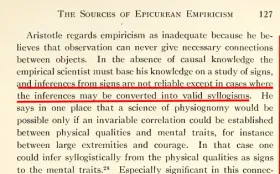
    This part too sounds very much like Philodemus is addressing in On Signs. If the emphasis is on "logical reason" then I think I can see my way to agreeing to these sentences, but at least in the past my reading of Philodemus is that he has been insisting on the senses as the test, not "logical reason."

    Here's a clip from the Delacy commentary of On Signs that I've used many times before:


    This "not reliable except in cases where the inferences may be converted into valid syllogisms" sounds a iot like - or related to - "All evident knowledge must be reducible to the principle of non-contradiction." (Which I gather Delacy is saying is not the Philodemus/Epicurean position.)

Resources

  1. Getting Started At EpicureanFriends
  2. Community Standards And Posting Policies
  3. The Major Doctrines of Classical Epicurean Philosophy
  4. Introductory Videos
  5. Lexicon
  6. Lucretius Today Podcast
    1. Podcast Episode Guide
  7. Key Epicurean Texts
    1. Chart Of Key Quotes
    2. Outline Of Key Quotes
    3. Side-By-Side Diogenes Laertius X (Bio And All Key Writings of Epicurus)
    4. Side-By-Side Lucretius - On The Nature Of Things
    5. Side-By-Side Torquatus On Ethics
    6. Side-By-Side Velleius on Divinity
    7. Lucretius Topical Outline
    8. Usener Fragment Collection
  8. Frequently Asked Questions
    1. FAQ Discussions
  9. Full List of Forums
    1. Physics Discussions
    2. Canonics Discussions
    3. Ethics Discussions
    4. All Recent Forum Activities
  10. Image Gallery
  11. Featured Articles
  12. Featured Blog Posts
  13. Quiz Section
  14. Special Resource Pages
  15. File Database
  16. Site Map
    1. Home

Frequently Used Forums

  • Frequently Asked / Introductory Questions
  • News And Announcements
  • Lucretius Today Podcast
  • Physics (The Nature of the Universe)
  • Canonics (The Tests Of Truth)
  • Ethics (How To Live)
  • Against Determinism
  • Against Skepticism
  • The "Meaning of Life" Question
  • Uncategorized Discussion
  • Comparisons With Other Philosophies
  • Historical Figures
  • Ancient Writers and Texts
  • Decline of The Ancient Epicurean Age
  • Unsolved Questions of Epicurean History
  • Welcome New Participants
  • Events - Activism - Outreach
  • Full Forum List

Latest Posts

  1. Atomism on Trial: The Condemnation of Nicholas of Autrecourt

    Cassius
    November 25, 2026 at 8:10 AM
  2. PD05 - The place of the word καλός elsewhere in the extant writings

    Cassius
    November 24, 2026 at 6:20 PM
  3. Why do we study Epicurean physics instead of normal physics?

    Cassius
    November 24, 2026 at 3:10 PM
  4. Updates To Participation Level Designations

    Cassius
    November 23, 2026 at 10:38 AM
  5. Welcome DevinH!

    Cassius
    November 23, 2026 at 8:32 AM
  6. Welcome Demstar555!

    DevinH
    November 23, 2026 at 12:33 AM
  7. Episode 361 - EATAQ43 - Continuing in Part 22 of Book 2 of Academic Questions - Not Yet Recorded

    Cassius
    November 22, 2026 at 2:32 AM
  8. The Drowning Men And Blind Puppies Test - Which Of The Following Is The Right Answer According To Epicurus?

    Cassius
    November 21, 2026 at 2:50 PM
  9. Discussion of Article - "One Wise Man Is Not Wiser Than Another: What Epicurus' Saying Tells Us About Pleasure, Happiness, And How We Know What Is Real"

    Cassius
    November 21, 2026 at 2:43 PM
  10. Catius' Cat Website / Poems / Videos

    Kalosyni
    November 21, 2026 at 7:34 AM

Frequently Used Tags

In addition to posting in the appropriate forums, participants are encouraged to reference the following tags in their posts:

  • #Physics
    • #Atomism
    • #Gods
    • #Images
    • #Infinity
    • #Eternity
    • #Life
    • #Death
  • #Canonics
    • #Knowledge
    • #Scepticism
  • #Ethics

    • #Pleasure
    • #Pain
    • #Engagement
    • #EpicureanLiving
    • #Happiness
    • #Virtue
      • #Wisdom
      • #Temperance
      • #Courage
      • #Justice
      • #Honesty
      • #Faith (Confidence)
      • #Suavity
      • #Consideration
      • #Hope
      • #Gratitude
      • #Friendship


Click Here To Search All Tags

To Suggest Additions To This List Click Here

EpicureanFriends - Classical Epicurean Philosophy

  1. Home
    1. About Us
    2. Classical Epicurean Philosophy
    3. Rules, Terms & Policies
  2. Lexicon
    1. Getting Started
  3. Frequently Asked Questions
    1. Site Map
  4. Forum
    1. Latest Threads
    2. Featured Threads
    3. Unread Posts
  5. Texts
    1. Core Texts
    2. Biography of Epicurus
    3. Lucretius
  6. Articles
    1. Latest Articles
  7. Gallery
    1. Featured Images
  8. Calendar
    1. This Month At EpicureanFriends
Powered by WoltLab Suite™ 6.2.9
Style: Inspire by cls-design
Stylename
Inspire
Manufacturer
cls-design
Licence
Commercial styles
Help
Supportforum
Visit cls-design