


1. Home
    1. Study Guide
    2. Community Standards
    3. Site Map
    4. Quizzes
    5. Articles On Physics
    6. Articles On Canonics
    7. Articles On Ethics
    8. All Articles
    9. Elli's Blog Posts
    10. Kalosyni's Blog
    11. All Blog Posts
  2. Lexicon
    1. Lexicon Home
    2. FAQ
    3. Files
    4. Search Assistance
    5. Foundations
    6. Navigation Outlines
    7. Reading List
    8. Key Pages
    9. Last Changes
  3. Forum
    1. Full Forum List
    2. Welcome Threads
    3. Ancient Texts Forum
    4. Physics
    5. Canonics
    6. Ethics
    7. Forum Shortcuts
    8. Forum Navigation Map
    9. Featured
    10. Most Discussed
  4. Latest
    1. New Activity
    2. Latest Threads
    3. Dashboard
    4. Search By Tag
    5. Complete Tag List
  5. Podcast
    1. Lucretius Today Podcast
    2. Episode Guide
    3. Lucretius Today At Youtube
    4. EpicureanFriends Youtube Page
  6. Texts
    1. Overview
    2. Torquatus On Ethics
    3. Velleius On Divinity
    4. Diogenes Laertius
    5. Principal Doctrines
    6. Vatican Collection
    7. Lucretius
    8. Herodotus
    9. Pythocles
    10. Menoeceus
    11. Fragments - Usener Collection
    12. Greek/Latin Help
  7. Gallery
    1. Latest Images
    2. Featured images
    3. Latest Comments
  8. More
    1. Featured Content
    2. Logbook
    3. EF ToDo List
  • Login
  • Register
  • Search
This Thread
  • Everywhere
  • This Thread
  • This Forum
  • Forum
  • Articles
  • Blog Articles
  • Files
  • Gallery
  • Pages
  • Wiki
  • FAQ
  • More Options
  1. EpicureanFriends - Classical Epicurean Philosophy
  2. Forum
  3. The Lucretius Today Podcast and EpicureanFriends Videos
  4. The Lucretius Today Podcast

Episode 359 - EATAQ41 - Cicero Begins His Defense of Academic Skepticism

  • Cassius
  • November 6, 2026 at 4:02 PM
  • Go to last post
  • Cassius
    5 - Administrator
    • I Too Am An Epicurean
    • Advocate
    • Lucretius Today Podcast Co-Host
    • 2025 Contributor
    • Active Member 5 Years or more
    Points
    115,820
    Posts
    15,957
    Quizzes
    9
    Quiz rate
    100.0 %
    • November 6, 2026 at 4:02 PM
    • #1

    Welcome to Episode 359 of Lucretius Today. This is a podcast dedicated to the poet Lucretius, who wrote "On The Nature of Things," the most complete presentation of Epicurean philosophy left to us from the ancient world. Each week we walk you through the Epicurean texts, and we discuss how Epicurean philosophy can apply to you today. If you find the Epicurean worldview attractive, we invite you to join us in the study of Epicurus at EpicureanFriends.com, where we discuss this and all of our podcast episodes.

    This week we are continuing our series reviewing Cicero's "Academic Questions" from an Epicurean perspective, which gives us an overview of the issues that split Plato's Academy and helps us understand Epicurus' position on the same issues. This week will continue in Section 20 of Book 2, where we are now seeing Cicero argue on behalf of skepticism, and we will be interjecting Epicurean responses.

    Our text will come from
    Cicero - Academic Questions - Yonge We'll likely stick with Yonge primarily, but we'll also refer to the Rackham translation here: Cicero On Nature Of Gods Academica Loeb Rackham : Free Download, Borrow, and Streaming : Internet Archive

    As we proceed through the end of Academic Questions, these are the topics we expect to cover:

    24. Lucullus's Extended Rebuttal of the Academic Doctrine, and His Concluding Appeal to Cicero (2:XIII)
    25. Cicero Begins His Reply (2:XX)
    26. Cicero Lays Out the Syllogism About Assent and Opinion (2:XXI)
    27. Cicero Turns to Antiochus's Own Inconsistency (2:XXII)
    28. Cicero Defends His Citation of the Ancient Philosophers (2:XXIII)
    29. Cicero Adds Chrysippus and the Cyrenaics, Then Returns to Arcesilas and Zeno (2:XXIV)
    30. Cicero Returns to Attacking the Senses (2:XXV)
    31. Cicero Presses the Sun's Size and the Limits of Trained Perception (2:XXVI)
    32. Cicero Turns the "Art" Argument Back on Lucullus (2:XXVII)
    33. Cicero Multiplies Examples From Madness (2:XXVIII)
    34. Cicero Attacks Reason and Dialectics: The Sorites Paradox (2:XXIX)
    35. Cicero Presses the Liar Paradox (2:XXX)
    36. Cicero Presents Carneades's Own Positive Doctrine of Probability (2:XXXI)
    37. Cicero Distinguishes the Academic Position From Epicurus's (2:XXXII)
    38. Cicero Defends Probability Against the Charge That It Cannot Support Memory or Action (2:XXXIII)
    39. Cicero Answers the "Self-Refuting" and "Two Incompatible Propositions" Objections (2:XXXIV)
    40. Cicero Broadens the Argument Beyond the Stoics (2:XXXV)
    41. Cicero Reflects on His Own Position Among the Competing Schools (2:XXXVI)
    42. Cicero's Survey of Disagreement Among the Natural Philosophers (2:XXXVII)
    43. Cicero Presses the Problem of Providence and the Limits of Physics (2:XXXVIII)
    44. Cicero's Survey Continues: The Soul, the Antipodes, and the Motion of the Earth (2:XXXIX)
    45. Cicero Asks Which Natural Philosopher He Would Even Choose to Follow (2:XL)
    46. Cicero Turns to Ethics: Even the Gods Are Disputed (2:XLI)
    47. Cicero's Roll Call of Rival Schools on the Chief Good, Part One (2:XLII)
    48. Cicero's Roll Call of Rival Schools on the Chief Good, Part Two (2:XLIII)
    49. Cicero Weighs Zeno Against Antiochus on Virtue and the Happy Life (2:XLIV)
    50. Cicero Catalogs the Stoic Paradoxes About the Wise Man (2:XLV)
    51. Cicero's Climactic Debate Between Pleasure and Honor (2:XLVI)
    52. Cicero Turns to the Canon of Truth, and Zeno's Hand (2:XLVII)
    53. The Dialogue's Close (2:XLVIII)
  • Cassius
    5 - Administrator
    • I Too Am An Epicurean
    • Advocate
    • Lucretius Today Podcast Co-Host
    • 2025 Contributor
    • Active Member 5 Years or more
    Points
    115,820
    Posts
    15,957
    Quizzes
    9
    Quiz rate
    100.0 %
    • November 9, 2026 at 4:20 PM
    • #2

    One of the issue we came across in this Episode was the Cicero stating early in his own defense of Academic Skepticism that he himself was "not a wise man." (See quote below)

    Combined with other statements we've come across already, and more we expect to confront, it's pretty clear that the question of "whether knowledge is possible" is closely related to the question of the existence of a wisdom - or of the wise man. Socrates of course said something to the effect that he was the wisest of men because he knew that he knew nothing. Does that mean Socrates, or the god, held Socrates to be a wise man? Likewise it appears that the Stoics held that the wise man can know truth, but that wise men as as rare as phoenixes. I also think I recall from Tusculan Disputations or On Ends that Cicero criticized Epicurus (or his followers) for holding Epicurus to be a wise man.

    So the question of whether someone is "wise" or "a wise man" appears to be very close to a term of art in this debate about knowledge.

    At this point I haven't found it yet but it will be worth pinning this down if possible. Do we have direct quotes stating that Epicurus was "wise" or "a wise man," or that in distinction with Socrates Epicurus "knows" the things he teaches as true? If so that will fit into the reconstruction of how the Epicureans themselves spoke about this question of the possibility of knowledge.

    Quote from Cicero - Academic Questions - Section XX

    But I myself am very apt to adopt opinions, for I am not a wise man, and I direct my thoughts, steering not to that little Cynosura,

    The nightly star, which shining not in vain,

    Guides the Phœnician sailor o’er the main,

    as Aratus says; — and those mariners steer in a more direct course because they keep looking at the constellation,

    Which in its inner course and orbit brief

    Surely revolves; —

    but looking rather towards Helice, and the bright north star, that is to say, to these reasons of a more expansive kind, not polished away to a point; and therefore I roam and wander about in a freer course. However, the question, as I said just now, is not about myself, but about a wise man.

    Display More


    In this quote above I left in this elaborate analogy or illustration of choosing to navigate by the North Star verses CIcero saying that he is better off navigating by a more expansive view.

    We (Joshua) addressed this in the podcast that will be out later this week, but the allegory is deep and probably also deserves a lot more development. Presumably Cicero is saying that he does not accept that the North Star truly reflects a fixed point by which to navigate, but if he can't be sure of that why would he think it makes sense to pick a wider constellation that roams and is much more difficult to pin down? Joshua picks out details of the story of the nurses of Zeus for whom the stars are named, and I suspect there is more to that story as to why one of the nurses seems the most reliable while the other nurse roamed about.

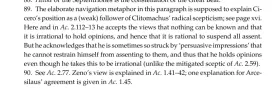
    All Brittain says is:

  • Cassius November 9, 2026 at 4:23 PM

    Changed the title of the thread from “Episode 359 - EATAQ41 - Continuing in Part 20 of Book 2 of Academic Questions - Not Yet Recorded” to “Episode 359 - EATAQ41 - Cicero Begins His Defense of Academic Skepticism”.
  • Joshua
    5 - Administrator
    • Advocate
    • Lucretius Today Podcast Co-Host
    • 2025 Contributor
    • Active Member 5 Years or more
    Points
    15,627
    Posts
    2,013
    Quizzes
    3
    Quiz rate
    95.8 %
    • November 9, 2026 at 6:42 PM
    • #3

    Cicero's metaphor invites us to undertake a fascinating literary and mythological journey, and we should begin by noticing that Cicero is quoting from his own partially-extant Latin translation of the Phenomena, a poem by the third-century Greek didactic poet Aratus:

    Quote

    The earliest translation of Aratus in Rome is much better preserved; it was made by Cicero, the most important Roman orator and also a distinguished politician during the time of the civil wars. Cicero also wrote many works on philosophical subjects and some poetry; of his translation of Aratus, which he composed when he was young in ca. 90-89 BCE, only 480 lines (corresponding to Aratus, Phaen. 229-701) are preserved by the manuscript tradition; we also have additional 73 lines (of which 8 are incomplete hexameters) in 34 fragments quoted by Cicero himself in his own other works (esp. De natura deorum).

    -Cicero's Aratea, Early Astronomy in the University of Michigan Collections

    In the three or four lines of this poem quoted by Cicero in section twenty of Academica book two, he abjures the method of the 'Phoenician Sailor', a somewhat odd thing to do given that Carthage, a Phoenician settlement, was the reigning sea power in the Mediterranean until the Punic wars. Presumably their methods of maritime navigation were good. However, Cicero had already confessed to the following view:

    Quote

    "although I consider to see the truth a most beautiful thing, so also do I think it a most disgraceful one to approve of what is false as if it were true."

    He denounces the method of the Phoenicians, perhaps not because it is faulty, but because he cannot prove that it is not faulty, and to err in such a case by staking out a position would be disgraceful. Did it not bother him that (according to Polybius) the Romans did not even have a wartime navy until they discovered and reverse-engineered a Phoenician warship? More on that here.

    Display Spoiler
    Quote

    "It was, then, because they saw that the war they had undertaken lingered to a weary length, that they first thought of getting a fleet built, consisting of a hundred quinqueremes and twenty triremes. But one part of their undertaking caused them much difficulty. Their shipbuilders were entirely unacquainted with the construction of quinqueremes, because no one in Italy had at that time employed vessels of that description. There could be no more signal proof of the courage, or rather the extraordinary audacity of the Roman enterprise. Not only had they no resources for it of reasonable sufficiency; but without any resources for it at all, and without having ever entertained an idea of naval war,—for it was the first time they had thought of it,—they nevertheless handled the enterprise with such extraordinary audacity, that, without so much as a preliminary trial, they took upon themselves there and then to meet the Carthaginians at sea, on which they had for generations held undisputed supremacy. Proof of what I say, and of their surprising audacity, may be found in this. When they first took in hand to send troops across to Messene they not only had no decked vessels but no war-ships at all, not so much as a single galley: but they borrowed quinqueremes and triremes from Tarentum and Locri, and even from Elea and Neapolis; and having thus collected a fleet, boldly sent their men across upon it. It was on this occasion that, the Carthaginians having put to sea in the Strait to attack them, a decked vessel of theirs charged so furiously that it ran aground, and falling into the hands of the Romans served them as a model on which they constructed their whole fleet. And if this had not happened it is clear that they would have been completely hindered from carrying out their design by want of constructive knowledge."

    Now in the poem, the Phoenician is guided by 'The nightly star, which shining not in vain', and this star (in the constellation Cynosura, the dog's tail, or, as we now call it, Ursa Minor, the little bear) must be the North Star, Polaris. Cicero announces that his preference is to take a more expansive view, and navigate by Helice, now Ursa Major, the big bear, and 'the bright north star'; "that is to say, to these reasons of a more expansive kind, not polished away to a point."

    To which star is he referring when he says 'the bright north star'? I originally took this to mean Polaris, but now I think he means a star even brighter than Polaris, and one that is to be found in Ursa Major: that star is Alioth.

    Setting aside the mythological references, Cicero seems to be saying that it would actually be better to take the area of the circle circumscribed by Alioth as probably containing the reference point for true north, rather than pointing directly to Polaris, which lies not truly north, but which is close enough for navigation.

    I think I handled the mythology well enough on the recording, so I won't commit to writing that up just yet.

    _____________________

    Quote

    Who can doubt that poetry will revive and lead in a new age, as the star1 in the constellation Harp, which now flames in our zenith, astronomers announce, shall one day be the pole-star for a thousand years?

    -Ralph Waldo Emerson, The American Scholar

    1 Vega, a star which today passes overhead in the Northern Hemisphere. Due to Earth's axial precession, Vega will be the northern pole star 11,700 years from now, as it was 14,000 years ago.

Resources

  1. Getting Started At EpicureanFriends
  2. Community Standards And Posting Policies
  3. The Major Doctrines of Classical Epicurean Philosophy
  4. Introductory Videos
  5. Lexicon
  6. Lucretius Today Podcast
    1. Podcast Episode Guide
  7. Key Epicurean Texts
    1. Chart Of Key Quotes
    2. Outline Of Key Quotes
    3. Side-By-Side Diogenes Laertius X (Bio And All Key Writings of Epicurus)
    4. Side-By-Side Lucretius - On The Nature Of Things
    5. Side-By-Side Torquatus On Ethics
    6. Side-By-Side Velleius on Divinity
    7. Lucretius Topical Outline
    8. Usener Fragment Collection
  8. Frequently Asked Questions
    1. FAQ Discussions
  9. Full List of Forums
    1. Physics Discussions
    2. Canonics Discussions
    3. Ethics Discussions
    4. All Recent Forum Activities
  10. Image Gallery
  11. Featured Articles
  12. Featured Blog Posts
  13. Quiz Section
  14. Special Resource Pages
  15. File Database
  16. Site Map
    1. Home

Frequently Used Forums

  • Frequently Asked / Introductory Questions
  • News And Announcements
  • Lucretius Today Podcast
  • Physics (The Nature of the Universe)
  • Canonics (The Tests Of Truth)
  • Ethics (How To Live)
  • Against Determinism
  • Against Skepticism
  • The "Meaning of Life" Question
  • Uncategorized Discussion
  • Comparisons With Other Philosophies
  • Historical Figures
  • Ancient Writers and Texts
  • Decline of The Ancient Epicurean Age
  • Unsolved Questions of Epicurean History
  • Welcome New Participants
  • Events - Activism - Outreach
  • Full Forum List

Latest Posts

  1. Episode 359 - EATAQ41 - Cicero Begins His Defense of Academic Skepticism

    Joshua
    November 9, 2026 at 6:42 PM
  2. Under What Circumstances, If Any, Would An Epicurean Choose A Course That Produced (For Example) 98% Pleasure And 2% Pain Over A Course That Was 100% Pleasure and 0% Pain?

    Cassius
    November 9, 2026 at 1:52 PM
  3. Welcome DevinH!

    Godfrey
    November 8, 2026 at 6:52 PM
  4. Using AI to create flow charts of Lucretius' De Rerum Natura

    Cassius
    November 7, 2026 at 3:41 PM
  5. Does Self-Determination Theory Fit in With Epicurean Philosophy?

    Cassius
    November 7, 2026 at 3:34 PM
  6. Episode 358 - EATAQ40 - The Hypocrisy And Darkness of Academic Skepticism

    Cassius
    November 6, 2026 at 4:00 PM
  7. Music and Auditory Pleasure and Neuroscience - transcript of interview

    Kalosyni
    November 4, 2026 at 1:31 PM
  8. Welcome Thomas Karion!

    Kalosyni
    November 3, 2026 at 10:10 AM
  9. Should Epicureans Celebrate Something Else Instead of Celebrating Halloween?

    Cassius
    November 3, 2026 at 9:36 AM
  10. Happy Halloween 2026 - Death is Nothing to Us!

    Joshua
    November 1, 2026 at 11:42 AM

Frequently Used Tags

In addition to posting in the appropriate forums, participants are encouraged to reference the following tags in their posts:

  • #Physics
    • #Atomism
    • #Gods
    • #Images
    • #Infinity
    • #Eternity
    • #Life
    • #Death
  • #Canonics
    • #Knowledge
    • #Scepticism
  • #Ethics

    • #Pleasure
    • #Pain
    • #Engagement
    • #EpicureanLiving
    • #Happiness
    • #Virtue
      • #Wisdom
      • #Temperance
      • #Courage
      • #Justice
      • #Honesty
      • #Faith (Confidence)
      • #Suavity
      • #Consideration
      • #Hope
      • #Gratitude
      • #Friendship


Click Here To Search All Tags

To Suggest Additions To This List Click Here

EpicureanFriends - Classical Epicurean Philosophy

  1. Home
    1. About Us
    2. Classical Epicurean Philosophy
    3. Rules, Terms & Policies
  2. Lexicon
    1. Getting Started
  3. Frequently Asked Questions
    1. Site Map
  4. Forum
    1. Latest Threads
    2. Featured Threads
    3. Unread Posts
  5. Texts
    1. Core Texts
    2. Biography of Epicurus
    3. Lucretius
  6. Articles
    1. Latest Articles
  7. Gallery
    1. Featured Images
  8. Calendar
    1. This Month At EpicureanFriends
Powered by WoltLab Suite™ 6.2.9
Style: Inspire by cls-design
Stylename
Inspire
Manufacturer
cls-design
Licence
Commercial styles
Help
Supportforum
Visit cls-design