


1. Home
    1. Study Guide
    2. Community Standards
    3. Site Map
    4. Quizzes
    5. Articles On Physics
    6. Articles On Canonics
    7. Articles On Ethics
    8. All Articles
    9. Elli's Blog Posts
    10. Kalosyni's Blog
    11. All Blog Posts
  2. Lexicon
    1. Lexicon Home
    2. FAQ
    3. Files
    4. Search Assistance
    5. Foundations
    6. Navigation Outlines
    7. Reading List
    8. Key Pages
    9. Last Changes
  3. Forum
    1. Full Forum List
    2. Welcome Threads
    3. Ancient Texts Forum
    4. Physics
    5. Canonics
    6. Ethics
    7. Forum Shortcuts
    8. Forum Navigation Map
    9. Featured
    10. Most Discussed
  4. Latest
    1. New Activity
    2. Latest Threads
    3. Dashboard
    4. Search By Tag
    5. Complete Tag List
  5. Podcast
    1. Lucretius Today Podcast
    2. Episode Guide
    3. Lucretius Today At Youtube
    4. EpicureanFriends Youtube Page
  6. Texts
    1. Overview
    2. Torquatus On Ethics
    3. Velleius On Divinity
    4. Diogenes Laertius
    5. Principal Doctrines
    6. Vatican Collection
    7. Lucretius
    8. Herodotus
    9. Pythocles
    10. Menoeceus
    11. Fragments - Usener Collection
    12. Greek/Latin Help
  7. Gallery
    1. Latest Images
    2. Featured images
    3. Latest Comments
  8. More
    1. Featured Content
    2. Logbook
    3. EF ToDo List
  • Login
  • Register
  • Search
This Thread
  • Everywhere
  • This Thread
  • This Forum
  • Forum
  • Articles
  • Blog Articles
  • Files
  • Gallery
  • Pages
  • Wiki
  • FAQ
  • More Options
  1. EpicureanFriends - Classical Epicurean Philosophy
  2. Forum
  3. Historical Events, Places, & Culture
  4. Culture & Customs

What Happened at an Epicurean Symposium?

  • Kalosyni
  • September 19, 2026 at 7:28 PM
  • Go to last post
  • Kalosyni
    Student of the Kepos
    • Advocate
    • Lucretius Today Podcast Co-Host
    • 2025 Contributor
    • Active Member 5 Years or more
    Points
    22,086
    Posts
    2,683
    Quizzes
    2
    Quiz rate
    90.9 %
    • September 19, 2026 at 7:28 PM
    • #1

    Here and there, I've done research on the ancient Greek symposium, and since we would guess that Epicureans were prudent and serious-minded folk, then we could speculate that they made sure to dilute their wine sufficiently, and thereby allow the philosophical discourse to continue longer into the evening.

    As for research, found this but access requires purchase:

    Chapter 9 The Hellenistic Symposium as Feast

    https://brill.com/edcollbook/title/35911

    Quote

    This paper will focus on drinking and dining at Athens using ceramic evidence from the excavations of the Athenian Agora to explore the shift from wine-soaked Archaic and Classical symposia to food-rich Hellenistic banquets and possible explanations for the change.

    (A lot more to discover and post in the future).
  • Cassius
    5 - Administrator
    • I Too Am An Epicurean
    • Advocate
    • Lucretius Today Podcast Co-Host
    • 2025 Contributor
    • Active Member 5 Years or more
    Points
    115,668
    Posts
    15,932
    Quizzes
    9
    Quiz rate
    100.0 %
    • September 19, 2026 at 7:43 PM
    • #2
    Quote from Kalosyni

    and since we would guess that Epicureans were prudent and serious-minded folk

    All of the time?

  • Kalosyni
    Student of the Kepos
    • Advocate
    • Lucretius Today Podcast Co-Host
    • 2025 Contributor
    • Active Member 5 Years or more
    Points
    22,086
    Posts
    2,683
    Quizzes
    2
    Quiz rate
    90.9 %
    • September 21, 2026 at 2:21 PM
    • #3

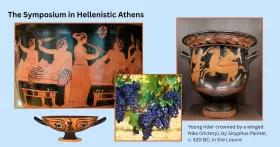
    At yesterday's Twentieth Zoom, I gave a short presentation on aspects of the symposium, and this was a slide, with further info.

    We don't know exactly what occurred at historical Twentieth gatherings...but here is some speculation:

    There was either a large gathering at the Kepos gardens (perhaps no more than 50 people, and not as a "symposium") and/or there were small gatherings at various private homes which may have been up to 12 attendees plus their hetairai (female companions, as was the ancient Greek custom) and which followed the cultural format of a symposium.

    Here is a bit more from yesterday's presentation:

    Written records and literary accounts of symposia in Hellenistic Athens do exist, though they are largely fragmentary and frequently preserved as quotes within later Roman-era texts. While the most famous complete accounts of the Athenian symposium come from the Classical period (most notably the works of Plato and Xenophon), prominent Hellenistic philosophers, playwrights, and historians continued to write about and record the evolving nature of these drinking parties in Athens.


    The Fragmentary Symposium of Epicurus: The most notable native written record from Hellenistic Athens is the lost Symposium written by the philosopher Epicurus. While the original text has not survived intact, extensive fragments and descriptions are preserved by later authors:

    • Athenaeus of Naucratis provides critical commentary on Epicurus' work in his encyclopedic text, the Deipnosophistae ("Doctors at Dinner"). Athenaeus notes that Epicurus broke traditional conventions by featuring a dialogue composed entirely of philosophers (pejoratively dubbed "atom prophets") and skipping traditional structural preliminaries like formal libations to the gods.

    • Plutarch also explicitly references Epicurus' Symposium, noting that the dialogue moved away from political theory to debate the physiological and scientific effects of wine and sex.

    Kraters were central to the symposium both literally and culturally. The Krater or "mixing bowl," used for mixing wine and water, was placed at the center of the room. The Symposiasts, or the participants, reclined on their couches around the krater. Their couches were placed along the wall of the room, and this limited the number of men attending to between eight and twelve. Tables on which the wine and food was served, were slightly lower and placed in front of the couches.
    The symposiarch would oversee the symposium. The main focus of his job was the dilution of the wine. It was up to him to decide how strong the wine would be depending on the type of discussion or entertainment that was expected for the evening Kraters were quite large, so they were not easily portable when filled. Thus, the wine-water mixture would be withdrawn from the krater with other vessels, such as a kyathos, an amphoreus, or a kylix.

    Before dilution, wine in ancient Athens typically had an alcohol content of 9% to 15% ABV (alcohol by volume), though some sweet or concentrated varieties could reach up to 16% to 18% ABV.
    Dilution and Consumption • Ancient Athenians almost never drank wine neat. Drinking unadulterated wine was considered a barbaric habit fit only for ruining one's mind or health. Wine was mixed with water in a large vessel called a krater before being served.

    • Common Ratios: Typical mixing ratios ranged from 3 parts water to 1 part wine (3:1) to 5 parts water to 2 parts wine (5:2).

    • Final Alcohol Strength: This heavy watering-down meant the actual cup of liquid consumed during a symposium or meal had a much lower alcohol content, usually resting around 2% to 5% ABV- similar to a modern light beer or cider.

    • Athenians enhanced their wine to balance or mask off-tasting flavors, using three primary methods: Infusion during fermentation - herbs like thyme, oregano, or mint were bundled into porous linen cloths, weighted down, and submerged in the grape must. Amphora linings and sealants of sticky pine resin from the Aleppo pine were used. And when needed they also added fresh herbs or floral perfumes directly into the krater shortly before consumption.

Resources

  1. Getting Started At EpicureanFriends
  2. Community Standards And Posting Policies
  3. The Major Doctrines of Classical Epicurean Philosophy
  4. Introductory Videos
  5. Lexicon
  6. Lucretius Today Podcast
    1. Podcast Episode Guide
  7. Key Epicurean Texts
    1. Chart Of Key Quotes
    2. Outline Of Key Quotes
    3. Side-By-Side Diogenes Laertius X (Bio And All Key Writings of Epicurus)
    4. Side-By-Side Lucretius - On The Nature Of Things
    5. Side-By-Side Torquatus On Ethics
    6. Side-By-Side Velleius on Divinity
    7. Lucretius Topical Outline
    8. Usener Fragment Collection
  8. Frequently Asked Questions
    1. FAQ Discussions
  9. Full List of Forums
    1. Physics Discussions
    2. Canonics Discussions
    3. Ethics Discussions
    4. All Recent Forum Activities
  10. Image Gallery
  11. Featured Articles
  12. Featured Blog Posts
  13. Quiz Section
  14. Special Resource Pages
  15. File Database
  16. Site Map
    1. Home

Frequently Used Forums

  • Frequently Asked / Introductory Questions
  • News And Announcements
  • Lucretius Today Podcast
  • Physics (The Nature of the Universe)
  • Canonics (The Tests Of Truth)
  • Ethics (How To Live)
  • Against Determinism
  • Against Skepticism
  • The "Meaning of Life" Question
  • Uncategorized Discussion
  • Comparisons With Other Philosophies
  • Historical Figures
  • Ancient Writers and Texts
  • Decline of The Ancient Epicurean Age
  • Unsolved Questions of Epicurean History
  • Welcome New Participants
  • Events - Activism - Outreach
  • Full Forum List

Latest Posts

  1. Happy Halloween 2026 - Death is Nothing to Us!

    Joshua
    November 1, 2026 at 11:42 AM
  2. Episode 358 - EATAQ40 - Continuing in Part 18 of Book 2 of Academic Questions

    Cassius
    November 1, 2026 at 6:14 AM
  3. Episode 357 - EATAQ39 - A Brief Word On Sextus Empiricus And The Goal of Skepticism

    Cassius
    October 31, 2026 at 3:46 PM
  4. Welcome Thomas Karion!

    Cassius
    October 31, 2026 at 10:04 AM
  5. Discussion of Article - "Aristotle - Introduction From An Epicurean Perspective"

    Cassius
    October 28, 2026 at 7:49 PM
  6. Discussion of Article - "Sextus Empiricus - Introduction From An Epicurean Perspective"

    Pacatus
    October 26, 2026 at 6:06 PM
  7. Heads up: New Book Coming in 2027

    Cassius
    October 26, 2026 at 4:29 PM
  8. Do some people still believe in fate?

    Kalosyni
    October 26, 2026 at 9:27 AM
  9. David Sedley - "Creationism And Its Critics In Antiquity"

    Cassius
    October 26, 2026 at 6:24 AM
  10. Turning to Religion to Make AI Morally Good (Comparing this to Epicurean Philosophy)

    Kalosyni
    October 25, 2026 at 8:07 AM

Frequently Used Tags

In addition to posting in the appropriate forums, participants are encouraged to reference the following tags in their posts:

  • #Physics
    • #Atomism
    • #Gods
    • #Images
    • #Infinity
    • #Eternity
    • #Life
    • #Death
  • #Canonics
    • #Knowledge
    • #Scepticism
  • #Ethics

    • #Pleasure
    • #Pain
    • #Engagement
    • #EpicureanLiving
    • #Happiness
    • #Virtue
      • #Wisdom
      • #Temperance
      • #Courage
      • #Justice
      • #Honesty
      • #Faith (Confidence)
      • #Suavity
      • #Consideration
      • #Hope
      • #Gratitude
      • #Friendship


Click Here To Search All Tags

To Suggest Additions To This List Click Here

Similar Threads

  • Revisiting Issues of The Use of AI in Epicurean Philosophy

    • TauPhi
    • March 24, 2026 at 9:26 PM
    • Artificial Intelligence and Epicurean Philosophy
  • Velleius - Epicurus On The True Nature Of Divinity - New Home Page Video

    • Cassius
    • October 29, 2025 at 7:17 PM
    • News And Forum Updates

EpicureanFriends - Classical Epicurean Philosophy

  1. Home
    1. About Us
    2. Classical Epicurean Philosophy
    3. Rules, Terms & Policies
  2. Lexicon
    1. Getting Started
  3. Frequently Asked Questions
    1. Site Map
  4. Forum
    1. Latest Threads
    2. Featured Threads
    3. Unread Posts
  5. Texts
    1. Core Texts
    2. Biography of Epicurus
    3. Lucretius
  6. Articles
    1. Latest Articles
  7. Gallery
    1. Featured Images
  8. Calendar
    1. This Month At EpicureanFriends
Powered by WoltLab Suite™ 6.2.8
Style: Inspire by cls-design
Stylename
Inspire
Manufacturer
cls-design
Licence
Commercial styles
Help
Supportforum
Visit cls-design
