
1. Home
    1. Start Here: Study Guide
    2. Community Standards And Posting Policies
    3. Terms of Use
    4. Moderator Team
    5. Website Overview
    6. Site Map
    7. Quizzes
    8. Articles
      1. Featured Articles
    9. All Blog Posts
      1. Elli's Blog / Articles
  2. Wiki
    1. Wiki Home
    2. FAQ
    3. Classical Epicureanism
    4. Files
    5. Search Assistance
    6. Not NeoEpicurean
    7. Foundations
    8. Navigation Outlines
    9. Reading List
    10. Key Pages
  3. Forum
    1. Full Forum List
    2. Welcome Threads
    3. Physics
    4. Canonics
    5. Ethics
    6. Forum Shortcuts
    7. Forum Navigation Map
    8. Featured
    9. Most Discussed
  4. Latest
    1. New Activity
    2. Latest Threads
    3. Dashboard
    4. Search By Tag
    5. Complete Tag List
  5. Podcast
    1. Lucretius Today Podcast
    2. Episode Guide
    3. Lucretius Today At Youtube
    4. EpicureanFriends Youtube Page
  6. Texts
    1. Overview
    2. Diogenes Laertius
    3. Principal Doctrines
    4. Vatican Collection
    5. Lucretius
    6. Herodotus
    7. Pythocles
    8. Menoeceus
    9. Fragments - Usener Collection
    10. Torquatus On Ethics
    11. Velleius On Gods
    12. Greek/Latin Help
  7. Gallery
    1. Featured images
    2. Albums
    3. Latest Images
    4. Latest Comments
  8. More
    1. Featured Content
    2. Calendar
      1. Upcoming Events List
      2. Zooms - General Info
      3. Fourth Sunday Meet-&-Greet
      4. Sunday Weekly Zoom
      5. Wednesday Zoom Meeting
    3. Logbook
    4. EF ToDo List
    5. Link-Database
  • Login
  • Register
  • Search
This Thread
  • Everywhere
  • This Thread
  • This Forum
  • Forum
  • Articles
  • Blog Articles
  • Files
  • Gallery
  • Events
  • Pages
  • Wiki
  • Help
  • FAQ
  • More Options

Welcome To EpicureanFriends.com!

"If anyone thinks that he knows nothing, he cannot be sure that he knows this, when he confesses that he knows nothing at all. I shall avoid disputing with such a trifler, who perverts all things, and like a tumbler with his head prone to the earth, can go no otherwise than backwards." (Lucretius 4:469)

Sign In Now
or
Register a new account
  1. Home
    1. Start Here: Study Guide
    2. Community Standards And Posting Policies
    3. Terms of Use
    4. Moderator Team
    5. Website Overview
    6. Site Map
    7. Quizzes
    8. Articles
      1. Featured Articles
    9. All Blog Posts
      1. Elli's Blog / Articles
  2. Wiki
    1. Wiki Home
    2. FAQ
    3. Classical Epicureanism
    4. Files
    5. Search Assistance
    6. Not NeoEpicurean
    7. Foundations
    8. Navigation Outlines
    9. Reading List
    10. Key Pages
  3. Forum
    1. Full Forum List
    2. Welcome Threads
    3. Physics
    4. Canonics
    5. Ethics
    6. Forum Shortcuts
    7. Forum Navigation Map
    8. Featured
    9. Most Discussed
  4. Latest
    1. New Activity
    2. Latest Threads
    3. Dashboard
    4. Search By Tag
    5. Complete Tag List
  5. Podcast
    1. Lucretius Today Podcast
    2. Episode Guide
    3. Lucretius Today At Youtube
    4. EpicureanFriends Youtube Page
  6. Texts
    1. Overview
    2. Diogenes Laertius
    3. Principal Doctrines
    4. Vatican Collection
    5. Lucretius
    6. Herodotus
    7. Pythocles
    8. Menoeceus
    9. Fragments - Usener Collection
    10. Torquatus On Ethics
    11. Velleius On Gods
    12. Greek/Latin Help
  7. Gallery
    1. Featured images
    2. Albums
    3. Latest Images
    4. Latest Comments
  8. More
    1. Featured Content
    2. Calendar
      1. Upcoming Events List
      2. Zooms - General Info
      3. Fourth Sunday Meet-&-Greet
      4. Sunday Weekly Zoom
      5. Wednesday Zoom Meeting
    3. Logbook
    4. EF ToDo List
    5. Link-Database
  1. Home
    1. Start Here: Study Guide
    2. Community Standards And Posting Policies
    3. Terms of Use
    4. Moderator Team
    5. Website Overview
    6. Site Map
    7. Quizzes
    8. Articles
      1. Featured Articles
    9. All Blog Posts
      1. Elli's Blog / Articles
  2. Wiki
    1. Wiki Home
    2. FAQ
    3. Classical Epicureanism
    4. Files
    5. Search Assistance
    6. Not NeoEpicurean
    7. Foundations
    8. Navigation Outlines
    9. Reading List
    10. Key Pages
  3. Forum
    1. Full Forum List
    2. Welcome Threads
    3. Physics
    4. Canonics
    5. Ethics
    6. Forum Shortcuts
    7. Forum Navigation Map
    8. Featured
    9. Most Discussed
  4. Latest
    1. New Activity
    2. Latest Threads
    3. Dashboard
    4. Search By Tag
    5. Complete Tag List
  5. Podcast
    1. Lucretius Today Podcast
    2. Episode Guide
    3. Lucretius Today At Youtube
    4. EpicureanFriends Youtube Page
  6. Texts
    1. Overview
    2. Diogenes Laertius
    3. Principal Doctrines
    4. Vatican Collection
    5. Lucretius
    6. Herodotus
    7. Pythocles
    8. Menoeceus
    9. Fragments - Usener Collection
    10. Torquatus On Ethics
    11. Velleius On Gods
    12. Greek/Latin Help
  7. Gallery
    1. Featured images
    2. Albums
    3. Latest Images
    4. Latest Comments
  8. More
    1. Featured Content
    2. Calendar
      1. Upcoming Events List
      2. Zooms - General Info
      3. Fourth Sunday Meet-&-Greet
      4. Sunday Weekly Zoom
      5. Wednesday Zoom Meeting
    3. Logbook
    4. EF ToDo List
    5. Link-Database
  1. EpicureanFriends - Classical Epicurean Philosophy
  2. Forum
  3. Canonics - The Tests of Truth
  4. Canonics - General Discussion
  • Sidebar
  • Sidebar

Discussion of Blog Article - "Reality Does Not Require Being Eternally The Same"

  • Cassius
  • March 31, 2026 at 10:27 AM
  • Go to last post

New Graphics: Are You On Team Epicurus? | Comparison Chart: Epicurus vs. Other Philosophies | Chart Of Key Epicurean Quotations | Note to all users: If you have a problem posting in any forum, please message Cassius  

  • Online
    Cassius
    05 - Administrator
    Points
    111,307
    Posts
    15,294
    Quizzes
    9
    Quiz rate
    100.0 %
    • March 31, 2026 at 10:27 AM
    • #1

    This will be the discussion thread for the blog article "Reality Does Not Require Being Eternally The Same" -
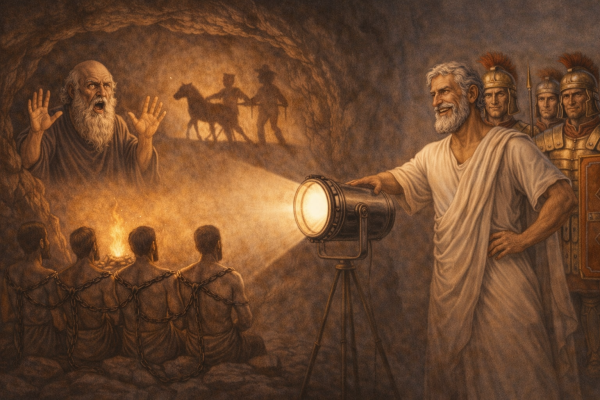
    Blog Article

    Reality Does Not Require Being Always The Same

    This post is also available on Substack.

    One of the deepest and most consequential divisions in the history of philosophy runs not between optimism and pessimism, or between free will and determinism, but between two fundamentally different answers to a single question: what makes something real?

    On one side stands a tradition stretching from Plato through the Stoics, through medieval theology, through Kant, and into much of modern religion and academic philosophy: the view that what is genuinely…
    Cassius
    March 31, 2026 at 10:24 AM
  • Martin
    04 - Moderator
    Points
    4,546
    Posts
    646
    Quizzes
    7
    Quiz rate
    85.9 %
    • March 31, 2026 at 12:45 PM
    • #2

    It should be made clear that the article is rather against Plato's idealism. Putting Kant in the same bucket as Plato is wrong because Kant removed the ideal forms and Plato's nonsense that reality is truthfully revealed only by the logic of philosophers like Plato. There are other issues with the text but just removing Kant from the text would already improve the credibility.

  • Online
    Cassius
    05 - Administrator
    Points
    111,307
    Posts
    15,294
    Quizzes
    9
    Quiz rate
    100.0 %
    • March 31, 2026 at 2:05 PM
    • #3

    Martin it looks to me like I mention Kant once in the article, in a sentence that is focused on rejection of the senses:

    Quote


    On one side stands a tradition stretching from Plato through the Stoics, through medieval theology, through Kant, and into much of modern religion and academic philosophy: the view that what is genuinely real must be eternal, unchanging, and accessible not through the senses but through some higher faculty — pure reason, divine revelation, or the intellectual intuition of necessary truths.


    I don't see that sentence as significantly a problem for the article's credibility. Of all the murkiness that surrounds Kant his rejection of sensation as a sufficient basis for considering this world of sensation as reality justifies including him in the general trend which is the focus of the article. For example I see in "Twilight of the Idols" that Nietzsche wrote:


    Fourth proposition. Any distinction between a "true" and an "apparent" world--whether in the Christian manner or in the manner of Kant (in the end, an underhanded Christian)--is only a suggestion of decadence, a symptom of the decline of life. That the artist esteems appearance higher than reality is no objection to this proposition. For "appearance" in this case means reality once more, only by way of selection, reinforcement, and correction. The tragic artist is no pessimist: he is precisely the one who says Yes to everything questionable, even to the terrible--he is Dionysian.

    If you see something specific or see other aspects of the article you'd like me to consider revising please let me know as I value your input and will include it as I consider revisions.

  • Online
    Cassius
    05 - Administrator
    Points
    111,307
    Posts
    15,294
    Quizzes
    9
    Quiz rate
    100.0 %
    • April 1, 2026 at 8:24 AM
    • #4

    Please use this thread for discussion of the merits of the article and suggestions for substantive changes. Posts originally made in this thread regarding the use of AI in the blog post are being moved to the thread below, which begins with this Admin Note:

    ADMIN NOTE BY CASSIUS -- I don't have the ability to create my own separate post here at the top of this thread so I am doing that in this ADMIN edit. I am moving all discussion of issues of the use of AI in two blog posts I generated in late March 2026 (of course it's applicable far beyond those) to this thread. I am posting in those original threads links to this thread. The original discussion threads for those articles should be used for discussing substantive comments, criticisms, changes, etc. Issues of the use of AI apply to both and should be made here in this thread entitled "Revisiting Issues of The Use of AI in Epicurean Philosophy"

    Thread

    Revisiting Issues of The Use of AI in Epicurean Philosophy

    ADMIN NOTE BY CASSIUS -- I don't have the ability to create my own post so as to explain this thread so I am doing so in this ADMIN edit. I am moving all discussion of issues of the use of AI in two blog posts I generated in late March 2026 (of course it's applicable far beyond those) to this thread. I am posting in those original threads links to this thread. The original discussion threads for those articles should be used for discussing substantive comments, criticisms, changes, etc. …
    Cassius
    March 24, 2026 at 9:26 PM
  • Martin
    04 - Moderator
    Points
    4,546
    Posts
    646
    Quizzes
    7
    Quiz rate
    85.9 %
    • April 1, 2026 at 11:38 AM
    • #5

    It is exactly that sentence ("On one side stands a tradition stretching from Plato...") which is false because Kant rejected dogmatism and did not reject the senses. In Kant's view, we know about the world through the senses. His epistemology examines how we make sense out of the input of the senses. That sentence is false with respect to modern academic philosophy, too, and maybe even with respect to some Stoics.
    A correct revision could be:
    "On one side stands a tradition stretching from Plato through medieval theology into much of modern religion: the view that what is genuinely real must be eternal, unchanging, and accessible not through the senses but through some higher faculty — pure reason, divine revelation, or the intellectual intuition of necessary truths."

    In this context: The article is excellent with respect to Plato and Epicurus. My own position is that Epicurus extreme affirmation on the real world made sense at his time as opposition to Plato's nonsense, but it is obsolete now, thanks to Kant and others. As this forum is focused on authentic Epicurean philosophy I refrain from elaborating on my heretic view here.

  • Online
    Cassius
    05 - Administrator
    Points
    111,307
    Posts
    15,294
    Quizzes
    9
    Quiz rate
    100.0 %
    • April 1, 2026 at 4:17 PM
    • #6

    Thanks Martin. I'll take a look at that aspect as I get time. I suspect in the end the issue might be summarized as "Kant rejected dogmatism and Epicurus embraced dogmatism."

    Obviously to drill down into that the word "dogmatism" would have to be defined carefully. I don't know Kant at this point well enough to be sure, but given what you've said it seems you're indicatingthat to Epicurus "dogmatism" means held that "knowledge of some things is possible" and Kant held that "no knowledge of any kind is possible." It's possible that it would be better to state that as "Epicurus held that "certainty about some things is possible" and Kant held that "no certainty of any kind is possible."

    If you think those are incorrect then maybe we could at least work toward a general division between the two positions. If you are saying that a significant aspect of Epicurus is obsolete then we ought to be able to at least get clarity on what aspect you're referring to.

    Quote from Martin

    My own position is that Epicurus extreme affirmation on the real world made sense at his time as opposition to Plato's nonsense, but it is obsolete now, thanks to Kant and others.

  • Martin
    04 - Moderator
    Points
    4,546
    Posts
    646
    Quizzes
    7
    Quiz rate
    85.9 %
    • April 2, 2026 at 6:08 AM
    • #7

    Those are incorrect. Whereas Plato's school apparently degenerated into plain skepticism, Kant's version of idealism was not that skeptic. Within Kant's epistemology, certainty with respect to knowledge about phenomena is possible but the metaphysical claim that that knowledge is the truth about how things actually are is unfounded. Moreover, Kant's epistemology can be restated in a materialistic framework. Therefore, the classification of Kant as an idealist is not relevant in this discussion.
    With trivial matters, the distinction between knowledge about phenomena and how things actually are does not matter: When I am hungry, I eat, then feel full.
    The distinction matters when we want to get a deeper understanding or when knowledge expands.
    Maybe this example can clarify this:
    If we kick a stone resting on Earth into motion on a horizontal surface, its speed will gradually decline and eventually stop. A simple theory can be stated that the natural state of non-living heavy things on Earth is to be at rest, and after they have been forced into motion, they gradually relax into their natural state of rest. (Aristotle came up with something similar to that). At that stage, people might have thought that the simple theory is the truth about how things actually are. Until a few hundred years ago, there was no experimental setup which could refute that theory. Even today, we could still use that simple (but ontologically wrong) theory for accurate solutions of engineering problems in cases which stay within its limitations. Newton had no way to experimentally refute it when he came up with a more general theory of mechanics of which the first "axiom" contradicts that simple theory. His theory was quickly accepted because it could explain more phenomena and at a deeper level. At that stage, people might have thought that Newton's theory is the truth about how things actually are. However, they had no superior knowledge from which they could justify that thought. Later, we found out that Newton's theory fails when high speeds are involved, contradicts electrodynamics and needs to be replaced by Einstein's special theory of relativity to resolve these issues. We might think that now, Einstein's special theory of relativity is the truth about how things actually are. But again, there is no superior knowledge from where we could justify that thought.

  • Online
    Cassius
    05 - Administrator
    Points
    111,307
    Posts
    15,294
    Quizzes
    9
    Quiz rate
    100.0 %
    • April 2, 2026 at 7:00 AM
    • #8
    Quote from Martin

    Within Kant's epistemology, certainty with respect to knowledge about phenomena is possible but the metaphysical claim that that knowledge is the truth about how things actually are is unfounded.

    So "knowledge is the truth about how things actually are is unfounded"
    is a "metaphysical claim" which is "unfounded."

    And as science advances still "there is no superior knowledge from where we could justify that thought."

    That certainly sounds to me like the equivalent of making the assertion that because we observe progress in science we cannot claim "knowledge" of anything physical. And since the physical is this world, and we can't claim knowledge of it.

    That sounds like the functional equivalent of saying that there is in fact a "true world" which is inaccessible to the senses and toward which we can never do anything more than approach knowledge.

    And I would say that it sounds like the equivalence of saying "nothing can be known" to any regular person who has to choose how to live today based on whether there is a supernatural god and reward/punishment after death.

    If that kind of formulation appeals to a certain type of "scientist" who are happy to have a theory that makes them feel good, then more power to them. But so far Kant adds up to me exactly as Nietzsche describes him.

    As you've said earlier Martin this isn't the time or place for an extensive exploration into how to advocate for Kant. People can go outside the forum for that, where it is readily accessible.

    But if you Martin or anyone else who has established that they are well disposed toward Epicurus want to add additional info about exactly what about Epicurus Kant makes "obsolete" then as far as I am concerned the floor will continue to be open to pursue this further.

  • DaveT
    03 - Level Three
    Points
    843
    Posts
    129
    • April 2, 2026 at 9:56 AM
    • #9

    I would like to see one aspect of this discussion of Epicurean vs Kantian perspectives in this or another thread on the forum.

    I know comparatively little about Epicurus and less about Kant. However, I sense that the current distinctions between the schools being discussed carry an unspoken acknowledgment. Newer philosophies have been influenced to the good by earlier deep thinking. As much as E. differed from Socrates, he had to have been influenced to some degree by him.

    If students of either school are inclined to do so, I'd enjoy reading relevant comparisons between E and Kant (and other more modern philosophers) that shows how they are similarly focused. Can it be done without avoiding the differences yet at the same time avoiding disputation?

    Dave Tamanini

    Harrisburg, PA, USA

  • Online
    Cassius
    05 - Administrator
    Points
    111,307
    Posts
    15,294
    Quizzes
    9
    Quiz rate
    100.0 %
    • April 2, 2026 at 11:35 AM
    • #10
    Quote from DaveT

    I'd enjoy reading relevant comparisons between E and Kant (and other more modern philosophers) that shows how they are similarly focused. Can it be done without avoiding the differences yet at the same time avoiding disputation?

    I definitely think it can be done, and that it would be helpful to do exactly that.

    Differences can be sharpened in an unbiased unemotional way. Once we have a sharp view of the differences, then we can pretty easily find the line where we cross into advocacy of anti-Epicurean positions. Those who want to advocate core positions that are clearly anti-Epicurean can receive our best wishes and proceed to do that elsewhere for as long and passionately as they want. And those who conclude that an Epicurean framework allows for the best living can do so here.

    For example it seems to me that it should be relatively easy to articulate positions on such core Epicurean views as "error is not in the senses but in the mind. "

    Likewise it ought to be possible to articulate what it means to "prove" something.

    On that last point I'm see the issue arise regularly: "Epicurus can't prove that the universe is infinite in size or eternal in time."

    In my view, Epicurus had very sound reasoning as to why the universe as a whole cannot be otherwise. Obviously there are many local phenomena with specific circumstances which scientists are exploring. In Epicurus' time the question was the size of the sun, how magnets appear to generate action at a distance, and other poorly understood issues such as are listed in Book 6 of Lucretius.

    Epicurus was very familiar that there are real-world issues like those for which we currently don't have adequate physical explanations.

    But that didn't stop Epicurus from concluding that at the "ultimate" level of the universe as a whole, the javelin argument and similar hypotheticals are sufficient to conclude that we can be certain that no matter how far we go in space there's either "something" there or it not. Epicurus makes no claim to itemize what the various "somethings" might be, but he's say that from our human perspective it makes sense to categorize those things that affect us as "something" and those things that don't affect us as "nothing to us."

    That is a kind of working real-world perspective that will take us through life with a practical frame of analysis. It doesn't exclude the possibility that there are in fact advanced civilizations that can create and destroy solar systems and living beings like we can only do in movies. I think Frances Wright was correct to include that possibility in her book. But such beings are not "supernatural" from the "universe as a whole" perspective. The possibility that such beings exist does not therefore negate the "universe as a whole" being eternal or infinite in size.

    But getting back to what it means to "prove" something: Suggesting that Epicurus' framework is not "proven" seems to me to be missing Epicurus' point entirely. It's rejecting his combined logic-human experience perspective and suggesting that we require a level of proof that is clearly impossible for a human to possess. It's ultimately "otherworldly" in nature, highly damaging to human happiness, and exists mainly to sneak in a form of absolute morality or Judeo-Christianity-lite just as Nietzsche was suggesting as to Kant. (There's no god to justify my viewpoint, but I still think everyone should reach the same moral decisions - I'll just call it "categorical imperative"! )

    Not everyone is going to agree completely with how to analyze these basic issues, but I firmly think that a forum that is dedicated to promoting Epicurean philosophy is going to at largely end up in the same place on the general outline.

    It appears to me that the ancient Epicureans thought it makes no sense whatsoever to allow such people to argue such things without pushback, as if they occupy some kind of Stoic / moralist high ground.

    So I do think it's important to dispassionately clarify where the issues really are found. After that we can passionately take sides as to the implications of those issues - after we are clear on what they really are.

  • Online
    Cassius
    05 - Administrator
    Points
    111,307
    Posts
    15,294
    Quizzes
    9
    Quiz rate
    100.0 %
    • April 2, 2026 at 1:25 PM
    • #11

    DaveT another example of my personal priority of where to spend time:

    (1) I think we need very clear lists and charts and descriptions of the most basic of Epicurean canonical, physical, and ethical positions. That's what I've been working on for months with the material that is on the first page, on epicurustoday.com. That provides a newcomer with a very clear list of things to focus on, and I think that's of primary importance. if people come to grips with those and largely agree with them, then we have firm grounds for studying nature using a shared framework as Epicurus repeatedly advises.

    (2) Next, i'm on the alert for pesky issues that continue to intrude on the objective. Those include (A) Stoicism (which I think in many cases translates into "seeing tranquility rather than pleasure as the goal." It also includes (B) "skepticism" - "Epicurus hasn't proved his case because in fact Epicurus CAN'T prove his case because it's really not possible to prove cases from nature in the first place. It appears to me that most modern philosophy but also Kant falls in this general category." Then there's (C) idealism / absolute moraiity - which is where "humanism" comes in, and again where the Kantian "categorical imperative" is involved.

    Each of those A B and C in the last paragraph are major issues that most people are going to bring with them when they come to the study of Epicurus. They are also very difficult to dislodge even among some who generally begin to appreciate that the core issue isn't "How much ice cream should I eat?" but "How should i view the world at its deepest levels? (from which you can derive how much ice cream to eat much later on).

    And as a specific example of that when I hear it said that "Epicurus' physics are obsolete" what I firmly believe to be going on is that they are not really saying "Epicurus didn't understand subatomic particles so his physics is obsolete." What they are really saying, or at least when normal people will hear, is "Epicurus' was wrong to conclude that the universe is eternal, and that there's nothing outside the universe, and all those questions are not answered, and will never be answered, so we'd better be humble about supernatural forces and life after death and make our Pascal's bargain to learn to live with the possibility that the reilgions are right."

    And one of the operating presumptions of this forum is that we are dealing with "normal people" who want "normal lives lived happily" and we're not catering to those who live for the exhilaration that they apparently get from reveling in uncertainty about every question in life. That's a description of the kind of people I think we have here at the forum, and that we want to cultivate. All the while realizing that there are many many people who don't agree with that framework, and that we aren't going to be able to do build the community we'd like to have here if we cater to that second category.

  • DaveT
    03 - Level Three
    Points
    843
    Posts
    129
    • April 2, 2026 at 4:32 PM
    • #12

    For conversation's sake: What philosopher actually proves anything? We've probably dealt with that issue often enough, but my devilish sense of humor drove me to ask it again.

    But seriously, imagine for a moment, Epicurus and Kant, and, I don't know, Camus at a conference somewhere, together in a reserved room at the end of the day, sipping ouzo, scnapps, and napoleon brandy, and discussing their lives "back in the day". Each of them having enjoyed notoriety after being in the major leagues of existential thinking, and having read the work of the others, they talk amiably. Would they not have common respect for each other and be able to good naturedly but seriously, poke each other in the ribs verbally on this point or that? And then afterwards they all retired to their bedrooms resolving to keep their own counsel on differences among them?

    Every comparison of existential concepts need not be direct testimony, cross examination, re-direct and re-cross into infinity until tempers flare.

    If you are studying philosophy (as we do) at any level, you are already among the elite, and capable of thinking about competing existential concepts. I don't think anyone needs to fear that comparative points on an Epicurean forum will confuse novice students. I suspect all forum members are already leaning into Epicurus and high level discussions.

    As I said previously, I'd welcome and certainly would learn from such discussions if any two or more care to engage in it.

    Dave Tamanini

    Harrisburg, PA, USA

  • DaveT
    03 - Level Three
    Points
    843
    Posts
    129
    • April 2, 2026 at 4:40 PM
    • #13
    Quote from Cassius

    And one of the operating presumptions of this forum is that we are dealing with "normal people" who want "normal lives lived happily" and we're not catering to those who live for the exhilaration that they apparently get from reveling in uncertainty about every question in life.

    I find that surprising in my limited knowledge of forum participants. You of course must have the data to support your comment. Also, I'm at a loss over your statement, "we're not catering to those who live for the exhilaration that they apparently get from reveling in uncertainty about every question in life." Who are you referring to here? "Revelling in uncertainty" seems a bit strong for any group, no?

    Dave Tamanini

    Harrisburg, PA, USA

  • Online
    Cassius
    05 - Administrator
    Points
    111,307
    Posts
    15,294
    Quizzes
    9
    Quiz rate
    100.0 %
    • April 2, 2026 at 4:43 PM
    • #14
    Quote from DaveT

    What philosopher actually proves anything? We've probably dealt with that issue often enough, but my devilish sense of humor drove me to ask it again.

    I think Epicurus would say that he has 'proven' that the universe as a whole is eternal and infinite in size and there is nothing "outside" of it. Now obviously that's a different definition than saying "I've been there and seen it and you can rely on me" or "god told me to tell you" but as I understand that is what it means to be a dogmatist. You take certain things to be beyond dispute, with beyond dispute at least meaning that at some point it's not worth wasting further time to discuss. That would be at least analogous to our legal framework of finality.

    Quote from DaveT

    Would they not have common respect for each other and be able to good naturedly but seriously, poke each other in the ribs verbally on this point or that?

    I don't think that's necessarily so. We have the list of disparaging names that Epicurus is cited to have used against other philosophers in Diogenes Laertius, and we have that intensity reflected in Lucretius and Diogenes of Oinoanda at least. Am I saying that they would get into a fistfight? Or refuse to talk to each other? No, but I also don't think that they would say "let's all just get along and spend the rest of our lives having tea with each other.

    And in the end, given the intensity that all of them felt about the importance of their philosophy, I doubt any friendly meetings would last much longer than necessary to explore any ambiguities that one felt that they might have about some detail of the other. They would see the importance of their own work as much more important than building bridges for the sake of unity.

    Quote from DaveT

    don't think anyone needs to fear that comparative points on an Epicurean forum will confuse novice students. I suspect all forum members are already leaning into Epicurus and high level discussions.

    That's trickier. Even at this point we're something of a "work in progress." I perceive I personally tend to want to confront other views more than I think that some others wish to do. And it's true that quarreling quickly gets tiresome, especially when it's readily available at Reddit. So that's why we have different sections and levels and try to meet as many needs as possible.

  • TauPhi
    03 - Level Three
    Points
    2,135
    Posts
    247
    Quizzes
    3
    Quiz rate
    92.5 %
    • April 2, 2026 at 7:21 PM
    • #15

    Martin and Cassius . Please correct me if my reasoning is faulty at any point but at the moment here are my thoughts about some of the things you mentioned in the posts above:

    Quote from Martin

    Within Kant's epistemology, certainty with respect to knowledge about phenomena is possible but the metaphysical claim that that knowledge is the truth about how things actually are is unfounded.

    Quote from Cassius

    That certainly sounds to me like the equivalent of making the assertion that because we observe progress in science we cannot claim "knowledge" of anything physical. And since the physical is this world, and we can't claim knowledge of it.

    I'm sorry but this doesn't make any sense based on what Martin said. We certainly can claim knowledge. We can't claim that our knowledge is equivalent to the truth about how things are.

    Quote from Cassius

    That sounds like the functional equivalent of saying that there is in fact a "true world" which is inaccessible to the senses and toward which we can never do anything more than approach knowledge.

    Again, this conclusion is incompatible with what Martin said above. There's no "true world". There simply is the world which we can gradually obtain knowledge about. The world doesn't care if some species on a third planet from their star declares that the world is "true". What we call "true" is what we experience with our senses, feelings and anticipations and these stimuli are processed with a bit of reasoning powers we possess. That is all. That is our limit. And Nature doesn't work this way: "Oh, humans got some knowledge about me. I better adjust to what they have just discovered and act accordingly so I am true to them." Our knowledge will never be the truth about how things actually are. And this statement is not incompatible with Epicurean philosophy. There are only subjective, human faculties in Epicurus' canon: feelings, senses and anticipations. There's not even one canonical faculty that would allow us to measure how things are outside of our human experiences.

    Quote from Cassius

    And I would say that it sounds like the equivalence of saying "nothing can be known" to any regular person who has to choose how to live today based on whether there is a supernatural god and reward/punishment after death.

    And again, I have real difficulty understanding how you draw conclusions like that. Your equivalences sound more like: There are stairs to knowledge we need to climb but we can't see the end of them therefore we must declare that the stairs don't exist.

    Things can be known. We can most definitely get knowledge from our human perspective. And the things we don't know about doesn't make them supernatural. We simply didn't find a way to discover them yet or we won't be able to discover them at all because of our human limitations. The knowledge we acquire is our "truth" but that knowledge doesn't mean we conquered Nature and know it to its core. We are not Nature. We'll never be Nature. We are only a part of it. Nature's "truth" is not equivalent to our "truth". And that's how I understand Martin 's initial quote.

  • Online
    Cassius
    05 - Administrator
    Points
    111,307
    Posts
    15,294
    Quizzes
    9
    Quiz rate
    100.0 %
    • April 2, 2026 at 9:13 PM
    • #16
    Quote from TauPhi

    We certainly can claim knowledge. We can't claim that our knowledge is equivalent to the truth about how things are.

    I clipped a number of statements to comment on but probably this one was all that is necessary. Whether we talk about "knowledge" or "truth" or "reality" or any other similar word, the issue is whether we can ever have confidence that our major conclusions about supernatural forces and life after death will ever need to be revised. I see Epicurus as being completely clear that there are issues like that at which we have no need of further observation, and the only compelling conclusion is "no" as to each. Holding those questions open as "maybe there will be new information tomorrow" creates needless doubt and anxiety, and more than that, has no logical basis, because you are speculating without evidence, and to do so means you are willing to give up your grip that Nature gave you on THIS world out of a speculative/imaginative possibility that "something else" may possibly - again without evidence - exist which will contradict the sum total of your and human prior experience.

    Quote from TauPhi

    ur knowledge will never be the truth about how things actually are. And this statement is not incompatible with Epicurean philosophy.

    We disagree. I believe this statement is fundamentally at odds with Epicurean philosophy. In Epicurean philosophy it is "the truth' that there are no supernatural gods and no life after death.

    We can all take personal positions on that in our personal lives, but there's only one position on those issues consistent with Epicurean philosophy, and to say otherwise is to simply ignore the totality of what is reliabily recorded. Where in any reliable citation can you find ANY opening for any other position?

    Quote from TauPhi

    There are only subjective, human faculties in Epicurus' canon: feelings, senses and anticipations.

    And based on those faculties it is reasonable to reach confident conclusions which you can reasonably say are knowledge about truth and reality.

    Quote from TauPhi

    There's not even one canonical faculty that would allow us to measure how things are outside of our human experiences.

    The faculties provide evidence on which we are confident that the nature operates through irreducible particles. The faculties provide the data but "true reason" produces the conclusions. That is why the sense are never wrong, but some opinions are wrong and others are right. And those right opinions constitute knowledge of truth and reality.

    Quote from TauPhi

    Your equivalences sound more like:There are stairs to knowledge we need to climb but we can't see the end of them therefore we must declare that the stairs don't exist.

    There are indeed stairs to knowledge, and in some opinions we can have greater confidence than in others. It is skepticism to say that there is a staircase but never a final conclusion on any subject, and that the staircase goes on "forever."

    The issue we're focusing on of course is that of dogmatism in Epicurean philosophy, not whether "everyone" has to agree on the subject. People are free to take whatever positions they like, but at some point it becomes obligatory on people who say that they are Epicureans to take a position on whether this is or is not part of Epicurean philosophy.

    And this is where I think some of us have come to an understanding: they pick and choose what elements of core Epicurean philosophy they want to adapt, and they label themselves accordingly. That's why you (Tau Phi) have been frank in stating that you are not an Epicurean, and I appreciate your frankness and we operate on those parameters.

    We simply disagree on these issues of skepticism. I'll close this post by saying that I'd be happy for someone to cite to me some very clear Epicurean texts that support the arguments Tau Phi is raising, but I don't expect Tau Phi himself to do that because he acknowledges that his position is not Epicurean.+

  • DaveT
    03 - Level Three
    Points
    843
    Posts
    129
    • April 2, 2026 at 9:20 PM
    • #17
    Quote from Cassius

    I doubt any friendly meetings would last much longer than necessary to explore any ambiguities that one felt that they might have about some detail of the other.

    Speaking as an Epicurean friend, I think you missed my point. I was not talking about those he was struggling against for contemporary dominance. I was referring to the progress of philosophy depending on the prior generations of great thinkers. And frankly, I wasn't talking about polemical writings of attack and counter attack that they may have engaged in. I was talking about great men who had to have respected the effort each put into thinking about their good fortune to be alive and grasping for truth in the best way they knew how.

    I have seen and been with politicians who behind closed doors look for common ground no matter their public disagreements. I am not willing to believe if those men, though they would never have met across the centuries, men like Epicurus, Kant and later great men would have acted any other way in private. And I think that is a goal among friends discussing comparative philosophers as Martin did, and as I explained earlier In this post.

    Quote from Cassius

    I perceive I personally tend to want to confront other views more than I think that some others wish to do. And it's true that quarreling quickly gets tiresome, especially when it's readily available at Reddit. So that's why we have different sections and levels and try to meet as many needs as possible.

    I think you missed my point here. I in no way was advocating "quareling quickly" which you described as "tiresome". On the contrary, I was anticipating that this forum's interactions could be designed to avoid loosely governed combat Reddit discussions may certainly contain threads where even juvenile and unsupported opinions can range far afield on many hotly contested issues. There is a lot of space between both ends of this spectrum.

    I don't mind if the forum remains the same or if it adds to itself. I think I made myself clear on my reasons in support.

    Sometimes this forum seems to take on the entire world as if in a black and white challenge to its philosophy. And yet, it is quite apparent that the goal of the forum is to host reasoned and frank discourse without excessive passion or extremism of any sort.

    Dave Tamanini

    Harrisburg, PA, USA

  • Online
    Cassius
    05 - Administrator
    Points
    111,307
    Posts
    15,294
    Quizzes
    9
    Quiz rate
    100.0 %
    • April 3, 2026 at 6:41 AM
    • #18
    Quote from DaveT

    I was referring to the progress of philosophy depending on the prior generations of great thinkers.

    It's fair to say that I think "philosophy" in general has done nothing but regress since about 50 BC (which I'm equating with the high-water mark of penetration by Epicurean thinking).

    Quote from DaveT

    Sometimes this forum seems to take on the entire world as if in a black and white challenge to its philosophy.

    Well stated! :)

    Quote from DaveT

    And yet, it is quite apparent that the goal of the forum is to host reasoned and frank discourse without excessive passion or extremism of any sort.

    No, the goal of this forum is not to "host reasoned and frank discourse without excessive passion or extremism of any sort." The goal of this forum is to study and promote Epicurean philosophy. While it is true that what you just described is often the instrument of doing do, the instrumentality is never the goal and there is much "reasoned and frank discourse without excessive passion or extremism" that is totally inappropriate and outside the goals of this forum.

  • Online
    Cassius
    05 - Administrator
    Points
    111,307
    Posts
    15,294
    Quizzes
    9
    Quiz rate
    100.0 %
    • April 3, 2026 at 7:09 AM
    • #19

    As to the arguments in recent posts as to the possibility of knowledge and proof and how to define terms, I want to cite and praise as insightful something that Titus raise in another context

    Quote from Titus

    What I am suggesting is, in analogy to information technology, an Epicurean thought serving on the kernel level that defines how the operative systems operate.

    I think this is an excellent analogy to be brought to bear on the problem.

    After 2000 years of Judeo-Christianty and all sorts of philosophical regression, and over 500 years of Pythagoreanism and Platonism and Academic Skepticism and even Democriteanism before that, what has happened is essentially the same thing as a "mind virus at the kernel level" which has destroyed any progress that Epicurus made with his canonics.

    The virus is the idea that "proof" or "proving something" requires omniscience, omniscience, and omnipresence -- an unhuman an inhuman level of "certainty" that is impossible by definition for a human to reach. This mind virus has destroyed the ability of many people to think that anything can be "proven" or anything can be "known" or that anything can be "real" if it fails to meet such an impossible standard.

    This is why I think philosophy has regressed so far since the Epicurean period. Rather than accept Epicurus' position that there is a reasonable standard of proof grounded in the senses in which the mind IS and SHOULD BE ACKNOWLEDGED to be able to prove things in human terms, such a position is denounced as the ultimate sin. Some will say "sin against god" but the majority of modern philosophers and intelligentsia will consider it a "sin against humanism" in a "good-without-god" kind of way.

    This argument entirely dismisses or ignores or flies in the face of what is explained at length in Lucretius Book 4. There it is made perfectly clear that those who say "nothing can be known" are not making a simple error, they are removing the possibility of reason and life itself if they fail to "trust the senses." Not only is that section ignored, but it's not even given a legitimate meaning, because it is also clear that the senses in Epicurean philosophy do not contain opinions of their own - the senses simply provide data from which the mind must produce true or false opinion.

    This thread makes clear that the Kantian-like attitude is to say that ALL opinion is false and can never be considered "truth" or "the way reality really is." That's clearly not the Epicurean framework, but people are so infected with this mind virus that they don't even recognize the issue and the self-contradiction implied in their anti-knowledge claim.

    That self-refutation is what Epicurus latched onto as the most clear way of explaining the problem, and it's probable that that remains the best argument for the Epicurean position.

    As Don might say "Thank Zeus" that this section of Lucretius remains preserved, and we can cite it as a red line for what it means to follow Epicurean philosophy:

    Quote from Lucretius 4-469

    4-469

    Lastly, if anyone thinks that he knows nothing, he cannot be sure that he knows this, when he confesses that he knows nothing at all. I shall avoid disputing with such a trifler, who perverts all things, and like a tumbler with his head prone to the earth, can go no otherwise than backwards.

    And yet allow that he knows this, I would ask (since he had nothing before to lead him into such a knowledge) whence he had the notion what it was to know, or not to know; what it was that gave him an idea of Truth or Falsehood, and what taught him to distinguish between doubt and certainty?

    4-478

    But you will find that knowledge of truth is originally derived from the senses, nor can the senses be contradicted, for whatever is able by the evidence of an opposite truth to convince the senses of falsehood, must be something of greater certainty than they. But what can deserve greater credit than the senses require from us? Will reason, derived from erring sense, claim the privilege to contradict it? Reason – that depends wholly upon the senses,which unless you allow to be true, all reason must be false. Can the ears correct the eyes? Or the touch the ears? Or will taste confute the touch? Or shall the nose or eyes convince the rest? This, I think, cannot be, for every sense has a separate faculty of its own, each has its distinct powers; and therefore an object, soft or hard, hot or cold, must necessarily be distinguished as soft or hard, hot or cold, by one sense separately, that is, the touch. It is the sole province of another, the sight, to perceive the colors of things, and the several properties that belong to them. The taste has a distinct office. Odors particularly affect the smell, and sound the ears. And therefore it cannot be that one sense should correct another, nor can the same sense correct itself, since an equal credit ought to be given to each; and therefore whatever the senses at any time discover to us must be certain.

    4-500

    And though reason is not able to assign a cause why an object that is really four-square when near, should appear round when seen at a distance; yet, if we cannot explain this difficulty, it is better to give any solution, even a false one, than to deliver up all Certainty out of our power, to break in upon our first principle of belief, and tear up all foundations upon which our life and security depend. For not only all reason must be overthrown, but life itself must be immediately extinguished, unless you give credit to your senses. These direct you to fly from a precipice and other evils of this sort which are to be avoided, and to pursue what tends to your security. All therefore is nothing more than an empty parade of words that can be offered against the certainty of sense.

    4-513

    Lastly, as in a building, if the principle rule of the artificer be not true, if his line be not exact, or his level bear in to the least to either side, every thing must needs be wrong and crooked, the whole fabric must be ill-shaped, declining, hanging over, leaning and irregular, so that some parts will seem ready to fall and tumble down, because the whole was at first disordered by false principles. So the reason of things must of necessity be wrong and false which is founded upon a false representation of the senses.


    That's a statement that the kind of skepticism we're arguing about is a "mind virus" and "at the kernel level" and at the end of the day it's not feasible to live the happiest live possible unless you eradicate it from your thinking. I didn't agree with Titus' analogy that it makes sense to try to get too close to supernatural religions in order to plant such a virus in them, but I think an analogy of attacking skepticism as a "mind virus at kernel level" is extremely useful.

  • Online
    Cassius
    05 - Administrator
    Points
    111,307
    Posts
    15,294
    Quizzes
    9
    Quiz rate
    100.0 %
    • April 3, 2026 at 7:30 AM
    • #20

    As an aside many of these same issues are discussed when Joshua quotes from Timaeus at length in Episode 327 of the podcast (to be released later today or tomorrow). This appears in depth around the 15 minute mark but much of the episode is devoted to it.

    The importance of these issues is why we are currently going through "Academic Questions." Plato makes very clear in Timaeus that the impossibility of stating anything about this world as more than "probable" is central to his viewpoint.

Finding Things At EpicureanFriends.com

Here is a list of suggested search strategies:

  • Website Overview page - clickable links arrranged by cards.
  • Forum Main Page - list of forums and subforums arranged by topic. Threads are posted according to relevant topics. The "Uncategorized subforum" contains threads which do not fall into any existing topic (also contains older "unfiled" threads which will soon be moved).
  • Search Tool - icon is located on the top right of every page. Note that the search box asks you what section of the forum you'd like to search. If you don't know, select "Everywhere."
  • Search By Key Tags - curated to show frequently-searched topics.
  • Full Tag List - an alphabetical list of all tags.

Resources

  1. Getting Started At EpicureanFriends
  2. Community Standards And Posting Policies
  3. The Major Doctrines of Classical Epicurean Philosophy
  4. Introductory Videos
  5. Wiki
  6. Lucretius Today Podcast
    1. Podcast Episode Guide
  7. Key Epicurean Texts
    1. Chart Of Key Quotes
    2. Outline Of Key Quotes
    3. Side-By-Side Diogenes Laertius X (Bio And All Key Writings of Epicurus)
    4. Side-By-Side Lucretius - On The Nature Of Things
    5. Side-By-Side Torquatus On Ethics
    6. Side-By-Side Velleius on Divinity
    7. Lucretius Topical Outline
    8. Usener Fragment Collection
  8. Frequently Asked Questions
    1. FAQ Discussions
  9. Full List of Forums
    1. Physics Discussions
    2. Canonics Discussions
    3. Ethics Discussions
    4. All Recent Forum Activities
  10. Image Gallery
  11. Featured Articles
  12. Featured Blog Posts
  13. Quiz Section
  14. Activities Calendar
  15. Special Resource Pages
  16. File Database
  17. Site Map
    1. Home

Frequently Used Forums

  • Frequently Asked / Introductory Questions
  • News And Announcements
  • Lucretius Today Podcast
  • Physics (The Nature of the Universe)
  • Canonics (The Tests Of Truth)
  • Ethics (How To Live)
  • Against Determinism
  • Against Skepticism
  • The "Meaning of Life" Question
  • Uncategorized Discussion
  • Comparisons With Other Philosophies
  • Historical Figures
  • Ancient Texts
  • Decline of The Ancient Epicurean Age
  • Unsolved Questions of Epicurean History
  • Welcome New Participants
  • Events - Activism - Outreach
  • Full Forum List

Latest Posts

  • Discussion of Blog Article - "Reality Does Not Require Being Eternally The Same"

    Cassius April 3, 2026 at 9:19 AM
  • Epicurus vs Kant and Modern Idealism - Introduction

    DaveT April 3, 2026 at 9:13 AM
  • Epicurean Philosophy in a Modern "A Few Day in Athens" Fictional Story

    Kalosyni April 3, 2026 at 8:31 AM
  • Episode 327 - EATAQ 09 - Cashing In On Dividing Nature Into Active And Passive Components - The False Assertion of Intelligent Design

    Cassius April 3, 2026 at 8:00 AM
  • Revisiting Issues of The Use of AI in Epicurean Philosophy

    Cassius April 2, 2026 at 8:37 PM
  • Good and Bad Desire and Doubt In Epicurean Philosophy

    Cassius April 1, 2026 at 8:44 AM
  • Happy Birthday General Thread

    Cassius April 1, 2026 at 4:05 AM
  • Use Of The Term "Metaphysics" In Discussing Epicurus

    Julia March 31, 2026 at 8:22 AM
  • Welcome Page259!

    Eikadistes March 29, 2026 at 10:12 PM
  • Connecting Thought With Atoms - Emergence, Downward Causation (From The Macroscopic To The Atomic), and Epicurus

    Cassius March 29, 2026 at 4:27 PM

Frequently Used Tags

In addition to posting in the appropriate forums, participants are encouraged to reference the following tags in their posts:

  • #Physics
    • #Atomism
    • #Gods
    • #Images
    • #Infinity
    • #Eternity
    • #Life
    • #Death
  • #Canonics
    • #Knowledge
    • #Scepticism
  • #Ethics

    • #Pleasure
    • #Pain
    • #Engagement
    • #EpicureanLiving
    • #Happiness
    • #Virtue
      • #Wisdom
      • #Temperance
      • #Courage
      • #Justice
      • #Honesty
      • #Faith (Confidence)
      • #Suavity
      • #Consideration
      • #Hope
      • #Gratitude
      • #Friendship


Click Here To Search All Tags

To Suggest Additions To This List Click Here

EpicureanFriends - Classical Epicurean Philosophy

  1. Home
    1. About Us
    2. Classical Epicurean Philosophy
  2. Wiki
    1. Getting Started
  3. Frequently Asked Questions
    1. Site Map
  4. Forum
    1. Latest Threads
    2. Featured Threads
    3. Unread Posts
  5. Texts
    1. Core Texts
    2. Biography of Epicurus
    3. Lucretius
  6. Articles
    1. Latest Articles
  7. Gallery
    1. Featured Images
  8. Calendar
    1. This Month At EpicureanFriends
Powered by WoltLab Suite™ 6.0.24
Style: Inspire by cls-design
Stylename
Inspire
Manufacturer
cls-design
Licence
Commercial styles
Help
Supportforum
Visit cls-design