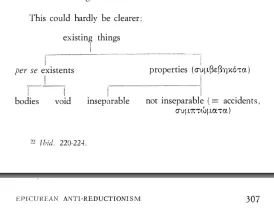
In our Zoom of 3/25/26 we discussed the topic of this thread and how it would be desirable to prepare a diagram / explanation of the proper use of these terms. Bryan has by far the best command of this and he has provided some basic information from which it would be desirable to come up with more explanatory material. Here are two charts of the words in issue, followed by an initial effort using an AI generator to make a diagram. Consider this just a starting point and not by any means authoritative, and let's see what we can do to produce a clear explanation.

Explaining The Relationship Between Properties / Qualities of Atoms and Emergent Qualities of Things Formed From Atoms
-
-
Again - consider these as initial drafts that will need further revision!
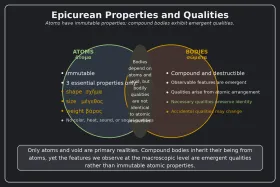
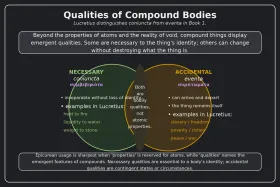
-
Another option:
Sedley's Routledge Encyclopedia entry (2005) states that "atoms themselves have only the primary or ineliminable features of body: size, shape and weight," and that the ground for this parsimony is the Letter to Herodotus §54–55: secondary properties are changeable by nature, whereas atoms are the enduring entities underlying change. Routledge Epicurus avoids the "reductionism" of Democritus — while everything is ultimately atoms and void, the emergent properties that arise from those combinations are not equivalent in every respect to their constituent atoms.
On the compound-body level, Lucretius distinguishes in De Rerum Natura properties that are inseparable (coniuncta, Greek συμβεβηκότα) from others that are accidental (eventa, συμπτώματα). Stanford Encyclopedia of Philosophy And crucially on the ontological status of those emergent qualities: although colors and other accidents are real, they are irreducibly different from atomic structures, and atomic structures are in no way ontologically privileged over the phenomenal level — neither level has a monopoly on truth. Routledge
Here is the main structural diagram showing the full ontological hierarchy:
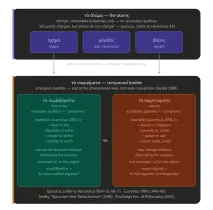
-
From the Sedley Article "Epicurean Anti-Reductionism"