

There's a link to the full transcription of P.Herc. 1005 in the annotations of that page.

New "TWENTIERS" Website
-
-

Thank you for your work on the Philodemus text! I see over at your link (the Twentiers website), there is this symbol used in the text:
[...]
...which is used when parts of the text are missing. Does the source text give any indication of how many words or lines are missing at each of these points?
DCLP/Trismegistos 62437 = LDAB 3610
You can look at the engravings for each page at the link.
To the Comrades by Philódēmos
What made you decide on "Comrades"? My understanding is that there is no noun in the title, just ΠΡΟΣ ΤΟΥΣ...
-

To the Comrades by Philódēmos
What made you decide on "Comrades"? My understanding is that there is no noun in the title, just ΠΡΟΣ ΤΟΥΣ...
As far as I know, you are correct. I went with the suggestion from Giuseppe Casanova (1806) who sketched it. He suggests the word ἐταίρους (étaírous) or “Comrades”. From this, I see other authors (who like re-naming everything in Latin) using “contubernales” (meaning “tent-mates” or “comrades”), which is suggested by Anna Angeli (1988). I also see a note which I believe indicates that Francesco Sbordone (1947) translated the name as “Adversus [sophistas]” meaning “Against Sophists”.
My personal preference is "For the Homies", but I can't academically justify it.

-
Got it.
For anyone curious as to what we're going on about, here's the end of the manuscript where the title is ...
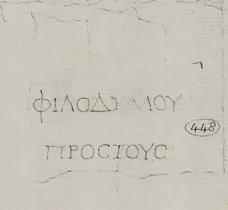
ΦΙΛΟΔΗΜΟΥ
ΠΡΟCΤΟΥC
(end of papyrus torn off)
Idiomatically then, all we have extant is:
By Philodemus
Against The/Pertaining to the/According to the...
Προς is a preposition, Τους is the masculine accusative plural definite article ("the"). NO ONE has ANY definitive idea of what came after that "the" and προς has many shades of meaning when followed by an accusative noun.
Here's the Wiktionary entry for προς with the accusative. I've italicized some possible interpretation of Philodemus' title. It becomes almost a Rorschach Test as to what translators want the title to convey:
ΠΡΟΣ (note: the C is the Hellenistic sigma - Σ = C = Latin S, so "pros")
(with accusative, expressing motion or direction) towards
(with verbs implying motion) upon, against
(expressing addition) over and above
(with verbs of seeing) towards, facing sth., to, against (the wind), in the light of, in (e.g. open day)
(in hostile or discursive sense) against, in reply to, in accusation
(for various kinds of intercourse or reciprocal action) with, (have certain feelings) towards, at the hands of, of, inspired by
before (a gremium, witness etc.), in the eyes of (a God etc.) (of legal or other business contracted)
towards (the evening etc.), at, about (of time)
relating to, in reference to, in respect of, touching (some matter); in consequence of, in view of (some fact); according to (a certain document, habitude etc.)
(music) accompanied by (an instrument)
(in various adverbial phrases) with, under (e.g. compulsion), by means of, in (e.g. due proportion)
-
My eyes are melting so I added a dark mode plugin (bottom-right corner).
The content cannot be displayed because you do not have authorisation to view this content. -
I formatted (and greatly expanded) the A-B-Cs of the "Epicurean Verses for When You're..." retort I made to the "Promises of God" section in the appendix of most Bibles, and put it online.
I'm constantly shifting things around and exchanging verses per my moods; there are at least a few, uncommon, catchy one-liners from fragmentary texts that I've enjoyed.
-