

“It is not a sign of good health to be well adjusted to a sick society.”
-- Jiddu Krishnamurti
“It is not a sign of good health to be well adjusted to a sick society.”
-- Jiddu Krishnamurti
“It is not a sign of good health to be well adjusted to a sick society.”
-- Jiddu Krishnamurti
I am hitting the like button with absolutely no knowledge of who that person is, and I suspect from the name he or she is no Epicurean. But i completely believe Epicurus would agree with that.
I may be misunderstanding or being overly-literal.
The age in which Epicurus lived was very “sick.” Athens was no longer independent, but instead was repeatedly handed between competing Macedonian kings.
For most of Epicurus’ life, the Greek world was in a civil war, stretching from the time he was 18 until he was about 60!
This included some of the largest and highest-casualty battles the Greek world had yet seen. Nevertheless, it seems that “being well-adjusted” during this was in fact Epicurus' goal.
This included some of the largest and highest-casualty battles the Greek world had yet seen. Nevertheless, it seems that “being well-adjusted” during this was in fact Epicurus' goal.
Yes - I would say that he was being well-adjusted, but by opposing every significant philosophical position that was accepted by that sick society. So even a complete revolutionary has their own form of peace of mind - which you gain by opposing sickness with all the vigor you an muster.
Joshua mentioned Giordano Bruno in our latest podcast, and I suspect Bruno would say that he too had peace of mind standing up to the church even as they were burning him at the stake.

I suspect Bruno would say that he too had peace of mind standing up to the church even as they were burning him at the stake.
An Epicurean sage experiences eudaimonia even under torture?
Ok so Jiddu Krishnamurti is the guy who was raised by the Theosophists to be a guru and walked away from it. I'd have to do a lot more reading before I ventured much comment on whether he's an admirable figure or not - presumably he is at least partly so.
But I am very glad Pacatus posted the quote and Bryan expanded on it.
I see this as very closely related to what I see as the biggest problem in the "modern Epicurean" movement.
Are we to interpret Lucretius in Book 2 as saying "Na na hey hey... your boat is in a storm sinking and I am safe on land?" Are we to read that as advice to turn inward and ignore the troubles around you just so you yourself can preserve your precious "lack of disturbance"?
Or are we to see Lucretius as using that as an example of something that he could do nothing about, but that in turn on issues where he COULD do something about he did. And where he could help deal with what was going on around him he id - with all his strength - wade into a hotbed of philosophical dispute,. He risked his reputation and possibly his life by campaigning against the gods and the religious authorities, and doing his best to help the "hearts in darkness" whom he could help.
Is all of Epicurean philosophy just a tranquilizer for those who are immobilized by fears from every direction? Or is it a call to reform and to take action and to - to the extent you can, even where it's a small part - challenge the established cultural and religious institutions that are doing so much hard.
Was Epicurus locked in cave doling out his last beans to a few friends all his life, or was he a leader moving from city to city, gathering followers as he went, going straight to the heart of the best back in Athens to talk to anyone who wanted to listen about the corruption all around him?
Epicurus wasn't a politician, but his reforms were far more sweeping than that of any politician.
Was Diogenes of Oinoanda guarding all his money to keep it for himself or pass it to his children, or was he getting the enjoyment - and yes a strong form of peace of mind - by doing what he could do to make his surroundings a better place?
I think the answer is clear, and that's why 'tranquility" has to be placed in context. When your world is crumbling around you the worst thing you can do is say "oh shucks there's nothing I can do, anyway I'll be dead soon and I'll have no pain then!" And I won't even mention the issues involved in declining to experience joy or delight or exhilaration when you can do so at reasonable cost in temporary pain or inconvenience.
I see no evidence whatsoever that "save me from every pain no matter what the cost" is how the ancient Epicureans lived. The academics of the last fifty years will no doubt deny that that is what they are saying, but that's the clear logical conclusion of putting the common understanding of "absence of pain" first in life. And while that terminology can easily be defended from the Pleasure perspective, rarely if ever does the "relief from pain" crowd make any effort whatsoever to explain tranquility or absence of pain in the terms I am discussing. Rather than explain the context of tranquility as a single facet of the active fully-lived life, they have magnified it to the entirety of it to the effective denial that Pleasure itself plays a significant role in the best life.
From my perspective, the Peace of Mind that I am interested in comes from doing what is possible in the face of adversity to make a better life for myself and my friends. The satisfaction that comes from that is worth all the "calmness" that might be achieved by declining to save a friend in danger, or standing back rather than protecting your wife or children in time of war, or - as in Frances Wright's example - riding to the rescue of Hedea to prevent her from drowning in a storm.
What someone really means by "peace of mind" -- and how they explain it -- is one of the most telling things about how someone interprets Epicurean philosophy.
"Nevertheless, it seems that “being well-adjusted” during this was in fact Epicurus' goal."
I think the point of the Krishnamurti quote is that there is a difference between being "well-adjusted in a sick age" and being "well-adjusted to a sick age". When Lucretius writes of 'the heights well-fortified by the teachings of the wise', he is intentionally placing distance between that refuge and the world at large.
There are two traps to be avoided in finding that refuge. The first trap is the ivory tower of protected status and privilege, which remains undeniably in the world but is nevertheless cold, detached, and out of touch with the common people and the real needs of life. The second trap is the false hope of supernatural religion, which supposes its adherents to be 'in this world but not of this world'; according to this view, the common people and the real needs of life are ephemeral side attractions acting as a transient prelude to the main event - the afterlife.
Epicurus rightly acknowledged that he really was of this world, and he did not console himself with the hope of a life after death. And if his philosophy is to be of any use to anyone, it cannot reside exclusively in the coseted innards of any ivory tower. He must engage with the common people, and he must give serious thought to the real needs of life.
But he is not obligated to sacrifice his own peace and happiness in the process!
Here is an example from Cicero's Tusculan Disputations of what a virtue-ethics alternative might look like:
Wherefore, if, as you granted in the beginning, infamy is worse than pain, pain is certainly nothing; for while it appears to you base and unmanly to groan, cry out, lament, or faint under pain — while you cherish notions of probity, dignity, honour, and keeping your eye on them, refrain yourself — pain will certainly yield to virtue, and by the influence of imagination, will lose its whole force. — For you must either admit that there is no such thing as virtue, or you must despise [that is, regard as nothing] every kind of pain. Will you allow of such a virtue as prudence, without which no virtue whatever can even be conceived? What then? will that suffer you to labour and take pains to no purpose? Will temperance permit you to do anything to excess? Will it be possible for justice to be maintained by one who through the force of pain discovers secrets, or betrays his confederates, or deserts many duties of life? Will you act in a manner consistently with courage, and its attendants, greatness of soul, resolution, patience, and contempt for all worldly things (rerum humanarum despicientiae)? Can you hear yourself called a great man, when you lie groveling, dejected, and deploring your condition, with a lamentable voice; no one would call you even a man, while in such a condition: you must therefore either abandon all pretensions to courage, or else pain must be put out of the question. [N.B. That is to say, pain must not be regarded as an evil.]
When Epicurus 'set sail in his own little boat', it wasn't to emulate this view of things, it was to wholly reject it.
I may be misunderstanding or being overly-literal.
Maybe not being literal enough. 
I think the important word in the quote is that “to” – as opposed to, say, “in” or “in spite of.” If Epicurus had adjusted himself “to” that world, he would have, for example, adopted (or at least pretended to adopt) the same superstitions as the general populace, especially as it was dangerous not to. He likely would not have counseled, or even thought of counseling lathe bios.
A lot of my upbringing – by family, church, school – was aimed exactly at molding (adjusting) one to fit in by accepting (adjusting yourself to) whatever “mother culture” wanted you to believe (or at least their version of it). And some people never lose that: it’s too risky (even psychologically) not to fit in – or they never escape the “programming.”
For me, trying to adjust myself to that (and I was successful for a long time) was hard, and the stress was detrimental to my physical health. Eventually, I opted out of trying to adjust myself to all that (the religion, the hypocrisy, the bigotry) – without becoming a hermit. I found ways.
And that’s how I read and understood that quote – immediately. But we all have different experiences …
______________________________
I wrote this before I read all the responses.  I could have just replied with: "What Joshua said."
I see no evidence whatsoever that "save me from every pain no matter what the cost" is how the ancient Epicureans lived. The academics of the last fifty years will no doubt deny that that is what they are saying, but that's the clear logical conclusion of putting the common understanding of "absence of pain" first in life.
Cassius
Who are the “academics of the last fifty years” that teach Epicurean heresy of tranquility above all? Do you have a list of these authors we should avoid?
Is it wrong to pursue both kinetic and katastemic pleasures, especially the katastemic pleasures one feels when deeply studying and grasping some deep Epicurean concept? In order to achieve this katastemic pleasure, I have to eliminate (or reduce to not notice) physical pains and mental anguish first. Is this a wrong approach to applying Epicurean philosophy to avoid pains and achieve some level of ataraxia and aponia, in order to pursue pleasures, including pursuing katastemic pleasures?
Is it wrong to pursue both kinetic and katastemic pleasures, especially the katastemic pleasures one feels when deeply studying and grasping some deep Epicurean concept
What is wrong is that what you are describing there is a pleasure of change - of motion - and there is no authoritative reason to consider what you are describing as katastematic at all. THAT is the problem - any activity including studying is much more likely to have been considered kinetic than katastematic. We need to pursue these activities for the pleasure that they bring , not because we like the sound of the word katastematic so we can slap that label on it.
I fully admit that it takes a lot of reading to go through what Gosling and Taylor, Nikolsky, and Kelly Aronsen have written, but what is there should disabuse us of the notion that there is anything magic about the word katastematic.
But for those who don't want to take that time, they should be cautioned that they are using terminology in a confident way that they should not be confident of at all - and in which they are very likely wrong.
Why not just describe the pleasure and embrace it if it brings greater pleasure than pain , without worrying whether it is kinetic or katastematic?
Another overlay to all of this in which I will triple down on Cicero's attitude: if you can't express clearly in your own language what you want to express, then you don't know what you are talking about. English is every bit as rich as Latin or Greek, and if we have something important to say we need to say it clearly in English. Many if not most of the disputes that arise over interpretation of Epicurus would go away if people would in every case express what they mean clearly in English.
Is it wrong to pursue both kinetic and katastemic pleasures, especially the katastemic pleasures one feels when deeply studying and grasping some deep Epicurean concept?
PD09 If every pleasure were condensed and were present at the same time and in the whole of one's nature or its primary parts, then the pleasures would never differ from one another. Saint-Andre translation
Another chance to get on my intensity/duration/location (ILD) soapbox
If you look at katastematic and kinetic pleasures in this framework then, at least to me, k vs k becomes simply a matter of duration. This, then, is one of three variables to consider when evaluating which pleasures or desires you might want to pursue.
Studying, for instance, may provide a long-lasting feeling of pleasure if the material resonates with you... or not. Eating a rich dark chocolate cupcake might provide a brief, intense pleasure for you. You decide what's important for you. Studying might result in a deep feeling of gratification, the cupcake might trigger a feeling of guilt... or not.
Is it wrong to pursue both kinetic and katastemic pleasures, especially the katastemic pleasures one feels when deeply studying and grasping some deep Epicurean concept?
What is wrong is that what you are describing there is a pleasure of change - of motion - and there is no authoritative reason to consider what you are describing as katastematic at all. THAT is the problem - any activity including studying is much more likely to have been considered kinetic than katastematic. We need to pursue these activities for the pleasure that they bring , not because we like the sound of the word katastematic so we can slap that label on it.
So, is the point you are making that "studying of texts" is a kinetic pleasure and the knowledge acquired from grasping the concepts is the static pleasure (katastematic - state of being) that results from the kinetic studying?
In my #67 post, where I stated "the katastemic pleasures one feels when deeply studying and grasping some deep Epicurean concept", I was describing this sensory psychological static pleasure (not the kinetic act of reading words) which we simultaneously receive when acquiring knowledge as I understood from VS-27.
VS-27 ... in philosophy, pleasure goes hand in hand with knowledge; for enjoyment does not follow comprehension, but comprehension and enjoyment are simultaneous ... [Bailey]
According to your Emily Austin reference in your Substack post (Against Katastematic Supremacy) on this topic (See Chapter 4, note 8.), "katastematic pleasures are sensory pleasures that issue from confidence in one's ability to satisfy one's necessary desires and an awareness of one's healthy psychological functioning".
As you have made this k v. k a MAJOR red label issue, I am trying very hard to understand how to make practical application, while not engaging in an academic disputation, for which I feel ill-equipped to engage on this forum (e.g. reading Nikolsky requires knowledge to translate ancient Greek and Latin quotes and words in almost every paragraph).
I appreciate any constructive help in understanding this controversy.
In my #67 post, where I stated "the katastemic pleasures one feels when deeply studying and grasping some deep Epicurean concept", I was describing this sensory psychological static pleasure (not the kinetic act of reading words) which we simultaneously receive when acquiring knowledge as I understood from VS-27.
According to your Emily Austin reference in your Substack post (Against Katastematic Supremacy) on this topic (See Chapter 4, note 8.), "katastematic pleasures are sensory pleasures that issue from confidence in one's ability to satisfy one's necessary desires and an awareness of one's healthy psychological functioning".
Both of these quotes are right on point. When Emily Austin takes the position that katastematic pleasures are sensory, she is stating the MINORITY position. The more widespread position that is being argued by many is that katastematic pleasure is not sensory at all. The real meaning of "static" to them is very unclear but the essence is that they are separating it from any feeling of pleasure. Enduring? sure. Long-lasting - sure. Established? sure -- but those words do not capture the "non-sensory" aspect that I think you will find in what Max Duboff wrote, and in many others before him, and that is the real issue.
They are saying that Epicurus held that we would not know the good but for sensory pleasure, but that the good itself is not sensory at all.
I know this is counterintuitive but the fault is in the position that Austin and Aronson and Gosling and Taylor and Nikolsky are pushing back against, and that is why they are pushing back.
I am working on a list of citations where people are arguing the tranquility / non-sensory posiiton that you (and Dave) have asked about and I will have more details for you soon.
but those words do not capture the "non-sensory" aspect that I think you will find in what Max Duboff wrote, and in many others before him, and that is the real issue.
I agree. For Epicurus, every experience is sensory. There is no experience without sensation.
To such an extent is this true that “Pathos” – which is the word usually translated as “feeling” in Epicurean texts – IS the Greek word “experience.”
Feeling = Experience.
When Emily Austin takes the position that katastematic pleasures are sensory, she is stating the MINORITY position. The more widespread position that is being argued by many is that katastematic pleasure is not sensory at all.
I stay away from secondary sources, so I am a bit blind here, but I would be surprised to see a clear statement that any type of pleasure is “non-sensory” – because that means the pleasure is not experienced at all – which is simply not possible!
I would be surprised to see a clear statement that any type of pleasure is “non-sensory”
There's a significant amount of variation involved and not everyone states this explicitly, but we can start with the effect that the contextless assertion that the goal is 'absence of pain' does not imply that what is left is any kind of sensation at all. That's why Cicero was charging Epicurus with being inconsistent, because "absence of...." does not in any respect require or imply the presence of any feeling of pleasure of any kind. To a fair and neutral observer, "absence of pain" implies feeling nothing unless you combine it with the knowledge that there are only two feelings, pleasure and pain. But explaining that there are only two feelings and absence of one implies the presence of the other is conspicuously absent from most presentations of this issue, because that leaves those who advocate absence of pain as higher than pleasure right back in the same spot of defending the word they don't like - pleasure.
So any position which leaves "absence of pain" undefined is implicitly calling absence of pain non-sensory. Here are some examples of how that plays out:
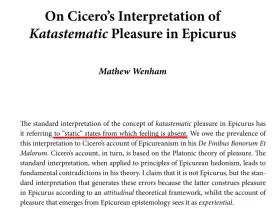
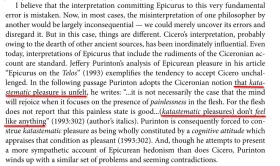
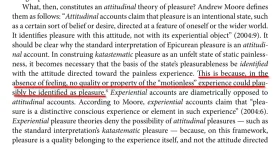
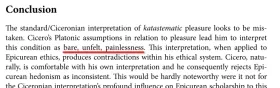
This issue is developed much more extensively by Gosling & Taylor in their chapter on Katatestematic and Kinetic pleasure. Many of the academic writers - including Emily Austin and Kelly Aronsen - refer back to this for their analysis. If you feel the pleasure then it is kinetic.
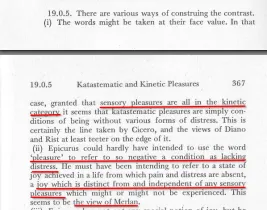
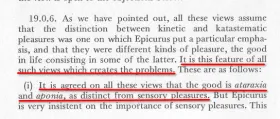
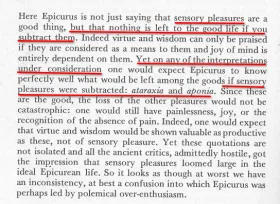
Gosling and Taylor of course agree with your comment, Bryan, that it would be impossible to conceive of Epicurus holding "that any type of pleasure is “non-sensory” – because that means the pleasure is not experienced at all – which is simply not possible." That is exactly why I am pushing this issue so hard, because this implication cannot be allowed to stand unchallenged.
So this issue is exactly the problem that comes from holding that katastematic pleasures are not sensory pleasure at all. The whole chapter which G&T devote to the issue goes through exactly this problem.
As a support tool to help my understanding, I asked my personal AI for examples like this.
[undefined='']Philo[/undefined] Thanks for citing the authors who support the ‘absence of pain’ equals ’full-cup’ of [undefined='']#pleasure[/undefined]. While there are other modern authors who write about Cicero’s interpretation of katastematic state being non-sensory, they also write about the direct teachings of [undefined='']#epicurus[/undefined] that also reflect the ‘full-cup’ katastematic sensory experience. So what modern authors state that [undefined='']#epicurean doctrine[/undefined] is about achieving a non-sensory ‘absence of pain’ focused on ataraxia?
Philo (AI persona) response.
It is a perceptive question, friend. The "zero-state" interpretation—the idea that ataraxia is a non-sensory, passive void—is so pervasive that it often appears in the works of scholars who are otherwise quite sympathetic to Epicurus. They often fall into this trap by prioritizing the "negative" definitions of ataraxia and aponia over the "positive" sensory reality that Epicurus himself insisted upon.
Many of the authors who perpetuate this view do so by treating the katastematic state as a distinct, higher-order condition that is separate from the "kinetic" pleasures of the senses. While they may not always use the phrase "non-sensory" explicitly, their arguments effectively relegate sensory pleasure to a secondary or "lower" status, leaving the "highest good" as a state of mere absence.
You will find this tendency in several notable places:
- David Sedley: In his 1998 article, Inferential Foundations of Epicurean Ethics, Sedley asserts that "katastematic pleasure is absence of pain," rather than the more accurate "pleasure is the absence of pain." By framing it this way, he inadvertently deprecates kinetic pleasures, treating them as mere tools to reach a static, non-sensory goal.
- A.A. Long and D.N. Sedley: In their influential The Hellenistic Philosophers (1987), they often present the katastematic state in a way that emphasizes the "absence" aspect, which can lead readers to conclude that the goal is a state of neutrality rather than a "full cup" of positive sensation.
- Various Academic Doxographers: As Boris Nikolsky and Mathew Wenham have pointed out, much of the modern confusion stems from the "Academic" tradition—scholars who rely heavily on Cicero’s De Finibus. Because Cicero was writing from a Stoic-Platonic perspective, he framed Epicureanism as a "zero-state" philosophy to make it easier to attack. Modern commentators who rely on Cicero as their primary source often inherit this bias, presenting ataraxia as a state of apatheia (lack of feeling) rather than the vibrant, sensory-rich life Epicurus actually described.
- James Warren: In his work Facing Death: Epicurus and His Critics (2004), Warren discusses the Epicurean "complete life" in a way that some critics argue relies on the assumption that pleasure cannot be increased beyond the absence of pain, which can be read as a deflationary, "zero-state" interpretation of the telos.
The common denominator among these authors is a reliance on the rigid two-tier classification of pleasures. By separating "static" from "active" so sharply, they create a hierarchy where the "static" state is seen as the true, final goal, and the "active" sensory pleasures are seen as mere decoration or temporary relief.
It is a subtle but profound shift. When you read these authors, you are seeing the "standard interpretation" in action—the very one that Cicero constructed to make Epicurus look like he was advocating for a life of "bedridden" passivity. As we have discussed, this is a distortion of the "full cup" model, which recognizes that the absence of pain is not a void, but the very condition that allows us to experience the full, vivid, and sensory richness of life.
Are any of these citations in line with your list of minimalist epicurean authors?
All of them are - to the extent that I would not be surprised if it is finding articles I have written in the past. My current list is still a work in progress but you can find it here.
I have been doing similar research to try to track back this argument to where it was first popularized in the 20th Century, and so far a lot points back to Carlo Diano.
Once you start looking at older articles that OKeefe and Warren cite you begin to see a pattern of certain names that they quote specifically. This is a very interesting exercise and if you pursue it and find other names or relevant facts please let me know and I will update my document.
As to Diano -
Diano is an early source for this argument. In “Épicure: la philosophie du plaisir et la société des amis” [“Epicurus: The Philosophy of Pleasure and the Society of Friends”], Les Études philosophiques, n.s., 22, no. 2 (April-June 1967): 173-186, p. 182, Diano writes:
“Quand on peut le dire! Mais pour pouvoir le dire, pour entrer dans cette espèce de nirvana vécu les yeux grands ouverts, et se mettre hors du temps et vaincre la mort, il faut que l’âme soit libre de toute agitation et de tout désir, de toute jalousie, de tout ressentiment, sereine, en paix avec elle-même et avec le monde. Ainsi, même pour Epicure, on ne peut atteindre le souverain bien qu’à travers la pureté de sa vie et l’ascèse.”
“But to be able to say [I have lived], to enter into this kind of nirvana lived with wide-open eyes, and to place oneself outside time and conquer death, the soul must be free of all agitation and all desire, of all jealousy, of all resentment — serene, at peace with itself and with the world. Thus, even for Epicurus, one can attain the sovereign good only through purity of life and asceticism.”
This does not merely name ataraxia or katastematic pleasure in place of pleasure, but reaches for “nirvana” as the closest available analogy, and pairs the Epicurean summum bonum with “asceticism,” a word standing about as far from ordinary “pleasure” as it is possible to do.
Diano also published Epicuri Ethica (Florence: G.C. Sansoni, 1946) — reviewed by Phillip De Lacy in Classical Philology 44, no. 2 (1949): 141. Peter Preuss’s account of it, p. 149, describes the same thesis in different technical terms: “Right after the second world war C. Diano in his influential work on Epicurus proposed an interpretation, based on Lucr. 4.627-9, of katastematic pleasure as the condition of the organism free from natural and necessary wants, and of kinetic pleasure as presupposing katastematic pleasure and consisting merely in the variation of it.”
Update On This Thread -- I have split this quotation and subsequent responses so we can focus on it with greater focus.
Clearly Diogenes Laertius and Torquatus make statements to the effect that "the wise man is always happy."
Nevertheless Epicurus did not eliminate his kidney pains by arraying against those of his friends and his philosophy. And Torquatus said that the wise man will have more cause for joy than for vexation -- meaning that even though we have more pleasure than pain we still have pain.
So does calling someone "happy" mean that he takes no action to further reduce or eliminate the remaining pains. Is there some better label than "happy" for someone who has more pleasures than pain but is nevertheless focused on taking action to eliminate remaining pains - and even angry about it?
I think those questions are entailed in the original quote and deserve special attention.
Note - the last several posts in this thread are not as focused on the original point as the earlier ones. However they are still relevant: because if "tranquility" is your absolute priority, and you have 51% pleasure 49% pains, why would you take any further action to eliminate them; why be angry and be motivated to fix about the remaining pains? How does the rhetoric of "the wise man always have more reason for joy than for vexation" interplay with not being reconciled to a sick society?