

Amazon description: This book links Plato and Epicurus, two of the most prominent ethicists in the history of philosophy, exploring how Platonic material lays the conceptual groundwork for Epicurean hedonism. It argues that, despite their significant philosophical differences, Plato and Epicurus both conceptualize pleasure in terms of the health and harmony of the human body and soul. It turns to two crucial but underexplored sources for understanding Epicurean pleasure: Plato's treatment of psychological health and pleasure in the Republic, and his physiological account of bodily harmony, pleasure, and pain in the Philebus.
Kelly Arenson shows first that, by means of his mildly hedonistic and sometimes overtly anti-hedonist approaches, Plato sets the agenda for future discussions in antiquity of the nature of pleasure and its role in the good life. She then sets Epicurus' hedonism against the backdrop of Plato's ontological and ethical assessments of pleasure, revealing a trend in antiquity to understand pleasure and pain in terms of the replenishment and maintenance of an organism's healthy functioning.

Opening Discussion of Kelly Arenson's "Health And Hedonism In Plato And Epicurus"
-
-
I am still in the process of reading this book but I have added it to the "recommended" section along with the DeWitt and Austin books for several reasons:
1. Generally, she takes a modified "Gosling & Taylor" approach and does not read "kinetic pleasure" out off the goal of Epicurean philosophy.
2. More specifically, these two paragraphs quoted below are a compelling argument against anyone who wants to argue that the Epicurean goal is "health" rather than pleasure. This is an excellent point and observation - I'd put it on par in terms of insight with Emily Austin's suggestion in Chapter 22 of Living For Pleasure that Lucretius likely intended to end Book Six of his poem with additional material from Thucydides. In what I am about to quote Arenson raises a point that is of even greater practical importance.
I have added the underlines to emphasize the issue.
Quote from Kelly Arenson - Health and Hedonism In Plato And Epicurus - p 161Given that the Epicureans stress how important health and the awareness of it is to happiness, one lingering question is why they do not identify health rather than pleasure as our highest and innate good. Why factor hedonism into the equation at all? It seems they could have gone the route of Plato’s Republic and claimed that although the best life is pleasant, our aim should be the internal harmony that engenders the pleasure rather than the pleasure itself. Perhaps this is just a version of Cicero’s objection that the Epicureans seem to propose two distinct goals: pleasure and the absence of pain. If the Epicureans understand the absence of pain in terms of health, then why not say that the end is health rather than pleasure? Perhaps the Epicureans do not stop at health because they are interested in describing the telos in terms of human feelings: that is, even if health were ontologically or epistemologically the best condition for humans, Epicureans would not be interested unless health also felt the best. We get the sense that in Plato’s eyes the just life will still be the best even if it is not the most pleasant: a just soul is always ontologically better than an unjust one. But the goal of Epicureanism is to help people feel better—to lessen their anxiety, help them avoid frustrated desires, and enable them to enjoy their lives. To say that health itself is the goal, divorced from our perceptions of how health feels, would be nonsensical to Epicureans, who would argue that health is worth talking about at all only because of its connection to the feeling of pleasure.
I think this point is related to Epicurus’ rejection of philosophy as an end in itself. For the most part, Epicurus advises us to concern ourselves with philosophy insofar as it will lead to pleasure. Th is position is expressed in an Epicurean work of unknown origin, reported by Porphyry: “Empty is that philosopher’s reasoning by which no human affliction is cured. For just as there is no benefit in the medical art if it does not cure the diseases of bodies, so there is no benefit in philosophy if it does not drive affliction out of the soul.” According to Epicureans, we should learn the truth about the gods, the limits of pain, and our abilities to get what we desire because having this knowledge enables us to maximize pleasure and minimize pain. We will have no use for philosophy if it should fail to bring about painless mental and physical experiences, and we will have no use for health if it should fail to do the same. Th is is not to say that Epicureans envision a contingent connection between health and pleasure; they argue, as I have tried to show in this study, that our experience of health—either in the process toward achieving it or in the condition itself—is intrinsically related to pleasure. Nevertheless, Epicureans would say that were health not linked to pleasure in this way, there would be no reason to care about health’s ontological credentials.
This is very perceptive. It's devastating to the argument that the true goal isn't Pleasure, and to arguments that state or imply that we don't need pleasure - "all we need is health of mind and body." Why did they talk so much about pleasure if all they wanted was "health"???
-
Note -- Godfrey posted that this "Health Hedonism" book by Erica Oberg is relevant to the "health" aspect of the Arenson book.
-
Today I also thought about this connection.
I do sport to maintain a healthy body. Why do I want a healthy body? To function? To satisfy my needs? To live... ultimately for pleasure, that is the intrinsic good.
Yes.
But would I take a shortcut if I could? Would I forgo exercise and health if I could obtain pleasure directly?
Two things come to my mind that argue against this:
1. Is it realistic? Can pleasure be separated from a healthy body?
2. Why do I feel an inner resistance/conflict at the thought of separating health from pleasure? Even if one were to feel comfortable in a sick body, suffering or pain would inevitably follow—at the very least, when bodily functions fail and I cannot fulfill my desires.
I can see this is quickly heading back toward the "Experience Machine" or drug scenarios.
I would decide against it precisely because one loses one's freedom and connection to the real world; returning is difficult to impossible, and one sacrifices everything. Major inner conflicts arise, and there is no ataraxia—hence the decision against it.
Of course, once you're inside, everything could be simulated to keep you there—at which point it’s likely too late; the decision has to be made beforehand. -
I would decide against it precisely because one loses one's freedom and connection to the real world; returning is difficult to impossible, and one sacrifices everything.
It is very interesting to see how individual people either deal with or refuse to deal with hypotheticals. It's certainly very important to evaluate whether the hypothetical is possible in reality or not.
But the purpose of a logical possibility is to exactly test the premise by abstracting out what are current realities. "But it's not possible" is essential to real life and it's why we choose real life over fantasy --- but some people are going to say that it is avoiding the question, and I do not think that they should be faulted to say that.
In this case the part I quoted above does not grapple with the question at hand.
Because in logical terms the answer to what is quoted above is clear --- why would you care about "freedom" or "connection to the real world" unless they bring pleasure?
That's why Kally Arenson made the statement she did -- NOTHING -- even "reality" or "being human" or anything else -- is desirable in itself unless it brings pleasure. Exempting ANYTHING from that test -- does it bring pleasure? -- is not good logic from the standpoint of logic alone.
If one chooses to play logic games, then rather than step outside of the philosophic position that pleasure is the supreme good, it would probably be better to say more like:
Logic is not truly useful unless its premises are grounded in reality, Your hypothetical is not grounded in realty, so I refuse to waste my time with it, just like Epicurus refused to entertain a hypothetical about necessity as to whether Hermarchus must be alive or dead tomorrow.
-
I have spent the morning listening to the first two chapters of the Arenson book, which is focused on what is said about Pleasure in the Republic and Philebus.
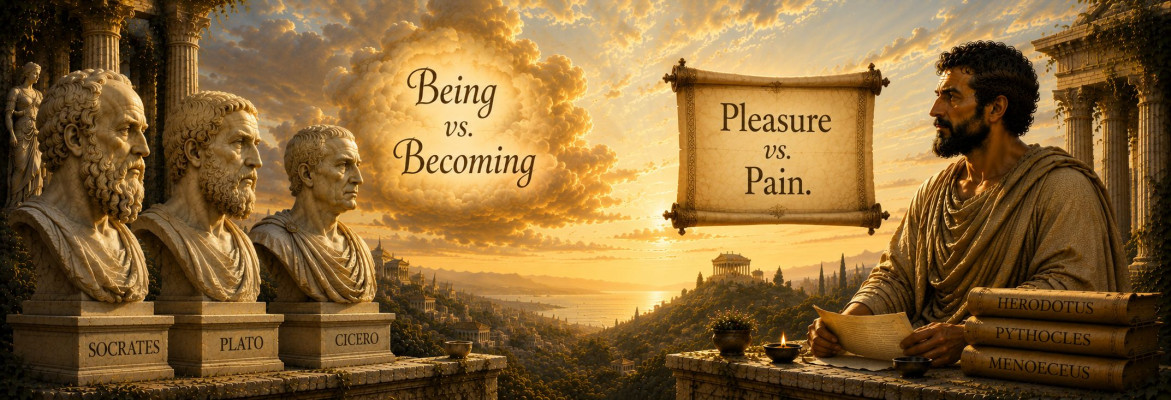
The whole structure of holding being to be better than becoming and the need to discuss "limits" is deeply disturbing to me in listening to this.
So much of this discussion of being vs becoming and limited vs unlimited is just unadulterated trash - it is very similar to religious discussion of angels dancing on pinheads.
This is likely to radicalize me further: Thomas Jefferson was far too lenient in his conclusions about Plato and other Greeks like the Stoics. These word games are as deceptive and manipulative as any religion ever invented.
Epicurus was right to point out their logical fallacies, but lingering too long in disputing them plays into their hands by distracting from a common sense understanding of pleasure and pain.
Probably the smartest this Torquatus said was at the beginning when he said that Epicurus refused to admit any need for argument or discussion to prove that pleasure is desirable and pain is to be avoided.
I am beginning to see this as very close to the argument as go religion. Yes it is good to point out that the religious view of the nature of divinity is flawed, but it makes no sense to spend your life debating priests about the supernatural.
And yes it makes sense to point out that the logic of the anti-pleasure arguments is wrong, but it makes no sense to argue forever about logical definitions of how to slice and dice pleasure into logical but meaningless categories.
It's as big a mistake to speculate endlessly about categories of pleasures as it is to speculate whether gods speak Greek or Latin.
If our goal is to better the lives of real people rather than pinheads, it's far better to stick to basic points and then work to apply them in real life, not just debate about words and definitions.
To clarify - this is an excellent book for those who want to understand how we got to where we are. Unfortunately those who need it most are probably the least likely to read it.
-
I'm getting it via interlibrary loan soon.
-

I'm getting it via interlibrary loan soon.
OMG.
Don, you and I and Joshua and many others here have done a creditable job and I'm not going to apologize for what we've done, because I think we're on the right track.
But what little we've done to comment on Philebus and Plato has been woefully incomplete.
I don't know where Arenson ends up yet (other than skimming the conclusion) so I can't say that we'll agree with all of her conclusions, but she's done in this book what we've needed to do for a long time -- go over in detail the arguments against pleasure not only in the Philebus but also in the Republic, and then go through Aristotle's tentative pushback.
Aristotle long before Epicurus had rejected this stupid and woefully insufficient "replenishment" theory of pleasure, which is tied to that cursed "process" and becoming vs being" argument which Aristotle also rejected. We've been talking around Epicurus' rejection of the same thing without getting the full picture in view of how central this "becoming is inferior to being" argument, and the citations she's collected will help us get much closer to where we need to be.
I think I can safely predict that neither you nor most of us here are going to find this to be an "enjoyable" book - at least in the sense of Emily Austin's "Living For Pleasure" because it's highly technical. But the background she provides is going to - I hesitate to say "revolutionize" but something on the same order - how we need to be discussing these issues.
A major difficulty is that she's doing what all academics do - presenting the various arguments without taking strong and immediate positions on which are correct. And many of us aren't going to be able to wade through it.
She covers much of the same ground as Gosling and Taylor, but they were even more frustatingly non-committal as they wade through it. Arenson is being considerably more clear in the implications of what's going on. And Socrates and Plato are just abominations who deserve to be exposed for the folly or maliciousness of their arguments, not simply viewed as being "clever" -- which itself appears to be a key word.
All this denunciation of pleasure as not the true good because it is a "process" rather than an "end" is definitely "clever" - but it's cleverness in the employment of something very much to be rejected.
I have a long way to go before finishing, and this is definitely not going to be a book for "everyone." But it's exactly the resource that those of us who are really trying to work through this need.
It is highly irritating to me that this has been out for over five years without me spending more time on it long ago.
That's a large part of why all this has to be a team effort.
-
Going back to Matteng 's post and Cassius ' response... The reasoning behind pleasure as the goal is that we are embodied human beings, and pleasure and pain are our guidance system. If a hypothetical removes or bypasses that constraint then the hypothetical serves no purpose for us. As long as it maintains that constraint then it may be worth our time and energy to ponder it.
-
I have another analogy that I think applies.
Today a friend sent me the linked video because he was so impressed how it went through the Bible and asked a series of questions that calls the Bible into question. 109 Questions For God
I think the video is good, and there was a time when I really would have been impressed by it. And a video like that probably has a lot of good uses for those people who are really worried about whether the Bible is true.
But the entire approach of the video is to "play on the other team's turf." It accepts many of the premises of the Bible and simply tries to use its own logic against it.
That's useful to a point, but when do you move on and stop granting them their premises in the first place.
Arenson's book really shines the spotlight on these stupid platnic arguments that the goal is "being" not 'becoming" and so our goal ought to be "heath" rather than the pleasures that plato acknowledges that some people find to be good.
When you accept the premise that only the "complete" or the "perfect" or "things that have a limit" are good, then you're playing on Platonic turf.
As Arenson says even Aristotle was smart enough to reject that "processes are inferior to goals" argument.
It looks to me like Epicurus included the discussion, such as contained in PDO3, because Plato was fixated on arguing that there is a middle ground between pleasure and pain and that that middle ground - absence of pain - is not pleasure at all.
Epicurus refutes that by arguing that there are only two feelings, that if you don't feel any pain what you feel is pleasure, and at that point that's actually the most "complete" pleasure because there's no pain involved at all.
That wins the logical point and is something that is important for people immersed in Platonism (like almost everyone was in 300 BC) to know.
But by even granting the premise that the state of "absence of pain" is important to talk about, you set the stage that Cicero walked into when he pointed out that "if you're concerned about pleasure you shouldn't care about absence of pain at all." That produced the argument that Epicurus really should have said he was a value dualist (a term we've seen here recently) and admitted that pleasure and pain are two separate goals and not the same thing.
Torquatus adamantly refused to admit that and for good reason - there's only pleasure and pain and so when we have no pain what is left is the most "complete" pleasure possible.
But is "complete pleasure" the most intense? Is it the longest in duration? Does it involve the most parts of the body? No necessarily on any of those three counts, except on purely "logical" terms. No one can credibly argue that "feeling no pain" tells you anything about the specific mental or bodily experience of a particular moment.
So while the point is important for refuting Plato's anti-pleasure logic, and needs to be discussed with anyone who is concerned about "being vs becoming" - it's a point that makes little sense outside that context. Arenson spends a lot of time talking about whether Cicero knew what he was talking about, and how much we should believe his descriptions about what Epicurus taught, but what is beyond dispute is that Cicero has succeeded in perpetuating this "war" between "pleasure as a process" vs. "the goal as some fixed and definite thing." And every anti-Epicurean of every religious stripe or ascetic position has used that as an invitation to say that that "fixed and definite thing" is not pleasure at all, but something entirely different.
So to be clear I am not criticizing Epicurus at all - he had to make the point to refute Plato on pleasure just like he refuted Aristotle on atomism. But we have to understand the specific history of the argument and the context in which it lives, because outside its context the terminology is easy to twist into the opposite of what Epicurus intended.
And that's the same reason most of us don't spend a lot of time on logical arguments about the flora and fauna of the garden of Eden -- we reject the whole paradigm, and it doesn't bother us.
The whole paradigm of "being vs becoming" and "pleasure as a process" and "pleasure as restricted to replenishment" are similar artifacts of a specific ancient argument that few people recognize or care about anyome - and for good reason - it was nonsense from the time Socrates and Plato et all started spinning it.
-
„The reasoning behind pleasure as the goal is that we are embodied human beings, and pleasure and pain are our guidance system…“
Good point.
Pleasure/Pain guide to what ? -
Pleasure/Pain guide to what ?
They are the guide to the best life, because pleasure is the word we choose to use to describe all that is intrinsically desirable.
Yes this is a word game, and if you want to argue that the goal should be set as "virtue" or "being like god" you can argue that too. In the end all these things are just words.
But some words can be tied to real experiences. In the case of Pleasure as the goal, that is tied to the feelings of pleasure and pain which our experiences reveal to us directly. Other goals are not so directly establishable - they are just words that float around forever in ambiguous and unprovable assertions about things like "gods" or "virtue" that can never be pinned down because they are just abstractions for which there is no direct sensory experience of them.
We have often mentioned in the past the cliche about the perfect not being the enemy of the good.
A variation of that is probably easier to see in this context is that the goal is not the enemy of the process, or the destination is not the enemy of the journey.
Embedded in the Platonic analysis seems to be the idea that "the good" should be viewed as the result of actions, but that the actions themselves are not good. It appears that the example that is cited is ships and shipbuilding -- that "ships" are "the good" of shipbuilding.
If you use that approach then ships are good, but shipbuilding is not good. Now the defenders of Platonism may say that that's not what they mean, but nevertheless that is what the ordinary person is going to gather from the statement. That shipbuilding is inferior to ships - that shipbulding is at best a necessary evil, and that what you really want is ships with the implication that you can dispense with shipbuilding.
That's also implied in the quoted statement - Pleasure/Pain guide to what ? As if all you need to know is what the goal is, and that once you know the goal you can dispense with pleasure and pain.
This attitude perspective is a big part of the issue with the way people are reading Menoeceus 128:
The right understanding of these facts enables us to refer all choice and avoidance to the health of the body and (the soul's) freedom from disturbance, since this is the aim of the life of blessedness. For it is to obtain this end that we always act, namely, to avoid pain and fear. And when this is once secured for us, all the tempest of the soul is dispersed, since the living creature has not to wander as though in search of something that is missing, and to look for some other thing by which he can fulfill the good of the soul and the good of the body. For it is then that we have need of pleasure, when we feel pain owing to the absence of pleasure; (but when we do not feel pain), we no longer need pleasure.
Yes you no longer need ADDITIONAL pleasure, but that's because what you have is made from all the normal pleasures of life. Would someone in the business of ships properly say "Now that I have a ship I no longer have need of nails, fabric, wooden beams, ropes, tar, or the rest?"
That would be ludicrous -- the only way to make sense of that is to understand you don't need MORE of them but ONLY because you already have them in the completed ship that you're going to sail on.
Would it be proper for a doctor to say - You have your health, so you no longer need skin, bones, food, water, air, shelter, or clothing. (?)
Of course not - that would be ludicrous - you have "health" ONLY because you have the things that make up health.
Epicurus is talking in Platonic terms to someone who would have understood that this relationship between the perfect and the good, between the goal and the process was a major concern of the time because Plato had preached it and Aristotle had wrestled with it without making the proper perspective clear.
And we're obviously still wrestling with it today, because CLEVER people have us convinced that "the good" is what we should be concerned about rather than what that term means.
And so we have people obsessed with 'a healthy mind in a healthy body" without any concern whatsoever for what "health" is all about - in fact allowing or even demanding that health be divorced from pleasure, even though it is absolutely ludicrous to do so.
We talk as if we are so superior to the rubes who believe in supernatural gods and punishments or rewards after death, when in truth much of the discussion about Epicurus today is trapped in an illusion that is far worse than those mistakes. As Epicurus said, at least those who follow religion have the hope of happiness by cozying up to the gods. Those who are mesmerized by "tranquility" and "health" and "happiness" and 'the good" and even "absence of pain" while looking down on pleasure are trapped in something far worse. They have created a divide that can never be healed because they think that "being" (the goal) is all that matters and that "becoming" (the required process) is beneath them.
Note: This analysis would also apply to the relationship between virtue to prudence, honor, and justice in PD05. Don't preach to me about "happiness" if you don't understand that happiness is inseparable from the actions that produce it (we call those actions virtues). It's the same point: Don't talk to me about "ships" if you don't understand that ships are inseparable from the wood and nails and cloth and rope from which a "ship" is made. Don't talk to me about "absence of pain" unless you understand that "absence of pain" is inseparable from the regular bodily and mental pleasures from which "absence of pain" is made.
-
I am posting this link to a new "blog" post I have just completed because it deals directly with the issues raised by Arenson in her book.
 Blog Article
The 'Academic Questions' Behind Evaluation Of Pleasure And Happiness
[legend='Superseded:','#b8860b']
This entry has been superseded. Please read the current version here.
[/legend]
"Academic Questions" sounds like exactly what a modern reader expects from ancient philosophy: a dry, technical argument about definitions, conducted by men with nothing better to do, over a question no one outside a classics department has any reason to care about. That impression is wrong. The argument Cicero stages between Lucullus and himself -- whether the senses can ever deliver… CassiusAugust 1, 2026 at 3:15 PM -
Cassius
August 2, 2026 at 10:22 AM Changed the title of the thread from “Opening Discussion of Kelly Arenson's "Health And Happiness In Plato And Epicurus"” to “Opening Discussion of Kelly Arenson's "Health And Hedonism In Plato And Epicurus"”. -
I've had the chance now to delve into this book--so far I've read chapters 5-8, and I'll next go to the beginning and pick it up from there. I tabled Chapter 4 temporarily as I didn't feel an immediate need to revisit the problems posed by De Finibus.
Just to set my bearings, here are take-homes from the chapters I read, as I understand them.
Katastematic pleasure is conscious, pleasurable, and sustained perception of one's well-being (Arenson uses the term "organic health"). Conscious perception is critical here. Bodily health is not pleasurable unless we are aware of it. The Epicurean highest good is not a perception-less state, but rather "belongs to an organism that suffers minimal disturbance to its normal operations and remains confident that its painless state will continue.”
Anticipation and recollection are elements of this kind of pleasure, which can be cultivated by means of the tetrapharmakon in combination with taking care of the body via proper nutrition and exercise.
- Kinetic pleasure encompasses what Arenson terms "restorative pleasures." These involve a return to the state of well-being following a disruption, such as the pangs caused by hunger or thirst.
- "Non-restorative pleasures," which are enjoyable but don't involve the disruption-restoration dynamic, belong in the katastematic category. Here, Arenson includes pleasures such as conversation, enjoying a beautiful view, hearing lovely sounds, and sex. In the latter case, I understand Arenson to be making a distinction between sex as sensory pleasure (in and of itself) and sex as the result of intense, disruptive craving. If so, her view might link up nicely with Book 4 of DRN.
At this point in my reading, I'm persuaded by her interpretation of katastematic pleasure as awareness of well-being. I'm less sold on her views regarding kinetic and non-restorative pleasures, but i probably need to mull her arguments further--and the foundations for it may be clearer after I read the opening chapters.
One thing that gives me pause: Arenson wants to include "active" pleasures in the katastematic category in part because she fears Epicureans would otherwise lead boring, passive lives. I don't quite get this. Even if all active pleasures (per Sedley) were to be defined as kinetic, that doesn't mean we're supposed to renounce them. An Epicurean's life can be as active as he or she wants it to be, as long as our choices are guided by prudence, courage, moderation, and justice. Contrast two situations- An Epicurean like Diogenes of Oenoanda, who led an active, cosmopolitan life
- An ascetic monk who leads a passive life and fears God/the afterlife due to religious superstition
It seems to me that the Epicurean here can enjoy a combination of well-chosen kinetic pleasures and katastematic ones--and this is true even if Arenson's non-restorative pleasures are in fact kinetic. The monk would enjoy only the kinetic pleasures allowed by the monastic code, and any katastematic pleasure would be compromised by fears and false beliefs.
So some aspects of Arenson's model give me pause--though, again, this could change as I reflect on it further. And I'll add that, whether or not we accept her model, she argues for it quite thoroughly and in the process delivers a useful summary of the debate. Thank you, Cassius, for making us aware of her work!
And I agree wholeheartedly with her "big picture" conclusion at the end of Chapter 7: unlike the Cyrenaics, who pursue any and all pleasures heedlessly and risk both immediate pain and unpleasant memories, Epicureans factor in long-term well-being (and the desire to be able to reflect happily on past pleasures) in our hedonic calculations.
-

One thing that gives me pause: Arenson wants to include "active" pleasures in the katastematic category in part because she fears Epicureans would otherwise lead boring, passive lives. I don't quite get this. Even if all active pleasures (per Sedley) were to be defined as kinetic, that doesn't mean we're supposed to renounce them. An Epicurean's life can be as active as he or she wants it to be, as long as our choices are guided by prudence, courage, moderation, and justice. Contrast two situations
I think she is wrestling with the issues we have been discussing -- she's aware of the argument that katastematic pleasures are somehow superior, but she is not going to accept the definition of katastemtic that equates those pleasures with basically nothing except some kind of ambiguous appreciation, because that would lead to the conclusion that the Epicurean goal is really to DO nothing in life -- and she isn't going to accept that as what Epicurus tought any more than Gosling and Taylor or Nikolsky or Emily Austin did.
I'm not finished yet myself but it appears to me that she's come up with the idea that Katastematic pleasures cannot really be the sensation-free nothingness that some allege, and she's dividing up pleasures into (1) those that respond to some lack or pain or need, and she's calling those kinetic, and (2) those that she's calling "painless" because they do not arise from a pain or lack. That's where she places smelling roses or music or even having sex, I gather (!)
So I'm still processing too, but as far as i can tell she's locked on in the real issue, sees it as a problem, and isn't going to accept it. She's not going to accept the idea that the best pleasure and therefore the supreme good is "katastematic" if that implies something that cannot be sensed. So she's rejecting the common interpretation of katastematic for that reason.
One really significant aspect of her analysis is that she's focusing on constructing something without reference to Cicero because of a combination of his unreliability or the simple confusion he causes.
But I note Robert that you said that you've read chapters 5-8, and I suspect you'll get a different picture when you read her analysis of Plato and Aristotle in the earlier chapters.
-
Oh - Robert - I meant to say one more thing:
The overwhelming feeling I have at the moment in my reading of this book is what an incredible waste of time all this debating about katastematic and kinetic is. I am very impressed with the book and I think it's an important step forward but it is the opposite of "Living For Pleasure." A normal person who tries to read this book is going to say "what in the world are you talking about, and why?" As appreciative as I am of the book I doubt I could recommend it to a layman - it's mainly useful only to someone who's debating the precise issue that we are talking about.
What makes me mad is that this book wouldn't be needed at all but for the fact that generations now of writers have created a mess that people like Arenson will need to clean up. We're already at the point where you have serious and qualified academic authorities who take multiple incompatible views of what the distinction means. That leads me to conclude that anyone who asserts that they are the confident arbiter of truth on this issue is blowing smoke. There's enough contradictory inference to support just about any conclusion someone would like to reach -- until you go back to the original Platonic / Aristotelian starting point of the debate.
But one thing I think is clear is that Arenson is completely rejecting the idea that --whatever else katastematic implies -- it is a "non-sensory" experience. All pleasure is sensory or it would not be pleasure.
-
We're already at the point where you have serious and qualified academic authorities who take multiple incompatible views of what the distinction means. That leads me to conclude that anyone who asserts that they are the confident arbiter of truth on this issue is blowing smoke. There's enough contradictory inference to support just about any conclusion someone would like to reach -- until you go back to the original Platonic / Aristotelian starting point of the debate.
Yes, I agree that no one should be overly confident about their take on this issue. We're just missing too many texts. It's tantalizing to read that passage in Diogenes Laertius and see his references to various works by Epicurus and Metrodorus--texts that would help resolve these debates, if only we had access to them!
As we don't, alas, I'll continue with reading Arenson's opening chapters this week and see if they strengthen my trust in her model (which I already find fairly persuasive). I'll let you know how it goes.

Finding Things At EpicureanFriends.com
Here is a list of suggested search strategies:
- Website Overview page - clickable links arrranged by cards.
- Forum Main Page - list of forums and subforums arranged by topic. Threads are posted according to relevant topics. The "Uncategorized subforum" contains threads which do not fall into any existing topic (also contains older "unfiled" threads which will soon be moved).
- Search Tool - icon is located on the top right of every page. Note that the search box asks you what section of the forum you'd like to search. If you don't know, select "Everywhere."
- Search By Key Tags - curated to show frequently-searched topics.
- Full Tag List - an alphabetical list of all tags.