

The 'Garden' Metaphor Was Cicero's Insult: The Ancient Epicureans Didn't Build On It For Good Reason
- Three Witnesses, No Metaphor
- Epicurus’s Garden: A Property, Not A Symbol
- Lucretius: Six Books Without A Garden
- Diogenes Of Oinoanda: Philosophy On A Public Wall
- What The Ancients Called Them: Epicureans, Not “The Garden”
- Where The Metaphor Comes From: Cicero’s “Little Gardens”
- What The Metaphor Does Today
- Conclusion: Leave The Garden To Cicero
This article was first published on EpicurusToday.com. Every citation below links to the passage itself in the texts on that site.
A Place-Name Is Not An Insult, But Neither Is It Praise. Overuse Perpetuates An Insult By Epicurus’s Enemies.
Three Witnesses, No Metaphor
Many books and websites call Epicurean philosophy “the Garden.” They speak of “the philosophers of the Garden,” of “Garden philosophy,” and of Epicurus “withdrawing to his garden.” The phrase is so common that most readers assume it comes from the Epicureans themselves.
It does not. We have three main witnesses for the arguments the Epicureans used to promote their own philosophy: Epicurus himself, the Roman poet Lucretius, and Diogenes of Oinoanda, who carved the doctrines of Epicurus on a city wall in Asia Minor in the second century AD. None of them builds anything on a “garden” metaphor. Epicurus mentions a garden as a piece of property. Lucretius never uses the Latin word for garden at all. In the surviving portions of his inscription Diogenes of Oinoanda never uses it either.
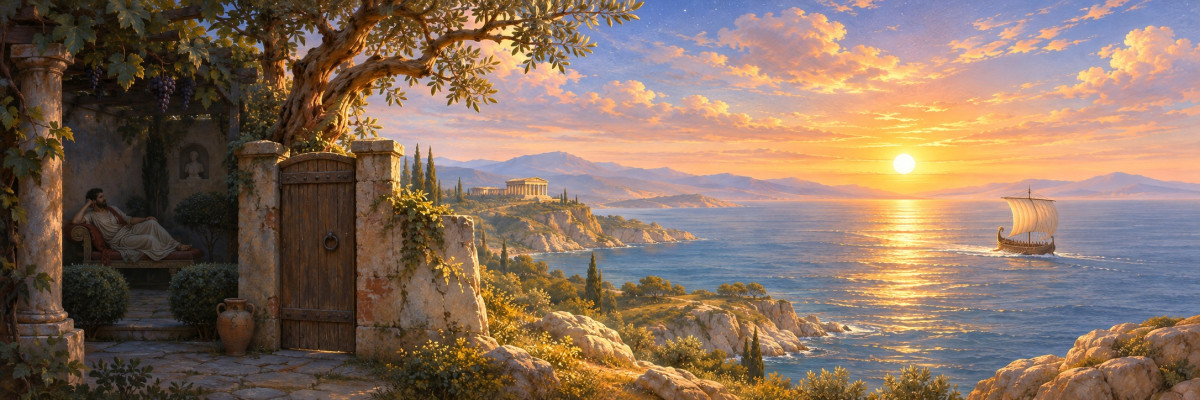
The metaphor as used today comes from the other side. Cicero, who wrote more against Epicurus than almost any other surviving author of the ancient world, suggested to his readers that they picture the Epicureans lounging in their “little gardens,” far from the public life that a Roman was supposed to serve. Later critics repeated the picture. That is the meaning the word carries today, and that is why those who support Epicurean philosophy should leave it to Cicero.
None of this is a complaint against gardens or gardening. Diogenes Laertius records that the Epicurean wise man “will be careful of his possessions and will provide for the future. He will be fond of the country” (DL X.120, tr. Bailey), and many who follow Epicurus today, the writer of this article among them, prefer life in a rural setting. If there is a lesson to draw from a garden that feeds its owner, it is the one Epicurus drew again and again: self-sufficiency, and the freedom of not being at the mercy of the crowd. “Independence of desire” (autarkeia, self-sufficiency) “we think a great good” (Letter to Menoeceus, DL X.130, tr. Bailey). “The greatest fruit of self-sufficiency is freedom” (Vatican Saying 77, tr. Bailey). “A free life cannot acquire many possessions, because this is not easy to do without servility to mobs or monarchs” (Vatican Saying 67, tr. Bailey).
That is not the picture Cicero launched. His “little gardens” were a slight aimed at a school whose founder took on the other philosophers directly. Cicero’s own spokesman Cotta complains that “Epicurus attacked Aristotle in the most insulting manner” (On the Nature of the Gods I.93, tr. Rackham). Shrinking that combative philosophy into a quiet hobby behind a wall was the point of the image.
Epicurus’s Garden: A Property, Not A Symbol
Epicurus bought a garden in Athens and taught there. Diogenes Laertius reports, on the authority of the Epicurean Apollodorus, that friends “came to him from all quarters, and took up their abode with him in the garden,” and that “he bought it for eighty minae” (DL X.10, tr. Bailey). Plato’s school met in the Academy, a public park and gymnasium, Aristotle’s in the Lyceum, and Zeno’s in the Painted Stoa (“Porch”). Greek schools were often known by where they met. A place-name is not an insult in itself, but neither is it praise. The word tells us where people gathered, not what they taught.
Epicurus’s will, preserved by Diogenes Laertius, uses the word in exactly this plain sense (DL X.17). He leaves “the garden and all that goes with it” to his successor Hermarchus “and to those who study philosophy with him,” and he asks his heirs to “preserve the garden” for those who “follow my philosophy.” The Greek word is κῆπος (kēpos, “garden”), and the will also speaks of τὴν ἐν τῷ κήπῳ διατριβήν (tēn en tōi kēpōi diatribēn, “the school in the garden”). A separate property, “the house in Melite,” is left for Hermarchus to live in.
Two things stand out. First, this is a legal document about real estate. The garden is land to be held, maintained, and passed on. Second, when Epicurus names the people who carry on his work, he does not call them “the Garden.” He calls them “those who study philosophy with” Hermarchus, and “those who hereafter follow my philosophy.” His name for his followers is drawn from what they do, not from where they meet.
The rest of what survives from Epicurus points the same way. His letters to Herodotus, Pythocles, and Menoeceus, and his Principal Doctrines, teach about atoms and void, the criteria of truth, the nature of divinity, death, desire, and pleasure. They are about the nature of things and how to live by that knowledge. They do not present the philosophy metaphorically as a garden, a retreat, or a cultivated plot.
Lucretius: Six Books Without A Garden
Lucretius wrote the longest surviving presentation of Epicurean philosophy, over seven thousand lines of Latin verse. The word hortus (“garden”) never appears in it. Neither does any related word.
This is not an accident of subject matter. Lucretius writes about farming at length. Michael Pope of Brigham Young University points out that in the long passage on the origins of agriculture (5.1361–78), Lucretius uses words for fields, small plots, vineyards, and grain fields, where hortus would be the natural companion, and still leaves it out (“The Strange Absence of Hort- in Lucretius,” Classical Quarterly 73.2, 2023, 926–928). Pope adds that the poem also lacks hortari (“to urge, encourage”) and all its compounds, though the poem as a whole is an exhortation.
Pope is sympathetic to Lucretius, but his own explanation is - as he says - tentative. He suggests that the poet lets the sound of hortus be heard in one place only, in the word exortus (“rising”), at the one point in the poem where Lucretius names Epicurus:
Epicurus himself died, when he had run his course in the light of life, Epicurus, who surpassed the race of men in understanding and quenched the light of all, even as the sun rising in the sky quenches the stars.
Lucretius 3.1042–44 (tr. Bailey)
On that reading, only Epicurus “exhorts.” While the idea may have poetic merit, what does not rest on any speculation is the plain fact Pope began with: in six books on Epicurean philosophy, Lucretius never once calls it a garden.
What Lucretius praises instead is a man who conquered fear with reason:
When the life of man lay foul to see and grovelling upon the earth, crushed by the weight of religion, which showed her face from the realms of heaven, lowering upon mortals with dreadful mien, ’twas a man of Greece who dared first to raise his mortal eyes to meet her, and first to stand forth to meet her … And so it was that the lively force of his mind won its way, and he passed on far beyond the fiery walls of the world, and in mind and spirit traversed the boundless whole.
Lucretius 1.62–74 (tr. Bailey)
And again:
He was a god, yea a god, noble Memmius, who first found out that principle of life, which now is called wisdom, and who by his skill saved our life from high seas and thick darkness, and enclosed it in calm waters and bright light.
Lucretius 5.8–12 (tr. Bailey)
The poem contains image after image - images of daring, of a mind that breaks through “the close-set bolts upon the doors of nature,” of a rescuer who brings men out of darkness into light. Lucretius describes his own work as explaining, teaching, and lighting up the mind. He never pictures Epicurus as resting in a garden. Even when he pictures a scene of rest, he places men “in friendly groups on the soft grass near some stream of water under the branches of a tall tree” (Lucretius 2.29–31, tr. Bailey), not in a garden. When Lucretius wants an image for the Epicurean, he chooses a conqueror, not a gardener.
Diogenes Of Oinoanda: Philosophy On A Public Wall
Diogenes of Oinoanda is the third great witness. In the second century AD he paid to have the doctrines of Epicurus carved on the wall of a stoa (a public colonnade) in the center of his city, in what is now southwestern Turkey. It is the largest Greek inscription known to us from the ancient world.
The latest and most complete English translation of the inscription is Martin Ferguson Smith’s Urbi et Orbi: The Epicurean Inscription and Prescription of Diogenes of Oinoanda (Rome, 2026), which Smith describes as “the first in English to include all the latest discoveries and research.” The word “garden” does not appear in it.
When Diogenes speaks of the Epicurean community, he speaks of people, not a place. A letter in the inscription mentions “Theodoridas of Lindos, a member of our school,” and its writer is “most eager to go and meet again both yourself and the other friends in Athens and in Chalcis and Thebes” (Smith, frs. 62–63). When he speaks of the source of his teaching, he names the man: there is “a free movement in the atoms, which Democritus failed to discover, but Epicurus brought to light” (fr. 54, tr. Smith), and he writes of friends who “have done some tasting of the doctrines of Epicurus” (NF 186, tr. Smith).
And Diogenes explains why he chose a public wall:
Moreover, [it is] right to help [also] generations to come (for they are our concern, although they are still unborn); and, besides, love of humanity prompts us to aid the foreigners who come here as well. Therefore, since the remedies of the inscription reach a larger number of people, I resolved to make use of this stoa to advertise publicly the [medicines] of salvation.
Diogenes of Oinoanda, fr. 3 (tr. Smith, Urbi et Orbi)
He even addresses those “who are called foreigners, although they are not really so. For, while the various segments of the earth give different people a different country, the whole compass of this world gives all people a single country, the entire earth, and a single home, the world” (fr. 30, tr. Smith). This is a man who put his philosophy in a public place at the center of his city and addressed it to the whole world. He is as far from a retreat into a garden as a man can be.
What The Ancients Called Them: Epicureans, Not “The Garden”
Before looking at the metaphor, notice what the ancient writers ordinarily called the school. Friend and enemy alike named it after the man, not the place. Counting in the texts on this site (Cicero in the Latin, the others in the English translations, leaving out the translators’ notes), the pattern is plain:
- Diogenes Laertius, in his life of Epicurus, calls the members of the school Ἐπικούρειοι (Epikoureioi, “Epicureans”). He uses “garden” only for the property itself (X.10, X.17) and in the nickname of one later head of the school, Apollodorus, “the Garden-tyrant” (X.25).
- Cicero, in his philosophical works, names Epicurus about 180 times and calls his followers Epicurei (“Epicureans”) more than thirty times. He mentions their garden six times.
- Seneca, in his Moral Letters, names Epicurus at least sixty times. He mentions the garden twice (4.10, 21.10).
- Sextus Empiricus, the skeptic, names Epicurus and the Epicureans at least eighty times. He calls them “the Garden philosophers” once (Against the Physicists I.64).
Place-names for Epicurus were used neutrally too. Epicurus was “an Athenian of the deme of Gargettus” (DL X.1), and Cicero, writing to his Epicurean friend Cassius, calls him “the famous Gargettian” when he jokes about Epicurean “images” (Letters to Friends XV.16, tr. Williams). No one today calls Epicureans “the Gargettians.” That name says nothing about how they lived, so it gave critics nothing to work with and dropped out of use. “The Garden” survived because it carries a picture: men withdrawn behind a wall.
The ordinary name was “Epicureans.” “The Garden” was the exception, and, as we will see, when it was used as more than the name of a property, it was nearly always used to belittle.
Where The Metaphor Comes From: Cicero’s “Little Gardens”
If the Epicureans did not build on the garden, who did? The earliest surviving metaphorical uses come from Cicero, and nearly all of them are hostile. The one friendly exception is a joke Cicero puts in the mouth of his Epicurean-leaning friend Atticus, who says that Antiochus “almost tore me away from our little gardens” (nostris hortulis) and led him a few steps into the Academy (Laws I.54, our translation). Even in that friendly joke, written by Cicero, the Epicurean side is the “little” one.
Pope offers two ancient passages as evidence that “the Garden” was the school’s “long-established nickname”: Epicurus’s will (DL X.17) and Cicero’s On the Nature of the Gods I.120. Those two passages tell the whole story. The first, as we have seen, is Epicurus using the word literally, for a piece of land. The second is the first true metaphor, and it is an insult. Cicero’s Academic spokesman Cotta says:
For my own part I believe that even that very eminent man Democritus, the fountain-head from which Epicurus derived the streams that watered his little garden, has no fixed opinion about the nature of the gods.
Cicero, On the Nature of the Gods I.120 (tr. Rackham)
The Latin is cuius fontibus Epicurus hortulos suos inrigavit: “from whose springs Epicurus watered his little gardens.” The garden here stands for Epicurus’s philosophy, and the point of the image is that it is small and borrowed, a plot kept alive with water taken from Democritus. The metaphor is born as a charge of plagiarism.
Earlier in the same book Cotta uses the garden to accuse the school of loose morals. After sneering at Leontion, a woman who wrote a book against Aristotle’s successor Theophrastus, he says, “such was the licence that prevailed in the Garden of Epicurus” (On the Nature of the Gods I.93, tr. Rackham).
Speaking for himself, Cicero uses the diminutive hortuli, “little gardens,” to push the Epicureans out of public life. In On Laws he says that those who measure everything they choose and avoid by pleasure and pain, “even if they speak the truth,” should be told to “say it in their own little gardens” (in hortulis suis) and to stay away from all part in the commonwealth, “of which they know no part and never wished to know any” (Laws I.39, our translation). In On the Orator he grants that Epicurean philosophy may keep its place, so long as it “rests in its own little gardens, where it wishes, where, reclining softly and delicately, it calls us away from the Rostra, the courts, and the Senate” (in hortulis quiescet suis, ubi vult, ubi etiam recubans molliter et delicate nos avocat a rostris, a iudiciis, a curia, On the Orator III.63, our translation).
Here we see the metaphor’s main use: the Epicurean as a soft man reclining in a small private plot, useless to his country. Cicero did not invent “the garden” as the name of the location of the school, but he invented what “the garden” has come to mean.
Later writers repeated him. Pliny the Elder calls Epicurus “that connoisseur in the enjoyments of a life of ease” (otii magister, literally “the master of leisure”), who “was the first to lay out a garden at Athens” (Natural History 19.51, tr. Bostock and Riley). Plutarch pictures “handsome young lassies too, such as Leontion, Boidion, Hedia, and Nicedion, that were wont to roam about in Epicurus’s philosophic garden,” and contrasts the joy of Epaminondas’s parents at his victory with “Epicurus’s mother, rejoicing that she had lived to see her son cooping himself up in a little garden” (That Epicurus Actually Makes a Pleasant Life Impossible 16, tr. Goodwin). Even Seneca, who quotes Epicurus with respect, uses the garden to paint him as a man of barley-meal and water: “This garden does not whet your appetite; it quenches it” (Seneca, Moral Letters 21.10, tr. Gummere). The garden thus becomes the standard shorthand for an Epicureanism that is idle, sensual, small, or thin, whichever the critic needs at the moment.
What The Metaphor Does Today
The same picture flourishes today, and it does the same damage intended by Cicero and his allies.
When a writer calls Epicurean philosophy “the Garden,” the reader hears retreat. The image is of a few quiet friends cultivating vegetables behind a wall, having given up on the world outside. Some readers take it literally. They conclude that the way to practice Epicurean philosophy is to take up gardening, as though the philosophy were a hobby of withdrawal and the ultimate Epicurean is a literal farmer. Others make the same mistake with food, and reduce Epicurean philosophy to fine dining. Both errors turn a philosophy about the nature of the universe and the guidance of all life into a pastime for the idle rich.
That was never the Epicurean message. Epicurus taught that the truth about nature can be known through the senses, that this knowledge gives us the confidence to dismiss the false claims of interfering gods and punishment after death, and that pleasure, of every kind and degree, is the guide of life. Pleasures run from the quiet to the exuberant: a meal with friends and a long conversation is no more necessarily to be preferred than climbing a mountain, sailing a rough sea, building a business, winning a hard contest, or exploring a new world. None of that fits behind a garden wall.
Nor did the Epicureans hide. Epicurus wrote letters to his friends in Mytilene and elsewhere, and he sailed to Ionia to visit friends there. His followers in Rome included statesmen and generals. Diogenes of Oinoanda put the doctrines on a public wall for citizens and foreigners alike. The picture of the Epicurean in a little garden is Cicero’s caricature, not Epicurus’s teaching.
Conclusion: Leave The Garden To Cicero
Epicurus named his followers for what they did: “those who study philosophy with” Hermarchus, “those who hereafter follow my philosophy.” Lucretius, in over seven thousand lines, praised Epicurus as a conqueror of fear and a bringer of light, and never once called the philosophy a garden. Diogenes of Oinoanda carved it on a public wall and addressed it to the whole world. The three witnesses who speak for Epicurus in his own tradition agree. The philosophy is not a garden.
The garden as a symbol belongs to Cicero, who used it to say that Epicureans should recline softly in their little plots and leave the Senate, the courts, and the public square to better men. We do not need to repeat his insult, however gently it is now phrased. Epicurus gave us a philosophy for the whole of life, lived in the open, in the full light that Lucretius praised. That is the life worth claiming, and that is the name to give it.