

Yes. It would give us newer folks a chance to become more acclimated too for awhile, in a cordial moderated atmosphere.
Posts by Pacatus
-
-
A suggestion from a "newbie": You might try having a "Newbie Night," say once a month, to start. Eventually some of the new people will become better-known regulars as you go. Just a thought.
-
"...as well as opening your mouth as you exhale ..."
I just wanted to add that when my wife had a heart attack a few years ago, we learned that exhaling with the lips parted (rather than just through the nose) relieves pressure on the heart. (That's my lay-person's translation.) Thus, it can be a bit more relaxing.
-
Thank you so much for that! I recently stumbled on just that phrase (in my own mind) when I was having difficulty: "Enjoy your breath." With some past experience of Centering Prayer and TM, I have sometimes coupled a simple short word/ phrase with the breath, just to remember. But I had forgotten.
 As Ram Dass once said: The most difficult thing can be to remember -- to remember ...
And this beautiful meditation connects the body and mind in a unified way. Thank you for reminding me ...
 I need to resurrect this simple practice.
-
Thanks. I am a "techno-peasant" -- but I'm willing to give it a go.
-
Since I have late-diagnosed (very late: 60 or so) ADHD, for me it's a bit of "one thought at a time."
Although that diagnosis was a big relief ("You mean I'm not crazy!?"), I personally reject the "disorder" in that last D. It's just the way my brain works, a bit outside the area of central tendency on the distribution; it has benefits and drawbacks, that's all. I naturally "hypertext" more than "knuckling down" my mind (which I did for years, to some detriment of my health).
I also cut off some social media (Facebook, some online forums; never tweeted) and have simply and peacefully left some former friends when the relationship became toxic. I feel more peaceful about that reading some of your experiences on here. Thanks.
-
I think I'd be interested in the future, just to get to know people a bit better. I don't "Zoom" -- but my wife has, and could help me get set up. Anyway, it seems like a good idea.
-

"Natural desires are limited; but those which spring from false opinion can have no stopping point. The false has no limits."
If Seneca is agreeing with Epicurus here (which it seems he sometimes did), then it seems in conflict with the conclusion in the 2nd quote: "The ability to increase is proof that a thing is still imperfect."
But why are "limits" a sign of imperfection? (That 2nd quote seems to be question-begging.) It can be recognition of the limit of a given pleasurable activity that keeps us from going over the tipping point, where it becomes painful (e.g., overeating). I might suggest that Nature has armed us as well as possible to enjoy a pleasurable/pleasant life of happy well-being. And that Epicurus got that right.
Sorry for wandering astray from the thread's request ...
-
Hey, thanks for the original post. It stirred things in me that I need to be aware of.
Be well!
-
Some are surely charlatans, some are true believers. I, too, have had my share of arguments on those fronts. For myself (and I'm only speaking for myself here), I had to realize that my anger was mine -- no matter how righteous it seemed -- and that I needed to find a way to deal with it, because I allowed it to spill over with people I loved: not at them, but like a wave they didn't need. I still am dealing with it.
Thanks for the correction on the trilemma.
-
Well, a proposition that the universe is (1) indifferent, (2) divine and (3) "works for the common good" seems to end up in a reductio ad absurdum -- unless (3) is strictly the outcome of randomness, even a "divine" randomness (whatever that might be).
But people can hold views that are contradictory without being liars. People can cling to beliefs that turn out to be logically inconsistent for many reasons -- sometimes, for example, in dealing with addictions, or past childhood traumas. Cognitive dissonance is not necessarily deceit.
BTW, I think Epicurus is sometimes credited with first pointing out that "serious dilemma" -- or, actually a trilemma.
-
I just want to say that so many of the insights shared by people here have helped me make this holiday season better than it would have been otherwise.
Be well and happy, all!
-

The issue of the actual physical existence of the Epicurean gods does not seem to me to be essential to any of those positions.
In my humble view, that seems exactly right. And that in itself removes fear of the gods (or personified Fate, or hellfire, etc.). My understanding is that Epicurus was not interested in either physics or metaphysics per se --- but only in understandings that led to a pleasurable/ pleasant life of happy well-being.
And although it perhaps should not be taken too dogmatically, the old maxim about absence of evidence not being evidence of absence would also seem relevant here. Especially given the apparent difficulty in defining the exact lineaments of such putative gods.
-
I think there are clearly feedback loops between the physical and the mental. But your chocolate cake example illustrates behaviors that may well become addictive, mask the mental pain, but ultimately create for pain/suffering themselves.
Although most of us are aware of psychosomatic responses that feed from the mental to greater physical health and well-being, it can also work the other way around. Non-stressful exercise for example -- walking, yoga, tai chi, laughter yoga (which starts with the physical rather than thoughts of funniness or good humor, but seems to feed fairly quickly -- 10 to 20 minutes -- into mental pleasure as well; the body enjoys laughing). Certain physical activities produce physical pleasure that fairly quickly translates into mental pleasure. I have personally found that physically stimulating the laughter response (e.g., by fluttering my diaphragm to simulate laughter) soon gets me to actually laughing, and becoming more cheerful. Norman Cousins famously testified to the reverse feedback (mental pleasure to physical pleasure), when laughing at funny movies for 20 minutes or so gave him hours of pain-free sleep.
I came across the following awhile back. Maybe it will be helpful:
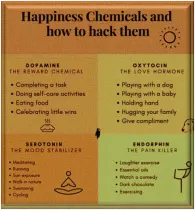
-
When I was 50, my wife and I mostly retired from the marketplace to what we called our "wildy garden": 20+ acres of forest, field and a quick-water creek; we lived in a 1940s cottage. We grew many of our own vegetables, planted fruit trees, and the like. We lived there for 15 years. We were far from our families and most of our close friends. Though occasionally they would come to visit, mostly we were on our own. (My wife did return to part-time teaching for a few years, and I did most of the household chores.) But we have always been best friends, and easy together.
Our main two Yule/winter solstice traditions then were to make a meal together for taking time over, and to "throw wishes on the fire." We had a good, stout fireplace (I enjoyed splitting a lot of wood each fall), and I would make a concoction of spices and alcohol - usually brandy or rum. We would throw spoonsful into the flames, watch them flare up, and laugh.
Since moving from the country to the town, we will make the place cozy (as Kalosyni said), with our enclosed gas fireplace and some electric candles (no open flames allowed in our apartment). We will visit some of her family for a few hours on Christmas eve. On Christmas day, we will make a meal together for taking time over - and will make a few lighthearted toasts. And be grateful for our happiness together.
Be well, all.
-
Thank you for this thread. My comments fold some of what I've absorbed reading this with thoughts I'd already come to.
First, I identify as an introvert. I learned long ago the definition of an introvert as someone who tends to replenish their energy more in solitude than with others, though they may still find great pleasure in the company of others - especially friends. I have known extroverts who, being the opposite sort, found much alone-time to be tiring. Except for a few on the hard edges of the spectrum, most of us likely find ourselves in some range of "ambiversion."
I enjoy measures of both solitude and company. That is just part of my personal hedonic calculus.
Similarly for tranquility (atarxia) and other pleasures. I can experience tranquillitas alone and in the company of others. And I don't find it in conflict with other pleasures, any more than I find the pleasure of a good afternoon nap in conflict with the pleasure of a glass of wine. And tranquility, for me, does not imply stillness - just a non-turmoiled mind. I can experience tranquility in meditation as well as while watching an exciting sports event. again, it's just all part of my personal hedonic calculus - lesson which has taken a long time to learn.
I find in Epicureanism, as I understand it thus far, a kind of relaxation - perhaps like letting out a long sigh - that I do not find in, say, Stoicism or Zen. Though the path does take practice, it does not seem to be a gritting-of-the teeth sort. That's why, in part, that I decided to revisit it.
-
Thank you, Martin.
-
Thanks, Cassius. It likely fits my "hypertexting mind" as well.
-
As best as I can recall, my introduction to Epicurus was DeWitt’s book, picked up randomly (or perhaps intuitively) from a library bookshelf. Next was Avraam Koen’s Atoms, Pleasure, Virtue: The Philosophy of Epicurus. I have since read others, including Catherine Wilson and Hiram Crespo; I have Cassius Amicus Elemental Epicureanism, which I am just beginning to delve into.
I just consider myself an explorer. [I have also read (strictly as an interested layperson) in Stoicism and Pyrrhonism. And some Wittgenstein.] I keep coming back to Epicurus both because of its “sensibleness” (double meaning intended) and its ability, thus far, to bring me back from turmoil to both pleasantness and calm.
I am an introvert who values a few friends. I do not take introversion as a problem: just a natural part of who I am—the same with my ADHD, which has benefits as well as constraints (I reject the “disorder” of that final “D”). I handle solitude well, but am not hermit. I am not a “joiner” by nature, and dislike anything that smacks of puritanism—in the sense of condemning further inquiry. I dislike strident argumentativeness.
The best model of a nurturing group environment that I have experienced was in 12-Step meetings, where direct cross-talk and criticism were discouraged—but where people shared often divergent viewpoints from their own experience, with an intimacy born of being in a safe environment. Lessons thus learned were indirect, rather than direct. More direct learning came from a sponsor, whom was freely chosen. It was a mutually nurturing friendship among people who might seldom meet outside that context.
I do not know if I “belong” here. But it seems a good place to continue exploring.
To borrow a phrase from Hemingway, I tend to see the Garden as “a moveable feast.”