1. Home
    1. Study Guide
    2. Community Standards
    3. Site Map
    4. Quizzes
    5. Articles On Physics
    6. Articles On Canonics
    7. Articles On Ethics
    8. All Articles
    9. Elli's Blog Posts
    10. Kalosyni's Blog
    11. All Blog Posts
  2. Lexicon
    1. Lexicon Home
    2. FAQ
    3. Files
    4. Search Assistance
    5. Foundations
    6. Navigation Outlines
    7. Reading List
    8. Key Pages
    9. Last Changes
  3. Forum
    1. Full Forum List
    2. Welcome Threads
    3. Ancient Texts Forum
    4. Physics
    5. Canonics
    6. Ethics
    7. Forum Shortcuts
    8. Forum Navigation Map
    9. Featured
    10. Most Discussed
  4. Latest
    1. New Activity
    2. Latest Threads
    3. Dashboard
    4. Search By Tag
    5. Complete Tag List
  5. Podcast
    1. Lucretius Today Podcast
    2. Episode Guide
    3. Lucretius Today At Youtube
    4. EpicureanFriends Youtube Page
  6. Texts
    1. Overview
    2. Torquatus On Ethics
    3. Velleius On Divinity
    4. Diogenes Laertius
    5. Principal Doctrines
    6. Vatican Collection
    7. Lucretius
    8. Herodotus
    9. Pythocles
    10. Menoeceus
    11. Fragments - Usener Collection
    12. Greek/Latin Help
  7. Gallery
    1. Latest Images
    2. Featured images
    3. Latest Comments
  8. More
    1. Featured Content
    2. Logbook
    3. EF ToDo List
  • Login
  • Register
  • Search
Everywhere
  • Everywhere
  • Forum
  • Articles
  • Blog Articles
  • Files
  • Gallery
  • Pages
  • Wiki
  • FAQ
  • More Options
  1. EpicureanFriends - Classical Epicurean Philosophy
  2. Cassius

Posts by Cassius

  • Welcome Thomas Karion!

    • Cassius
    • October 27, 2026 at 4:12 PM

    Welcome to the forum and that's a very interesting question.

    Quote from Thomas Karion

    If I were to attempt an approximate and unsatisfactory answer myself, I would begin by saying that, these days, most people seem to me to be less troubled by what he calls celestial realities (particularly the gods) and death. Because of this, I imagine that if Epicurus were to write books about nature today, it would be primarily to fully understand the limits of pain and desire (especially in the capitalist society of overconsumption in which we live). Furthermore, Epicurus would write about the Canon.


    I suppose it would be necessary to evaluate the context in which one might imagine Epicurus appearing and how he would arrive.

    If you were to literally have a time machine and transport the literal Epicurus, he would have a lot to do to pick up where he left off and decide how to evaluate what had happened in the intervening 2000 years. And if you allowed him time to investigate the history of the intervening time, I suspect he would be very unhappy about how society and social structures had developed during that time.

    When he left, Epicurean views were young and gaining popularity, as they did for hundreds of years after he died. The views that the espoused on most major issues of life were well respected and even opposition was within reasonable limits. Much of what has happened since that time represents a setback for those views, however, and I suspect that first and foremost he would want to know "why" and "what happened" to prevent the continuing development of his nature-based viewpoint.

    So in the most general terms I think "catching up" and then diagnosing "what happened and why" would probably be his first step. Then depending on what circumstances you placed him in, you'd probably have his attention drawn according to those circumstances (rich, poor, peaceful, at war, etc).

    That's only a general initial answer but thanks for your post and welcome to the forum!
  • Discussion of Article - "Aristotle - Introduction From An Epicurean Perspective"

    • Cassius
    • October 27, 2026 at 11:57 AM

    This thread is for discussion of the article below, which - like the Sextus article - focuses on providing citations rather than just providing broad generalizations -

    Article

    Aristotle - Introduction From An Epicurean Perspective

    Many readers think of Aristotle as the down-to-earth empiricist who turned away from Plato toward nature and the senses. His own words show otherwise: knowledge from first principles rather than the senses, a finite world with no void, a divine unmoved mover, and happiness as virtue and contemplation instead of pleasure. A guide to eight of Aristotle's core works and the passages that matter to Epicureans.
    Cassius
    October 27, 2026 at 11:50 AM

  • Welcome Thomas Karion!

    • Cassius
    • October 27, 2026 at 10:19 AM

    Welcome Thomas Karion!

    Thomas tells us:

    Quote

    Hello, my dear Epicurean friends,
    I hope you are all doing well.
    My name is Thomas Karion. I'm from France.
    I agree to the community's standards, rules, and terms of use.
    I first discovered Epicurus in 2005 by reading the Letter to Menoeceus.
    Since then, I've read just about everything I could find on Epicurus and Epicureanism.
    I'm requesting an account here to meet fellow Epicureans and reflect on what "being an Epicurean today" might mean in 2026. I hope to gain a better understanding of Epicureanism thought through my participation in the forum, while perhaps contributing my humble part to the current body of knowledge on the subject.
    I understand and acknowledge that the supreme good is pleasure.
    See you soon,
    Thomas

    Display More


    Thank you for registering at EpicureanFriends.com, and for writing to us about your background and interest in Epicurus. We look forward to hearing more from you!

    As a reminder, all posts are subject to our Community Standards, Rules, and Terms of Use.

    Welcome to EpicureanFriends!

  • Discussion of Article - "Sextus Empiricus - Introduction From An Epicurean Perspective"

    • Cassius
    • October 26, 2026 at 5:40 PM
    Quote from Pacatus

    I remain agnostic about whether there are any such beings as “gods.” I am not agnostic about rejecting supernaturalism. Nor am I agnostic about what happens after death – when I am no longer. Thank you, Epicurus!

    And therefore as such you are clearly NOT a Pyrrhonist and therefore are always welcome here! :)

  • Heads up: New Book Coming in 2027

    • Cassius
    • October 26, 2026 at 4:29 PM
    Quote from Pacatus

    are not susceptible.

    At least, that's not their present issue......

  • Heads up: New Book Coming in 2027

    • Cassius
    • October 26, 2026 at 4:18 PM
    Quote from Pacatus

    Epicurean philosophy as the best antidote to the modern ills of consumerism

    This is more an aside than a comment on the book, as I have other things i want to do before i dive into it.

    But I begin to wonder, Pacatus, if describing the ills of modern life as "consumerism" is a diagnosis that belongs to your and my generation, and that diagnosis itself is in the process of passing away as "boomerthink."

    I suspect most of the real upheavals in the modern world - the ones generating the wars and the really bitter conflicts, are not well described as arising from "consumerism" -- at least not in the way we grew up thinking of it as "keeping up with the Joneses."

    I gather most people younger than about 40 aren't plagued with the troubles of having too many career options or too much money to spend or too many houses or boats or trinkets to buy.

  • Heads up: New Book Coming in 2027

    • Cassius
    • October 26, 2026 at 3:30 PM

    So it's out -- and I see the photo on the cover is Epicurus looking down as if he is depressed or downtrodden or otherwise exhausted. Well we know this was coming....

  • Discussion of Article - "Sextus Empiricus - Introduction From An Epicurean Perspective"

    • Cassius
    • October 26, 2026 at 1:59 PM

    There are a lot of excellent quotations in Sextus Empiricus which I had an idea existed but had never seen in context. The point of this introduction is to organize those and provide links to them to make them easier to read in context. I also added this to a PDF and the links in the PDF resolve to the PDF version, ad that one contains a full set of Bury's footnotes.

  • Discussion of Article - "Sextus Empiricus - Introduction From An Epicurean Perspective"

    • Cassius
    • October 26, 2026 at 1:08 PM

    This thread is for discussion of the article:

    Article

    Sextus Empiricus - Introduction From An Epicurean Perspective

    Sextus Empiricus and Epicurus both spoke of ataraxia, and many readers conclude that the two wanted the same thing. Sextus's own words show how far apart they are: he names Epicurus a Dogmatist, reaches his "quietude" by giving up on truth, and attacks the pleasure Epicurus made the goal of life. A guide to Sextus's surviving works and the passages that matter to Epicureans.
    Cassius
    October 26, 2026 at 1:03 PM

  • David Sedley - "Creationism And Its Critics In Antiquity"

    • Cassius
    • October 26, 2026 at 6:24 AM

    Something else I was not aware of - Socratic roots of seeing god as omniscient and ominpotent - page 83

    Quote

    In Socrates the two modes of thought—the religious and the scientific—move
    apart, not in the sense that they become in any way incompatible, but in
    that Xenophon’s Socrates on the one hand advocates the cultivation of proper
    religious attitudes as morally indispensable, but on the other strongly advises against the study of physics at a theoretical level. Appreciation of god’s
    special care for mankind in no way depends on theorizing about just how
    his gifts have been engineered.

    In so far as the Socrates we meet in the pages of Xenophon permits himself any theoretical speculation in this domain, it is with regard to theology. Once freed of physics, theological theory is permitted to remain on the agenda. Thus Socrates is ready to propound a specific argument that the world possesses intelligence (the “Cosmic Intelligence Argument,” to whichI shall return in chapter VII §3). And he attributes to the supreme deity not only benevolence, but also powers that make that deity both omniscient and omnipresent (I 4.17–18) when he describes god as “so great and of such a kind as at one and the same time to see everything, to hear everything, to be present everywhere, and to take care of everything.” This theology has a Presocratic history, but not in the tradition of physics. What it unmistakably echoes and develops is the radical theology of Xenophanes,22 who in the late sixth or early fifth century b.c. had satirically denounced the anthropomorphization of gods (21 B 11–16 DK), redescribing the supreme divinity as an unmoved being capable of moving everything by the power of thought alone (B 23–26).

  • Sextus Empiricus - Clearly Stating That Skepticism Leads Not To Pleasure But To "Quietude"

    • Cassius
    • October 25, 2026 at 7:37 AM

    1 - So now I understand why the song sounds like the Kinks! :)

    2 - The song is a fun way to dramatize the central question. Radical Skeptics seem likely to say "Sounds good to me!" Let's just say for now that I don't think the way Epicurus spent his life leads to the conclusion that Epicurus - or anyone concerned about the difference between true and false or good and bad - would agree.

    Quote

    Full Lyrics:

    Something's happenin' but I'm just gonna turn a blind eye
    If I see no evil, ask no questions, and I hear no lies
    Can't communicate with minds that are small
    With some people it's like talkin' to the wall
    And a fellow who walks away
    Lives to battle another day
    And I've really got no appetite
    For a fight
    Not tonight

    All I want is a quiet life
    Anything for a quiet life
    No ambition to rock the boat
    When I can just stay afloat

    Be content with a quiet life
    All I want is a quiet life
    Anything for a quiet life
    Hear no evil, see no evil, speak no evil at all
    Confidentially, between these walls
    I'm on top of it all

    I'd rather have 'em think I'm deaf, dumb, and blind
    Than aggravation every time I speak my mind
    Keep at a quiet life
    Anything for a quiet life

    I could easily blow my top
    Start a row
    But why start now?

    Give your daddy a quiet life
    Give your mother a quiet life
    Anything for a quiet life

    Give your daddy a quiet life
    Give your mother a quiet life
    Anything for a quiet life
    Confidentially, between these walls
    I'm on top of it all

    Display More
  • Sextus Empiricus - Clearly Stating That Skepticism Leads Not To Pleasure But To "Quietude"

    • Cassius
    • October 25, 2026 at 7:08 AM

    One of that paper's conclusions is below. This in my mind takes the wrong position of saying that "Epicureans aimed at pleasure and understood this to consist in ataraxia." So the article has to be read in perspective from one's assessment of the crucial issue of whether they want to equate "ataraxia" and "pleasure" as exactly the same thing to Epicurus - to which there are many pieces of evidence that the answer to that is "no." Pleasure is a wider and more important goal than ataraxia, and even in Epicurean terms Sextus Empiricus sees that - and therefore Sextus does not clearly endorse Epicurus' ethical conclusions as his own.

    Quote

    Let us return to my original question: can an ancient Greek sceptic be eudaimôn?
    The answer, I think, is not entirely straightforward. It is not impossible that a sceptic (not, of course, through any deliberate choice) might happen to live the kind of life that, according to some other school’s account of eudaimonia, would qualify as eudaimôn. This is in fact not going to happen in most cases, given that such specifications of eudaimonia will usually include a component of definite belief that would be anathema to a sceptic. This is clearly true of the Stoic specification, and presumably of the Aristotelian one. But perhaps the sceptic – assuming he did indeed achieve ataraxia – might qualify as eudaimôn as conceived by an Epicurean, albeit via a different route from the one laid down by the Epicureans themselves. For the Epicureans aimed at pleasure, and understood this to consist in ataraxia; and while the Epicureans, unlike the Pyrrhonists, took the route to ataraxia to involve the adoption of certain beliefs about the world, it is not clear that they saw the state of ataraxia as itself incorporating any element of belief. What a sceptic would be advised not to do, if I am right, is himself lay claim to the achievement of eudaimonia, and include it as a component of the sceptical outlook in
    a role parallel to the one it occupies in other philosophies; for, as we have seen, the very concept seems to bring with it a number of theoretical presuppositions that one would expect a sceptic to want to avoid. And this, I suspect, is why Sextus decided not to use it in Outlines of Pyrrhonism, even though he had done so in Against the Ethicists

  • Sextus Empiricus - Clearly Stating That Skepticism Leads Not To Pleasure But To "Quietude"

    • Cassius
    • October 25, 2026 at 6:50 AM

    Apparently a paper very close to Robert's question, with evidence that aiming for happiness is not consistent with suspension of judgment. I haven't read it yet but looks interesting based on the Abstract.

    Can an ancient Greek sceptic be eudaimôn (or happy)? And what difference does the answer make to us? | Journal of Ancient Philosophy

    Abstract

    The paper explores how far the ancient Greek sceptics in fact accept, and how far they should accept, the central Greek ethical notion of eudaimonia, usually translated "happiness" - and what, if anything, the answers may tell us today. The first section shows that sceptics of both the Academic and Pyrrhonist traditions frequently employ the notion of eudaimonia, apparently without discomfort. The second section draws attention to a contrast within the relevant works of Sextus Empiricus - one of them being willing to speak of the sceptic's eudaimonia and the other entirely avoiding this - and considers some possible reasons why, at some point in his life, Sextus might have found the notion problematic. The answers suggested are, first, that the term eudaimonia, at least as normally used by non-sceptical philosophers, presupposes that it is possible to rank human lives objectively in terms of their levels of well-being, and second, that the term standardly carries with it a commitment to a certain kind of long-term structure in one's life; there is at least a serious question whether either of these is consistent with sceptical suspension of judgement. The third section examines how far a sceptic could aspire to happiness, where this is not assumed to be equivalent to eudaimonia, and touches on several modern philosophers who have focused on happiness or, more generally, on wellbeing. The conclusions are that the notions of happiness and eudaimonia are closer in their presuppositions than one might have expected; that a sceptic would be well advised to avoid either one; and that this constitutes a sobering lesson for anyone today who regards values as in some sense subjective, but who aims to construct a satisfactory conception of happiness.

  • Episode 357 - EATAQ39 - Continuing in Part 18 of Book 2 of Academic Questions - Not Yet Recorded

    • Cassius
    • October 24, 2026 at 5:55 PM

    Welcome to Episode 357 of Lucretius Today. This is a podcast dedicated to the poet Lucretius, who wrote "On The Nature of Things," the most complete presentation of Epicurean philosophy left to us from the ancient world. Each week we walk you through the Epicurean texts, and we discuss how Epicurean philosophy can apply to you today. If you find the Epicurean worldview attractive, we invite you to join us in the study of Epicurus at EpicureanFriends.com, where we discuss this and all of our podcast episodes.

    This week we are continuing our series reviewing Cicero's "Academic Questions" from an Epicurean perspective, which gives us an overview of the issues that split Plato's Academy and helps us understand Epicurus' position on the same issues. This week will continue in Section 18 of Book 2.

    Our text will come from
    Cicero - Academic Questions - Yonge We'll likely stick with Yonge primarily, but we'll also refer to the Rackham translation here: Cicero On Nature Of Gods Academica Loeb Rackham : Free Download, Borrow, and Streaming : Internet Archive

    As we proceed through the end of Academic Questions, these are the topics we expect to cover:

    24. Lucullus's Extended Rebuttal of the Academic Doctrine, and His Concluding Appeal to Cicero (2:XIII)
    25. Cicero Begins His Reply (2:XX)
    26. Cicero Lays Out the Syllogism About Assent and Opinion (2:XXI)
    27. Cicero Turns to Antiochus's Own Inconsistency (2:XXII)
    28. Cicero Defends His Citation of the Ancient Philosophers (2:XXIII)
    29. Cicero Adds Chrysippus and the Cyrenaics, Then Returns to Arcesilas and Zeno (2:XXIV)
    30. Cicero Returns to Attacking the Senses (2:XXV)
    31. Cicero Presses the Sun's Size and the Limits of Trained Perception (2:XXVI)
    32. Cicero Turns the "Art" Argument Back on Lucullus (2:XXVII)
    33. Cicero Multiplies Examples From Madness (2:XXVIII)
    34. Cicero Attacks Reason and Dialectics: The Sorites Paradox (2:XXIX)
    35. Cicero Presses the Liar Paradox (2:XXX)
    36. Cicero Presents Carneades's Own Positive Doctrine of Probability (2:XXXI)
    37. Cicero Distinguishes the Academic Position From Epicurus's (2:XXXII)
    38. Cicero Defends Probability Against the Charge That It Cannot Support Memory or Action (2:XXXIII)
    39. Cicero Answers the "Self-Refuting" and "Two Incompatible Propositions" Objections (2:XXXIV)
    40. Cicero Broadens the Argument Beyond the Stoics (2:XXXV)
    41. Cicero Reflects on His Own Position Among the Competing Schools (2:XXXVI)
    42. Cicero's Survey of Disagreement Among the Natural Philosophers (2:XXXVII)
    43. Cicero Presses the Problem of Providence and the Limits of Physics (2:XXXVIII)
    44. Cicero's Survey Continues: The Soul, the Antipodes, and the Motion of the Earth (2:XXXIX)
    45. Cicero Asks Which Natural Philosopher He Would Even Choose to Follow (2:XL)
    46. Cicero Turns to Ethics: Even the Gods Are Disputed (2:XLI)
    47. Cicero's Roll Call of Rival Schools on the Chief Good, Part One (2:XLII)
    48. Cicero's Roll Call of Rival Schools on the Chief Good, Part Two (2:XLIII)
    49. Cicero Weighs Zeno Against Antiochus on Virtue and the Happy Life (2:XLIV)
    50. Cicero Catalogs the Stoic Paradoxes About the Wise Man (2:XLV)
    51. Cicero's Climactic Debate Between Pleasure and Honor (2:XLVI)
    52. Cicero Turns to the Canon of Truth, and Zeno's Hand (2:XLVII)
    53. The Dialogue's Close (2:XLVIII)

  • David Sedley - "Creationism And Its Critics In Antiquity"

    • Cassius
    • October 24, 2026 at 4:48 PM

    Time for another memorable point:

    Sedley alleges that (at least in Greek thought) the first Creationist and first proponent of the Argument from Design was SOCRATES, as documented in Xenophon giving the following argument:

    Quote from Sedley, Creationism And Its Critiics In Antiquity, Page 84

    1. Representational artists are admirable creators, even though their products are not living beings.
    2. If that which produces living beings does so by mere chance, it is not more admirable than representational artists. (Implicit reason: it manifests less intelligence than they do.)
    3. If that which produces living beings does so by design, it is more admirable than representational artists. (Implicit reason: it is an intelligent creative artist, as they are, but a more admirable one, since its products are superior to theirs.)
    4. To determine whether that which produces living beings does so by mere chance or by design, we must ask whether its products, living beings, are typical of the products of chance or of those of design.


    Here we encounter for the first time the explicit disjunction of accident and design, offered as competing causal origins of life. The evidence of systematically purposive structures in nature is then cited by Socrates to discount the first alternative in favor of the second. And his clear, albeit implicit, conclusion is that the origin of life forms lies in a creator superior to any human creator. Do we not have here the earliest instance, or at least direct forerunner, of the Argument from Design?

  • Major Upgrade To Forum Software - Now Completed

    • Cassius
    • October 23, 2026 at 9:11 PM
    Quote from Cassius

    Let us know in this thread as you come across them and we will address them asap.

    One change that our users will note is that the Quote system works a little differently. Once you mark quotes they don't appear at the bottom right of the screen but at the bottom right of any post you are editing, and you can use them as before but from this different location. If anyone finds it confusing just ask about it.

  • Major Upgrade To Forum Software - Now Completed

    • Cassius
    • October 23, 2026 at 6:36 PM

    As of about 6:30 PM EDT the forum is back up after the upgrade. No doubt there will be theme and other issues that will need addressing. Let us know in this thread as you come across them and we will address them asap.

  • Major Upgrade To Forum Software - Now Completed

    • Cassius
    • October 23, 2026 at 4:34 PM

    As part of the security updates we are going to upgrade the software for the forum over the next several hours. Nothing major should be lost, but the site may be inaccessible during the upgrade. Please don't start any major new posts without having a backup!

  • Note Regarding This Week's Internet Security Issues

    • Cassius
    • October 23, 2026 at 3:46 PM

    Some of you may be aware that over the last several days there have been security issues in software known as "PHP" that runs many internet websites, including this one. I am not aware that this issue has caused us any issues whatsoever so far, but we have today integrated the latest patches so this should not be a problem for us going forward. However security is a constantly moving target so as always, if you detect any weirdness in operation of the forum please contact me so we can address it asap.

  • Sextus Empiricus - Clearly Stating That Skepticism Leads Not To Pleasure But To "Quietude"

    • Cassius
    • October 23, 2026 at 9:30 AM

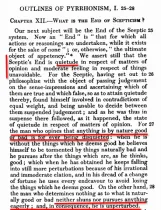
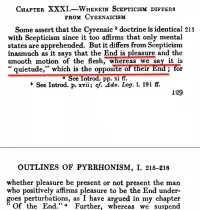
    Sextus says the goal of the Sceptic is “quietude” (ataraxia), reached by suspending judgement and giving up the search for truth (Outlines I.25–30). He contrasts this directly with the pleasure schools. Pleasure as the end, he says, is “the opposite” of Sceptic quietude (Outlines I.215).


Resources

  1. Getting Started At EpicureanFriends
  2. Community Standards And Posting Policies
  3. The Major Doctrines of Classical Epicurean Philosophy
  4. Introductory Videos
  5. Lexicon
  6. Lucretius Today Podcast
    1. Podcast Episode Guide
  7. Key Epicurean Texts
    1. Chart Of Key Quotes
    2. Outline Of Key Quotes
    3. Side-By-Side Diogenes Laertius X (Bio And All Key Writings of Epicurus)
    4. Side-By-Side Lucretius - On The Nature Of Things
    5. Side-By-Side Torquatus On Ethics
    6. Side-By-Side Velleius on Divinity
    7. Lucretius Topical Outline
    8. Usener Fragment Collection
  8. Frequently Asked Questions
    1. FAQ Discussions
  9. Full List of Forums
    1. Physics Discussions
    2. Canonics Discussions
    3. Ethics Discussions
    4. All Recent Forum Activities
  10. Image Gallery
  11. Featured Articles
  12. Featured Blog Posts
  13. Quiz Section
  14. Special Resource Pages
  15. File Database
  16. Site Map
    1. Home

Frequently Used Forums

  • Frequently Asked / Introductory Questions
  • News And Announcements
  • Lucretius Today Podcast
  • Physics (The Nature of the Universe)
  • Canonics (The Tests Of Truth)
  • Ethics (How To Live)
  • Against Determinism
  • Against Skepticism
  • The "Meaning of Life" Question
  • Uncategorized Discussion
  • Comparisons With Other Philosophies
  • Historical Figures
  • Ancient Writers and Texts
  • Decline of The Ancient Epicurean Age
  • Unsolved Questions of Epicurean History
  • Welcome New Participants
  • Events - Activism - Outreach
  • Full Forum List

Latest Posts

  1. Welcome Thomas Karion!

    Thomas Karion
    October 27, 2026 at 6:37 PM
  2. Discussion of Article - "Aristotle - Introduction From An Epicurean Perspective"

    Cassius
    October 27, 2026 at 11:57 AM
  3. Discussion of Article - "Sextus Empiricus - Introduction From An Epicurean Perspective"

    Pacatus
    October 26, 2026 at 6:06 PM
  4. Heads up: New Book Coming in 2027

    Cassius
    October 26, 2026 at 4:29 PM
  5. Do some people still believe in fate?

    Kalosyni
    October 26, 2026 at 9:27 AM
  6. David Sedley - "Creationism And Its Critics In Antiquity"

    Cassius
    October 26, 2026 at 6:24 AM
  7. Turning to Religion to Make AI Morally Good (Comparing this to Epicurean Philosophy)

    Kalosyni
    October 25, 2026 at 8:07 AM
  8. Sextus Empiricus - Clearly Stating That Skepticism Leads Not To Pleasure But To "Quietude"

    Cassius
    October 25, 2026 at 7:37 AM
  9. Episode 357 - EATAQ39 - Continuing in Part 18 of Book 2 of Academic Questions - Not Yet Recorded

    Cassius
    October 24, 2026 at 5:55 PM
  10. Major Upgrade To Forum Software - Now Completed

    Cassius
    October 23, 2026 at 9:11 PM

Frequently Used Tags

In addition to posting in the appropriate forums, participants are encouraged to reference the following tags in their posts:

  • #Physics
    • #Atomism
    • #Gods
    • #Images
    • #Infinity
    • #Eternity
    • #Life
    • #Death
  • #Canonics
    • #Knowledge
    • #Scepticism
  • #Ethics

    • #Pleasure
    • #Pain
    • #Engagement
    • #EpicureanLiving
    • #Happiness
    • #Virtue
      • #Wisdom
      • #Temperance
      • #Courage
      • #Justice
      • #Honesty
      • #Faith (Confidence)
      • #Suavity
      • #Consideration
      • #Hope
      • #Gratitude
      • #Friendship


Click Here To Search All Tags

To Suggest Additions To This List Click Here

EpicureanFriends - Classical Epicurean Philosophy

  1. Home
    1. About Us
    2. Classical Epicurean Philosophy
    3. Rules, Terms & Policies
  2. Lexicon
    1. Getting Started
  3. Frequently Asked Questions
    1. Site Map
  4. Forum
    1. Latest Threads
    2. Featured Threads
    3. Unread Posts
  5. Texts
    1. Core Texts
    2. Biography of Epicurus
    3. Lucretius
  6. Articles
    1. Latest Articles
  7. Gallery
    1. Featured Images
  8. Calendar
    1. This Month At EpicureanFriends
Powered by WoltLab Suite™ 6.2.8
Style: Inspire by cls-design
Stylename
Inspire
Manufacturer
cls-design
Licence
Commercial styles
Help
Supportforum
Visit cls-design