


1. Home
    1. Start Here: Study Guide
    2. Community Standards And Posting Policies
    3. Terms of Use
    4. Moderator Team
    5. Website Overview
    6. Site Map
    7. Quizzes
    8. Articles
      1. Featured Articles
    9. All Blog Posts
      1. Elli's Blog / Articles
  2. Wiki
    1. Wiki Home
    2. FAQ
    3. Classical Epicureanism
    4. Files
    5. Search Assistance
    6. Not NeoEpicurean
    7. Foundations
    8. Navigation Outlines
    9. Reading List
    10. Key Pages
  3. Forum
    1. Full Forum List
    2. Welcome Threads
    3. Physics
    4. Canonics
    5. Ethics
    6. Forum Shortcuts
    7. Forum Navigation Map
    8. Featured
    9. Most Discussed
  4. Latest
    1. New Activity
    2. Latest Threads
    3. Dashboard
    4. Search By Tag
    5. Complete Tag List
  5. Podcast
    1. Lucretius Today Podcast
    2. Episode Guide
    3. Lucretius Today At Youtube
    4. EpicureanFriends Youtube Page
  6. Texts
    1. Overview
    2. Diogenes Laertius
    3. Principal Doctrines
    4. Vatican Collection
    5. Lucretius
    6. Herodotus
    7. Pythocles
    8. Menoeceus
    9. Fragments - Usener Collection
    10. Torquatus On Ethics
    11. Velleius On Gods
    12. Greek/Latin Help
  7. Gallery
    1. Featured images
    2. Albums
    3. Latest Images
    4. Latest Comments
  8. More
    1. Featured Content
    2. Calendar
      1. Upcoming Events List
      2. Zooms - General Info
      3. Fourth Sunday Meet-&-Greet
      4. Sunday Weekly Zoom
      5. Wednesday Zoom Meeting
    3. Logbook
    4. EF ToDo List
    5. Link-Database
  • Login
  • Register
  • Search
Everywhere
  • Everywhere
  • Forum
  • Articles
  • Blog Articles
  • Files
  • Gallery
  • Events
  • Pages
  • Wiki
  • Help
  • FAQ
  • More Options

Welcome To EpicureanFriends.com!

EpicureanFriends is a community of real people dedicated to the study and promotion of Classical Epicurean Philosophy. We offer what no encyclopedia, AI chatbot, textbook, or general philosophy forum can provide — genuine teamwork among people committed to rediscovering and restoring the actual teachings of Epicurus, unadulterated by Stoicism, Skepticism, Supernatural Religion, Humanism, or other incompatible philosophies.

Sign In Now
or
Register a new account
  1. Home
    1. Start Here: Study Guide
    2. Community Standards And Posting Policies
    3. Terms of Use
    4. Moderator Team
    5. Website Overview
    6. Site Map
    7. Quizzes
    8. Articles
      1. Featured Articles
    9. All Blog Posts
      1. Elli's Blog / Articles
  2. Wiki
    1. Wiki Home
    2. FAQ
    3. Classical Epicureanism
    4. Files
    5. Search Assistance
    6. Not NeoEpicurean
    7. Foundations
    8. Navigation Outlines
    9. Reading List
    10. Key Pages
  3. Forum
    1. Full Forum List
    2. Welcome Threads
    3. Physics
    4. Canonics
    5. Ethics
    6. Forum Shortcuts
    7. Forum Navigation Map
    8. Featured
    9. Most Discussed
  4. Latest
    1. New Activity
    2. Latest Threads
    3. Dashboard
    4. Search By Tag
    5. Complete Tag List
  5. Podcast
    1. Lucretius Today Podcast
    2. Episode Guide
    3. Lucretius Today At Youtube
    4. EpicureanFriends Youtube Page
  6. Texts
    1. Overview
    2. Diogenes Laertius
    3. Principal Doctrines
    4. Vatican Collection
    5. Lucretius
    6. Herodotus
    7. Pythocles
    8. Menoeceus
    9. Fragments - Usener Collection
    10. Torquatus On Ethics
    11. Velleius On Gods
    12. Greek/Latin Help
  7. Gallery
    1. Featured images
    2. Albums
    3. Latest Images
    4. Latest Comments
  8. More
    1. Featured Content
    2. Calendar
      1. Upcoming Events List
      2. Zooms - General Info
      3. Fourth Sunday Meet-&-Greet
      4. Sunday Weekly Zoom
      5. Wednesday Zoom Meeting
    3. Logbook
    4. EF ToDo List
    5. Link-Database
  1. Home
    1. Start Here: Study Guide
    2. Community Standards And Posting Policies
    3. Terms of Use
    4. Moderator Team
    5. Website Overview
    6. Site Map
    7. Quizzes
    8. Articles
      1. Featured Articles
    9. All Blog Posts
      1. Elli's Blog / Articles
  2. Wiki
    1. Wiki Home
    2. FAQ
    3. Classical Epicureanism
    4. Files
    5. Search Assistance
    6. Not NeoEpicurean
    7. Foundations
    8. Navigation Outlines
    9. Reading List
    10. Key Pages
  3. Forum
    1. Full Forum List
    2. Welcome Threads
    3. Physics
    4. Canonics
    5. Ethics
    6. Forum Shortcuts
    7. Forum Navigation Map
    8. Featured
    9. Most Discussed
  4. Latest
    1. New Activity
    2. Latest Threads
    3. Dashboard
    4. Search By Tag
    5. Complete Tag List
  5. Podcast
    1. Lucretius Today Podcast
    2. Episode Guide
    3. Lucretius Today At Youtube
    4. EpicureanFriends Youtube Page
  6. Texts
    1. Overview
    2. Diogenes Laertius
    3. Principal Doctrines
    4. Vatican Collection
    5. Lucretius
    6. Herodotus
    7. Pythocles
    8. Menoeceus
    9. Fragments - Usener Collection
    10. Torquatus On Ethics
    11. Velleius On Gods
    12. Greek/Latin Help
  7. Gallery
    1. Featured images
    2. Albums
    3. Latest Images
    4. Latest Comments
  8. More
    1. Featured Content
    2. Calendar
      1. Upcoming Events List
      2. Zooms - General Info
      3. Fourth Sunday Meet-&-Greet
      4. Sunday Weekly Zoom
      5. Wednesday Zoom Meeting
    3. Logbook
    4. EF ToDo List
    5. Link-Database
  1. EpicureanFriends - Classical Epicurean Philosophy
  2. Cassius
  • Sidebar
  • Sidebar

Posts by Cassius

New Graphics: Are You On Team Epicurus? | Comparison Chart: Epicurus vs. Other Philosophies | Chart Of Key Epicurean Quotations | Accelerating Study Of Canonics Through Philodemus' "On Methods Of Inference" | Note to all users: If you have a problem posting in any forum, please message Cassius  

  • Thomas Jefferson's Epicurean Writing And Development

    • Cassius
    • April 15, 2018 at 10:14 AM

    I'm revising a thread originally started in 2018 to serve as a focal point for finding Jefferson's Epicurean-related writing. At the moment, the best collection of Epicurean-related fragments that I've put together in the past is located here:

    Jefferson – NewEpicurean

    Unfortunately that's not particularly well formatted, so I will work on improving that and adding it here at the forum.

    Also, I'd like us to use this as a thread to assist in research and discussion of what we can reconstruct about Thomas Jefferson's interest in and development of Epicurean ideas. What can we reconstruct as a timetable as to when Jefferson first began to become familiar with Epicurean ideas, leading up to his 1819 letter to William Short where he wrote "I too am an Epicurean?" Jefferson died in 1826, so the 1819 letter was near the end of his life.

  • Planning for Upcoming Voice Chats on DeWitt's Epicurus and His Philosophy

    • Cassius
    • April 14, 2018 at 11:03 AM

    Looks like at this point we better plan for April 21st. I'll put up a notice at the top of the EF page, and also post to Facebook in a couple of days. The "announcement" at the top of the page has now been added, and I will add a Facebook notice next week. In the meantime let me say this: We can make a pragmatic judgment call on how many people we need to indicate that they will attend before we schedule, and if we need to do so we'll postpone til we have more. But if we do, it will be just that - a postponement - because while we may be delayed, we will persevere until we have the numbers to go forward!

  • Responses to Nussbaum's Criticism That Epicureanism Is Not A Real Philosophy; That Epicureanism Numbs Intellect And Critical Thinking

    • Cassius
    • April 12, 2018 at 6:37 AM

    More on Elena Nicoli, someone definitely worth following! https://radboud.academia.edu/ElenaNicoli

    Based on her public posts on her facebook page, she is VERY active in Epicurean scholarship - https://www.facebook.com/elena.nicoli2

    CV listing her articles: https://portal.ru.nl/people/cv/665145.pdf

  • Responses to Nussbaum's Criticism That Epicureanism Is Not A Real Philosophy; That Epicureanism Numbs Intellect And Critical Thinking

    • Cassius
    • April 12, 2018 at 6:18 AM

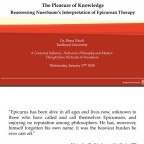
    This is a thread to discuss the presentation material posted by Jason Baker entitled "The Pleasure of Knowledge: Reassessing Nussbaum’s Interpretation of Epicurean Therapy" by Dr. Elena Nicoli, Radboud University, subtitled "A Contested Influence. Hellenistic Philosophy and Modern Thought from Nietzsche to Nussbaum." This is not the full lecture, but summarizes the main points with some excellent citations to Epicurean literature.

    The original post is here:

    File

    The Pleasure of Knowledge. Reassessing Nussbaum's Interpretation of Epicurean Therapy - Elena Nicoli

    A Contested Influence. Hellenistic Philosophy and Modern Thought from Nietzsche to Nussbaum
    jbaker
    April 11, 2018 at 8:30 PM
  • A Thread For Encouraging Thoughts

    • Cassius
    • April 11, 2018 at 7:10 AM

    All of us get discouraged at times, but we shouldn't be tempted to think that we need a fraudulent Jewish ghost or a mindless Christian ethical system. We are fighting for the people and the things that we love in life, and that is more than enough reason to fight. All the evidence our heart needs come from the pleasure we feel in that which we love, and the pain that we feel in losing it. And all the evidence our mind needs starts with the fundamental Epicurean observation we make with our own eyes: that nothing comes from nothing, and nothing goes to nothing.

  • Welcome Matthaios!

    • Cassius
    • April 9, 2018 at 6:27 PM

    Welcome Matthaios! When you get a chance please introduce yourself and let is know about your background in Epicurus.

  • The Process of Pulling Out Of Facebook

    • Cassius
    • April 9, 2018 at 2:43 PM

    Someone else I respect leaving facebook - Steve Wozniak -- https://www.usatoday.com/story/tech/201…book/497392002/

  • The Process of Pulling Out Of Facebook

    • Cassius
    • April 9, 2018 at 1:16 PM

    I am looking into this and will report back! I too am concerned.

  • "Easter Sunday 2018" - Epicurean Philosophy Doesn't Start And End With "Pleasure"

    • Cassius
    • April 9, 2018 at 6:24 AM

    I begin to think that at various parts of my websites I am going to replace quotes that focus narrowly on pleasure with quotes that highlight the physics / canonics basis of Epicurean philosophy, not out of concern about pleasure but so not to play into the hands of those who argue that pleasure is the only subject Epicurus addressed. And then, at the same time and in parallel, pursue how "pleasure" covers much more ground than it appears.

  • Talking About Epicurus With Someone Who Is A Stoic (Or Of Some Other Anti-Epicurean Philosophy)

    • Cassius
    • April 8, 2018 at 8:49 PM

    This thread is to kick off discussion of how to approach discussing Epicurus with someone who is a Stoic, or a fan or student of some other anti-Epicurean philosophical school.

    It's possible that a table of comparisons like the following might be helpful: A Comparison Chart: Stoic vs. Epicurean Philosophy


    This is a kickoff thread -- please add your suggestions.

  • Talking About Epicurus With Someone Who Is Secular Humanist / Atheist

    • Cassius
    • April 8, 2018 at 8:47 PM

    This thread is to kick off discussion of how to approach discussing Epicurus with someone who is secular humanist / atheist.

    This would seem to be a category that almost doesn't have to be discussed, because secular humanists/atheists are often thought of as already Epicurean. In fact, however, it has been my experience that this is far from the truth. Secular humanists often adopt Judea-Christian ethics almost totally, simply dispensing with the idea of a supernatural god. That's a good start, but in Epicurean terms it doesn't go nearly far enough to firmly endorse pleasure as the guide of life, death as the end of consciousness, and - even more controversially - the Epicurean view of Justice as not built on abstract absolutes, bu on the individual happiness of the people concerned.

    For example, it is possible that in dealing with someone of this background that there are references in Nietzsche, or Dimitri Liantinis, which would point the way more directly to Epicurus.


    Anyway this is a kickoff thread -- please add your suggestions.

  • Talking About Epicurus With Someone Who Is Religious

    • Cassius
    • April 8, 2018 at 8:38 PM

    This thread is to kick off discussion of how to approach discussing Epicurus with someone who is religious.

    Although the case will probably differ with type of religious background, it would be helpful to have a list of major points to make early in the discussion process, plus a suggested reading list of articles and books.

    For example, it is possible that in dealing with a American of Christian background, reference to something from Thomas Jefferson, or even Thomas Paine's "Age of Reason" (which is not Epicurean) would provide a foothold for extending the argument further.

    Another approach might entail pointing the religious persons to collections of contradictions within the Bible, or lists of outrageous ethical statements in the Bible. Anyway this is a kickoff thread -- please add your suggestions.

  • The Process of Pulling Out Of Facebook

    • Cassius
    • April 8, 2018 at 6:00 PM

    I am going to do that eventually once I make a final evaluation of whether I can restrict its use to "advertising." Lot's of people here I probably never would have "met" except for Facebook's groups feature, but that period is coming to a close.

  • Planning for Upcoming Voice Chats on DeWitt's Epicurus and His Philosophy

    • Cassius
    • April 7, 2018 at 11:58 AM

    Shall we start planning for another Discordapp discussion of the next chapter of DeWitt's book? I think the last time we talked we discussed skipping over several of the "life of" chapters and going straight to the meatier chapters, probably the next one of which is Chapter 6 - Sensations, Anticipations and Reason. How about either the 14th or the 21st? Leave comments and we'll pick one.

  • td76's outline

    • Cassius
    • April 6, 2018 at 6:35 AM

    I would recommend starting with the Pontius Pilate question: "What is truth?"

    Many people accept the standard implication that "truth" requires identification of something that is true at all times, places, and for all people, but is such a thing even possible? If not, what IS possible? Think about the discussion of images and illusions in Lucretius. The awning at the spectacle casts a color on the Senators. Did that "truly" make the Senators that color?

    As for anticipations we have much less to go on, but I follow the DeWitt theory and you should at least consider it before deciding. The issue here revolves around whether anticipations are (1) simply what is referred to as conceptualization after experience (I see these animals standing in the field and I names them cows) or whether (2) they are indeed PREconceptions which operated prior to experience. Again, be sure to read and consider DeWitt on this topic before you accept the majority "conceptualization" view.

  • A General Thought About The Future Of Epicurean Philosophy - On The Meaning of "Pleasure"

    • Cassius
    • April 5, 2018 at 7:50 PM

    What I need to write on this is a book, and not a short post, but this is all I have time for at present. I reflect a lot about what might be missing from the modern interpretation of Epicurus that explains why some of us can find it so compelling, yet many others find it not worth a second thought. In the ancient world there were MANY who found it compelling, and even more who found it outrageously evil and worth tremendous effort to stamp out.

    There are no doubt many factors that explain the discrepancy, but one I find most likely: the narrow meaning and implication assigned to the term "pleasure" in modern discussions of Epicurus.

    I think Epicurus intended "pleasure" to include everything in life we find worthwhile - which by Epicurean definition means everything that gives us pleasure of any kind, not just physical but also mental / emotional. If we find something lovable in life, that response within us is a subset of pleasure. That means everything we find in life that is motivational, from art and science to politics and fame (the latter of which are deemed unacceptable in the modern orthodox interpretation) are desirable because they bring pleasure. There are many passages from which it ought to be clear that NOTHING that brings pleasure is undesirable in itself, and it is only in the likelihood (but not certainty!) that some choices will bring inordinate pain that we are well served to avoid them. That means that the decision to pursue any choice in life which we find to be pleasurable can be understood to be consistent with Epicurean philosophy - it is simply up to us to deal with the consequences if we choose unwisely and our choices bring more pain than we anticipated.

    I am of the age where I have gradually had to accept that virtually every religious and ethical proposition I was taught when I was growing up in the 60's and 70's was wrong. As an adult, like everyone else, I witness that public discussion (the media) is totally devoid of "objectivity." The truth of *any* significant matter, if it can be found at all, comes only after intense individual study of competing opinions.

    Epicurean philosophy is revolutionary because it teaches that the ethical and political norms which we were taught as children were not grounded, as we were taught, in "god" or "absolute truth" or "natural law." In fact they are grounded in NOTHING. Once we accept the Epicurean world view that a life that there IS no absolute justice, or absolute ethical truth, and instead it is the pursuit of pleasure as we find it that is everyone's true goal, we see that there is no reason to conform to existing norms and orthodoxies if they do not bring us happiness. That's the realization that the world is wide open to *our own* decision and action as to how we pursue our own happiness.

    This leads in my mind to the *reverse* of the standard opinion that Epicurean philosophy leads to passivity and withdrawal. Once we grasp the Epicurean insights into the nature of the universe, from which we see that there is no god or central point of reference from which any truth can be deemed absolute, we ought all begin to wake up from our lethargy. Add to that the realization that this is our ONLY life, that for an eternity afterward we will be no more, and that if we don't act to live THIS life to the fullest then there is no god or "force" that will come to our aid, and what do we have? We have a prescription for the most liberating and motivational and *activist* philosophy of life ever invented!

    Many in the ancient world saw that, and many adopted that viewpoint, especially the Roman Epicurean examples about which we know the most. But for those Stoics and Religionists who wanted no part of the Epicurean view, we ought to ask ourselves what they would have likely chosen to do in response. What would the more intelligent of them thought to be the most effective way to undercut the philosophy at its start?

    I suggest that what the enemies of Epicurus decided to do (remember, he warned against this very thing in the letter to Menoeceus) was is to spread the word that Epicurean "pleasure" amounts to nothing more than sex, drugs, and rock'n'roll. Spread the word that love of wives, love of children, love of family, love of friends, love of one's county, love of one's way of life, love of one's own view of art, love of one's own striving to make oneself better - spread the word that THESE were no part of Epicurean philosophy! Spread the word that Epicurus taught that we should do nothing to gain these, or to protect them when we gain them. Spread the word that Epicureans were lazy, good-for-nothing parasites off the main body of the community, contributing nothing to defend it, nothing to keep it going, playing no role in forming or supporting the organizations that can alone keep us safe from enemies both foreign and domestic.

    I'll end these thoughts at this point, but I think the lies we see spouted about every political, religious, and philosophical topic today are not new. Not only are they not new, these same attitudes have been working overtime for 2000 years to keep the majority of people "in line" and "in conformity" with groundless orthodoxies that would be blown away by the slightest breeze of reasoned analysis. Remember Alexander the Oracle-Monger - that story is repeated thousands of time daily in the modern world, but there are few who stand up to it in the spirit of Epicurus!

    If we're to rediscover the key to what made Epicurean philosophy so successful in the ancient world, and light that flame again today, it's time to rethink and redefine our understanding of "pleasure."

  • td76's outline

    • Cassius
    • April 5, 2018 at 6:29 PM

    Good to hear from you TD76! Here are my thoughts on each of your sections, again remembering that there's two ways of looking at these things: (1) Do they accurately reflect Epicurus? and (2) Do we think personally they are correct? My comments are primarily from perspective one:

    (1) This one seems very complete, very accurate, and well stated.

    (2) This section is probably more difficult, and that's reflected in the brevity of your treatment. What you've said of course is fine, but it's the implications of this section that are the beginning of the stark difference in approach as against the modern world. One of the most important aspects is to address the place and role of "reason" and "logic," and it would be good to expand this section to address that. It's also important to address what Epicurus meant by "truth," whether it is "relative" or "absolute," etc.

    (3) I think perhaps because section (2) is a little abbreviated, section (3) is where you need to probably give the most attention. I grant you that your statements after the first two are consistent with the majority view that you'll find on the internet, but I would suggest to you that once in section (2) you fully take leave from any ideas of "absolute" truth or "absolute" justice or "absolute" morality, you'll have reason to reconsider some of your "must" phrasing in section 3. That's the first question I would pose to you - are these "musts" or are they "should probably depending on the circumstances" rules of thumb? Converting them from "musts" to "tools" helps refocus the emphasis from the "tool" to the result, which is going to vary widely according to circumstances.

    I would say the same comment especially applies to "live unknown" and "avoid politics." Those are two of the most common deductions of the "passivist" view of Epicurus, to which I personally suggest people keep an open mind toward whether they might be substantially off base, especially if considered to be "musts." We have many examples in the ancient world of Epicureans who did not "live unknown" or "avoid politics," even including the founders, and certainly considering prominent Epicureans in the Roman world.

    So in general I think your comments are a great start at a good outline, and the process of working through it and talking about it will be good for you (and all of us who participate here) because these same questions arise over and over.

    When you say you are "still thinking about some things" -- are there any in particular that would be good to discuss?

  • "Easter Sunday 2018" - Epicurean Philosophy Doesn't Start And End With "Pleasure"

    • Cassius
    • April 1, 2018 at 10:53 AM

    On this Easter Sunday (appropriately April Fool's Day, 2018) it's important to remember that Epicurean philosophy doesn't *start* with "pleasure."

    Look at the Principle Doctrines, look at the opening of the letter to Menoeceus, look at the argument presented in Book 1 of Lucretius, and you'll see in the order of discussion the REAL foundation of Epicurean philosophy. That foundation, long before we discuss pleasure and pain is this: (1) There are no supernatural gods creating universes, controlling this Earth, or meddling in human life to punish enemies and reward friends, and (2) Death is the end of our consciousness, and we have but this one life to live as best we can.

    These two premises are the antidote to the poison that is celebrated across the world today in "Passover" and "Resurrection Day." There's no need to worry about the rest of Epicurean philosophy until we accept the foundation - the declaration of war on he ideas that are the REAL enemies of our happiness.

    Thus also said Nietzsche:

    "The sneakishness of hypocrisy, the secrecy of the conventicle, concepts as black as hell, such as the sacrifice of the innocent, the unio mystica in the drinking of blood, above all, the slowly rekindled fire of revenge, of Chandala revenge–all that sort of thing became master of Rome: the same kind of religion which, in a pre-existent form, Epicurus had combatted. One has but to read Lucretius to know what Epicurus made war upon — not paganism, but “Christianity,” which is to say, the corruption of souls by means of the concepts of guilt, punishment and immortality. — He combatted the subterranean cults, the whole of latent Christianity–to deny immortality was already a form of genuine salvation.

    Epicurus had triumphed, and every respectable intellect in Rome was Epicurean–when Paul appeared. . . Paul, the Chandala hatred of Rome, of “the world,” in the flesh and inspired by genius–the Jew, the eternal Jew par excellence. . . . What he saw was how, with the aid of the small sectarian Christian movement that stood apart from Judaism, a “world conflagration” might be kindled; how, with the symbol of “God on the cross,” all secret seditions, all the fruits of anarchistic intrigues in the empire, might be amalgamated into one immense power. “Salvation is of the Jews.”–Christianity is the formula for exceeding and summing up the subterranean cults of all varieties, that of Osiris, that of the Great Mother, that of Mithras, for instance: in his discernment of this fact the genius of Paul showed itself. His instinct was here so sure that, with reckless violence to the truth, he put the ideas which lent fascination to every sort of Chandala religion into the mouth of the “Saviour” as his own inventions, and not only into the mouth–he made out of him something that even a priest of Mithras could understand. . . This was his revelation at Damascus: he grasped the fact that he needed the belief in immortality in order to rob “the world” of its value, that the concept of “hell” would master Rome–that the notion of a “beyond” is the death of life. Nihilist and Christian: they rhyme in German, and they do more than rhyme."

  • AFewDaysInAthens.com Back Online

    • Cassius
    • March 31, 2018 at 3:53 PM

    My project for the "Easter Weekend" is to get my older websites moved to a new host and out of the clutches of the infuriating "Godaddy." I am going through them sequentially with the smaller ones first, with NewEpicurean.com to be last. [Epicureanfriends.com has always been safely out of reach of the "upselling" mania of Godaddy.

    If you haven't seen AFewDaysInAthens.com before, it's a website devoted to the best non-ancient original composition of Epicurean theory, and it is well worth reading. Very rarely does one come across a reading recommendation by Thomas Jefferson himself! If you come across any dead links, typos, or other issues, please let me know.

  • KDF's Epicurean Outline

    • Cassius
    • March 28, 2018 at 8:02 PM

    That sounds to me like KDF has been reading a little Nietzche, and then channeling THIS passage from Lucretius Book 3, (Martin Ferguson Smith), especially the sentence in bold:

    "It is the same with human beings. Although education may give certain people equal refinement, it cannot obliterate the original traces of each individual’s natural disposition. We must not suppose that faults of [310] character can be extirpated, and that it is possible to stop one person from being excessively prone to sudden fits of rage, another from succumbing a little too readily to fear, and a third from accepting certain situations more meekly than one should. And in many other respects people must differ in character and consequently in behavior. But for the moment I cannot explain the secret causes of this variety or find names for all the atomic conformations that give rise to it. What I see that I can affirm in this connection is that the surviving traces of our natural dispositions, [320] which philosophy is unable to erase, are so very faint that there is nothing to prevent us from living a life worthy of the gods."

    I think we could point to passages in Lucretius on death as being examples of removing self-pity by looking at the big picture. Dealing with resentment (at least in terms of feelings toward those who have more wealth and power than we do) could also be exampled by numbers of passages in Lucretius.

    (Now that I think about it, maybe not a Nietzschean reference, in that KDF wrote "self-pity" rather than "pity." I think I keep references to "pity" stored up in my mind because I find that a challenging issue on which I think Epicurus can also help.)

Finding Things At EpicureanFriends.com

Here is a list of suggested search strategies:

  • Website Overview page - clickable links arrranged by cards.
  • Forum Main Page - list of forums and subforums arranged by topic. Threads are posted according to relevant topics. The "Uncategorized subforum" contains threads which do not fall into any existing topic (also contains older "unfiled" threads which will soon be moved).
  • Search Tool - icon is located on the top right of every page. Note that the search box asks you what section of the forum you'd like to search. If you don't know, select "Everywhere."
  • Search By Key Tags - curated to show frequently-searched topics.
  • Full Tag List - an alphabetical list of all tags.

Resources

  1. Getting Started At EpicureanFriends
  2. Community Standards And Posting Policies
  3. The Major Doctrines of Classical Epicurean Philosophy
  4. Introductory Videos
  5. Wiki
  6. Lucretius Today Podcast
    1. Podcast Episode Guide
  7. Key Epicurean Texts
    1. Chart Of Key Quotes
    2. Outline Of Key Quotes
    3. Side-By-Side Diogenes Laertius X (Bio And All Key Writings of Epicurus)
    4. Side-By-Side Lucretius - On The Nature Of Things
    5. Side-By-Side Torquatus On Ethics
    6. Side-By-Side Velleius on Divinity
    7. Lucretius Topical Outline
    8. Usener Fragment Collection
  8. Frequently Asked Questions
    1. FAQ Discussions
  9. Full List of Forums
    1. Physics Discussions
    2. Canonics Discussions
    3. Ethics Discussions
    4. All Recent Forum Activities
  10. Image Gallery
  11. Featured Articles
  12. Featured Blog Posts
  13. Quiz Section
  14. Activities Calendar
  15. Special Resource Pages
  16. File Database
  17. Site Map
    1. Home

Frequently Used Forums

  • Frequently Asked / Introductory Questions
  • News And Announcements
  • Lucretius Today Podcast
  • Physics (The Nature of the Universe)
  • Canonics (The Tests Of Truth)
  • Ethics (How To Live)
  • Against Determinism
  • Against Skepticism
  • The "Meaning of Life" Question
  • Uncategorized Discussion
  • Comparisons With Other Philosophies
  • Historical Figures
  • Ancient Texts
  • Decline of The Ancient Epicurean Age
  • Unsolved Questions of Epicurean History
  • Welcome New Participants
  • Events - Activism - Outreach
  • Full Forum List

Latest Posts

  • Klavan's "Gateway To Epicureanism" (Note: The Title Is Part Of A "Gateway" Series - The Author Himself Is Strongly Anti-Epicurean)

    Eikadistes May 7, 2026 at 8:50 AM
  • Considering The Feelings (Pleasure and Pain) and Prolepsis/Anticipations as Sensations

    Cassius May 7, 2026 at 6:27 AM
  • Alex O'Connor made a video about us.

    Cassius May 5, 2026 at 12:41 PM
  • Episode 332 - EATAQ 14 - The Stoic Failure To Grasp That Judgment Never Happens In The Senses

    Cassius May 4, 2026 at 7:54 PM
  • Happy Birthday General Thread

    Cassius May 4, 2026 at 4:05 AM
  • Neither "ataraxia" nor "not ataraxia", but "Joy as the goal"

    Don May 3, 2026 at 3:59 PM
  • Welcome Stas!

    Don May 3, 2026 at 2:48 PM
  • Discussion of Blog Post: The Continuing Vitality of Epicurean Physics

    Cassius May 3, 2026 at 12:20 PM
  • Sunday May 3, 2026 - Zoom Discussion 12:30 PM EST - Lucretius Book 1 - 430 - More On How Everything Fits In The Matter / Void Paradigm

    Cassius May 2, 2026 at 9:14 PM
  • Episode 331 - EATAQ 13 - The Self-Defeating Paradox of Radical Skepticism

    Cassius May 2, 2026 at 10:17 AM

Frequently Used Tags

In addition to posting in the appropriate forums, participants are encouraged to reference the following tags in their posts:

  • #Physics
    • #Atomism
    • #Gods
    • #Images
    • #Infinity
    • #Eternity
    • #Life
    • #Death
  • #Canonics
    • #Knowledge
    • #Scepticism
  • #Ethics

    • #Pleasure
    • #Pain
    • #Engagement
    • #EpicureanLiving
    • #Happiness
    • #Virtue
      • #Wisdom
      • #Temperance
      • #Courage
      • #Justice
      • #Honesty
      • #Faith (Confidence)
      • #Suavity
      • #Consideration
      • #Hope
      • #Gratitude
      • #Friendship


Click Here To Search All Tags

To Suggest Additions To This List Click Here

EpicureanFriends - Classical Epicurean Philosophy

  1. Home
    1. About Us
    2. Classical Epicurean Philosophy
  2. Wiki
    1. Getting Started
  3. Frequently Asked Questions
    1. Site Map
  4. Forum
    1. Latest Threads
    2. Featured Threads
    3. Unread Posts
  5. Texts
    1. Core Texts
    2. Biography of Epicurus
    3. Lucretius
  6. Articles
    1. Latest Articles
  7. Gallery
    1. Featured Images
  8. Calendar
    1. This Month At EpicureanFriends
Powered by WoltLab Suite™ 6.0.25
Style: Inspire by cls-design
Stylename
Inspire
Manufacturer
cls-design
Licence
Commercial styles
Help
Supportforum
Visit cls-design