

Once again this is great - I particularly like the ghost behind the "desert of illusion"! Is it time to start working on a "legend" or description, or do you think major changes are yet to come? I see you have dropped the "pathways" and that may lead to more questions about how to follow the "progression"
Posts by Cassius
New Graphics: Are You On Team Epicurus? | Comparison Chart: Epicurus vs. Other Philosophies | Chart Of Key Epicurean Quotations | Accelerating Study Of Canonics Through Philodemus' "On Methods Of Inference" | Note to all users: If you have a problem posting in any forum, please message Cassius
-
-

Those are good arguments to address as well, but in this case I have to very specific cites from Plato, and from Seneca, that I think show the setup explicitly. I want to let the question run for a while to see what other responses I get. Of course I may be wrong in suggesting this is third in importance, but i think it has a claim to that.
-
Suppose for a moment that you were asked this question:
"What did Epicurus consider to be the most compelling arguments against setting 'pleasure' as the highest goal of life - arguments which he had to meet as a matter of the most urgent importance?"
Probably the majority (at least in the past, but probably still now today if we consider the world as a whole) would say: "The gods wouldn't like it and would punish you!"
Others would say "When you die you will face judgment, and you will burn in hell!, so you better live in fear of that and live a virtuous life now!"
But I want to suggest to you that there is a THIRD argument that Epicurus also felt he had to address, and that third argument is very clear, and very logically compelling, even to this day, and that Epicurus met it in very explicit and clear terms.
As a test on my thought process I'd like to see how many here would agree with me on what that is. Could we discuss here in this thread what that third best argument against making pleasure the highest goal of life might be? -
Thanks to JAWS for finding and posting this video. I agree with her that most of the discussion is very consistent with Epicurean theory.
Notes:- My main concern is that his use of the term "hallucinate" has a negative connotation. If the point is that the brain "assembles" our conscious reality from the perceptions provided by the senses, then on the face of it I would think that would agree. No doubt we don't "create reality" in the sense that our minds don't create rocks and trees, but certainly our brains do assemble our awareness of them.... (?)'
- "instead of perception depending largely on signals coming into the brain from the outside world, it depends at least, if not more, on perceptual predictions flowing in the opposite direction...." The world we experience comes as much from the inside out, as outside in..... ---- Sounds like related to anticipations to me!
- The final conclusion at the very end is great, plus I think Epicurus would fully agree with what he said at 15:44 to the effect that we can't be uploaded to AI - ****just making things smarter does not make them sentient***"
- The only thing I DISAGREE with is his insistence on using the word "hallucination." I think that creates the negative inference that our lives are not worth worrying about since we are really just "hallucinating" anyway. I think a lot of people, especially the most vulnerable to depression, will hear that kind of talk in terms of the definition I clipped below - as if nothing in the world exists outside their minds.I agree that almost everything in this talk is consistent with Epicurus, and most all of it also is derived from easy to observe tests that Epicurus himself could have done in his garden. So Epicurus himself could well have been thinking exactly along these lines - that our minds assemble the senses into the ongoing movie in our minds that is our self and our lives.
But Epicurus was always careful to stress how important this movie is to us, that life is desirable, that we don't have time to waste, and that we should do all we can to say at the end of our life that we have lived well. That's still the emphasis that needs to be coupled with discussions like this.
Final general comment: It's always seemed to me that what can get lost in epistemology discussions is the *importance* of getting it right. The TED talk was - to me - was right on with every technical conclusion that he was making, but he still insisted on calling the whole thing an "hallucination." Whenever I hear someone talk like that, it makes me think that no matter how correct he may be on the details, he's essentially a sad hopeless kind of guy who is really "digging" the technical processes because in the end he doesn't think that his own life is worth very much. What I hear is a chain that goes from "everything's a hallucination" straight to "so nothing really matters" --- but I think that's the furthest thing from the truth. Everything that we experience may in fact be a movie assembled in our minds, but that doesn't mean that the people and things outside us don't exist, and it doesn't mean that we totally create our own reality. It means this is the way Nature made us and we darn well better make the best use of our time because we aren't going to have any more after we are dead!
-
All sounds good to me Nate! Also, here is a thought that I am not sure fits in with this theme, but I was reminded of it by the TED talk that JAWS posted tonight:
It's always seemed to me that what can get lost in epistemology discussions is the *importance* of getting it right. The TED talk was - to me - was right on with every technical conclusion that he was making, but he still insisted on calling the whole thing an "hallucination." Whenever I hear someone talk like that, it makes me think that no matter how correct he may be on the details, he's essentially a sad hopeless kind of guy who is really "digging" the technical processes because in the end he doesn't think that his own life is worth very much. What I hear is a chain that goes from "everything's a hallucination" straight to "so nothing really matters" --- but I think that's the furthest thing from the truth. Everything that we experience may in fact be a movie assembled in our minds, but that doesn't mean that the people and things outside us don't exist, and it doesn't mean that we totally create our own reality. It means this is the way Nature made us and we darn well better make the best use of our time because we aren't going to have any more after we are dead!
So like I said that really may not apply to the schematic you are drawing, but I wanted to say it because you're the creative guy and who knows where a thought may lead

-
Thinking back to the Platonic allegory, if I recall it starts focused on the people chained in the cave, then has the movement of one of them to the outside, and then the same guy back again.
Is there any parallel movement going on here, or what would be the substitute for the "story line"?
-
Wow very interesting and good! This is quite a difference in approach from the first one! A "board game" analogy. Is there a "starting point"? Where would you suggest that someone looking at it for the first person would rest their eyes first?
-
Yes I understand the general definitions, and I agree that there are certain contexts in which they have to be engaged. In general my difference in perspective is more that I want to spend more time developing our own path, in the terms of that Nietzsche quote we recently discussed, rather than spending all our time rescuing others from their errors.
Both need to be done to some extent, but I personally think I have a lot more I want to develop before I wade into the more popular existing groups. Certainly even the stoic groups are good hunting grounds as well, but I want to be able to point them to good explanations of the Epicurean alternative, and I don't think we (at least me) are there quite yet.
-
That sounds like good reasoning to me Godfrey. Over time I'd like to devote some more time to thinking about "no bound or limit can be discovered." In regard to the total picture of pleasure as the guide, we DO have the limit as expressed in the full experience without any mixture of pain. I am sure that some desires are more easily categorized as without bound or limit than are others, but to some degree the general limit applies to all. Probably this is the kind of subject where discussing possibilities helps flesh out the real issues.
-
Hiram is that response yours? I generally agree with it and think it goes in the right direction. My caveats would be:
(1) I know what Epicurus wrote, but I don't know what "Humanism" means, so I personally don't consider myself a "humanist" any more than I consider myself a "hedonist." So as for me personally I do not write an answer implying that I accept anything about those frameworks. And so the way the question is phrased I would not even hazard a guess as to the right answer because in my view there's no way to define "Humanist" without a specific context and definition. And even if one were asserted, I wouldn't accept it as possibly final, because no one really has the authority to give one.
(2) When we talk objective morality it sounds like (and I bet lots of people read it as) Ayn Rand objectivism. Here's one place I agree with her - in her dislike of "package deals." That's why I can't accept "hedonism" or "humanism" or anything else because there is too much baggage that goes with them. And so when the answer ends "So I would say NO, humanists "must" not (or are not obligated)....." I am not sure whether that is valid or not, since I see no way to tell what "a humanist" really thinks.(3) I think the same objections apply to "moral realism" -- I don't know what that means either, nor is there anyone authorized to give a single definition for it. We can start talking about "according to the definition of so-and-so, but in most cases I really don't have the time to pursue that kind of thing, which seems to me like rabbit-chasing.
(4) So to get to the point beyond the unacceptable context of the question, I agree with your direction that the real issue is what the word "objective" means. To most people "objective" means one-size-fits-all and "there's only one answer" and everyone who fairly looks at the same question will reach the same answer. I think Epicurean theory rejects that kind of thing - it rejects the idea that there is a single perspective that is valid for all people, and I think most definitions of "objective" imply that.
(5) Does morality exist apart from the humans involved in the relationship? Does morality exist "in the air"? No, of course not - how could it in the absence of gods or ideal forms? Now to be fair to Ayn Rand, I am not sure that she thought it existed in the air either, even though her followers probably interpret her that way.
(6) I think all these questions find answers in the Epicurean physics which shows that gods and ideal forms do not exist, and also in PD30-40. The only morality worthy of its name is that which succeeds in providing for pleasant / happy living. All relationships among people should be geared to that goal in order to be consistent with nature. As to precisely how those gears are set in any particular case, that is going to be determined under the circumstances of the people involved, always looking toward the goal of pleasant/happy living. Nothing in the field of morality is exempt from that perspective, no matter what words might be used to substitute for "virtue." -
On page 385 of "Ninon De L'Enclos Life And Letters" by Robinson-Overton (1903), Lord Saint Evremond is recorded to have stated in a letter to NDLE:
Who is Francois Bernier? Wikipedia Article
François Bernier (25 September 1620 – 22 September 1688) was a French physician and traveller. He was born at Joué-Etiau in Anjou. He was briefly personal physician to Mughal prince Dara Shikoh (28 October 1615 – 30 August 1659), the eldest son of the Mughal emperor Shah Jahan, and after Dara Shikoh's demise, was attached to the court of the Mughal emperor Aurangzeb (14 October 1618 – 20 February 1707), for around 12 years during his stay in India.
His 1684 publication Nouvelle division de la terre par les différentes espèces ou races qui l'habitent (A new division of the Earth) is considered the first published post-Classical classification of humans into distinct races. He also wrote Travels in the Mughal Empire, which is mainly about the reigns of Dara Shikoh and Aurangzeb. It is based on his own extensive journeys and observations, and on information from eminent Mughal courtiers who had witnessed the events at first hand.
Bernier abridged and translated the philosophical writings of his friend Pierre Gassendi from Latin into French. Initial editions of Bernier's Abregé de la Philosophie de Gassendi were published in Paris in 1674 by the family Langlois and in 1675 by Estienne Michallet. A complete edition in eight volumes was published by Anisson and Posuel at Lyon in 1678; Anisson and Posuel joined with Rigaud to publish a second edition in seven volumes in 1684. Bernier objectively and faithfully rendered Gassendi's ideas in his Abregé, without editorial interjection or invention. However, Bernier remained uncomfortable with some of Gassendi's notions: in 1682, Estienne Michallet was again his publisher, putting forth his Doutes de Mr. Bernier sur quelques-uns des principaux Chapitres de son Abregé de la Philosophie de Gassendi.
What did Bernier write or do that caused Saint Evremond to call him "the great partisan of Epicurus"? It appears that Bernier was a close associate of Gassendi. Where can we find an English translation of Bernier material on Epicurus?Any suggestions or links will be appreciated!
-
Ninon De L'Enclos - Life And Letters --- Note: When I see a book that looks to be important I want a decent copy to read where I can be sure that the text is is good condition, and not botched by some half-way optical character recognition. This is the public domain PDF of the book issued in 1903 by William Overton. That part is available everywhere, but I have added in PDF bookmarks of all the letters and sections, with the exception of the biography section. Of special note is the article by Saint Evremond entitled the "Doctrine of Epicurus" which he wrote in a letter to NDLE. Here are several important questions that need to be answered:
- Did Ninon De L'Enclos represent herself to be an Epicurean?
- Did NDLE understand Epicurus properly?
- Did Saint Evremond understand Epicurus properly?
- Did they understand it differently?
- Who understood it better?
If in writing this book NDLE and/or SE was applying Epicurean principles to the issue of romantic love, then this book will have wide interest in this group. We've had good comments from several group members which indicate that is the case. If so,we need a standard copy for reference and from which to cite page numbers. This copy should provide that.
For now, please get this book from THIS LINK. -
This letter from Jefferson to Maria Cosway, October 12, 1786, is fascinating and has many implications for consideration of romantic love from the perspective of an admirer of Epicurus. This post is just to start the thread with relevant links:
NewEpicurean post: "The Greater Part of Life Is Sunshine"Text of Letter at NewEpicurean.com
Founders Online Transcript of Letter
Handwritten Version of Letter at Library of Congress
-
I am making this as a general "thinking out loud" comment and not to make any specific point, but when you write:
"enjoy all natural pleasures as long as you don't stress out over money..." and " Autarky is achieved by avoiding unnatural desires"This reminds me again of what is said in "On Ends" that:
"One kind he classified as both natural and necessary, a second as natural without being necessary, and a third as neither natural nor necessary; the principle of classification being that the necessary desires are gratified with little trouble or expense; the natural desires also require but little, since nature's own riches, which suffice to content her, are both easily procured and limited in amount; but for the imaginary desires no bound or limit can be discovered."
This is of course Cicero talking hundreds of years later, but I continue to think that the emphasis should be on "the principle of classification being that the necessary desires are gratified with little trouble or expense; the natural desires also require but little......"To me that makes perfect sense and is consistent with everything we know about the practical reasoning of Epicurus. But a problem I think occurs when we think that we can too easily know BEFOREHAND and "without context" what a "natural" or a "necessary" desire is. OK "necessary" would appear to be fairly reasonable, in that there are clear necessities of life like food and water and shelter. But even there, I see no bright line at where to stop. And what in the world does "unnatural" mean in terms of bright lines? We know that all pleasures are "good" because they are pleasing, but what is an "unnatural" pleasure?
To me, it seems the analysis must originally have focused on how easy or how hard a desire is to attain. Labeling something as "unnecessary" or "unnatural" outside of a particular context seems to me to be a perilous course tending toward formalistic rules which would violate the spirit of much of the rest of the philosophy. And in fact there is in my observation no reliable statement from Epicurus or Lucretius giving a list of what goes into what category. I understand there may be some notes in Diogenes Laertius or perhaps other places, but nothing that looks authoritative to me.
So my suspicion is that while the natural / necessary categorization may in fact originate with Epicurus, I don't see it working as an exception to the general rule of "What will happen to me if I make this choice or avoidance."
Godfrey all of this wasn't spurred just by your comment, this is a continuing subject that interests me and comes up frequently. It just seems to me that trying to classify things as unnatural or unnecessary is a lot less productive an exercise than some people want to make it appear. -
Thank You LD! Thank you for stopping by and I hope you and your family too have a great Christmas!
-
That's very interesting and I have two followups:
(1) so is there something about you that spurred your interest in Zen?
(2) If in your "practice" category you are looking in part for "what can I do every day to keep connected with Epicurean thinking and see myself as part of a community of like-minded people" then that is exactly one of the main questions before the house that we need to be working on in this forum.
And Godfrey, pat yourself on the back every time you think about the fact that you are not wasting as much time on Facebook as some of us are Here I am really going to work to keep the community discussions productive, and the ban hammer is going to fall more quickly here on people who are just so negative or pessimistic that they black pill the whole site.
And that's something that we will always deal with going forward. Epicurus is identified in common understanding as an "anesthesia" philosopher much like the Stoics, and so we are always going to draw a certain number of people who are so hurt (in many ways) that they just cannot see beyond the immediate need to escape pain. And while I want to do was much as we can for them, there is a natural limit to what can be done.
That's the reason for my posting that Nietzsche quote today. -
-
Related thought: What would happen if the world were to all of a sudden agree with Nietzche/Epicurus, and the entire world saw that "the goal is pleasure" and not false religions and ideals?
It seems to me that having common general goals is a first and necessary step in determining who your friends are. I know you are not suggesting it, but I also think we would be wrong to expect that everyone who shares the goal of "pleasure" is also going to be our "friend."
Since there is no single god or ideal structure enforcing a single view of what everyone is going to find pleasurable, we have to expect that different people and different groups are going to find different things to be pleasurable. We therefore have to anticipate that saying "the goal is pleasure" does not at once erase all conflict between all people.
I don't think anyone here is in danger of asserting that, but I can see confusion over the issue. To convince everyone in the world that "the goal is pleasure" would indeed be a great thing, and no doubt improve the general level of harmony. But at that level of abstraction "the goal is pleasure" and without explanation of the nature of how the faculty the pleasure works (such as we are discussing here), the proposition "the goal is pleasure" can appear to take on a form that is very close to an idealism of its own.
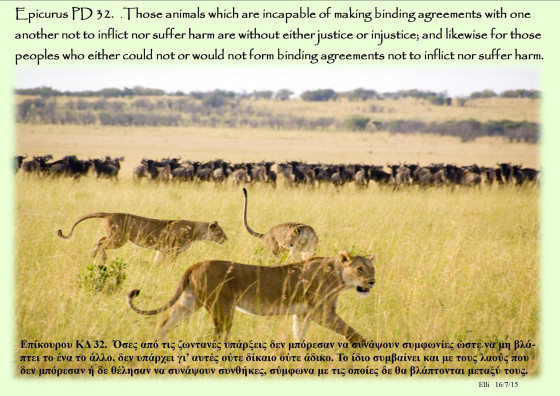
Individuals are individuals first, and in most every case (at least at birth, and until they are corrupted) their loyalty is to themselves and to their family and friends, and not to "humanity" as a whole. I have no doubt that if false ideas of religion and abstractions where shown to be false and were abandoned, then people would find it easier to understand it each other. But to conclude from that observation that the lions would lie down with the lambs and that all would be peace and brotherly love is probably as false as any other kind of idealism. -
Elli @ELLI P You are going to help us make some graphic memes of this quote, correct? If ever I found a quote I need to read every day, this is it!
-
I think this ("encourages philosophical therapists to prioritize their own self-discovery and cultivation and then, by extension, focus only on kindred souls who they can genuinely understand and help....") is applicable to many of our recent conversations. First from the blog, then the Nietzsche quote:
"A year later in The Gay Science Nietzsche returns to this idea and unpacks it more carefully. Pointing out the ways in which the causes and inner logic of a person’s suffering are for the most part inaccessible or incomprehensible to others—and thus why pity is an ineffective and even counter-productive response to suffering—he encourages philosophical therapists to prioritize their own self-discovery and cultivation and then, by extension, focus only on kindred souls who they can genuinely understand and help. The primary concern is never to lose “one’s own way”:
How is it possible to keep to one’s own way? Constantly, some clamor or other calls us aside; rarely does our eye behold anything that does not require us to drop our own preoccupation instantly to help. I know, there are a hundred decent and praiseworthy ways of losing my own way, and they are truly highly “moral”! Indeed, those who now preach the morality of pity even take the view that precisely this and only this is moral—to lose one’s own way in order to come to the assistance of a neighbor. I know just as certainly that I only need to expose myself to the sight of some genuine distress and I am lost. And if a suffering friend said to me, “Look, I am about to die; please promise to die with me,” I should promise it; and the sight of a small mountain tribe fighting for its liberty would persuade me to offer it my hand and my life . . . All such arousing of pity and calling for help is secretly seductive, for our “own way” is too hard and demanding and too remote from the love and gratitude of others, and we do not really mind escaping from it . . . while I shall keep silent [verschweigen, i.e., hide, conceal, keep secret] about some points, I do not want to remain silent about my morality which says to me: Live in seclusion [Lebe im Verborgenen, i.e, live secretly, discreetly, in hiding or concealment] so that you can live for yourself. Live in ignorance about what seems most important to your age. Between yourself and today lay the skin of at least three centuries. And the clamor of today, the noise of wars and revolutions should be a mere murmur for you. You will also wish to help – but only those whose distress you understand entirely because they share with you one suffering and one hope – your friends – and only in the manner in which you help yourself."
(GS 338)[37]
http://agonist.nietzschecircle.com/wp/great-polit…-cultivation/3/
Finding Things At EpicureanFriends.com
Here is a list of suggested search strategies:
- Website Overview page - clickable links arrranged by cards.
- Forum Main Page - list of forums and subforums arranged by topic. Threads are posted according to relevant topics. The "Uncategorized subforum" contains threads which do not fall into any existing topic (also contains older "unfiled" threads which will soon be moved).
- Search Tool - icon is located on the top right of every page. Note that the search box asks you what section of the forum you'd like to search. If you don't know, select "Everywhere."
- Search By Key Tags - curated to show frequently-searched topics.
- Full Tag List - an alphabetical list of all tags.