


1. Home
    1. Study Guide
    2. Community Standards
    3. Site Map
    4. Quizzes
    5. Articles On Physics
    6. Articles On Canonics
    7. Articles On Ethics
    8. All Articles
    9. Elli's Blog Posts
    10. Kalosyni's Blog
    11. All Blog Posts
  2. Lexicon
    1. Lexicon Home
    2. FAQ
    3. Files
    4. Search Assistance
    5. Foundations
    6. Navigation Outlines
    7. Reading List
    8. Key Pages
    9. Last Changes
  3. Forum
    1. Full Forum List
    2. Welcome Threads
    3. Ancient Texts Forum
    4. Physics
    5. Canonics
    6. Ethics
    7. Forum Shortcuts
    8. Forum Navigation Map
    9. Featured
    10. Most Discussed
  4. Latest
    1. New Activity
    2. Latest Threads
    3. Dashboard
    4. Search By Tag
    5. Complete Tag List
  5. Podcast
    1. Lucretius Today Podcast
    2. Episode Guide
    3. Lucretius Today At Youtube
    4. EpicureanFriends Youtube Page
  6. Texts
    1. Overview
    2. Torquatus On Ethics
    3. Velleius On Divinity
    4. Diogenes Laertius
    5. Principal Doctrines
    6. Vatican Collection
    7. Lucretius
    8. Herodotus
    9. Pythocles
    10. Menoeceus
    11. Fragments - Usener Collection
    12. Greek/Latin Help
  7. Gallery
    1. Latest Images
    2. Featured images
    3. Latest Comments
  8. More
    1. Featured Content
    2. Logbook
    3. EF ToDo List
  • Login
  • Register
  • Search
This Thread
  • Everywhere
  • This Thread
  • This Forum
  • Forum
  • Articles
  • Blog Articles
  • Files
  • Gallery
  • Pages
  • Wiki
  • FAQ
  • More Options
  1. EpicureanFriends - Classical Epicurean Philosophy
  2. Forum
  3. Ancient Texts Relevant To Epicurus
  4. Epicurus - Letters And Works
  5. Epicurus - Principal Doctrines

PD05 - Visualizing Principal Doctrine Five

  • Cassius
  • February 24, 2019 at 11:26 AM
  • Online
    Cassius
    5 - Administrator
    • I Too Am An Epicurean
    • Advocate
    • Lucretius Today Podcast Co-Host
    • 2025 Contributor
    • Active Member 5 Years or more
    Points
    115,565
    Posts
    15,917
    Quizzes
    9
    Quiz rate
    100.0 %
    • February 24, 2019 at 11:26 AM
    • #1

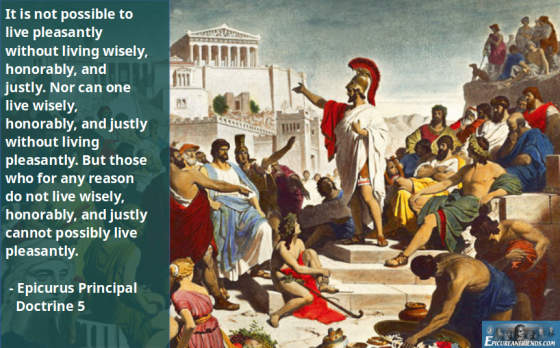
    **Visualizing Principal Doctrine 5** This doctrine is commonly cited by those who wish to equate Epicurus with Stoicism, and to argue that both are essentially the same because they value "virtue." The text is: "It is not possible to live pleasantly without living wisely, honorably, and justly. Nor can one live wisely, honorably, and justly without living pleasantly. But those who for any reason do not live wisely, honorably, and justly cannot possibly live pleasantly."

    If we look at the full context, however, we see how living virtuously fits in with every other aspect of Epicurean ethical doctrine, as a tool for the achievement of pleasurable living. This is the wider explanation and full application of the doctrine as provided by Torquatus in Cicero's "On Ends":

    "Here is indeed a royal road to happiness — open, simple, and direct! For clearly man can have no greater good than complete freedom from pain and sorrow coupled with the enjoyment of the highest bodily and mental pleasures. Notice then how the theory embraces every possible enhancement of life, every aid to the attainment of that Chief Good which is our object.

    Epicurus, the man whom you denounce as a voluptuary, cries aloud that no one can live pleasantly without living wisely, honourably and justly, and no one wisely, honourably and justly without living pleasantly.

    For a city rent by faction cannot prosper, nor a house whose masters are at strife; much less then can a mind divided against itself and filled with inward discord taste any particle of pure and liberal pleasure. But one who is perpetually swayed by conflicting and incompatible counsels and desires can know no peace or calm. Why, if the pleasantness of life is diminished by the more serious bodily diseases, how much more must it be diminished by the diseases of the mind! But extravagant and imaginary desires, for riches, fame, power, and also for licentious pleasures, are nothing but mental diseases. Then, too, there are grief, trouble and sorrow, which gnaw the heart and consume it with anxiety, if men fail to realize that the mind need feel no pain unconnected with some pain of body, present or to come. Yet there is no foolish man but is afflicted by some one of these diseases; therefore there is no foolish man that is not unhappy.

    Moreover, there is death, the stone of Tantalus ever hanging over men’s heads; and superstition, that poisons and destroys all peace of mind. Besides, they do not recollect their past nor enjoy their present blessings; they merely look forward to those of the future, and as these are of necessity uncertain, they are consumed with agony and terror; and the climax of their torment is when they perceive too late that all their dreams of wealth or station, power or fame, have come to nothing. For they never attain any of the pleasures, the hope of which inspired them to undergo all their arduous toils. Or look again at others, petty, narrow-minded men, or confirmed pessimists, or spiteful, envious, ill‑tempered creatures, unsociable, abusive, brutal; others again enslaved to the follies of love, impudent or reckless, wanton, headstrong and yet irresolute, always changing their minds. Such failings render their lives one unbroken round of misery. The conclusion is that no foolish man can be happy, nor any wise man fail to be happy. This is a truth that we establish far more conclusively than do the Stoics. For they maintain that nothing is good save that vague phantom which they entitle Moral Worth, a title more splendid than substantial; and say that Virtue resting on this Moral Worth has no need of pleasure, but is herself her own sufficient happiness.

    (Translation by Harris Rackham, Loeb Classical Library, Harvard University Press, vol. XVII, 1931)

    Does the failure of every moment of life to be complete pleasure mean that a person is not living wisely, honorably, or justly? Would it be true that no effort to visualize this doctrine can be true because any human example, no matter how wise, honorable, or just he or she may have been, still experienced pain at times?

    No - that would be a misreading of the doctrine. Note that Epicurus used words to the effect that "It is not possible..." and "cannot possibly...." Because there is no fate or providence in Epicurean philosophy or the world in reality, it is not possible to guarantee results. Negative interventions of other people and natural events can and should be minimized to the extent possible, but they cannot be totally avoided. As Epicurus said in the letter to Menoeceus:

    ...[W]e do not choose every pleasure whatsoever, but will often pass over many pleasures when a greater annoyance ensues from them. And often we consider pains superior to pleasures when submission to the pains for a long time brings us as a consequence a greater pleasure. While therefore all pleasure because it is naturally akin to us is good, not all pleasure is should be chosen, just as all pain is an evil and yet not all pain is to be shunned. It is, however, by measuring one against another, and by looking at the conveniences and inconveniences, that all these matters must be judged. Sometimes we treat the good as an evil, and the evil, on the contrary, as a good.


    The full set of graphics for Principal Doctrine 5 can be found here:


    https://www.epicureanfriends.com/wcf/gallery/in…e-list/192-pd5/

  • Cassius November 26, 2022 at 3:55 PM

    Moved the thread from forum PD 5 - It is not possible to live pleasantly without living... to forum New PD5 Forum.
  • Cassius July 5, 2025 at 4:45 PM

    Moved the thread from forum PD 05 - It is not possible to live pleasantly without living prudently ... to forum Epicurus - Principal Doctrines.
  • Cassius July 5, 2025 at 5:19 PM

    Changed the title of the thread from “Visualizing Principal Doctrine Five” to “PD05 - Visualizing Principal Doctrine Five”.

Resources

  1. Getting Started At EpicureanFriends
  2. Community Standards And Posting Policies
  3. The Major Doctrines of Classical Epicurean Philosophy
  4. Introductory Videos
  5. Lexicon
  6. Lucretius Today Podcast
    1. Podcast Episode Guide
  7. Key Epicurean Texts
    1. Chart Of Key Quotes
    2. Outline Of Key Quotes
    3. Side-By-Side Diogenes Laertius X (Bio And All Key Writings of Epicurus)
    4. Side-By-Side Lucretius - On The Nature Of Things
    5. Side-By-Side Torquatus On Ethics
    6. Side-By-Side Velleius on Divinity
    7. Lucretius Topical Outline
    8. Usener Fragment Collection
  8. Frequently Asked Questions
    1. FAQ Discussions
  9. Full List of Forums
    1. Physics Discussions
    2. Canonics Discussions
    3. Ethics Discussions
    4. All Recent Forum Activities
  10. Image Gallery
  11. Featured Articles
  12. Featured Blog Posts
  13. Quiz Section
  14. Special Resource Pages
  15. File Database
  16. Site Map
    1. Home

Frequently Used Forums

  • Frequently Asked / Introductory Questions
  • News And Announcements
  • Lucretius Today Podcast
  • Physics (The Nature of the Universe)
  • Canonics (The Tests Of Truth)
  • Ethics (How To Live)
  • Against Determinism
  • Against Skepticism
  • The "Meaning of Life" Question
  • Uncategorized Discussion
  • Comparisons With Other Philosophies
  • Historical Figures
  • Ancient Writers and Texts
  • Decline of The Ancient Epicurean Age
  • Unsolved Questions of Epicurean History
  • Welcome New Participants
  • Events - Activism - Outreach
  • Full Forum List

Latest Posts

  1. Discussion of Article - "Aristotle - Introduction From An Epicurean Perspective"

    Cassius
    October 27, 2026 at 11:57 AM
  2. Welcome Thomas Karion!

    Cassius
    October 27, 2026 at 10:19 AM
  3. Discussion of Article - "Sextus Empiricus - Introduction From An Epicurean Perspective"

    Pacatus
    October 26, 2026 at 6:06 PM
  4. Heads up: New Book Coming in 2027

    Cassius
    October 26, 2026 at 4:29 PM
  5. Do some people still believe in fate?

    Kalosyni
    October 26, 2026 at 9:27 AM
  6. David Sedley - "Creationism And Its Critics In Antiquity"

    Cassius
    October 26, 2026 at 6:24 AM
  7. Turning to Religion to Make AI Morally Good (Comparing this to Epicurean Philosophy)

    Kalosyni
    October 25, 2026 at 8:07 AM
  8. Sextus Empiricus - Clearly Stating That Skepticism Leads Not To Pleasure But To "Quietude"

    Cassius
    October 25, 2026 at 7:37 AM
  9. Episode 357 - EATAQ39 - Continuing in Part 18 of Book 2 of Academic Questions - Not Yet Recorded

    Cassius
    October 24, 2026 at 5:55 PM
  10. Major Upgrade To Forum Software - Now Completed

    Cassius
    October 23, 2026 at 9:11 PM

Frequently Used Tags

In addition to posting in the appropriate forums, participants are encouraged to reference the following tags in their posts:

  • #Physics
    • #Atomism
    • #Gods
    • #Images
    • #Infinity
    • #Eternity
    • #Life
    • #Death
  • #Canonics
    • #Knowledge
    • #Scepticism
  • #Ethics

    • #Pleasure
    • #Pain
    • #Engagement
    • #EpicureanLiving
    • #Happiness
    • #Virtue
      • #Wisdom
      • #Temperance
      • #Courage
      • #Justice
      • #Honesty
      • #Faith (Confidence)
      • #Suavity
      • #Consideration
      • #Hope
      • #Gratitude
      • #Friendship


Click Here To Search All Tags

To Suggest Additions To This List Click Here

Tags

  • PD05

EpicureanFriends - Classical Epicurean Philosophy

  1. Home
    1. About Us
    2. Classical Epicurean Philosophy
    3. Rules, Terms & Policies
  2. Lexicon
    1. Getting Started
  3. Frequently Asked Questions
    1. Site Map
  4. Forum
    1. Latest Threads
    2. Featured Threads
    3. Unread Posts
  5. Texts
    1. Core Texts
    2. Biography of Epicurus
    3. Lucretius
  6. Articles
    1. Latest Articles
  7. Gallery
    1. Featured Images
  8. Calendar
    1. This Month At EpicureanFriends
Powered by WoltLab Suite™ 6.2.8
Style: Inspire by cls-design
Stylename
Inspire
Manufacturer
cls-design
Licence
Commercial styles
Help
Supportforum
Visit cls-design