

Welcome to Episode 359 of Lucretius Today. This is a podcast dedicated to the poet Lucretius, who wrote "On The Nature of Things," the most complete presentation of Epicurean philosophy left to us from the ancient world. Each week we walk you through the Epicurean texts, and we discuss how Epicurean philosophy can apply to you today. If you find the Epicurean worldview attractive, we invite you to join us in the study of Epicurus at EpicureanFriends.com, where we discuss this and all of our podcast episodes.
This week we are continuing our series reviewing Cicero's "Academic Questions" from an Epicurean perspective, which gives us an overview of the issues that split Plato's Academy and helps us understand Epicurus' position on the same issues. This week will continue in Section 20 of Book 2, where we are now seeing Cicero argue on behalf of skepticism, and we will be interjecting Epicurean responses.
Our text will come from
Cicero - Academic Questions - Yonge We'll likely stick with Yonge primarily, but we'll also refer to the Rackham translation here: Cicero On Nature Of Gods Academica Loeb Rackham : Free Download, Borrow, and Streaming : Internet Archive
As we proceed through the end of Academic Questions, these are the topics we expect to cover:
24. Lucullus's Extended Rebuttal of the Academic Doctrine, and His Concluding Appeal to Cicero (2:XIII)
25. Cicero Begins His Reply (2:XX)
26. Cicero Lays Out the Syllogism About Assent and Opinion (2:XXI)
27. Cicero Turns to Antiochus's Own Inconsistency (2:XXII)
28. Cicero Defends His Citation of the Ancient Philosophers (2:XXIII)
29. Cicero Adds Chrysippus and the Cyrenaics, Then Returns to Arcesilas and Zeno (2:XXIV)
30. Cicero Returns to Attacking the Senses (2:XXV)
31. Cicero Presses the Sun's Size and the Limits of Trained Perception (2:XXVI)
32. Cicero Turns the "Art" Argument Back on Lucullus (2:XXVII)
33. Cicero Multiplies Examples From Madness (2:XXVIII)
34. Cicero Attacks Reason and Dialectics: The Sorites Paradox (2:XXIX)
35. Cicero Presses the Liar Paradox (2:XXX)
36. Cicero Presents Carneades's Own Positive Doctrine of Probability (2:XXXI)
37. Cicero Distinguishes the Academic Position From Epicurus's (2:XXXII)
38. Cicero Defends Probability Against the Charge That It Cannot Support Memory or Action (2:XXXIII)
39. Cicero Answers the "Self-Refuting" and "Two Incompatible Propositions" Objections (2:XXXIV)
40. Cicero Broadens the Argument Beyond the Stoics (2:XXXV)
41. Cicero Reflects on His Own Position Among the Competing Schools (2:XXXVI)
42. Cicero's Survey of Disagreement Among the Natural Philosophers (2:XXXVII)
43. Cicero Presses the Problem of Providence and the Limits of Physics (2:XXXVIII)
44. Cicero's Survey Continues: The Soul, the Antipodes, and the Motion of the Earth (2:XXXIX)
45. Cicero Asks Which Natural Philosopher He Would Even Choose to Follow (2:XL)
46. Cicero Turns to Ethics: Even the Gods Are Disputed (2:XLI)
47. Cicero's Roll Call of Rival Schools on the Chief Good, Part One (2:XLII)
48. Cicero's Roll Call of Rival Schools on the Chief Good, Part Two (2:XLIII)
49. Cicero Weighs Zeno Against Antiochus on Virtue and the Happy Life (2:XLIV)
50. Cicero Catalogs the Stoic Paradoxes About the Wise Man (2:XLV)
51. Cicero's Climactic Debate Between Pleasure and Honor (2:XLVI)
52. Cicero Turns to the Canon of Truth, and Zeno's Hand (2:XLVII)
53. The Dialogue's Close (2:XLVIII)
One of the issue we came across in this Episode was the Cicero stating early in his own defense of Academic Skepticism that he himself was "not a wise man." (See quote below)
Combined with other statements we've come across already, and more we expect to confront, it's pretty clear that the question of "whether knowledge is possible" is closely related to the question of the existence of a wisdom - or of the wise man. Socrates of course said something to the effect that he was the wisest of men because he knew that he knew nothing. Does that mean Socrates, or the god, held Socrates to be a wise man? Likewise it appears that the Stoics held that the wise man can know truth, but that wise men as as rare as phoenixes. I also think I recall from Tusculan Disputations or On Ends that Cicero criticized Epicurus (or his followers) for holding Epicurus to be a wise man.
So the question of whether someone is "wise" or "a wise man" appears to be very close to a term of art in this debate about knowledge.
At this point I haven't found it yet but it will be worth pinning this down if possible. Do we have direct quotes stating that Epicurus was "wise" or "a wise man," or that in distinction with Socrates Epicurus "knows" the things he teaches as true? If so that will fit into the reconstruction of how the Epicureans themselves spoke about this question of the possibility of knowledge.
But I myself am very apt to adopt opinions, for I am not a wise man, and I direct my thoughts, steering not to that little Cynosura,
The nightly star, which shining not in vain,
Guides the Phœnician sailor o’er the main,
as Aratus says; — and those mariners steer in a more direct course because they keep looking at the constellation,
Which in its inner course and orbit brief
Surely revolves; —
but looking rather towards Helice, and the bright north star, that is to say, to these reasons of a more expansive kind, not polished away to a point; and therefore I roam and wander about in a freer course. However, the question, as I said just now, is not about myself, but about a wise man.
In this quote above I left in this elaborate analogy or illustration of choosing to navigate by the North Star verses CIcero saying that he is better off navigating by a more expansive view.
We (Joshua) addressed this in the podcast that will be out later this week, but the allegory is deep and probably also deserves a lot more development. Presumably Cicero is saying that he does not accept that the North Star truly reflects a fixed point by which to navigate, but if he can't be sure of that why would he think it makes sense to pick a wider constellation that roams and is much more difficult to pin down? Joshua picks out details of the story of the nurses of Zeus for whom the stars are named, and I suspect there is more to that story as to why one of the nurses seems the most reliable while the other nurse roamed about.
All Brittain says is:

Cassius November 9, 2026 at 4:23 PM
Cicero's metaphor invites us to undertake a fascinating literary and mythological journey, and we should begin by noticing that Cicero is quoting from his own partially-extant Latin translation of the Phenomena, a poem by the third-century Greek didactic poet Aratus:
The earliest translation of Aratus in Rome is much better preserved; it was made by Cicero, the most important Roman orator and also a distinguished politician during the time of the civil wars. Cicero also wrote many works on philosophical subjects and some poetry; of his translation of Aratus, which he composed when he was young in ca. 90-89 BCE, only 480 lines (corresponding to Aratus, Phaen. 229-701) are preserved by the manuscript tradition; we also have additional 73 lines (of which 8 are incomplete hexameters) in 34 fragments quoted by Cicero himself in his own other works (esp. De natura deorum).
-Cicero's Aratea, Early Astronomy in the University of Michigan Collections
In the three or four lines of this poem quoted by Cicero in section twenty of Academica book two, he abjures the method of the 'Phoenician Sailor', a somewhat odd thing to do given that Carthage, a Phoenician settlement, was the reigning sea power in the Mediterranean until the Punic wars. Presumably their methods of maritime navigation were good. However, Cicero had already confessed to the following view:
"although I consider to see the truth a most beautiful thing, so also do I think it a most disgraceful one to approve of what is false as if it were true."
He denounces the method of the Phoenicians, perhaps not because it is faulty, but because he cannot prove that it is not faulty, and to err in such a case by staking out a position would be disgraceful. Did it not bother him that (according to Polybius) the Romans did not even have a wartime navy until they discovered and reverse-engineered a Phoenician warship? More on that here.
Display Spoiler
"It was, then, because they saw that the war they had undertaken lingered to a weary length, that they first thought of getting a fleet built, consisting of a hundred quinqueremes and twenty triremes. But one part of their undertaking caused them much difficulty. Their shipbuilders were entirely unacquainted with the construction of quinqueremes, because no one in Italy had at that time employed vessels of that description. There could be no more signal proof of the courage, or rather the extraordinary audacity of the Roman enterprise. Not only had they no resources for it of reasonable sufficiency; but without any resources for it at all, and without having ever entertained an idea of naval war,—for it was the first time they had thought of it,—they nevertheless handled the enterprise with such extraordinary audacity, that, without so much as a preliminary trial, they took upon themselves there and then to meet the Carthaginians at sea, on which they had for generations held undisputed supremacy. Proof of what I say, and of their surprising audacity, may be found in this. When they first took in hand to send troops across to Messene they not only had no decked vessels but no war-ships at all, not so much as a single galley: but they borrowed quinqueremes and triremes from Tarentum and Locri, and even from Elea and Neapolis; and having thus collected a fleet, boldly sent their men across upon it. It was on this occasion that, the Carthaginians having put to sea in the Strait to attack them, a decked vessel of theirs charged so furiously that it ran aground, and falling into the hands of the Romans served them as a model on which they constructed their whole fleet. And if this had not happened it is clear that they would have been completely hindered from carrying out their design by want of constructive knowledge."
Now in the poem, the Phoenician is guided by 'The nightly star, which shining not in vain', and this star (in the constellation Cynosura, the dog's tail, or, as we now call it, Ursa Minor, the little bear) must be the North Star, Polaris. Cicero announces that his preference is to take a more expansive view, and navigate by Helice, now Ursa Major, the big bear, and 'the bright north star'; "that is to say, to these reasons of a more expansive kind, not polished away to a point."
To which star is he referring when he says 'the bright north star'? I originally took this to mean Polaris, but now I think he means a star even brighter than Polaris, and one that is to be found in Ursa Major: that star is Alioth.
Setting aside the mythological references, Cicero seems to be saying that it would actually be better to take the area of the circle circumscribed by Alioth as probably containing the reference point for true north, rather than pointing directly to Polaris, which lies not truly north, but which is close enough for navigation.
I think I handled the mythology well enough on the recording, so I won't commit to writing that up just yet.
_____________________
Who can doubt that poetry will revive and lead in a new age, as the star1 in the constellation Harp, which now flames in our zenith, astronomers announce, shall one day be the pole-star for a thousand years?
-Ralph Waldo Emerson, The American Scholar
1 Vega, a star which today passes overhead in the Northern Hemisphere. Due to Earth's axial precession, Vega will be the northern pole star 11,700 years from now, as it was 14,000 years ago.
There's a lot to unpack in Cicero's star guidance analogy, and it's interesting enough that I want to read further.
I wouldn't trust this ChatGPT summary except for its intended purpose - to point the way to scholarly articles where those who are interested can find more reading material. Here it is:
Display Spoiler
Cicero's Two Bears: Cynosura, Helice, and the Navigation of Academic Skepticism
A study of Cicero, Academica 2 (Lucullus) 66, ancient astronomy, mythology, and modern scholarship Prepared 10 November 2026 by ChatGPT
The central problem
In the passage commonly numbered Academica 2.66 (within Book II, chapter XX in some editions), Cicero speaks as an Academic sceptic who sometimes follows persuasive appearances without claiming infallible knowledge. He compares his intellectual conduct to a sailor's choice between two northern constellations. The more accurate guide is Cynosura (Ursa Minor, the Little Bear), traditionally used by Phoenician sailors. Yet Cicero prefers Helice (Ursa Major, the Great Bear), a larger and more conspicuous constellation traditionally used by Greek sailors. His preference is deliberate: the image acknowledges that his way of forming opinions is less exact than the ideal of perfectly disciplined assent, while defending it as usable for an imperfect human being.
The essential correction to a common reading is that Cicero is not contrasting one wandering star with a stationary North Star. Both names designate constellations, and both appear to circle the north celestial pole. Cynosura's stars trace smaller apparent circles because the constellation lies nearer the pole. Helice is easier to see but offers a less precise directional reference. The star Polaris, in Ursa Minor, was not as close to the celestial pole in Cicero's time as it is today, because the Earth's axis slowly precesses. Yonge's phrase “the bright north star” is therefore liable to mislead modern readers: it should not be treated as a precise identification of modern Polaris or as an independent third guide.
1. What Cicero is arguing
The astronomical analogy belongs to a discussion of assent, perception, and the wise person. Cicero's Academic position rejects the Stoic claim that some cognitive impressions carry an unmistakable guarantee of truth. He nevertheless concedes that, being no sage, he often adopts opinions and sometimes assents to compelling impressions. He distinguishes this practical concession from possessing knowledge or an infallible criterion.
The navigation image does several things at once:
- It concedes a cost. Cicero's preferred course is more expansive and less precise than the route guided by Cynosura. The reference to wandering is an admission of possible error, not a boast that error is better than accuracy.
- It contrasts intellectual temperaments. A tiny, tightly turning constellation stands for rigorous precision and restraint; a large, easily recognized constellation stands for a more accommodating, fallible way of proceeding.
- It defends practical life without certainty. Sailors can navigate using the Great Bear, even if another guide permits a straighter course. Likewise, a non-sage can conduct inquiry and life through persuasive appearances without claiming certainty.
- It limits the claim. Cicero immediately turns back to the wise person, for whom avoiding mistaken assent is a stricter ideal. His own conduct should not automatically be attributed to the fully wise Academic.
The irony is important: Cicero does not choose the better astronomical instrument. He chooses the less precise one because that better depicts his philosophical practice. Reading the passage as a literal recommendation to sailors reverses its function.
2. What Aratus actually says about the constellations
Cicero draws on Aratus, Phaenomena 26–44, a Hellenistic astronomical poem. Aratus describes two Bears circling near the northern axis: Helice, used by Achaean/Greek mariners, and Cynosura, used by Phoenician mariners. He explicitly contrasts Helice's large, readily recognizable appearance with Cynosura's smaller circuit and greater navigational accuracy. Thus the practical advantage of Cynosura is not a modern inference; it is part of Cicero's literary source.
| Feature | Helice | Cynosura |
|---|---|---|
| Modern identification | Ursa Major / Great Bear | Ursa Minor / Little Bear |
| Ancient sailing association | Greek/Achaean | Phoenician/Sidonian |
| Appearance | Large, conspicuous, readily recognized | Smaller, less conspicuous |
| Apparent rotation | Larger circuit about the north celestial pole | Smaller circuit about the pole |
| Navigation | Useful but less precise | Better approximation to true north |
| Cicero's analogy | Broad, fallible judgment | Tight, disciplined precision |
The “brightness” question requires distinguishing a constellation's visibility from the brightness of a single star. Aratus says that Helice is conspicuous and easy to identify, not that every star in it exceeds every star in Cynosura. Modern Polaris has visual magnitude about 2; the seven familiar stars of the Big Dipper include stars of roughly magnitude 1.8–3.3. The Great Bear's conspicuous pattern, rather than one uniquely superior beacon, explains its usefulness. A brighter-looking guide can nevertheless be worse for finding the pole if it lies farther away from it.
3. Why the North Star is not the obvious ancient answer
Today Polaris lies less than one degree from the north celestial pole. But axial precession shifts the pole among background stars over a cycle of approximately 26,000 years. In Cicero's first-century BCE sky, Polaris was several degrees farther from the pole than today. Ancient navigators therefore did not have the nearly stationary bright marker that modern northern observers take for granted. The relevant ancient comparison was between recognizable northern star groups with different distances from the pole.
Every star outside the exact celestial pole changes apparent position during the night, even though the stars maintain nearly fixed positions relative to one another over a human lifetime. “Wandering” in Cicero's metaphor is not the technical astronomical wandering of a planet. It evokes the broader route of the Great Bear and, above all, Cicero's own willingness to entertain opinions. Neither constellation was a wandering planet.
Nor does the existence of a better celestial guide imply that every sailor could always use it: visibility, familiarity, haze, and the ability to recognize an asterism mattered. Ancient sources record conventional Greek and Phoenician preferences; they do not prove that every individual Greek or Phoenician sailor invariably used only one constellation.
4. Mythology: why two Bears?
There is a rich mythology, but the myths do not provide Cicero's explicit reason for choosing Helice. The reason is philosophical and metaphorical, based on Aratus's astronomical comparison.
One well-known account associates Ursa Major with Callisto, a companion of Artemis transformed into a bear and eventually placed among the stars; her son Arcas is connected with the story in several versions. Other ancient traditions identify Helice and Cynosura as nymphs who nursed the infant Zeus in Crete and were rewarded with places in the sky. The mythological identities vary between authors and should not be flattened into a single canonical tale. The name Cynosura literally evokes a “dog's tail,” an additional reminder that constellation names and mythological identifications were not fixed in one uniform system.
These stories explain the cultural prominence of the Bears, but not the greater brightness or navigational accuracy of either constellation. Their geometry follows from the position of the stars relative to the celestial pole, not from the narrative of Callisto or Zeus's nurses.
5. Scholarly studies: citations and assessment
A. Navigating cognitive success (and failure): Cicero, Lucullus 66
Bibliographic lead: “Navigating cognitive success (and failure): Cicero, Lucullus 66,” deposited in the University of Oxford Research Archive. Oxford repository record.
Summary: This is the most directly relevant study located: its abstract specifically identifies Lucullus 66 as an extended night-navigation allegory contrasting Academic scepticism with dogmatism. It investigates ancient navigation and the astronomical-poetic tradition to clarify what the allegory can and cannot establish. Its stated conclusion is that the Academic's admittedly imperfect and fallible method remains serviceable. That directly supports interpreting Helice not as the better astronomical guide but as an adequate model of practical life without guaranteed cognition.
Assessment: This should be the first article to consult in full. The accessible repository search record provided its title and abstract, but not reliably its author, journal, pagination, or full argument; those details are intentionally not invented here. The summary above reflects the abstract, not an independent reading of the entire paper.
B. Barney McCullagh, “Aratus’ Phaenomena: the Bears, the Waggons, Kynosura, Helice” (2022)
Citation: McCullagh, Barney. “Aratus’ Phaenomena: the Bears, the Waggons, Kynosura, Helice.” Învăţământ, Cercetare, Creaţie 8, no. 1 (2022): 217–262. Article and abstract.
Summary: McCullagh proposes an unusually literary reading of Aratus's northern constellations. The abstract argues that astronomical movement and the succession of visible signs also represent how meanings emerge and recede in Aratus's poetry. It challenges the assumption that the poem was simply a practical navigational manual and emphasizes layered allegory and verbal associations.
Relevance and limitation: This work is directly about the very two constellations Cicero borrows, and helps explain why Aratus's description could become philosophical imagery. It is not, on the evidence of the accessible abstract, a direct interpretation of Academica 2.66. Its strongly allegorical proposal should be distinguished from the simpler astronomical observation that Cynosura lies closer to the pole.
C. Kathryn Dorothy Wilson, Signs in the Song: Scientific Poetry in the Hellenistic Period (2015)
Citation: Wilson, Kathryn Dorothy. Signs in the Song: Scientific Poetry in the Hellenistic Period. PhD dissertation, University of Pennsylvania, 2015, especially chapter 1, “Aratus, the Poet of Signs.” Open-access PDF.
Summary: Wilson argues that Aratus's poetry integrates scientific information and literary form rather than simply decorating astronomy with verse. The central concept is sign-reading: the capacity to recognize patterns in nature and act upon them. In discussing the Bears, she notes Aratus's explicit distinction between conspicuous Helice and smaller but more useful Cynosura. This makes the episode particularly apt for Cicero's argument about interpreting appearances: signs can be useful without providing the same degree of precision.
Assessment: Wilson offers valuable background for the intellectual role of Aratus in Cicero, but her dissertation is principally about Hellenistic didactic poetry, not a line-by-line commentary on Cicero's passage. The final application to Academic assent is an interpretation developed here.
D. Emma Gee, “Cicero's Astronomy” (2001)
Citation: Gee, Emma. “Cicero's Astronomy.” The Classical Quarterly 51, no. 2 (2001): 520–536. DOI: 10.1093/cq/51.2.520. Publisher record.
Summary and relevance: A scholarly study of Cicero's engagement with astronomy and astronomical poetry, particularly useful for contextualizing his longstanding interest in Aratus. Caution: The accessible publisher record does not provide an abstract or enough full text to verify whether Gee discusses Lucullus 66 or reaches a particular conclusion about Helice. It is therefore a contextual research lead, not evidence for a specific interpretation of this passage.
E. Ancient navigation: “Maritime Space and Night-Time Sailing in the Ancient Eastern Mediterranean”
Citation: “Maritime Space and Night-Time Sailing in the Ancient Eastern Mediterranean,” in materials from Tropis VII (1999). Conference-volume PDF.
Summary: The indexed conference text quotes Aratus's contrast between the more readily recognized Helice and the smaller, better navigational Cynosura. It supplies maritime-historical context for taking the astronomical contrast seriously rather than dismissing it as purely decorative poetry. Limitation: The precise author and page range of the relevant contribution were not verified from the indexed excerpt; cite the PDF provisionally until the article's first page is checked.
6. Primary sources and further checking
- Cicero, Academica 2.66, also called Lucullus 66, chapter XX in the Yonge translation. Yonge's text.
- Aratus, Phaenomena 26–44, especially approximately 37–44, describing the two Bears and their contrasting use by Greek and Phoenician sailors. Read this alongside Cicero to see that the advantage of Cynosura is already explicit in the original poem.
- Hyginus, De astronomia 2.1–2, for ancient identifications and myths of the Bears.
- M. R. Wright, A Dictionary of Classical Mythology, entries “Ursa Major” and “Ursa Minor.” University of Patras-hosted text.
- William Smith, Dictionary of Greek and Roman Antiquities, “Astronomia” (1875), on the ancient names, Phoenician and Greek practices, and the distinction between the whole constellation and the pole star. LacusCurtius text.
7. Final interpretation
The apparent paradox dissolves when three different questions are separated:
Which guide is more accurate? Cynosura, because it turns in a smaller apparent circle near the celestial pole. Which is easier to identify? Helice, because its larger, prominent star pattern stands out. Which does Cicero choose for his analogy? Helice, because he is describing the freer, imperfect intellectual navigation of someone who is not a sage.
Cicero's point is not that the larger constellation is scientifically superior, nor that myth obliges him to prefer it. He chooses a recognized but less exact guide to dramatize the possibility of a workable life without the Stoic ideal of certainty. The best recent specialist study identified here explicitly frames the passage in terms of cognitive success despite fallibility. Cicero's image thus expresses both intellectual modesty and a practical defense of Academic scepticism.
Research note: The references above distinguish findings verifiable from accessible abstracts or full text from additional contextual leads. The Oxford paper is especially important and should be checked in full before making detailed claims about its author's precise reconstruction of ancient seamanship.
Good - the article most directly on point dissecting the Navigation analogy is free in full at this link. From the abstract, the writer seems friendly to Cicero and Academic skepticism, but probably the information contained here will be useful in constructing what the Epicureans would have said in reply.
The Ciceronian corpus of philosophical works features on a number of occasions first-person speakers who explain how they live their Academic scepticism, whose hallmark was the rejection of certain knowledge. Lucullus 66 is an interesting instance of this: the Academic way of life is contrasted with that of the dogmatist with reference to an extended allegory relating to navigation at sea by night. The article aims to elucidate this passage, by considering how navigation by the stars worked in antiquity, to what extent the scholarly and poetic tradition of the night sky reflected these realities, and ultimately what the allegory does and does not illustrate. The Academic’s way of navigating life, while being avowedly imperfect and fallible, emerges as entirely serviceable
https://ora.ox.ac.uk/objects/uuid:3…iles/r9880vr95t
Random notes:
- "Finally, Augustine’s Contra Academicos engages closely with Cicero’s Academici libri, including with parts of that work which have not come down to us, but does so in a highly original way which prevents the simple isolation of fragments." --- So that means that one of Augustine's works presents the Christian argument against Academic Skepticism. I was not aware of the existence of that.
- I wonder if there is not something in either Lucretius or the letter to Pythocles relevant to this: "The noun consideratio can just mean ‘scrutiny’ or ‘accurate consideration’, but it can be documented that a particular etymology was placed on it by some ancient users of Latin and arguably Cicero, too, viz. the mental act of gathering together the individual stars (stellae) which make up a constellation (sidus) and the holding of all the stars in an evaluative gaze. 12 I have suggested elsewhere that Cicero used the image of a constellation to ‘translate’ a different and, to his readership, less familiar image which he found in his Academic source material and which is preserved in Sextus, 13 namely the notion of the syndrome in the medical sense, i.e. the simultaneous occurrence of a number of symptoms, which individually might be indicative of other conditions but jointly add up to a particular medical condition (M. 7.176‒9):
- Here's some of the technical background I was looking for: "At this point it becomes necessary to investigate how exactly the two constellations can be used for navigation, how Cicero assumed they were used for the purposes of our passage, and what learned discussion existed about them at that time. The present-day survivalist would refer to both constellations not directly, but in order to figure out where the North Star is (sc. in the northern hemisphere), i.e. the star which is closest to the celestial pole, the point in the night sky around which the constellations appear to rotate. For the Great Bear, this would involve drawing a line through the two stars marking the rear of the constellation and extending it until one finds the North Star. 19 As to the Little Bear, Polaris or α ursae minoris is actually contained within the constellation; it is the star at the tip of the handle.
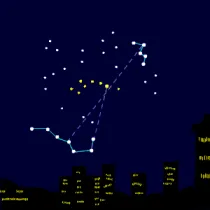
We need something labelled better than this to illustrate Cicero's allusion, but here we see the big and little dipper and their relation to Polaris.
Chatgpt - The Big Dipper and Little Dipper are not separate constellations from the Great Bear and Little Bear. They are recognizable groups of seven stars, called asterisms, within the larger constellations.
- Big Dipper: Seven bright stars forming part of Ursa Major (the Great Bear). The dipper's handle corresponds approximately to the bear's tail, while its bowl lies in the bear's hindquarters.
- Little Dipper: Seven stars within Ursa Minor (the Little Bear). Polaris, the North Star, marks the end of the Little Dipper's handle and the tip of the Little Bear's tail.
So far I am not finding in this discussion something I think is probably the most important part:
Why should a pole star be a reliable means of navigation. There are going to be generic answers to this which should be fleshed out such as:
- Stoic - We can rely on it because it was created by divine forces to be that way. Stories like Zeus turning his nurses into stars may be true or may be allegory but in the end the universe is governed by providence and all is as it was meant to be.
- Academic - We can't really rely on it any more than we can rely on anything else - we know nothing, and we aren't even sure of that. But some of us are willing to take more chances than others, and they can view it is more probable than not and roll the dice based on "probability."
- Epicurean (? something like this) - We can rely on it because we have tested it repeatedly through observation and found it to be supported by results time after time, and we have no evidence that would reasonably contradict its reliability. Therefore unless and until it stops working, which we have no current reason to believe it ever will, we will take the position that its reliability is proven and therefore true. We aren't going to waste time with hypotheticals which have no evidence to support them, or arguing that this means that navigativing by the north star "will probably work," because we base our decisionmaking on reason grounded in the evidence of the sensese and we don't entertain arguments that have no evidence in the senses to support them. That's called "dreaming," not "admitting that what we think is true is really only probable."
It's worth also documenting here according to the Tobias Reinhardt background article that the Stoic founder Zeno of Citium was reputedly of Phoenician descent -
... Zeno of Citium, who formulated the definition of the cataleptic impression (Luc. 77), was famously of Phoenician descent, 8
8 See Cic. Fin. 4.46: Postea tuus ille Poenulus ‒ scis enim Citieos, clientes tuos, e Phoenica profectos ‒, homo igitur acutus ...; D.L. 7.1, 7.3. Zeno was of eastern Phoenician descent, and the use of the Little Bear for navigation is in the Aratean tradition associated with ‘Sidonians’ (e.g., Seneca, Medea 697: maior Pelasgis apta, Sidoniis minor), but partly because Carthage was a Phoenician foundation, Poenus (and its diminutive) can be used to designate Phoenicians in Latin. See the discussion in Prag 2006, and idem 2014. In 7.4 Diogenes Laertius reports that “some people” said in jest that Zeno had written his Republic on “the dog’s tail” (ἐπὶ τῆς τοῦ κυνὸς οὐρᾶς), but the import of the remark and whether it might aid the identification here is not clear; for discussion see Bees 2011, 8‒26.
In this episode part of what we discuss is Cicero's defense of himself that he is not simply being quarrelsome, but that he is motivated in his arguments by a desire for truth -- even though in Cicero's mind the conclusion is that truth is impossible to find. In this context here is what Sextus Empiricus said about the "main principle of the skeptic system - with the end not being truth - but ceasing to look for or suggesting that anything is truth,
The originating cause of Scepticism is, we say, the hope of attaining quietude. Men of talent, who were perturbed by the contradictions in things and in doubt as to which of the alternatives they ought to accept, were led on to inquire what is true in things and what false, hoping by the settlement of this question to attain quietude. The main basic principle of the Sceptic system is that of opposing to every proposition an equal proposition; for we believe that as a consequence of this we end by ceasing to dogmatize.
Here is a link to a chapter from a booklet about ancient navigation. This is focused on Lucan's Pharsalia (the war between Caesar and Pompey) so the time frame is close to that of cicero's discussion.
Solely, the Bear was of real significance for navigation, and Calypso warned Ulysses to keep it on the left, therefore to sail eastward. The visible movement of the sky (in reality, the effect of Earth’s rotation) makes all constellations (the starry sky of antiquity) rotate anticlockwise around the North Pole. Due to the precession of equinox, modern Polaris (α Ursae Minoris) was significantly further away from the pole than it is now. Around 500 BC, β Ursae Minoris was the closest star to the North Pole. Like the whole constellation it turned around the pole, whose position was marked only approximately. At any latitude within the Mediterranean, it stayed always above the horizon and thus remained visible for any time of the year and day. The further a constellation lies away from the pole, the longer is the circumference of its apparent movement, and the longer is the time it stays below the horizon.
The fact that the indiscernable North Pole provided the only useful astronomical means of orientation is underlined by a well-known passage in Lucanus’ Pharsalia15 , where Pompey asks the steer man’s about the secret of the relationship between stars and sailing routes. The latter answers that constellations cannot be used directly to find the direction to a destination. In fact, such a use would be dangerous:
“Not by the constellations moving ever
Across the heavens do we guide our barks;
For that were perilous; but by that star
Which never sinks nor dips below the wave,
Girt by the glittering groups men call the Bears.
When stands the Lesser Bear clear before the mast,
Then to the Bosporus look we, and the main
Which carves the coast of Scythia.”Only the Pole Star and its relation to parts of the boat provided the direction. Several similar indications are to be found in the Stadiasmus Maris Magni. 16 For that reason, with the exception of the Bears, star constellations in general were of little use for sailing, unless not only an instrument like the astrolabe, but also a mathematical perception and application of geography were involved in sailing.
Cassius November 12, 2026 at 12:01 PM
Lucretius Today Podcast Episode 359 is now available: "According To The Skeptics, Why Aim For The Truth When You Can GIve Up Trying To Be Right And Never Have To Admit That You're Wrong?"
Summary:
Cassius and Joshua begin Section 20 of Book Two of Cicero’s Academic Questions, where Cicero at last answers Lucullus and starts his defense of Academic skepticism. Cassius opens by noting how much of Lucretius is canonics, about how to take confident positions when we don’t have all the evidence we would like. Joshua recalls Lucullus’s charge about the Catilinarian conspiracy and Catulus’s advice to ignore it, and reads Cicero’s reply. Cicero says he is “inflamed with a desire of discovering the truth,” yet thinks it most disgraceful “to approve of what is false as if it were true,” and he admits that he is not a wise man and is “very apt to adopt opinions.” Cassius compares Yonge’s “agitated” with Rackham’s “nervous,” and points to Sextus Empiricus’s practice of throwing every possible argument at an opponent. He argues that the skeptics set up a false standard of truth, omniscience, which only fits a world with something beyond this one. Epicurus held that all sensations are true because there is no other world behind this one. And if Cicero is not a wise man, why follow him at all? Joshua explains Cicero’s image of steering not by Cynosura, the Little Bear that holds the North Star, but by Helice, the Great Bear. He tells the myths of the two nurses of Zeus turned into bears, and of Ovid’s Helice telling Demeter that “night is free of blame.” He contrasts Demeter’s search with Lucretius’s mother cow, who knows her calf and does not give up. Cassius concludes that a man who never claims to be right can never be wrong, and that the skeptics’ failure to stand for anything left the ancient world open to those who claimed that God told them what to do. Epicurus avoided both errors and gave guidance based on nature.
Transcript:
Display Spoiler
Cassius:
Welcome to Episode 359 of Lucretius Today. This is a podcast dedicated to the poet Lucretius, who wrote On the Nature of Things, the most complete presentation of Epicurean philosophy left to us from the ancient world. Each week we walk you through the Epicurean texts, and we discuss how Epicurean philosophy can apply to you today. If you find the Epicurean worldview attractive, we invite you to join us in the study of Epicurus at EpicureanFriends.com, where we discuss this and all of our podcast episodes.
Before I go further, let me pick up on the allusion to Lucretius again, because over the years it has struck me more and more how much of Lucretius is not just devoted to physics and talking about atoms, but to how we can become confident taking positions on subjects about which we don’t have all the evidence that we’d like to have. Much of Lucretius is not so much physics as it is canonics: the discussion of what is true and how to get to truth, when we can get there and when we can’t. And that’s what we’re talking about in going through Cicero’s Academic Questions.
The Stoics, the Academic skeptics and the Pyrrhonian skeptics all had different views on whether any kind of truth is possible. The Stoics took the position that some truth is possible for us, but they went off in the direction that we can recognize truth on the basis of a divine order, a providential order, with things basically inscribed in the nature of things by a creator who has given us the ability, through geometry or mathematics or different types of logical analysis, to get to truth in ways other than through the senses. And of course all of them, skeptics and Stoics alike, are largely throwing out confidence in the senses. They refuse to take the position that Epicurus took, that all sensations are true. Either they went off in the direction of the skeptics, basically getting rid of sensation and saying it’s all just a deception and a house of mirrors, or they went in the Stoic direction of trying to find some kind of divine order by which they could say that some sensations are true while others are false.
We’ve been spending weeks now going through the Stoic position, arguing from their perspective that some sensations are true and others are false. And last week Lucullus charged Cicero with the grossest kind of hypocrisy: “You’d better watch out, Cicero. You are out there convicting people in court and taking positions all the time that you know something is true. And yet what in the world are you telling me as a philosopher, that nothing can be known?” That was the climax of Lucullus’s closing argument, and now we turn to Cicero’s justification of his own position.
People listening to this podcast are probably well aware that it’s not proper to think of Cicero as a Stoic. On these issues of knowledge Cicero was a dedicated Academic skeptic, and he is now going to argue against the Stoics that knowledge is impossible. As we also mentioned last week, there’s no Epicurean included in this discussion, so we are going to have to stand in the shoes of the Epicurean and make sure that Epicurus’s position is understood as we go through Cicero’s attempt to justify a position that the Stoics themselves thought was unjustifiable. I think Epicurus would agree with that bottom-line analysis. Cicero is basically going to channel the arguments that had been brewing from Socrates, Plato, Arcesilaus, Carneades and others throughout the development of Greek philosophy, moving in this direction of skepticism. And Cicero does a good job for us in packaging up these arguments and presenting them in a way that gives us a window into a discussion that we otherwise just wouldn’t have. So we’re going to turn now to Section 20. Joshua, give us your current thoughts, and when you’re ready, read us into Section 20.
Joshua:
It’ll be important to remember that in Section 19 Lucullus, as you said, Cassius, had raised the question of Cicero’s peak political moment: his uncovering of the Catilinarian conspiracy, and his putting the conspirators to death in clear violation of Roman law. Citizens were not supposed to be executed; they were supposed to be exiled. After Lucullus finishes his discourse we get a word or two from Hortensius, and then Catulus steps in. Catulus says:
“If the discourse of Lucullus has had such influence over you, — and it has been a wonderful exhibition of memory, accuracy, and ingenuity, — I have nothing to say; nor do I think it my duty to try and deter you from changing opinion if you choose. But I should not think it well for you to be influenced merely by his authority. For he was all but warning you, said he, jestingly, to take care that no worthless tribune of the people, of whom you know what a number there will always be, seize upon you, and ask of you in the public assembly how you are consistent with yourself, when at one time you assert that nothing certain can be discovered, and at another time affirm that you yourself have discovered something. I entreat you, do not let him terrify you. But I would rather have you disagree with him on the merits of the case itself.”
We are hoping, Cassius, to get a response from Cicero to the objection Lucullus raised at the end: if you know nothing, how can you pretend that you knew what the Catilinarian conspirators were planning? If you know nothing, how can you put a man’s life on the line, suspend the Roman constitution and order a citizen to be put to death for conspiracy, while you yourself claim that nothing can be conceived? Whether Cicero is going to respond, I don’t know. Catulus says to Cicero, in effect: don’t let Lucullus terrify you with threats that a tribune will hale you into court to answer for saying one thing in private and another in public. Don’t worry about that. I just want to hear you argue the merits of the case itself, and forget everything he said about your political career, the Catilinarian conspiracy and all the rest of it. I think that may have been Cicero’s way of dodging the question, so I don’t know if he’s going to answer it at any point. It certainly seems that he’s not going to get to it today. But at the beginning of Section 20, Cicero says he is agitated:
“Then I, being no less agitated than I usually am when pleading important causes, began to speak something after this fashion: —
“The discourse of Lucullus, O Catulus, on the matter itself…”
Again, on the matter itself, not on the threat to carry him before the tribune.
“…moved me a good deal, being the discourse of a learned and ingenious and quick-witted man, and of one who passes over nothing which can be said for his side; but still I am not afraid but that I may be able to answer him. But no doubt such authority as his would have influenced me a good deal, if you had not opposed your own to it, which is of equal weight. I will endeavour, therefore, to reply to him after I have said a few words in defence of my own reputation, as it were.
“If it is by any desire of display, or any zeal for contentious disputes, that I have been chiefly led to rank myself as an adherent of this school of philosophy, I should think not only my folly, but also my disposition and nature deserving of severe censure; for if obstinacy is found fault with in the most trifling matters, and if also calumny is repressed, should I choose to contend with others in a quarrelsome manner about the general condition and conduct of my whole life, or to deceive others and also my own self? Therefore, if I did not think it foolish in such a discussion to do what, when one is discussing affairs of state, is sometimes done, I would swear by Jupiter and my household gods, that I am inflamed with a desire of discovering the truth, and that I do truly feel what I say. For how can I avoid wishing to discover the truth, when I rejoice if I have discovered anything resembling the truth? But although I consider to see the truth a most beautiful thing, so also do I think it a most disgraceful one to approve of what is false as if it were true. Not, indeed, that I am myself a man who never approve of anything false, who never give assent to any such thing, and am never guided by opinion; but we are speaking of a wise man. But I myself am very apt to adopt opinions, for I am not a wise man, and I direct my thoughts, steering not to that little Cynosura,
The nightly star, which shining not in vain, Guides the Phoenician sailor o’er the main,
“as Aratus says; — and those mariners steer in a more direct course because they keep looking at the constellation,
Which in its inner course and orbit brief Surely revolves; —
“but looking rather towards Helice, and the bright north star…”
Helice is Ursa Major, the Big Dipper.
“…that is to say, to these reasons of a more expansive kind, not polished away to a point; and therefore I roam and wander about in a freer course. However, the question, as I said just now, is not about myself, but about a wise man. For when these perceptions have made a violent impression on the intellect and senses, I admit them, and sometimes I even assent to them, but still I do not perceive them: for I do not think that anything can be perceived. I am not a wise man, therefore I submit to perceptions and cannot resist them: but Arcesilas, being on this point in agreement with Zeno, thinks that this is the most important part of the power of a wise man, that he can guard against being entangled, and provide against being deceived. For there is nothing more incompatible with the idea which we have of the gravity of a wise man than error, levity, and temerity. Why, then, need I speak of the firmness of a wise man? whom even you too, Lucullus, admit to be never guided by mere opinion. And since this is sanctioned by you, (if I am dealing irregularly with you at this moment, I will soon return to the proper order of your arguments,) just consider what force this first conclusion has.”
Cassius:
Okay, Joshua, we’re breaking off almost in the middle of the argument, but there’s a lot we should talk about in Section 20 before we go further. One minor point at the very beginning, in the very first sentence, is the perennial question of how best to translate. There’s a fairly significant discrepancy here between Yonge and Rackham, and I think Yonge has the better of this one. He says, “Then I, being no less agitated than I usually am when pleading important causes.” That strikes me as very likely the sense in English that we would expect from Cicero. He’s not someone who is shy about giving his position. He’s going to be agitated and forceful, and state his position with as much impact as possible. Rackham translates it, “therefore, I feeling quite as nervous as I usually do when I have a specially big case.” Certainly there’s a relationship between nervousness and agitation, but I think Yonge has the better of it, because Cicero is going to be animated and forceful.
Joshua:
It must be a cocktail of emotions, right? If you ask people what they fear, public speaking ranks higher than death, or something like that, among the things people fear most. For a lot of people it’s nerve-racking to stand up there in front of a crowd, and you’re feeling all kinds of things in that moment. And for Cicero, pleading an important cause, a cause he is personally invested in, there’s the added emotion of “I really need not to get this wrong.” I don’t picture Cicero, this grizzled orator of a thousand lawsuits, being as nervous as someone getting up there for the first time. But do you ever fully shake that off? That’s a question for you, Cassius, because this is law, closer to your area.
Cassius:
Joshua, I think you never completely lose the sense of nervousness, of the importance of what you’re doing, in a big case. Cicero has a reputation as one of the great orators of Western civilization, and Hortensius, who is also participating in this conversation, had a similar reputation as an extremely good speaker. It’s not always very admirable to think about the details of how a good lawyer can take any side of a case and make it sound persuasive, but Cicero certainly has the reputation of being one of the preeminent lawyers of his time. So it’s hard to say exactly what was going on here.
You raised earlier whether Cicero will actually address Lucullus’s accusation that he needed to be careful about inconsistency, given his past convictions of people. I haven’t read far enough to be certain whether he’s going to get back to the Catilinarian conspiracy or not. But I do think we’re going to find Cicero aggressively pushing his case. Ironically enough, I don’t think we’re going to find any hesitation on Cicero’s part. He’s advocating for hesitation. He’s advocating for skepticism. He’s advocating for doubt. But he’s doing it in about as intensely confident a way as you can, given the irony of his position. I don’t think he’s going to waver over the next many paragraphs. He is going to throw the book at the dogmatic Stoic position, argument after argument after argument.
And maybe it’s also useful to point out that this is part of what’s going on here, especially when you compare it with what Sextus Empiricus says. It is the job of the skeptic to throw the kitchen sink at every argument, to come up with every possible argument he can, as a way of proving that nobody really knows what the right answer is. And I think Cicero is alluding to that in this opening. He admits that Lucullus is somebody he has tremendous respect for. Lucullus is an ally of his in matters of state, so Cicero is not lightly disagreeing with him. He’s paying tribute to somebody he respects, and he’s saying that in these contentious disputes he is not being obstinate and he is not being quarrelsome. He thinks the best thing to do is to contend and to throw these arguments as a way of achieving the goal. And of course, with Cicero, the goal is not finding the truth. You don’t express the goal that way. You wrestle with the questions: Are you a wise man? Is it possible to be wise? What is wisdom? You come up with question after question after question. You never give a specific answer. You answer every question with another question.
Joshua:
Pontius Pilate, Cassius, right? “What is truth?” The core question of our whole study of this text.
Cassius:
That’s exactly right. Cicero says, “I am inflamed with a desire of discovering the truth,” but he is really inflamed with the desire of proving that it’s impossible to find the truth. But let me let you get back into the opening and say what you find interesting before we go further.
Joshua:
One thing I do want to remind people of is that at the beginning of Book Two, which we’re in now, Cicero opens with an expansive and congratulatory biography of Lucullus. He drapes him with plaudits. So I think the respect there is genuine. It’s not artifice. He genuinely admires Lucullus as a person, and is grateful for the work he did in the Mithridatic Wars and in Roman politics. I say that because it would be very easy to think that all the glad-handing in this section and the previous one is just political. But there is real friendship and real respect here.
It’s at this point that Cicero moves on to, as he says, a few words in defense of his own reputation. He says that if he was led to join the school of Academic skepticism by any desire of display or any zeal for contentious disputes, “I should think not only my folly, but also my disposition and nature deserving of severe censure; for if obstinacy is found fault with in the most trifling matters, and if also calumny is repressed, should I choose to contend with others in a quarrelsome manner about the general condition and conduct of my whole life, or to deceive others and also my own self?” So as much as you’re talking there, Cassius, about throwing everything including the kitchen sink and seeing what works, Cicero is at pains to show that his Academic skepticism is sincere. It is not for show. It is not motivated by a desire just to argue endlessly. If it were, that would be foolishness, and his folly and his disposition would both be deserving of severe censure.
Cassius:
Joshua, go further and read the very next sentence, because it is a sort of answer to your question about defending his actions in the Catilinarian conspiracy. You see what he says there about “when one is discussing affairs of state”? What do you think about that?
Joshua:
Right. “Therefore, if I did not think it foolish in such a discussion to do what, when one is discussing affairs of state, is sometimes done, I would swear by Jupiter and my household gods, that I am inflamed with a desire of discovering the truth, and that I do truly feel what I say.” If I did not think it foolish in such a discussion, he says, I would do that.
Cassius:
But it is something he does sometimes do in discussing affairs of state. So it’s almost as if he’s admitting that when he’s talking and acting as a statesman, he’s able to go with mere opinion.
Joshua:
Right. And he ends by saying, “For how can I avoid wishing to discover the truth, when I rejoice if I have discovered anything resembling the truth?”
Cassius:
Even here, it’s almost as if he’s giving both sides of the argument without necessarily even taking a side.
Joshua:
And where we’re going next is that he is splitting a difference of a kind, by saying that in all these discussions about whether it’s possible to conceive or perceive the truth, we are talking about the hypothetical wise man, the sage. And it costs an Academic skeptic nothing to notice that he is not a sage, right? For a Stoic this is a problem. For Lucullus it’s a problem to admit that he’s not a sage, because only the sage is capable of really conceiving or perceiving the truth. But for Cicero, it’s just like what Lucullus quoted from the Academic skeptics before: what do you want us to do? Democritus already said that the truth lies at the bottom of a well. What do we owe you in terms of the truth, if even the mighty Democritus couldn’t help you on that matter? They have a kind of home-field advantage here that I think is worth noticing. They can say that the sage is as rare as a phoenix, and it doesn’t matter, right? It has no effect. It costs Cicero nothing to say that, because even if he did nominate himself as a sage, he’s never going to say that he has full command of the truth.
I talked about splitting the difference between Cicero and this hypothetical sage. All through this passage, and indeed going forward, another difference is being split as well: Cicero is not fully aligned with Academic skepticism on every issue. He sides with the Stoics in many important ways. At the end of this section he cites Zeno, the founder of Stoicism, on a point of agreement with Arcesilaus: that the most important part of the power of a wise man is that he can guard against being entangled and provide against being deceived, and that this allows him to pronounce on matters of truth.
Cassius:
Joshua, before we go too much further, let’s talk about that for just a second. Cicero is clearly saying, according to Yonge’s translation, “for I am not a wise man.” Let’s contrast that with Socrates. Did Socrates consider himself to be wise? Well, Socrates said, “All that I know is that I know nothing,” right? I don’t know if he would nominate himself as a wise man, and I don’t have a textual citation in front of me, but didn’t he say that the god said he was the wisest of men, or something like that?
Joshua:
That’s a good point. Socrates said that all he knew was that he knew nothing, and it was because he was able to say that that an oracle pronounced him the wisest man in Greece. That is a great point, Cassius. It’s another case of splitting the difference. For Socrates, wisdom doesn’t mean knowing, or possessing knowledge or the truth. It means knowing that you don’t possess these things.
Cassius:
I don’t want to lean too heavily on a particular translation, or on the particular way Cicero has stated it here. But there’s clearly this question of whether Cicero considers himself a wise man, and whether Socrates held that the god considered him wise, or considered himself the wisest of men. Does “wisest of men” mean that he’s wise, or that he’s the least foolish on a ship of fools? All those points are debatable, no doubt, but that’s just going further down the slope into skepticism, dancing around whether anyone is really worth following or not. Cicero disclaims being a wise man, all the while that he’s going to launch into pages and pages of argument about what you should think about truth and falsity and so forth. Why would I listen to anything at all you have to say, Cicero, if you’re not a wise man? Why don’t we just close the book at this moment, Cicero, when you say you’re not a wise man? That makes no sense from a practical point of view.
And this is something I want to say now, and I’m going to keep coming back to it as we move forward with this argument: it’s important always to ask again, what is your standard of truth and reality? Cicero says here that it is most disgraceful to approve of what is false as if it were true. Well, you’re setting yourself up as a god if you say that you’re never going to make a mistake. If you are so afraid of making a mistake that you will never affirm anything to be true, then you’re essentially going down the path of saying that only God knows, or that anything is possible, and that only if I were everywhere at all times, omniscient and omnipotent, could I really know whether something is true. That’s a false standard. It’s a non-starter in Epicurean physics and canonics and ethics, because in an Epicurean universe there is no supernatural god. There’s no center of the universe where you can stand and say that this is forever and always true for everyone, or the reverse.
So there’s something going on behind all of this. There’s a lot going on behind all of this. Cicero’s dancing around the issue of truth is related to the question of otherworldliness versus this-worldliness. All sensations are true in Epicurus’s point of view because there is no other world behind this one where you can find a source of truth beyond what’s available to us in this one, through the faculties that nature gave us. All this dancing around, “Oh, well, I’m not wise, because it’s impossible for me to know with certainty, forever and always, that my conclusion is true,” is just bogus. It’s a bogus approach to the whole question of truth and reality. It is not legitimate to set up a standard of omniscience and omnipotence and omnicompetence before you can say that you know something. But that is what Cicero and these Academic skeptics, and the Pyrrhonian skeptics as well, are doing. They say, “I’m not God. I don’t know. Anything is possible.” And in doing so they try to eliminate from human affairs the position that you can be confident about anything. That’s something to keep in the back of our minds as we proceed.
I’ll wrap up my rant by saying that if Cicero is going to tell us right here that he’s not a wise man, then what the hell are we doing listening to Cicero in the first place? I don’t care what fools think. I only care what a wise person thinks, as a way of judging the direction I should go. If Cicero is going to stand up here at the very beginning and say, in effect, that he’s not wise, then I think I can find somebody better than Cicero to follow as a guide. All of that leads into the next analogy, which is especially interesting, and Joshua, you’ll get into it when you’re ready: the question of following the North Star versus following a wider view of the constellations as you navigate a ship.
Joshua:
Right. It comes on the heels of Cicero admitting that he is not a wise man. He says, “Not, indeed, that I am myself a man who never approve of anything false, who never give assent to any such thing, and am never guided by opinion; but we are speaking of a wise man. But I myself am very apt to adopt opinions, for I am not a wise man, and I direct my thoughts, steering not to that little Cynosura.” Then he quotes a poet: “The nightly star, which shining not in vain, guides the Phoenician sailor o’er the main,” as Aratus says, “and those mariners steer in a more direct course because they keep looking at the constellation,” and he quotes the poem again, “which in its inner course and orbit brief surely revolves.” Then Cicero takes it up again: “but looking rather towards Helice, and the bright north star, that is to say, to these reasons of a more expansive kind, not polished away to a point; and therefore I roam and wander about in a freer course.”
Now, before we started recording, Cassius, we were discussing this analogy and what Cicero meant to convey by it. Surely you would adopt the method of the Phoenician sailors! If we’re talking about Carthage, that was the naval power of the Mediterranean until the aftermath of the Punic Wars. The Phoenicians were the greatest sailors known to the Romans. They had a trading empire, which Rome saw as a threat. Rome didn’t have a navy until the beginning of the Punic Wars. The Romans had to capture a Carthaginian ship, a Phoenician ship, and reverse-engineer it to build their own fleet. Why would you not use the method of the best sailors in the Mediterranean? But Cicero says: I don’t. I don’t steer by that little Cynosura, the nightly star which, shining not in vain, guides the Phoenician sailor o’er the main. I look rather towards Helice and the bright north star, that is to say, to these reasons of a more expansive kind.
All right, let’s get into the mythology behind this, because there are some interesting features to the story. It starts with the birth of Zeus to his mother Rhea on the island of Crete. If you remember the myth, Ouranos and Gaia, the sky and the earth, were born out of Chaos. Their union produced the Titans, and also the Hecatonchires, the hundred-handed ones, and some other horrifying creatures. But Ouranos despised these beings, so he shoved them back into Gaia’s womb. She became furious with him, so she conspired with one of her sons, Cronus, her youngest, to overthrow the father. They do it. Gaia is somewhat horrified at what has happened, and she retires into a more passive state, and Cronus takes the throne himself. But Ouranos, before he was destroyed, said to his son, “Your children will destroy you as you have destroyed me.”
So when Cronus marries his sister Rhea, another Titan and child of Ouranos and Gaia, and Rhea becomes pregnant, Cronus knows that he’s going to have to deal with the child so that it doesn’t overthrow him. Over the course of time they have six children, and Cronus eats every single one of them. He just swallows them whole. Then Rhea feels a seventh child growing inside her, and she says, “I’m not going to let him have this one.” This one is Zeus. When Zeus is about to be born, she pretends to be going through her labor pains, swaddles a stone in cloth, and presents it to Cronus as her seventh child. He doesn’t even think; he just swallows it whole. Then she goes into labor and gives birth to Zeus on the island of Crete, attended by a number of nurses.
Our story today concerns two of these nurses. One of them is Helice, and the other is Cynosura. Once, when Cronus came to Crete in search of the boy Zeus, the young god hid himself and his nurses by turning them into bears and himself into a serpent. Later, when Zeus became king of the gods, he made them both into constellations, Ursa Major and Ursa Minor, the Great Bear and the Little Bear, or what we call today the Big Dipper and the Little Dipper. Ursa Major is a useful guide for finding the North Star, but the North Star is part of the constellation Ursa Minor. So here we have Zeus born to Rhea on Crete, with Cronus looking for him. To hide from his father he turns himself into a serpent and his nurses into bears, and then, when he takes his throne on Olympus, he catasterizes them: he raises them to the stars.
There is another myth, preserved for us by the Roman poet Ovid, in which Helice, as a constellation, appears when Demeter loses her daughter Persephone, who has been swallowed up by the earth and taken down to the realm of Hades. Demeter is looking all over for her daughter. In Ovid’s Fasti, Book Four, it says:
“No place on earth remained unvisited by Ceres. She wandered the sky too, and spoke to the constellations, those near the chilly pole, free of the ocean waves: ‘You Arcadian stars, since you can see all things, never plunging beneath the watery wastes, show this wretched mother her daughter, Persephone.’ She spoke, and Helice answered her in this way: ‘Night is free of blame. Ask the light about your stolen daughter: the Sun views widely things done by day.’”
And then she went to ask the Sun. Again, Helice is Ursa Major, the Big Dipper. The Wikipedia disambiguation page for Helice, which is where I’m finding all of this, has an interesting summary: “In one version, Demeter asks the stars whether they know anything about her daughter Persephone’s abduction, and Helice tells her to ask Helios, who knows the deeds of the day, because the night is blameless and knows nothing.” You see how this all wraps together, Cassius? The night is blameless and knows nothing.
It’s a weird little analogy. What Cicero is saying is: I’m not using the method of the Phoenician sailors, who guide themselves by the Little Dipper, the constellation that contains Polaris, the North Star. I’m not guiding myself by that. I am looking rather towards Helice, Ursa Major, “to these reasons of a more expansive kind, not polished away to a point; and therefore I roam and wander about in a freer course.” I do wonder whether that passage from Ovid informs the analogy: you go to ask the constellations, and the constellations say that night knows nothing. You have to ask the day, because the day sees everything that happens under the light, but night is darkness.
Cassius:
Yes, Joshua, there’s a lot of rich analogy here that we can draw on. In the end it probably comes back to this: if you know the destination you want to reach, you’re going to guide yourself by the most reliable source possible, the North Star, which doesn’t move in the heavens. It stays in the same position, and if you know where you want to go, you can navigate by it and get there. But if you say you don’t know where you want to go, if you say anything is possible, then you’re going to compare yourself to someone wandering all over the night sky, going in every direction, because you don’t know where you want to go, so why not just wander around? There’s a logic to Cicero’s position, but it rests on the premise that he doesn’t know, and that it’s impossible to know, where he really wants to go. If you take the position that you can be confident about where you want to go, then you’re going to want to navigate there as directly as possible.
So I think the analogy is great. It lays out the choices. But from my point of view it exposes the depravity, the ridiculousness, of Cicero’s position, rather than being something to be proud of, as if he were the only one who is free. It’s the stupidity of saying, “Nothing can be known. I’m lost. I’m going to spend my whole lifetime wandering around. I’m the person you can trust never to be wrong, because I’m never going to claim that I know what’s right.” The one human method of never being wrong is never to claim that you’re right.
Joshua:
I think that is the key takeaway here: he won’t focus on one star and say, “That’s Polaris, that’s the North Star, that’s what we’re going to steer our ship by,” because if you do that, there’s always a chance you’re pointing at the wrong star. There’s always a chance that you’re wrong. And what did he say above about being wrong? He talked about how disgraceful it is to approve of what is false as if it were true. So, as you’re saying, Cassius, the only way for him to be sure he’s not doing that is not to look at any one particular star. He has to take in the whole view and not come down to any one conclusion about it.
Something I may have skipped over in talking about the mythology behind the analogy is the line from Ovid that I did read: “You Arcadian stars, since you can see all things, never plunging beneath the watery wastes.” The other stars in the sky, the star that’s overhead at midnight, for example, will be on the opposite side of the Earth at noon the next day, so it won’t see what happened here during the day. But if you’re going to ask the stars what happened during the day, it does make sense to ask the stars closest to the North Star, because they keep their position in the sky approximately. They don’t make those huge circuits that appear to us to be orbits around the Earth. Of course, we know that’s not how it actually works. But I thought that was an interesting point too.
It’s a very useful myth for Cicero, first of all because the night is blameless and knows nothing. That’s from the Wikipedia page on the myth of the search for Persephone. And what occurs to me is that this almost exactly echoes what Lucretius says about the mother cow searching for her calf. In the myth it’s Demeter, or Ceres, searching for her daughter Persephone, who has been taken from her, and she goes all over earth and heaven trying to find anyone who knows anything. In Lucretius’s poem we have the mother cow looking for her calf. She is not deterred by the length of the search or by how far she has to go. And she’s not tricked by the presence of other calves. She knows her child. She knows whom she’s looking for, and she isn’t confused by the presence of other young ones. She’s able to ferret out the truth, and it’s important to her to be able to do so.
But in Cicero’s retelling of the myth, Demeter is searching in vain, because she’s asking the stars, and the stars know nothing, just as Cicero knows nothing, and just as Demeter, if she were honest with herself, would admit that she knows nothing. But when your child is missing, as Persephone was in the myth, you’re not going to admit to yourself that you know nothing. You’re not going to entertain skeptical fantasies, endlessly arguing the same fine details of epistemology. You’re going to go and find her. That’s what Demeter does in the story, and that’s what the mother cow in Lucretius does, or tries to do. So it’s fascinating that Cicero uses this myth in a way that lets him escape without giving assent to any particular truth claim.
Cassius:
That is a very good way of summarizing it, Joshua. We’re coming to where we need to end today’s episode, and I don’t know that we’re going to do much better than what you’ve just said, so why don’t we bring today’s episode to a close? What are your closing thoughts for today?
Joshua:
Well, my main question going into today was how Cicero was going to answer Lucullus’s objection, based on what Lucullus knows about Cicero’s career, and especially about Cicero’s uncovering of the Catilinarian conspiracy. And as you pointed out, Cassius, we did see Cicero mention what one does when discussing affairs of state, and how people swear by Jupiter and their household gods that they are inflamed with a desire of discovering the truth. Cicero says, “For how can I avoid wishing to discover the truth, when I rejoice if I have discovered anything resembling the truth?”
But I think your objection to this story of the constellations is a really good one. How can you claim, Cicero, to have discovered anything resembling the truth if you don’t know what the truth is? What use is it to be in the approximate area of the North Star if you don’t know where the North Star is? How do you even know you’re looking in the right place, if there’s nothing to guide you? He has already said that he’s not going to use the method of the Phoenician sailors, who are able to steer a more direct course, according to the poet. He has to keep a looser, freer and more expansive view. But what use is keeping that view if you have nothing solid to peg it to? If there’s no way to attach it to reality, I think Cicero has a real problem there.
Cassius:
Cicero has a real problem. The Academy had a real problem. And the problem was not solved by the Stoics looking for a sort of divine designer and providence to give them the answers. If you want to talk about crises in the ancient world, and why it was eventually overwhelmed by outsiders, I would point the finger in this direction. Cicero was trying to say, “Well, in politics I can give you my best opinion, and that’s what we do in politics. But ultimately I’m not a wise man. I really don’t know what the truth is.” That is a contradiction, a hypocrisy, a lack of conviction that was going to be fatal to ancient civilization. These men could not maintain the justice and reasoning and fundamental principles of the ancient world while saying at the same time that they don’t know what the truth is. That is a prescription for disaster. It was going to be superseded by people who say, “Well, I do know what the truth is, and you’re going to do it my way or not at all.” You’re going to get swept away eventually by people who have no hesitation about what they’re going to do. They feel no need to talk about being free or wandering around the universe. They’re simply going to say that God told them to do it the way they’re doing it, and if you don’t agree, they have a stake or a sword or a gallows for you.
That may be an overly dramatic way to end the episode, but I do think that major issues like that are involved here, and Epicurus was not subject to them. Epicurus was not going in this direction. He saw the problems with this direction, and with the direction of deferring questions of right and wrong to supernatural realms, and he produced a philosophy that does give you rational guidance, based on nature, about how to live the best life. We are in the middle of some fascinating material from Cicero as he illustrates all these points for us, and we’re going to continue in this same vein next week when we go into Section 21. So thanks for your time this week. As always, we invite everyone to drop by the EpicureanFriends forum. Thanks for your time today. We’ll be back soon. See you then. Bye.