

I should probably add references to the Principal Doctrines, etc.
I made this using my own brain and Canva (there is no AI used at any point in making this) 
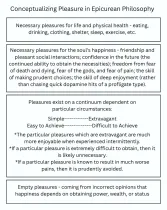

I should probably add references to the Principal Doctrines, etc.
I made this using my own brain and Canva (there is no AI used at any point in making this)
The one comment I would make on this is directed to the last block:

I personally find the meaning of "empty" in English in this context to be unclear, and to require explanation. And I specifically believe that it requires explanation because to immediately equate "empty" with "incorrect" does not explain what the standard of correct or incorrect is. And the biggest problem I think in evaluating power, wealth, status, etc is that a significant number of people argue that those things are "bad in themselves" and thus "always empty."
I don't think that is correct at all. The power to defend yourself, enough money to live reasonably, and enough status to be well-regarded by your friends are perfectly proper Epicurean goals. So happiness does depend on some amount of power, wealth, and status. It is not reasonable to expect to be helpless, penniless, and hated by all your neighbors and still live a happy life. Extremely rare exceptions to that generalization might exist but the fact that they are extremely rare establishes the conclusion as a general good rule to follow.
The most authoritative text I can find on this is the statement of Torquatus:
§45
Nothing could be more useful or more conducive to well-being than Epicurus's doctrine as to the different classes of the desires. One kind he classified as both natural and necessary, a second as natural without being necessary, and a third as neither natural nor necessary; the principle of classification being that the necessary desires are gratified with little trouble or expense; the natural desires also require but little, since nature's own riches, which suffice to content her, are both easily procured and limited in amount; but for the imaginary desires no bound or limit can be discovered.
So the point is not that the pursuit of some amount of wealth, fame, and power is in itself "incorrect" but that if you seek them to an unlimited agree then there is no way to achieve your goal. That's because you have not identified the "limit" with which you will be satisfied. You have by definition sentenced yourself to frustration if you pursue anything in unlimited amount because you are a limited being and you simply cannot obtain anything in unlimited amount.