


1. Home
    1. Study Guide
    2. Community Standards
    3. Site Map
    4. Quizzes
    5. Articles On Physics
    6. Articles On Canonics
    7. Articles On Ethics
    8. All Articles
    9. Elli's Blog Posts
    10. Kalosyni's Blog
    11. All Blog Posts
  2. Lexicon
    1. Lexicon Home
    2. FAQ
    3. Files
    4. Search Assistance
    5. Foundations
    6. Navigation Outlines
    7. Reading List
    8. Key Pages
    9. Last Changes
  3. Forum
    1. Full Forum List
    2. Welcome Threads
    3. Ancient Texts Forum
    4. Physics
    5. Canonics
    6. Ethics
    7. Forum Shortcuts
    8. Forum Navigation Map
    9. Featured
    10. Most Discussed
  4. Latest
    1. New Activity
    2. Latest Threads
    3. Dashboard
    4. Search By Tag
    5. Complete Tag List
  5. Podcast
    1. Lucretius Today Podcast
    2. Episode Guide
    3. Lucretius Today At Youtube
    4. EpicureanFriends Youtube Page
  6. Texts
    1. Overview
    2. Torquatus On Ethics
    3. Velleius On Divinity
    4. Diogenes Laertius
    5. Principal Doctrines
    6. Vatican Collection
    7. Lucretius
    8. Herodotus
    9. Pythocles
    10. Menoeceus
    11. Fragments - Usener Collection
    12. Greek/Latin Help
  7. Gallery
    1. Latest Images
    2. Featured images
    3. Latest Comments
  8. More
    1. Featured Content
    2. Logbook
    3. EF ToDo List
  • Login
  • Register
  • Search
This Thread
  • Everywhere
  • This Thread
  • This Forum
  • Forum
  • Articles
  • Blog Articles
  • Files
  • Gallery
  • Pages
  • Wiki
  • FAQ
  • More Options
  1. EpicureanFriends - Classical Epicurean Philosophy
  2. Forum
  3. Comparisons With Other Philosophies
  4. Epicurus vs. Pyrrho, Sextus Empiricus, And Radical Skeptics

Sextus Empiricus - Clearly Stating That Skepticism Leads Not To Pleasure But To "Quietude"

  • Cassius
  • October 23, 2026 at 9:30 AM
  • Go to last post
  • Online
    Cassius
    5 - Administrator
    • I Too Am An Epicurean
    • Advocate
    • Lucretius Today Podcast Co-Host
    • 2025 Contributor
    • Active Member 5 Years or more
    Points
    115,573
    Posts
    15,918
    Quizzes
    9
    Quiz rate
    100.0 %
    • October 23, 2026 at 9:30 AM
    • #1

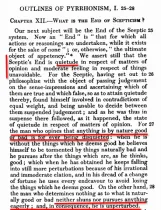
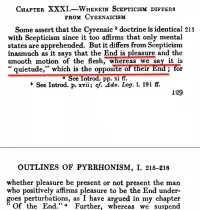
    Sextus says the goal of the Sceptic is “quietude” (ataraxia), reached by suspending judgement and giving up the search for truth (Outlines I.25–30). He contrasts this directly with the pleasure schools. Pleasure as the end, he says, is “the opposite” of Sceptic quietude (Outlines I.215).


  • Robert
    3 - Friend
    Points
    547
    Posts
    72
    • October 25, 2026 at 12:08 AM
    • #2

    But, do they still aim for eudaimonia? Perhaps for them (as for Democritus, if I understand him correctly), the quiet life is the happiest life. ☺️

  • Online
    Cassius
    5 - Administrator
    • I Too Am An Epicurean
    • Advocate
    • Lucretius Today Podcast Co-Host
    • 2025 Contributor
    • Active Member 5 Years or more
    Points
    115,573
    Posts
    15,918
    Quizzes
    9
    Quiz rate
    100.0 %
    • October 25, 2026 at 6:50 AM
    • #3

    Apparently a paper very close to Robert's question, with evidence that aiming for happiness is not consistent with suspension of judgment. I haven't read it yet but looks interesting based on the Abstract.

    Can an ancient Greek sceptic be eudaimôn (or happy)? And what difference does the answer make to us? | Journal of Ancient Philosophy

    Abstract

    The paper explores how far the ancient Greek sceptics in fact accept, and how far they should accept, the central Greek ethical notion of eudaimonia, usually translated "happiness" - and what, if anything, the answers may tell us today. The first section shows that sceptics of both the Academic and Pyrrhonist traditions frequently employ the notion of eudaimonia, apparently without discomfort. The second section draws attention to a contrast within the relevant works of Sextus Empiricus - one of them being willing to speak of the sceptic's eudaimonia and the other entirely avoiding this - and considers some possible reasons why, at some point in his life, Sextus might have found the notion problematic. The answers suggested are, first, that the term eudaimonia, at least as normally used by non-sceptical philosophers, presupposes that it is possible to rank human lives objectively in terms of their levels of well-being, and second, that the term standardly carries with it a commitment to a certain kind of long-term structure in one's life; there is at least a serious question whether either of these is consistent with sceptical suspension of judgement. The third section examines how far a sceptic could aspire to happiness, where this is not assumed to be equivalent to eudaimonia, and touches on several modern philosophers who have focused on happiness or, more generally, on wellbeing. The conclusions are that the notions of happiness and eudaimonia are closer in their presuppositions than one might have expected; that a sceptic would be well advised to avoid either one; and that this constitutes a sobering lesson for anyone today who regards values as in some sense subjective, but who aims to construct a satisfactory conception of happiness.

  • Online
    Cassius
    5 - Administrator
    • I Too Am An Epicurean
    • Advocate
    • Lucretius Today Podcast Co-Host
    • 2025 Contributor
    • Active Member 5 Years or more
    Points
    115,573
    Posts
    15,918
    Quizzes
    9
    Quiz rate
    100.0 %
    • October 25, 2026 at 7:08 AM
    • #4

    One of that paper's conclusions is below. This in my mind takes the wrong position of saying that "Epicureans aimed at pleasure and understood this to consist in ataraxia." So the article has to be read in perspective from one's assessment of the crucial issue of whether they want to equate "ataraxia" and "pleasure" as exactly the same thing to Epicurus - to which there are many pieces of evidence that the answer to that is "no." Pleasure is a wider and more important goal than ataraxia, and even in Epicurean terms Sextus Empiricus sees that - and therefore Sextus does not clearly endorse Epicurus' ethical conclusions as his own.

    Quote

    Let us return to my original question: can an ancient Greek sceptic be eudaimôn?
    The answer, I think, is not entirely straightforward. It is not impossible that a sceptic (not, of course, through any deliberate choice) might happen to live the kind of life that, according to some other school’s account of eudaimonia, would qualify as eudaimôn. This is in fact not going to happen in most cases, given that such specifications of eudaimonia will usually include a component of definite belief that would be anathema to a sceptic. This is clearly true of the Stoic specification, and presumably of the Aristotelian one. But perhaps the sceptic – assuming he did indeed achieve ataraxia – might qualify as eudaimôn as conceived by an Epicurean, albeit via a different route from the one laid down by the Epicureans themselves. For the Epicureans aimed at pleasure, and understood this to consist in ataraxia; and while the Epicureans, unlike the Pyrrhonists, took the route to ataraxia to involve the adoption of certain beliefs about the world, it is not clear that they saw the state of ataraxia as itself incorporating any element of belief. What a sceptic would be advised not to do, if I am right, is himself lay claim to the achievement of eudaimonia, and include it as a component of the sceptical outlook in
    a role parallel to the one it occupies in other philosophies; for, as we have seen, the very concept seems to bring with it a number of theoretical presuppositions that one would expect a sceptic to want to avoid. And this, I suspect, is why Sextus decided not to use it in Outlines of Pyrrhonism, even though he had done so in Against the Ethicists

  • Online
    Cassius
    5 - Administrator
    • I Too Am An Epicurean
    • Advocate
    • Lucretius Today Podcast Co-Host
    • 2025 Contributor
    • Active Member 5 Years or more
    Points
    115,573
    Posts
    15,918
    Quizzes
    9
    Quiz rate
    100.0 %
    • October 25, 2026 at 7:37 AM
    • #5

    1 - So now I understand why the song sounds like the Kinks! :)

    2 - The song is a fun way to dramatize the central question. Radical Skeptics seem likely to say "Sounds good to me!" Let's just say for now that I don't think the way Epicurus spent his life leads to the conclusion that Epicurus - or anyone concerned about the difference between true and false or good and bad - would agree.

    Quote

    Full Lyrics:

    Something's happenin' but I'm just gonna turn a blind eye
    If I see no evil, ask no questions, and I hear no lies
    Can't communicate with minds that are small
    With some people it's like talkin' to the wall
    And a fellow who walks away
    Lives to battle another day
    And I've really got no appetite
    For a fight
    Not tonight

    All I want is a quiet life
    Anything for a quiet life
    No ambition to rock the boat
    When I can just stay afloat

    Be content with a quiet life
    All I want is a quiet life
    Anything for a quiet life
    Hear no evil, see no evil, speak no evil at all
    Confidentially, between these walls
    I'm on top of it all

    I'd rather have 'em think I'm deaf, dumb, and blind
    Than aggravation every time I speak my mind
    Keep at a quiet life
    Anything for a quiet life

    I could easily blow my top
    Start a row
    But why start now?

    Give your daddy a quiet life
    Give your mother a quiet life
    Anything for a quiet life

    Give your daddy a quiet life
    Give your mother a quiet life
    Anything for a quiet life
    Confidentially, between these walls
    I'm on top of it all

    Display More

Resources

  1. Getting Started At EpicureanFriends
  2. Community Standards And Posting Policies
  3. The Major Doctrines of Classical Epicurean Philosophy
  4. Introductory Videos
  5. Lexicon
  6. Lucretius Today Podcast
    1. Podcast Episode Guide
  7. Key Epicurean Texts
    1. Chart Of Key Quotes
    2. Outline Of Key Quotes
    3. Side-By-Side Diogenes Laertius X (Bio And All Key Writings of Epicurus)
    4. Side-By-Side Lucretius - On The Nature Of Things
    5. Side-By-Side Torquatus On Ethics
    6. Side-By-Side Velleius on Divinity
    7. Lucretius Topical Outline
    8. Usener Fragment Collection
  8. Frequently Asked Questions
    1. FAQ Discussions
  9. Full List of Forums
    1. Physics Discussions
    2. Canonics Discussions
    3. Ethics Discussions
    4. All Recent Forum Activities
  10. Image Gallery
  11. Featured Articles
  12. Featured Blog Posts
  13. Quiz Section
  14. Special Resource Pages
  15. File Database
  16. Site Map
    1. Home

Frequently Used Forums

  • Frequently Asked / Introductory Questions
  • News And Announcements
  • Lucretius Today Podcast
  • Physics (The Nature of the Universe)
  • Canonics (The Tests Of Truth)
  • Ethics (How To Live)
  • Against Determinism
  • Against Skepticism
  • The "Meaning of Life" Question
  • Uncategorized Discussion
  • Comparisons With Other Philosophies
  • Historical Figures
  • Ancient Writers and Texts
  • Decline of The Ancient Epicurean Age
  • Unsolved Questions of Epicurean History
  • Welcome New Participants
  • Events - Activism - Outreach
  • Full Forum List

Latest Posts

  1. Welcome Thomas Karion!

    Thomas Karion
    October 27, 2026 at 6:37 PM
  2. Discussion of Article - "Aristotle - Introduction From An Epicurean Perspective"

    Cassius
    October 27, 2026 at 11:57 AM
  3. Discussion of Article - "Sextus Empiricus - Introduction From An Epicurean Perspective"

    Pacatus
    October 26, 2026 at 6:06 PM
  4. Heads up: New Book Coming in 2027

    Cassius
    October 26, 2026 at 4:29 PM
  5. Do some people still believe in fate?

    Kalosyni
    October 26, 2026 at 9:27 AM
  6. David Sedley - "Creationism And Its Critics In Antiquity"

    Cassius
    October 26, 2026 at 6:24 AM
  7. Turning to Religion to Make AI Morally Good (Comparing this to Epicurean Philosophy)

    Kalosyni
    October 25, 2026 at 8:07 AM
  8. Sextus Empiricus - Clearly Stating That Skepticism Leads Not To Pleasure But To "Quietude"

    Cassius
    October 25, 2026 at 7:37 AM
  9. Episode 357 - EATAQ39 - Continuing in Part 18 of Book 2 of Academic Questions - Not Yet Recorded

    Cassius
    October 24, 2026 at 5:55 PM
  10. Major Upgrade To Forum Software - Now Completed

    Cassius
    October 23, 2026 at 9:11 PM

Frequently Used Tags

In addition to posting in the appropriate forums, participants are encouraged to reference the following tags in their posts:

  • #Physics
    • #Atomism
    • #Gods
    • #Images
    • #Infinity
    • #Eternity
    • #Life
    • #Death
  • #Canonics
    • #Knowledge
    • #Scepticism
  • #Ethics

    • #Pleasure
    • #Pain
    • #Engagement
    • #EpicureanLiving
    • #Happiness
    • #Virtue
      • #Wisdom
      • #Temperance
      • #Courage
      • #Justice
      • #Honesty
      • #Faith (Confidence)
      • #Suavity
      • #Consideration
      • #Hope
      • #Gratitude
      • #Friendship


Click Here To Search All Tags

To Suggest Additions To This List Click Here

EpicureanFriends - Classical Epicurean Philosophy

  1. Home
    1. About Us
    2. Classical Epicurean Philosophy
    3. Rules, Terms & Policies
  2. Lexicon
    1. Getting Started
  3. Frequently Asked Questions
    1. Site Map
  4. Forum
    1. Latest Threads
    2. Featured Threads
    3. Unread Posts
  5. Texts
    1. Core Texts
    2. Biography of Epicurus
    3. Lucretius
  6. Articles
    1. Latest Articles
  7. Gallery
    1. Featured Images
  8. Calendar
    1. This Month At EpicureanFriends
Powered by WoltLab Suite™ 6.2.8
Style: Inspire by cls-design
Stylename
Inspire
Manufacturer
cls-design
Licence
Commercial styles
Help
Supportforum
Visit cls-design