


1. Home
    1. Study Guide
    2. Community Standards
    3. Site Map
    4. Quizzes
    5. Articles On Physics
    6. Articles On Canonics
    7. Articles On Ethics
    8. All Articles
    9. Elli's Blog Posts
    10. Kalosyni's Blog
    11. All Blog Posts
  2. Lexicon
    1. Lexicon Home
    2. FAQ
    3. Files
    4. Search Assistance
    5. Foundations
    6. Navigation Outlines
    7. Reading List
    8. Key Pages
    9. Last Changes
  3. Forum
    1. Full Forum List
    2. Welcome Threads
    3. Ancient Texts Forum
    4. Physics
    5. Canonics
    6. Ethics
    7. Forum Shortcuts
    8. Forum Navigation Map
    9. Featured
    10. Most Discussed
  4. Latest
    1. New Activity
    2. Latest Threads
    3. Dashboard
    4. Search By Tag
    5. Complete Tag List
  5. Podcast
    1. Lucretius Today Podcast
    2. Episode Guide
    3. Lucretius Today At Youtube
    4. EpicureanFriends Youtube Page
  6. Texts
    1. Overview
    2. Torquatus On Ethics
    3. Velleius On Divinity
    4. Diogenes Laertius
    5. Principal Doctrines
    6. Vatican Collection
    7. Lucretius
    8. Herodotus
    9. Pythocles
    10. Menoeceus
    11. Fragments - Usener Collection
    12. Greek/Latin Help
  7. Gallery
    1. Latest Images
    2. Featured images
    3. Latest Comments
  8. More
    1. Featured Content
    2. Logbook
    3. EF ToDo List
  • Login
  • Register
  • Search
This Thread
  • Everywhere
  • This Thread
  • This Forum
  • Forum
  • Articles
  • Blog Articles
  • Files
  • Gallery
  • Pages
  • Wiki
  • FAQ
  • More Options
  1. EpicureanFriends - Classical Epicurean Philosophy
  2. Forum
  3. Canonics - The Tests of Truth
  4. He Who Says Nothing Can Be Known Knows Nothing - Rejection of Skepticism

Plato's Meno, the "Eristic Paradox," and the Epicurean Response

  • Cassius
  • March 8, 2023 at 9:01 AM
  • Go to last post
  • Online
    Cassius
    5 - Administrator
    • I Too Am An Epicurean
    • Advocate
    • Lucretius Today Podcast Co-Host
    • 2025 Contributor
    • Active Member 5 Years or more
    Points
    115,543
    Posts
    15,915
    Quizzes
    9
    Quiz rate
    100.0 %
    • March 8, 2023 at 9:01 AM
    • #1

    In our review of the work of David Glidden on Epicurean "anticipations," we see a topic that Dr. Glidden has mentioned that goes by the name of the "eristic paradox."

    Quote from Author Unknown, From "Educheer"

    The erisitic paradox, which stems from this view of knowledge, states that if you know what it is you are inquiring about, you need not inquire, for you already know. If, however, you do not know what it is you are inquiring about, you are unable to inquire, for you do not know what it is into which you are inquiring.

    Below is a brief description of the issue from a website called "Educheer." (probably not the best source but the first I can find that seems relatively clear). It would seem almost certain that Epicurus was aware of this argument and fashioned his own philosophy of knowledge (especially "anticipations") in a way as to show how Plato/Socrates were wrong. Therefore in this thread let's discuss what Epicurus would have seen as wrong with Plato's assertions and how Epicurus responded. (The eristic paradox, and Epicurus' likely position in response, are discussed in Dr. Glidden's articles.)

    The Erisitic Paradox and The Slave Boy

    Quote

    Throughout history, philosophers have sought to understand the nature of true knowledge and how to achieve it. Most believe that true knowledge is acquired empirically, and not latent in our minds from birth. In Plato's Meno, Socrates argues in favor of the pre-natal existence of knowledge, the opposite of this proposal: that knowledge is essentially latent, and is brought to light through questioning.

    The erisitic paradox, which stems from this view of knowledge, states that if you know what it is you are inquiring about, you need not inquire, for you already know. If, however, you do not know what it is you are inquiring about, you are unable to inquire, for you do not know what it is into which you are inquiring.

    One consequence of this view is Plato's rejection of empiricism, the claim that knowledge is derived from sense experience. However, when one examines the scene in the Meno between Socrates and the slave boy in greater depth, one can see the flaws in this paradox. Plato uses Socrates' experiment, in which he draws one of Meno's slaves out from the gathered crowd and proceeds to demonstrate the theory of recollection using geometry; however, this experiment's purpose tests the credulity of the reader; and in some cases Socrates' questions are blatantly leading. Socrates merely places obvious propositions in front of the boy that can be immediately recognized.

    <>Also, contrary to what Plato asserts, knowledge can be obtained by other means, and not exclusively through intellectual inquiry and questioning. It is far too difficult to dismiss, as Plato does, any and all claims or assertions about the physical or visible world, including both common-sense observations and the propositions of science, as mere opinions. Furthermore, the interpretation of the experiment with the slave boy can be expanded to suggest yet another position: that Plato is demonstrating the flawed nature of sophistry by showing that what on the surface appears to be Socratic dialectic is really Sophistic practice. In light of all of these factors, it becomes clear that the eristic paradox is, in fact, flawed. In the experiment, Socrates guides a slave through a series of geometric proofs in an effort to illustrate that the slave already possessed this knowledge and, therefore, that learning is not acquisition but recollection. Plato maintains that the slave is simply recalling knowledge learned in a former incarnation.
    Source: https://educheer.com/essays/platos-…ristic-paradox/

  • Online
    Cassius
    5 - Administrator
    • I Too Am An Epicurean
    • Advocate
    • Lucretius Today Podcast Co-Host
    • 2025 Contributor
    • Active Member 5 Years or more
    Points
    115,543
    Posts
    15,915
    Quizzes
    9
    Quiz rate
    100.0 %
    • March 8, 2023 at 9:27 AM
    • #2

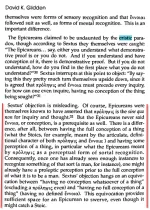
    Here is a strong, and even witty at the expense of the Stoics, hint from Dr. Glidden as to how he thinks the Epicureans responded:

  • Online
    Cassius
    5 - Administrator
    • I Too Am An Epicurean
    • Advocate
    • Lucretius Today Podcast Co-Host
    • 2025 Contributor
    • Active Member 5 Years or more
    Points
    115,543
    Posts
    15,915
    Quizzes
    9
    Quiz rate
    100.0 %
    • March 8, 2023 at 9:31 AM
    • #3

    And here is a section from Diogenes of Oinoanda that on its face seems to be directed more toward physics, but probably impacts the same question:

    Fr. 4

    ... [as is supposed by] some of the philosophers and especially the Socratics. They say that pursuing natural science and busying oneself with investigation of [celestial phenomena] is superfluous and unprofitable, and they do [not even] deign [to concern themselves with such matters.]

    Fr. 5

    [Others do not] explicitly [stigmatise] natural science as unnecessary, being ashamed to acknowledge [this], but use another means of discarding it. For, when they assert that things are inapprehensible, what else are they saying than that there is no need for us to pursue natural science? After all, who will choose to seek what he can never find?

    Now Aristotle and those who hold the same Peripatetic views as Aristotle say that nothing is scientifically knowable, because things are continually in flux and, on account of the rapidity of the flux, evade our apprehension. We on the other hand acknowledge their flux, but not its being so rapid that the nature of each thing [is] at no time apprehensible by sense-perception. And indeed [in no way would the upholders of] the view under discussion have been able to say (and this is just what they do [maintain] that [at one time] this is [white] and this black, while [at another time] neither this is [white nor] that black, [if] they had not had [previous] knowledge of the nature of both white and black.

  • Online
    Cassius
    5 - Administrator
    • I Too Am An Epicurean
    • Advocate
    • Lucretius Today Podcast Co-Host
    • 2025 Contributor
    • Active Member 5 Years or more
    Points
    115,543
    Posts
    15,915
    Quizzes
    9
    Quiz rate
    100.0 %
    • March 8, 2023 at 10:58 AM
    • #4

    Meaning of "Eristic" -

    In philosophy and rhetoric, eristic (from Eris, the ancient Greek goddess of chaos, strife, and discord) refers to an argument that aims to successfully dispute another's argument, rather than searching for truth. According to T.H. Irwin, "It is characteristic of the eristic to think of some arguments as a way of defeating the other side, by showing that an opponent must assent to the negation of what he initially took himself to believe."[1] Eristic is arguing for the sake of conflict, as opposed to resolving conflict.[2]

    Eristic - Wikipedia

  • Cassius August 30, 2023 at 9:06 AM

    Moved the thread from forum Epicurean Canonics - Methods of Reasoning And Determining Truth - General Discussion and Navigation to forum Knowledge Is Possible.

Resources

  1. Getting Started At EpicureanFriends
  2. Community Standards And Posting Policies
  3. The Major Doctrines of Classical Epicurean Philosophy
  4. Introductory Videos
  5. Lexicon
  6. Lucretius Today Podcast
    1. Podcast Episode Guide
  7. Key Epicurean Texts
    1. Chart Of Key Quotes
    2. Outline Of Key Quotes
    3. Side-By-Side Diogenes Laertius X (Bio And All Key Writings of Epicurus)
    4. Side-By-Side Lucretius - On The Nature Of Things
    5. Side-By-Side Torquatus On Ethics
    6. Side-By-Side Velleius on Divinity
    7. Lucretius Topical Outline
    8. Usener Fragment Collection
  8. Frequently Asked Questions
    1. FAQ Discussions
  9. Full List of Forums
    1. Physics Discussions
    2. Canonics Discussions
    3. Ethics Discussions
    4. All Recent Forum Activities
  10. Image Gallery
  11. Featured Articles
  12. Featured Blog Posts
  13. Quiz Section
  14. Special Resource Pages
  15. File Database
  16. Site Map
    1. Home

Frequently Used Forums

  • Frequently Asked / Introductory Questions
  • News And Announcements
  • Lucretius Today Podcast
  • Physics (The Nature of the Universe)
  • Canonics (The Tests Of Truth)
  • Ethics (How To Live)
  • Against Determinism
  • Against Skepticism
  • The "Meaning of Life" Question
  • Uncategorized Discussion
  • Comparisons With Other Philosophies
  • Historical Figures
  • Ancient Writers and Texts
  • Decline of The Ancient Epicurean Age
  • Unsolved Questions of Epicurean History
  • Welcome New Participants
  • Events - Activism - Outreach
  • Full Forum List

Latest Posts

  1. Discussion of Article - "Sextus Empiricus - Introduction From An Epicurean Perspective"

    Pacatus
    October 26, 2026 at 6:06 PM
  2. Heads up: New Book Coming in 2027

    Cassius
    October 26, 2026 at 4:29 PM
  3. Do some people still believe in fate?

    Kalosyni
    October 26, 2026 at 9:27 AM
  4. David Sedley - "Creationism And Its Critics In Antiquity"

    Cassius
    October 26, 2026 at 6:24 AM
  5. Turning to Religion to Make AI Morally Good (Comparing this to Epicurean Philosophy)

    Kalosyni
    October 25, 2026 at 8:07 AM
  6. Sextus Empiricus - Clearly Stating That Skepticism Leads Not To Pleasure But To "Quietude"

    Cassius
    October 25, 2026 at 7:37 AM
  7. Episode 357 - EATAQ39 - Continuing in Part 18 of Book 2 of Academic Questions - Not Yet Recorded

    Cassius
    October 24, 2026 at 5:55 PM
  8. Major Upgrade To Forum Software - Now Completed

    Cassius
    October 23, 2026 at 9:11 PM
  9. Note Regarding This Week's Internet Security Issues

    Cassius
    October 23, 2026 at 3:46 PM
  10. Epicurean Pleasure and Enjoyment Differs Depending on Introvert vs. Extrovert Brain Differences

    Pacatus
    October 23, 2026 at 12:33 PM

Frequently Used Tags

In addition to posting in the appropriate forums, participants are encouraged to reference the following tags in their posts:

  • #Physics
    • #Atomism
    • #Gods
    • #Images
    • #Infinity
    • #Eternity
    • #Life
    • #Death
  • #Canonics
    • #Knowledge
    • #Scepticism
  • #Ethics

    • #Pleasure
    • #Pain
    • #Engagement
    • #EpicureanLiving
    • #Happiness
    • #Virtue
      • #Wisdom
      • #Temperance
      • #Courage
      • #Justice
      • #Honesty
      • #Faith (Confidence)
      • #Suavity
      • #Consideration
      • #Hope
      • #Gratitude
      • #Friendship


Click Here To Search All Tags

To Suggest Additions To This List Click Here

EpicureanFriends - Classical Epicurean Philosophy

  1. Home
    1. About Us
    2. Classical Epicurean Philosophy
    3. Rules, Terms & Policies
  2. Lexicon
    1. Getting Started
  3. Frequently Asked Questions
    1. Site Map
  4. Forum
    1. Latest Threads
    2. Featured Threads
    3. Unread Posts
  5. Texts
    1. Core Texts
    2. Biography of Epicurus
    3. Lucretius
  6. Articles
    1. Latest Articles
  7. Gallery
    1. Featured Images
  8. Calendar
    1. This Month At EpicureanFriends
Powered by WoltLab Suite™ 6.2.8
Style: Inspire by cls-design
Stylename
Inspire
Manufacturer
cls-design
Licence
Commercial styles
Help
Supportforum
Visit cls-design