
Where Was the Garden of Epicurus? The Evidence from the Ancient Sources and Archaeology
By Don
While we will probably never know the exact location of Epicurus’s Garden in ancient Athens, we can take a number of educated guesses. We have two primary sources from which to make these guesses: ancient texts that hint at the location of the Garden and modern archaeological excavations. This paper will present the evidence for several possible — and even probable — locations for the properties where Epicurus lived and taught and where his school existed for several centuries after his death.
One of the primary goals of this exercise is to dispel the myth that Epicurus and his students fled society and founded their communities far from city centers, isolated from society. As will be demonstrated, Epicurus’s Garden was not inaccessible to passers-by or curious visitors. Seneca himself states that the motto displayed at the entrance to the original Garden invited people to enter:
Hospes hic bene manebis, hic summum bonum voluptas est.
O Guest, here you will do well to tarry; here our highest good is pleasure.
(Seneca, Epistulae morales ad Lucilium, Letter XXI)
Lewis & Short define “hospes” as “a sojourner, visitor, guest, friend, ξένος xenos.” Of course, the inscription would have been in Greek which lends significance to the dictionary definition including ξένος which implied the host-guest relationship of extending hospitality to both friends and strangers.
In fact, as we’ll see, Epicurus’s Garden was described as being along the road that led from the Dipylon Gate in the city walls of Athens directly to the open-air gymnasium known as the Academy where a certain philosopher by the name of Plato established his school. It’s no more than a pleasant stroll from the Gate to the Academy, and the Garden would have been a welcoming stop along the way. Most scholars do not claim that Plato placed his school in some remote location, and the Garden was even closer to the city than the Academy. The Garden was only a short walk from the city, and Epicurus also encouraged his students to take part in the festivals held regularly in Athenian life. The Epicureans were not living in some remote cave off in the hills somewhere. Additionally, as we’ll explore, the purchase price of Epicurus’s properties in Athens hints at a sizable plot of land and not some solitary, out-of-the-way, individual building.
It should also be remembered that other Epicurean communities were not isolated. Philodemus had his workspace and “his simple cottage” where the Twentieth celebrations were held most likely within the villa of his patron Lucius Calpurnius Piso Caesoninus in Herculaneum. Diogenes of Oenoanda had his massive carved text explaining and expounding Epicurean philosophy on the very public walls of the stoa of the marketplace of his town. Epicureans did not hide themselves away. Epicurus merely warned of the troubles inherent in a political career. He didn’t advocate for his students to shut themselves away from their communities, sealed in some kind of hermetic existence.
If the Garden was in an isolated spot in ancient Athens, who would have had the opportunity to read the Welcome sign?
Ancient Sources in Chronological Order for “The Garden” Established by Epicurus in Athens
Active/Extant: 306 BCE to ~4th century CE
Source 1: Epicurus’s Will (c. 270 BCE via 3rd century CE)
Source 1 Text: Diogenes Laertius, Lives of Eminent Philosophers, Book 10.16-17.
On this wise I give and bequeath all my property to Amynomachus, son of Philocrates of Bate and Timocrates, son of Demetrius of Potamus, to each severally according to the items of the deed of gift laid up in the Metroön, [17] on condition that they shall place the garden and all that pertains to it at the disposal of Hermarchus, son of Agemortus, of Mitylene, and the members of his society, and those whom Hermarchus may leave as his successors, to live in and study in. And I entrust to my School in perpetuity the task of aiding Amynomachus and Timocrates and their heirs to preserve to the best of their power the common life in the garden (ἐν τῷ κῆπω) in whatever way is best, and that these also (the heirs of the trustees) may help to maintain the garden (τὸν κῆπον) in the same way as those to whom our successors in the School may bequeath it. And let Amynomachus and Timocrates permit Hermarchus and his fellow-members to live in the house in Melite (τὴν δʼ οἰκίαν τὴν ἐν Μελίτῃ) for the lifetime of Hermarchus.
Source 2: The Testimony of Apollodorus the Epicurean (2nd century BCE via 3rd century CE)
Source 2 Text: Diogenes Laertius, Lives of Eminent Philosophers, Book 10.10-11.
Friends indeed came to him from all parts and lived with him in his garden (ἐν τῷ κῆπω). This is stated by Apollodorus, who also says that he purchased (πρίασθαι) the garden for eighty minae (ὁγδοήκοντα μνῶν); and to the same effect Diocles in the third book of his Epitome speaks of them as living a very simple and frugal life…
Source 3A: Cicero reporting a walk in Athens (1st century BCE)
Source 3A Text: Cicero, De Finibus Bonorum et Malorum, 5.1
We arranged to take our afternoon stroll in the Academy, chiefly because the place would be quiet and deserted at that hour of the day. Accordingly at the time appointed we met at our rendezvous, Piso’s lodgings, and starting out conversed on various subjects while we covered the three-quarters of a mile from the Dipylon Gate. (trans., Rackham) (Alternative: we completed the six stades from the Dipylon: sex illa a Dipylo stadia confecimus.)
Source 3B: Cicero’s companion Pomponius on passing the Garden (1st century BCE)
Source 3B Text: Cicero, De Finibus Bonorum et Malorum, 5.3
“For my part,” said Pomponius, “you are fond of attacking me as a devotee of Epicurus, and I do spend much of my time with Phaedrus, who as you know is my dearest friend, in Epicurus’s Garden which we passed just now;…” (quos modo praeteribamus) (alternative translation: “which we were just passing by”)
Source 4: Cicero writes to Memmius to ask that he cease his project to tear down Epicurus’s house in Athens (703 AUC = 51 BCE)
Source 4 Text: Cicero, Epistulae ad Familiares, 13.1
This Patron, therefore, having written to me at Rome, begging me to reconcile you to him, and to ask you to grant him some ruined house or other once belonging to Epicurus, I did not write to you on the subject, because I did not want any plan of building which you might have to be hampered by a recommendation of mine. (is igitur Patro quum ad me Romam litteras misisset, uti te sibi placarem peteremque, ut nescio quid illud Epicuri parietinarum sibi concederes, nihil scripsi ad te ob eam rem, quod aedificationis tuae consilium commendatione mea nolebam impediri;) (Note: Cicero’s entire letter to Memmius is of interest and is reproduced as Appendix A)
Source 5: Philodemus (d. 40 or 35 BCE) noting the “school” was “in the Garden.”
Source 5 Text: Philodemus, The Hellenistic Philosophers (P.Herc. 1780, fragment 7)
… the school … they shall [give] to those [of our group and to those with] them and to whom … the successors of the [school] … they shall be masters of the Garden and of the [school] in the Garden; and those to whom at any time it is left and to whom they hand it over …
Source 6: Pliny the Elder (d. 79 CE)
Source 6 Text: Pliny the Elder, Natural History, 19.19
Epicurus, that connoisseur in the enjoyments of a life of ease, was the first to lay out a garden at Athens; up to his time it had never been thought of, to dwell in the country in the middle of the town. (iam quidem hortorum nomine in ipsa urbe delicias agros villasque possident. primus hoc instituit athenis epicurus magister otii; usque ad eum moris non fuerat in oppidis habitari rura.)
Source 7: Emperor Julian (d. 363 CE)
Source Text: Emperor Julian, Letter to Themistius the Philosopher, 259b. (Usener 551)
Now if, reflecting on this, one is afraid to be constrained to adopt a life from which so much is expected, do you therefore conclude that one admires the inaction recommended by Epicurus, the gardens and suburbs of Athens, or the myrtles, or the humble home of Socrates? (Note: the Greek implies Julian is referring to the Epicurean gardens and suburbs; also myrtle was associated with Aphrodite/Venus, and the plant was thought to be an aphrodisiac and to have been held by the goddess when she arose from the ocean.)
Source 8: Heliodorus of Emesa’s novel (220s or 370s CE; c. 3rd or 4th century CE)
Source Text: Heliodorus of Emesa, Aethiopica, 1.16
‘But what must I do now?’ ‘You know the garden in which the Epicurean monument stands; go and wait for me there in the evening.’ Note: By 220 or 370 CE, it is likely that the residence in Melite was in ruins or already razed and a new structure having take its place. The Garden proper, however, was still imbued with the memory of Epicureans, acutely enough so that Heliodorus could place his characters in that setting and have it readily recognized by readers.
Additional mentions of the Garden of Epicurus in ancient sources
These do not necessarily aid in determining the location of the Garden; however, they do testify to the longevity of the memory of Epicurus’s Garden in the ancient world:
- Seneca (d. 65 CE), Letters to Lucilius, 4.10. (Usener 477): But I must end my letter. Let me share with you the saying which pleased me today. It too is culled from another man’s Garden: "Poverty, brought into conformity with the law of nature, is great wealth." (et hoc quoque ex alienis hortulis sumptum est: ‘magnae divitiae sunt lege naturae composita paupertas.’)
- Plutarch (d. early 2nd century CE), Non posse suaviter vivi secundum Epicurum, 16: Handsome young lassies too, such as Leontion, Boidion, Hedia, and Nicedion, that were wont to roam about in Epicurus’s philosophic garden (περὶ τὸν κῆπον)… Let us then compare with Epaminondas’s Epicurus’s mother, rejoicing that she had lived to see her son cooping himself up in a little garden (τὸ κηπίδιον) and getting children in common with Polyaenus upon the strumpet of Cyzicus.
- Juvenal (d. 2nd century CE), Satires, 14.316. (Usener 471): Yet if any should ask of me what measure of fortune is enough, I will tell him: as much as thirst, cold and hunger demand; as much as sufficed you, Epicurus, in your little garden (tibi paruis suffecit in hortis); as much as in earlier days was to be found in the house of Socrates. (Note: No connotation of “little” in Latin)
- Pompeia Plotina, widow of the emperor Trajan, sent Emperor Hadrian a series of letters (121 CE) asking for assistance with an issue concerning the succession of the heads of the Epicurean school in Athens. While the letters do not address the location of the Garden — and hence the Epicurean school — they do impact the topic of the separateness of the Garden (the location of the school) and Epicurus’s house. As such, the letters are provided as Appendix B.
- Readers are also encouraged to refer to the list of mentions of the Garden in texts from 3rd century BCE (including the Will of Epicurus cited above) through 1806 at ToposText.org: https://topostext.org/place/380237BGEp
Where Was Epicurus’s Garden? Commentary on the Evidence Provided by the Ancient Sources and Archaeology
Arguably the oldest information we have for Epicurus’s Garden and its location is the Will of Epicurus himself (Source 1), as included in Diogenes Laertius’ Lives of Eminent Philosophers, Book 10. While Epicurus’ Will itself dates arguably from around 270 BCE, Diogenes Laertius didn’t compile his sources until the 3rd century CE, around six centuries later. The fact that Diogenes Laertius could include the entire will shows the admiration that this document received. The text continued to be transmitted for more than five centuries, just like Epicurus’s letters that Diogenes also includes in his work.
The Will clearly states that there were two separate — or at least “separable” — properties, namely, the garden (τὸν κῆπον, kepos) and the house in Melite (τὴν δʼ οἰκίαν τὴν ἐν Μελίτῃ, oikia). This important two-property issue seems to be often ignored when discussing Epicurus’s school. There is understandable debate as to whether the two properties were located nearby each other but in separate districts (deme) of the city; but there is no question as to there being two properties.
We will look closer at the location of Melite below (including some maps); however, it may be useful to establish what Melite was early in our discussion. When Epicurus’s Will states that the house was “in Melite” (ἐν Μελίτῃ), it means that the structure was situated in the deme of Melite. A deme is defined by Merriam-Webster as simply “a unit of local government in ancient Attica.” These were the political subdivisions of ancient Athens and the surrounding countryside from which, for example, a certain quota of citizens were chosen to serve in the governing bodies of ancient Athens. The word comes from δῆμος (demos) meaning either a people/inhabitants or a tribe or the land on which those people lived. In his book, John S. Traill states that Melite was west of the Agora and that the “general location [is] known with certainty from literary sources (e.g. Strabo, I, 4, 7, etc.), supported by strong archaeological evidence for a more exact location.” Another deme mentioned by Diogenes Laertius in connection with Epicurus was Gargettus: “Epicurus, son of Neocles and Chaerestrate, was a citizen of Athens of the deme Gargettus.” Gargettus (or Gargettos) was a deme to the northeast of Athens, farther inland.
It would appear that Epicurus’s house (oikia) in Melite was in ruins (or was at least in a run-down condition) in 51 CE when Cicero was writing to Memmius (Source 4). However, note that there was a thriving school at that time presided over by Patro. Additionally, Cicero has his traveling companion talk about “just passing the school” on a walk in Athens (Source 3). It is doubtful if a thriving philosophical school would have its headquarters in a run-down building that was bought by a notable Roman citizen.
Norman W. DeWitt, in his paper “Epicurus’ Three-Wheeled Chair,” posits the novel idea, based on the word τρικύλιστος (DL 10.5) in Epicurus’s letter to Themista, that Epicurus “commuted daily between the house in Melite and the Garden” in a three-wheeled chair, pushed by someone and steered by himself. Whether this mode of transportation was used or not, DeWitt shows the impact of there being two properties sufficiently removed from each other to entail a “commute” between them to teach in the Garden each day.
In light of this, the school proper is evidently headquartered in the Garden itself, with lectures taking place in open areas among the trees and crops. This situation is also implied by Sources 5, 6, and 7. To use a modern analogy, there would be the dormitories (if the president lived with the students) in one location and the class buildings in another. By the time Heliodorus of Emesa is writing his novel (Source  in the 3rd or 4th century CE, the Garden property is where the memory of the Epicureans is placed with no mention of the residence.
That fact that there are two properties implies the potential for a sizable holding of land. For a start, we have Diogenes Laertius including an account from Apollodorus the Epicurean (Source 2) on how much Epicurus paid for the Garden — 80 mina (ὁγδοήκοντα μνᾶν) — which could provide an idea of the size of the property. Apollodorus was the scholarch of the Garden prior to Zeno of Sidon, who was Apollodorus’s student. Zeno was succeeded in 75 BCE as scholarch of the Garden by Phaedrus, who appears in Source 3 from Cicero. The purchase price of the Garden must come from Apollodorus’s Life of Epicurus, but it is only the fragment quoted by Diogenes Laertius that we have. That comes with a lack of context for how the price appeared in Apollodorus’s earlier work. Although Apollodorus was writing in the 2nd century BCE (c. 100 BCE) and Epicurus bought the Garden around 306 BCE, Apollodorus would have had a vested interest in knowing its purchase price or value since he was responsible for the property, being scholarch of the Epicurean school in Athens. The text seems to me to be ambiguous: Did Epicurus purchase only the Garden for 80 mina or did he purchase both the house in Melite and the garden together for that price? Or did Epicurus buy one property then the other? There’s no way to know; however, my conjecture will be that 80 mina was the price for the two properties together, regardless of the timeline of the purchases. I would further conjecture that “The Garden,” as referring to “The School of Epicurus,” encompassed both properties at the time of the initial purchase. It is entirely possible that Apollodorus was also giving the value of the properties in his time instead of the initial price that Epicurus paid. Again, the texts provide tantalizing clues without giving us enough details to state anything conclusively.
Source 2 is also important in that it states that friends came “from all parts and lived with him in his garden.” Diogenes Laertius is quoting Apollodorus here as well. So, from this, we know the Garden was big enough for friends to come, visit, and stay for extended periods of time. However, a κῆπος (kepos “garden”) appears to typically not have had any buildings. To my reading, the text is again conflating the residence (oikia) with the garden (kepos). It could be that, over time, some buildings were added to the garden property, but it need not always have been that way. Initially, it appears to me, that the garden/kepos supplied food for teachers and students (possibly with some surplus to sell) and space for classes, while "residential" students and teachers stayed in the residence. As the residence became more ramshackle (per Source 4), even the head of the Epicurean school no longer lived there, although the property held sentimental and historical significance for the "Garden."
A valuable resource for a description of a garden/kepos vs house/oikia and on the economy of ancient Athens in general is “The Attic Stelai: Part II” by W. Kendrick Pritchett and Anne Pippin. In that work, the authors provide a helpful description of the word κῆπος (kepos):
κῆπος (X, 17). P. Roussel inferred from the use of the word at Delos that a kepos was an enclosed field which contained no buildings. J.H. Kent in his admirable work on the Delian temple estates restudied the evidence and concluded that kepos referred to a “plot of land under cultivation,” since the revenues from the kepoi-estates were derived from vines, grain, and fruit trees (arable land). Non-epigraphical evidence shows that trees and vegetables (λάχανα) were grown in kepoi. The word corresponds, therefore, to English “garden” and “orchard.” Buck has written of kepos and its Indo-European cognates, "there may be specialization of garden to flower garden, “vegetable garden,” or “tree garden, orchard.” (p.264)
The word for “house” οἰκία (oikia), which is used in Epicurus’s Will for the property in Melite, is described as follows:
Oikia, used in Homer for the nests of birds and bees and occurring in tragedy only in one papyrus fragment, is very common in Aristophanes and prose texts with the meanings of 'building, household, family,' etc. In legal contexts, it seems to refer generally to a 'private residence.' Finley in his section on houses in the horoi has recently written, "an analysis of the economics of real security will show that, in all likelihood, it is the personal residence that is usually meant by the word 'house' in the horoi." (p. 265)
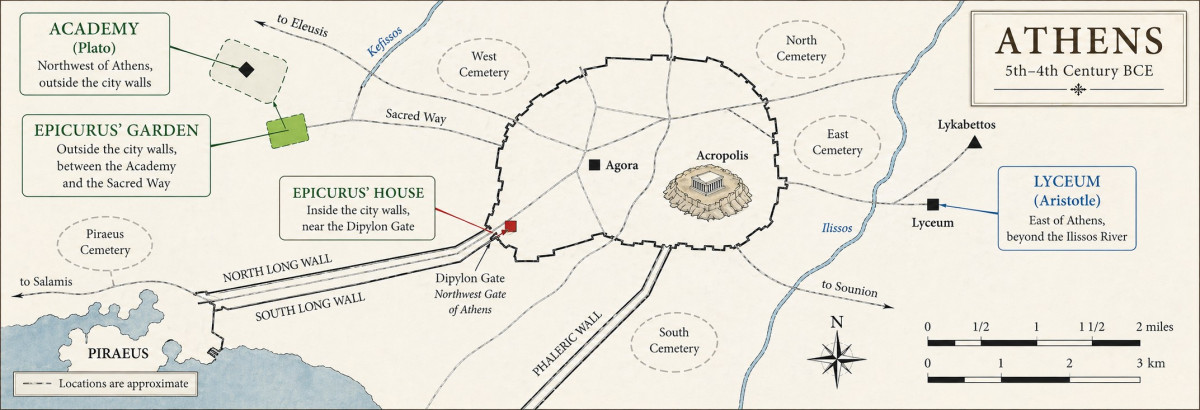
Epicurus's kepos and oikia then occupy two distinct spaces with the house in the Melite district and, it would appear, the Garden outside the Dipylon Gate on the road to Plato's Academy (Source 3). But before we delve deeper into the locations, let's look closer at the implications of that purchase price of 80 mina, a significant sum of money.
One mina was worth 100 drachmas, as stated in Aristotle's Athenian Constitution (10.2). A skilled worker could earn one drachma for a day’s work. Even with that comparison, it is difficult, if not impossible, to equate a contemporary financial value with an ancient monetary denomination. However, in looking at comparative values within the ancient world, we may get a glimpse of what 80 mina (8,000 drachmas) would purchase. The following list of the values of land and houses in ancient Greece is adapted from Economy and Economics of Ancient Greece by Stanford University economist Takeshi Amemiya (Routledge, 2007. p.71, with additional references) and Pritchett and Pippin (P&P). These give a selection from which to extrapolate a reasonable size of the land area occupied by Epicurus's properties.
Land and Houses
- 414 BCE: “cheapest recorded price of a house at an unattractive location” = 105 drachmas (1.05 mina)
- Most houses well above 1,000 drachmas (10 mina)
- The median value of seven houses sold in Athens = 410 drachmas (4.1 mina)
- 4c BCE: Prices of properties mentioned by the Attic orators:
- House, 300–5,000 drachmas (average of 12 being 2,600 (26 mina))
- House and land, 5,000 drachmas (50 mina)
- Multiple-dwelling house, 10,000 and 1,600 drachmas (100 and 16 mina, respectively)
- Farm land, 6,000–15,000 drachmas (average of four being 10,000 (100 mina))
- Land, 1,000–7,000 drachmas (average of six being 4,000 (40 mina)) (P&P, pp. 271–2)
- 388 BCE: 70 acres of land and a house (worth 50 minas) for five talents (Lysias XIX, 29 and 42).
- Note: An Attic talent is equivalent to 60 minae or 6,000 drachmae. Five talents would then equal 300 mina (5*60) making the 70 acres of land equal 250 mina.
- 362 BCE: House bequeathed to Demosthenes, 30 minas
- 360 BCE: A cottage, 300 drachmas (3 mina)
- 4c BCE: House rent, 36 drachmas a year — 12 percent of 3 minas
- 4c BCE: Many plots are in the range of 2,000 drachmas (20 mina) for 3.6 hectares (8.9 acres) to 3,000 drachmas (30 mina) occupying 5.4 hectares (13+ acres)
- Late 4c BCE: 2 out of 3 Athenians had property worth at least 2,000 drachmas (20 mina)
- 4c BCE: A typical house cost approximately 3,000 drachmas (30 mina) in mid-fourth century BCE.
As can be seen, 80 mina would buy a considerable oikas or residence and a significant number of acres of land for a kepos. Note, that in 388 BCE, 70 acres of land with a house worth 50 minas sold for five talents (300 mina). Additionally, 30 drachmas would buy a 13+ acre plot, with nine acres selling for 20 mina. In the 4th century BCE, one multiple-dwelling house was 100 mina with another (presumably smaller one) valued at only 16 mina.
To provide some perspectives, the footprint of the Great Pyramid of Giza is almost 13 acres with each side of its square base measuring 230.6 m (756.4 ft) long. Seventy acres is 64% the size of Vatican City! These are huge tracts of land.
For the sake of argument, let's conjecture that Epicurus paid 30 mina for his house in Melite and 50 mina for the Garden property. These numbers are not documented anywhere. We're simply making a guess. All we have is Apollodorus's total. Even taking into account higher prices/values by 306 BCE, 30 mina could purchase a "typical" house. On the other hand, 50 mina would conceivably purchase, conservatively, 17 acres (at around 3 mina/acre). That's approximately the size of almost 10 "FIFA-sanctioned international match soccer fields" (per Wolfram Alpha). So, with that, let's say the Garden proper could have occupied a space 200m by 350m (i.e., 656 ft by 1,149 ft) That’s an area measuring about .12 mile by about .22 mile. While complete conjecture as to size, this impresses upon one the concept that the Garden was a plot of land and not a single spot or building. Coincidentally, this is comparable in size to the Academy where Plato established his school.
Although beyond the scope of this article, we have to wonder how Epicurus had access to this amount of money with parents of modest means, and the fact that "Epicurus did not think it right that their property should be held in common." (DL 10.11) Could his students in Lampsacus have donated funds to purchase the Athenian house and garden? Could Epicurus have inherited one of the other property from someone? History is, unfortunately, silent on the details.
From the previous section, we have an idea of the possible size of the Garden. Now we turn our attention to the possible locations of the Garden and the residence. We really have no clues as to the exact location of the house other than that it was in the Melite district of Athens and was large enough to attract the attention of Memmius, a well-to-do Roman citizen, who wanted to raze the property and construct his own villa on the site (Source 4). From Epicurus’s Will (Source 1), we only know that the house/oikia was in Melite, the deme of Athens to the west of the Agora.
[The original paper includes several period and modern maps at this point — a detail from Traill's Political Organization of Attica showing Melite's location west of the Agora, a 1908 interpretive map of ancient Athens, and Google Maps overlays of the candidate excavation sites near Achilleos and Marathonos Streets. See the original PDF for these maps.]
Reproduced in the original is a detail of Map 3 from Traill's The Political Organization of Attica which shows Melite's location within the city walls of Athens to the west of the Agora. An interpretive map from 1908 maintains Melite's position to the west of the Agora and south of the Ceramicus (Kerameikos) district. This 1908 map provides additional details for orientation: the Dipylon Gate in the Wall of Themistocles, the Agora, the Acropolis, and other landmarks. Melite then is, according to Epicurus's Will itself, where the residence (oikia) was located.
Cicero (Source 3) provides a vital piece of evidence — possibly the most vital textual piece — on the location of the Garden itself. Cicero is writing when the Garden was still a living, breathing, functioning institution presided over by Phaedrus, scholarch of the Garden after the death of Zeno of Sidon around 75 BC. Zeno was the teacher of Philodemus. Cicero’s walk across Athens, through the Dipylon Gate, and ending at Plato’s Academy provides a tantalizing route for a walking tour through the ancient city. According to Cicero’s text, he and his friends walked six stades from the Dipylon Gate while talking about various topics (inde sermone vario sex illa a Dipylo stadia confecimus), and his companion Pomponius remarks that, upon arriving at the Academy, they had just passed (quos modo praeteribamus) Epicurus’s Garden.
While Cicero’s statement is of great importance, we first have to establish where the Academy was in ancient Athens to know the route along which the group of friends was walking!
Judith Binder’s posthumously posted finding aid, The Monuments and Sites of Athens, A Sourcebook, is an indispensable resource for tracking down information on the sites of the ancient city. Binder’s work also links directly to the TopostText.org website which provides maps and documentation for ancient sites.
The Academy grounds, which have had extensive excavations, were northwest of the Dipylon Gate. Today, the walk from the Dipylon Gate (Archaeological Site of Kerameikos, Psaromiligkou 33) to Plato’s Academy Archeological Park would be a pleasant half-hour stroll (approx. 2 km or 1.3 miles).
Binder makes note that there were evidently private dwellings on the grounds of the Academy, citing Plutarch, Moralia, 603B: The Academy, a little plot of ground bought for three thousand drachmas, was the dwelling of Plato and Xenocrates and Polemon, who taught and spent their lives there, except for the one day every year when Xenocrates went down to the city for the new tragedies at the Dionysia, and graced the festival, as people said. So, it is not out of the question that Epicurus’s Garden also included some residential buildings, either originally or as additions to the property. Interestingly, note that Plutarch mentions the purchase price of the Academy was 3,000 drachma, which translates to 30 mina. If we keep our conjecture that Epicurus paid 50 mina for the plot of land enclosed by the Garden, we can again guess that the area of the Academy and Garden were at least similar.
Accepting the archaeological evidence, we can compare the location of Plato’s Academy Archeological Park with the description of Cicero’s walk with his friends. According to Cicero, the group walked six “stades” from the Dipylon Gate to arrive at the grounds of the Academy. Per Liddell & Scott’s A Greek-English Lexicon, a stade (or stadium) was a distance of 125 paces, or 625 Roman feet, equal to 606 feet 9 inches English; “it was an eighth part of a milliarium, or somewhat less than an eighth of an English mile.” Elsewhere, a pes/foot is given as 296 mm and the stade as 600 feet. Using the 606.75 feet as a figure, six stades would equal 3,640.5 feet or .7 miles (1.1 km) which is considerably shorter than the 1.3 miles (2 km) that Google maps takes on a walk from the gate to the Academy. However, if one measures a straight line from the Dipylon Gate to the closest point of the Academy grounds, the measurement decreases to 1 mile (1.6 km). It would appear that the actual distance would be more like 8 or 9 stades. Do we know the exact layout of the roads and boundaries of the Gate and the boundaries of the Academy in Cicero’s time? Actually, it has been proposed that the road leading from the Dipylon ended 200 meters from the entrance to the Academy.
Additionally, while we have Cicero’s six “Graeco-Roman” stades marking the distance from the Dipylon to the Academy, Livy (XXI, 24) states that “it was 1,000 Roman paces, i.e. 1478 metres,” which is closer to the distance established through archaeological evidence. We now have the two endpoints along which the Garden was situated.
The road itself, the Dromos, was one of the most important and ancient roads leading out of Athens. It ran through the Kerameikos (Ceramicus) district, which was also the burial grounds of individuals as well as the place of the state burial grounds. In some places the road was 39 meters wide and was also the site of athletic contests to honor the dead, including a torch race that began at the entrance to the Academy. This, again, emphasizes that Epicurus was not trying to hide his school!
This means that if Cicero and his friends passed the Garden on their way to the Academy, it would have to have been along the Dromos in the Kerameikos district. Moreover, if Pomponius can say they “just passed” the Garden upon their arrival at the Academy, the two properties cannot be that far removed from each other. Although, one could conceivably say they “just passed” a landmark anywhere along a mile or so stroll.
At this point, we return to Binder’s sourcebook for clues on the location of Epicurus's Garden itself. According to her sources and later additions to the work, a statue of a seated philosopher in Epicurean style had been excavated at 54 Achilleos St. and “Later finds in the neighbouring property indicate that this statue comes from Epicurus’ Garden.” In the finds excavated in 1968, the sourcebook states that the finds at 61 Marathonos Street included “two statues of Epicurus and two statues of enthroned philosophers, all of the 2nd-3rd c. A.D., built into a Roman wall, a short distance from the findspot of the seated philosopher found in 1963 [at 54 Achilleos St.].” These finds do provide compelling evidence of Epicurean activity in the area near Achilleos and Marathonos Streets. And the area is only 2,860 ft (871.98 m) from the boundary of the Academy.
To provide an overlay of the ancient city layout with modern Athens, Iōannēs Traulos included a map of this type in the Pictorial Dictionary of Ancient Athens (1971). In the original paper, a solid red square marks where the Achilleos and Marathonos statues were excavated, with a red outline around the possible area enclosed by the Garden using the conjecture formulated above. The finds are intriguing and Achilleos/Marathonos do fit some of the criteria for the location where we would expect the Garden to be. However, it should be clearly understood that this is still a guess — an educated guess — to the location of the Garden. On the one hand, the statues were part of a Roman wall, so they could have been moved there. On the other hand, there were five Epicurean statues in one location, two of Epicurus himself according to published reports. But there is controversy on the site even within Binder’s work.
In another entry, we read under the finds for 1871: “Road from the Dipylon Gate to the Academy, 1871 — Zographou St. just off Plataion St. [mistakenly called site of Epicurus’ Garden]: St. Koumanoudes, Archaeological Society, found a carelessly constructed, poorly preserved building complex, no finds recorded, on the east side of the Road to the Academy from the Dipylon Gate. [This unpromising site received no further attention for 97 years. In 1963 and 1968 five statues of Epicurus and his circle were found at 54 Achilleos St. and 61 Marathonos St., the actual site of Epicurus’ Garden. In 1968 J. Travlos persuaded G. S. Dontas that the five statues had been moved in Late Roman times from the site at Zographou St. to the place where they were found. Travlos did not want Epicurus’ Garden to be at 61 Marathonos St. site because it obstructed his (mistaken) location for the Demosion Sema on the Road to the Academy.]”
So, it appears that J. Travlos (Traulos) had a pet theory that Epicurus’s Garden was located at “Zographou St. just off Plataion St.” Where is this located in relation to the Achilleos location? It is only a 4 minute walk from the Zographou/Zografou site to the Achilleos site. Even if the statues were moved from one location to the other, it is clear (from this author’s perspective) that they could still have been moved within the grounds of the Garden! That general area remains a very viable option for the Garden.
One source shared that “Some modern Athenians believe the site of the Garden was at the point where the Leoforos Athinon (“Athens Highway”) crosses the ancient Dromos, via a monstrous overpass. That is as may be. There is, pleasingly, a little park there, but it’s unlikely nowadays to stir Epicurean feelings of tranquility.” In fact, this site is not that far from the Achilleos site, again within the possible grounds of the Garden’s plot of land.
All that said, it is intriguing to consider some other alternatives. The route from the Dipylon Gate to the Academy is today lined with churches. It is not out of the question that a church would have been built on top of the Garden’s precincts as was done with countless other pagan sites. Two in particular are:
- Church of the Holy Trinity at Kerameikos (Ἱερός Ναός Ἀγίας Τριάδος)
- Holy Church of Agios Georgios of Academia Plato (Ἱερος Ναος Ἀγίου Γεωργίου Ἀκαδημίας Πλάτωνος)
with the Church of the Holy Trinity just outside the Dipylon Gate and the Holy Church of Agios Georgios near the Academy (as the name suggests). The latter is 1,542.59 ft (470.18 m) away from the Achilleos site, but also directly on the line of the ancient Dromos road. It’s tantalizing to consider linking the church with the Garden, but there is no direct evidence for this.
For those who find it hard to visualize the size of the Garden being proposed, consider that the land area would fit inside the grounds of the White House in Washington, DC. The area is approximately 639,627.19 ft² (59,423.31 m²) or 14.7 acres. That is approximately the size of the Garden proposed here. Granted, it’s a large plot of land, but not an inconceivable plot of land. Additionally, we can see how some residential buildings could be situated and that it is sizable enough to grow crops for a small household.
My hope is that this exploration of the possible location and size of Epicurus’s properties in Athens has at least piqued the reader’s interest in exploring the topic for themselves. Situating the Garden along one of the busiest and most important thoroughfares in Athens will hopefully dispel rumors of the Epicureans being hidden away like hermits. The Garden was easily accessible, making it easily visited for a lecture by Epicurus by those in all ranks of Athenian society.
Bibliography & Further Reading
- Takeshi Amemiya. Economy and Economics of Ancient Greece. Routledge, 2007.
- Judith Binder. The Monuments and Sites of Athens, A Sourcebook. https://dipylon.org/pdfjs/web/Judi…uments.html.pdf
Note from source: Judith Binder devoted the last years of her professional life to assembling a finding aid to the antiquities of Athens. When she died in 2013, that work was still unpublished. This website, based on three volumes of print-outs she shared with colleagues, is placed on line in her honor by Dipylon.org, Robert Pitt, and Brady Kiesling. Athens 2018 - M. L. Clarke. “The Garden of Epicurus.” Phoenix. Winter, 1973, Vol. 27, No. 4, pp. 386-387. Classical Association of Canada. https://www.jstor.org/stable/1087810
- Diskin Clay. “The Athenian Garden.” The Cambridge Companion to Epicureanism. Cambridge University Press, 2009. link
- Norman W. DeWitt. “Epicurus' Three-Wheeled Chair.” Classical Philology, Apr., 1940, Vol. 35, No. 2, pp. 183-185. The University of Chicago Press. https://www.jstor.org/stable/264963
- M. I. Finley. “Land, Debt, and the Man of Property in Classical Athens.” Political Science Quarterly, Vol. 68, No. 2, pp. 249-270. Oxford University Press. https://www.jstor.org/stable/2144970
- Geoffrey Kron. “The Distribution of Wealth at Athens in Comparative Perspective.” Zeitschrift für Papyrologie und Epigraphik, Bd. 179 (2011), pp. 129-138. https://www.jstor.org/stable/41616887
- John S. Traill. The political organization of Attica; a study of the demes, trittyes, and phylai, and their representation in the Athenian Council. Princeton, N.J., American School of Classical Studies at Athens, 1975. link
- R. E. Wycherley. “The Garden of Epicurus.” Phoenix. Summer, 1959, Vol. 13, No. 2, pp. 73-77. Classical Association of Canada. https://www.jstor.org/stable/1086973
I remain unconvinced by Wycherley’s contention that both the Garden and the residence were in Melite inside the city walls; however, all viewpoints should be considered.
Appendix A
Cicero, Epistulae ad Familiares: 13.1.
Cicero wrote to Gaius Memmius (c.99-c.49 BC), who had previously been in Athens but had subsequently moved to Mytilene, in 51 CE (at the beginning of the month Quinctilius). Memmius is arguably most famous for being the person to whom Lucretius dedicated De Rerum Natura.
Translation (see the original PDF for the full Latin text)
TO GAIUS MEMMIUS
ATHENS, JULYTHOUGH I had not quite made up my mind whether the prospect of seeing you at Athens was painful or pleasant—because your undeserved calamity would have caused me sorrow, yet the philosophic spirit with which you bear it delight—nevertheless, I should have preferred to have seen you. For I do not feel the pain much less when you are out of sight, while such pleasure as is possible would at any rate have been greater had I seen you. Therefore I shall not hesitate to endeavour to see you whenever I shall be conveniently able to do so. Meanwhile, such business as can be put before you by letter, and, as I think, can be brought to a conclusion, I will put before you now at once… I am in thorough sympathy with Patron the Epicurean, except that I differ from him widely in philosophy. But not only at the very beginning in Rome… did he also cultivate my acquaintance with special care, but recently also… he has continued to regard me as almost the first of his supporters and friends. Besides this, he was introduced and recommended to me by Phaedrus… This Patron, therefore, having written to me at Rome, begging me to reconcile you to him, and to ask you to grant him some little house or other once belonging to Epicurus, I did not write to you on the subject, because I did not want any plan of building which you might have to be hampered by a recommendation of mine. On my arrival at Athens, however, having been asked by the same person to write to you on the subject, I have granted his request, because all your friends agreed in saying that you had given up that building idea…
…However, I am sure that Patron's line of argument and the merits of his case are known to you. He says that he has to maintain his own honour and duty, the sanctity of a will, the prestige of Epicurus, the solemn injunction of Phaedrus, the home, the dwelling-place, the footprints of famous men… But to come to the point—for I must mention this sooner or later—I love Pomponius Atticus as a second brother… he is very fond of Patron, and was much attached to Phaedrus—presses this upon me… Wherefore I beg you to write word to your agents that the decree of the Areopagites… may be cancelled with your free consent… if you do what I ask, I shall take it as a very great favour. Farewell.
Appendix B
Pompeia Plotina’s correspondence with Hadrian concerning the succession of the Epicurean School at Athens
(Transcription of the Greek/Latin inscription omitted here — see the original PDF for the full epigraphic text.)
Translation of the letters (Translation by R. van Bremen, 2005)
Plotina wrote to Hadrian as follows:
How greatly I favor the school of Epicurus you know full well, my lord. The succession therein needs your help, for since none but a Roman citizen may be elected head of the school the choice is narrowly limited. I pray therefore on behalf of Popillius Theotimus, who is now the head at Athens, that you will allow him to provide by will in Greek concerning that part of his instructions which pertains to the regulation of the headship, and to name a successor to himself of non-citizen status if he is so persuaded by the attainments of the person; and that future heads of the school may hereafter exercise with the same right the privilege you grant to Theotimus, all the more so because the practice is that whenever an error has been made by the testator concerning the choice of a head, he who will be best is, by common consent, selected by the students of the school, and this will be easier if he can be chosen from a larger number.
The emperor answered:
I, Imperator Caesar Traianus Hadrianus Augustus permit Popillius Theotimus to testate in Greek concerning those matters which pertain to the succession of the Epicurean sect, and since it will be easier for him to select a successor if the option exists also to appoint from among the peregrine, I guarantee this too and it will be permitted from now on to those who have obtained the succession that this right be transmitted either to a peregrine or to a Roman citizen.
(Note: Peregrine refers to a foreigner or foreign resident, as the context shows, i.e., not a Roman citizen.)
Plotina then passes on the news that her request has been granted to all the Athenian Epicureans:
Plotina Augusta to all her friends, greetings. We now have what we were keen to achieve. For it has been granted to each successor who will lead the School of Epicurus in Athens, both to make dispositions about the entire administration concerning the school by means of Greek testament, and to choose at will, either a Greek or Roman Head of the School. Because this excellent extension of authority has been granted to us — which binds us to express true gratitude to him who is verily a benefactor and guardian of all culture and therefore a most venerable emperor; to me personally also most dear in all respects as both an outstanding master and a good son — it is proper that each of those who have been trusted with the decision concerning the headship always tries to appoint in his own place the best of those who share in the doctrine and to attach more importance to the view of the community as a whole than to his own predilections for particular individuals. It would therefore please me if he did not show preference to anyone over those who are acknowledged as outstanding in the power of our doctrines and, accordingly, in the superiority of their moral conduct. If this were not to be the case, not because of the particular nature of the matter, but because of our own weakness, or through some other accidental impediment, I consider it proper that he who will plan ahead for the common observances will aim for that which will please all in common and not that which will please him personally. But, by Zeus, I do not think that he who has grasped the benefit which has come to him from the teachings and is grateful for the wonderful insight it brings, by virtue of his adhering to a reasoned principle which does not permit him to abuse the magnitude of that gift, will fail to dispose by testament in such a way that both the preservation of the dignity of that place which contains the (…) will be firmly secured and equally the opinion concerning the successor of our saviour, which… when… became master of the school, since Epicurus… according to other specific qualities, not according to the pre-eminence of…