

Caricatures to the Left of Them, Caricatures to the Right of Them, Caricatures In Front of Them, Volleyed and Thundered
-
Cassius -
May 4, 2020 at 9:08 AM -
- Ethics - General
-
100 Views -
3 Replies


As much as Epicurus advised against devoting life to politics, it appears that the politicians cannot return the favor and leave Epicurus alone. On both left and right, partisans of every cause except that of Epicurus himself feel compelled to enlist Epicurus as a saint or a demon, for or against their own preferred political position. The result can leave us feeling like Tennyson's Charge of the Light Brigade, facing volleys not of cannons but of false accusations against Epicurus from left, right, and center - and all at once.
Many current books on Epicurus, such as those by Catherine Wilson, drip with political arguments. In Wilson's case we have suggestion after suggestion that we should look to Epicurus for guidance because he was (in Wilson's view) the original promoter of the sort of virtue ethics and political correctness that many people follow today. Writers such as Wilson have no problem ignoring how Epicurus taught clearly that there is no such thing as absolute justice or absolute virtue, and that both, properly understood, exist only as tools for the achievement of pleasurable living, and constantly change with context and circumstance.
Wilson writes from the "left," but today in my daily Google feel I see another variation on the political use of Epicurus - this time from the "right." In an article by Roger Kimball appearing at the "American Greatness" website, the argument is made that:
"At bottom, Epicureanism is a workable philosophy only for a small subset of people. You must be unafflicted by life’s tragedies: grave poverty or illness or oppression makes being an Epicurean difficult. You must also be largely unafflicted by deep passions. A profound love of life is incompatible with Epicureanism, as is a profound love of one’s children. The true Epicurean is more of a spectator of than a participant in life."
I skip over the opening political references to coronavirus and General Flynn, because they are really irrelevant to Kimball's view of Epicurus. The heart and importance of the article is the view that Kimball shares with those who evaluate Epicurus from the left. Those views are grounded on the central contention that Epicurus was a trickster with his definition of the word "pleasure":
"For in fact, Epicureanism is a deeply ascetic philosophy. It preaches the gospel of pleasure. But it defines pleasure in such a way that no hedonist worth his salt would embrace it. A hedonist is someone devoted to pleasure in the positive sense: he seeks to gratify his senses. An Epicurean is devoted to pleasure in the negative sense: he seeks to avoid pain. “We do everything we can,” Epicurus wrote, “for the sake of being neither in pain nor terror.”
...
Epicurus says that pleasure is the goal of life. But what he taught was immunity to pain. “The removal of all feeling of pain,” he wrote, “is the limit of the magnitude of pleasures.”
...
There are three things distinctive about Epicureanism. One is its identification of pleasure with the absence of pain. Another is its emphasis on sense experience as the ultimate reality. The third is its identification of tranquillity as the aim or goal of life. (The Greek word is “ataraxia,” i.e., not troubled, not disturbed: note the privative character of the Epicurean ideal.)"
This evaluation of Epicurus is essentially the same as that which is presented in almost any modern review of Epicurus. It is shared with few exceptions by the political left, the political right, and the self-described "non-partisans" in the ivory tower of Academia.
And this "expert consensus" ought to be the first and only red flag you need you need in order to realize that something is terribly wrong, because when the Left, the Right, and Academia unite on anything, you can be sure (or so I would contend) that the brew that results is more poisonous than any witch or Satanist could ever dream of concocting.
Looking back to Lord Tennyson again, let's recall another verse that describes the current situation:
Forward, the Light Brigade!Was there a man dismay'd?
Not tho' the soldier knew, Some one had blunder'd.
Theirs not to make reply,Theirs not to reason why,
Theirs but to do and die.Into the valley of Death
Rode the six hundred.
Someone has blundered indeed, but it was not and is not Epicurus. Kimball himself includes in his article the key from which we can diagnose the problem:
A common Greek word for pleasure is “hedone,” whence our word “hedonism.” A hedonist, we know, is someone who devotes himself to sensual pleasure. Add that to the fact that Epicureanism is a deeply materialistic philosophy—“all good and bad,” Epicurus says, “consists in sense experience”—and it is easy to see why people often conclude that Epicureanism advocates sensual abandon. Easy, but mistaken.
In fact, the "mistake" in this analysis is a relatively minor one, and it is very different from the mistake of failing to recognize Epicurus as an ascetic, as Kimball asserts.
The mistake is that the modern view of "hedonism" has been so corrupted by religion and academia that it has come to be defined as ONLY "sensual pleasure." in fact, as Epicurus used the term, the word "pleasure" embraces EVERYTHING that we feel to be desirable in life, from the bodily pleasure of a drink of water when thirsty to the most sublime mental pleasure that we take in the most intellectually advanced music, art, literature, or any other of the most majestic achievements of humans or Nature.
It is only by "dumbing down" the texts of Epicurus to define pleasure narrowly that assertions such as Kimball's (or many of Wilson's) can appear to make sense. But while the cannon-fire can appear withering, it is not invulnerable, and direct review of the texts make clear that the Kimball/Wilson/Academic interpretation of Epicurus flies in the face of what Epicurus actually wrote. There are in fact many clear statements of Epicurus that "pain" is by no means the focus of life, and that indeed "pleasure" meant to the Epicureans exactly what we all sense it does as living breathing humans today.
If we tried to list here all the examples showing that the "anesthesia" interpretation of Epicurus is wrong, we would quickly run out of space, but here are a few.
First, Diogenes Laertius, biographer and preserver of most of what we know about Epicurus, wrote:
It is observed too that in his treatise On the Ethical End he [Epicurus] writes in these terms: “I know not how to conceive the good, apart from the pleasures of taste, of sex, of sound, and the pleasures of beautiful form.”
Cicero, avowed enemy of Epicurus, nevertheless preserved many reliable records of his views, including:
“According to your {Epicurean} school, it is right to try to get money even at some risk; for money procures many very delightful pleasures.” (Cicero, On Ends, II.17.55)
Why do we shirk the question, Epicurus, and why do we not confess that we mean by pleasure what you habitually say it is, when you have thrown off all sense of shame? Are these your words or not? For instance, in that book which embraces all your teaching (for I shall now play the part of translator, so no one may think I am inventing) you say this: “For my part I find no meaning which I can attach to what is termed good, if I take away from it the pleasures obtained by taste, if I take away the pleasures which come from listening to music, if I take away too the charm derived by the eyes from the sight of figures in movement, or other pleasures by any of the senses in the whole man. Nor indeed is it possible to make such a statement as this – that it is joy of the mind which is alone to be reckoned as a good; for I understand by a mind in a state of joy, that it is so, when it has the hope of all the pleasures I have named – that is to say the hope that nature will be free to enjoy them without any blending of pain." And this much he says in the words I have quoted, so that anyone you please may realize what Epicurus understands by pleasure. (Cicero, Tusculan Disputations,III.18.41)
For he has not only used the term pleasure, but stated clearly what he meant by it. “Taste,” he says, “and embraces and spectacles and music and the shapes of objects fitted to give a pleasant impression to the eyes.” (Cicero, Tusculan Disputations, III.20.46)
(Torquatus to Cicero): “Does not Epicurus recognize pleasure in your sense?” **(Cicero): “Not always,” said I, “now and then, I admit, he recognizes it only too fully, for he solemnly avows that he cannot even understand what good there can be or where it can be found, apart form that which is derived from food and drink, the delight of the ears, and the grosser forms of gratification. Do I misrepresent his words?” (Cicero – On Ends)
Cicero, On End-Goals, Good and Bad: ** The truth of the position that pleasure is the ultimate good will most readily appear from the following illustration. Let us imagine a man living in the continuous enjoyment of numerous and vivid pleasures alike of body and of mind, undisturbed either by the presence or by the prospect of pain: what possible state of existence could we describe as being more excellent or more desirable? One so situated must possess in the first place a strength of mind that is proof against all fear of death or of pain; he will know that death means complete unconsciousness, and that pain is generally light if long and short if strong, so that its intensity is compensated by brief duration and its continuance by diminishing severity. Let such a man moreover have no dread of any supernatural power; let him never suffer the pleasures of the past to fade away, but constantly renew their enjoyment in recollection, and his lot will be one which will not admit of further improvement. (Cicero, On End-Goals)
Plutarch, another avowed enemy of Epicurus, wrote:
[Epicurus'] words are these: “That which produces a jubilation unsurpassed is the nature of good, if you apply your mind rightly and then stand firm and do not stroll about {a jibe at the Peripatetics}, prating meaninglessly about the good.” (Plutarch, That Epicurus actually makes a pleasant life impossible, 7, p. 1091A)
These few references must suffice for now, but many more, combined with much more forceful argument, could be produced.
If you are a student of Epicurus and you want to escape the Valley of Death represented by the Left, Right, and the Academics who pound you with argument that Epicurus was a weakling, a passivist, and a deserter from the cause of pleasure. You will need to know where you can find the resources to fight back against their combined cannon-fire.
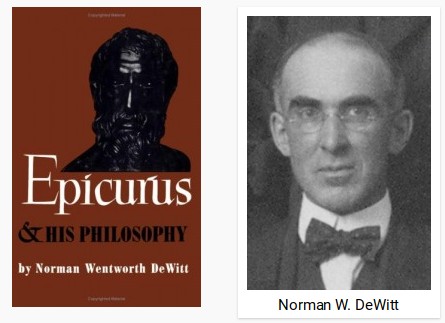
The first modern leader in the fight to recover a consistent and reliable understanding of classical Epicurean thought was Norman DeWitt, a Canadian Professor who wrote the essential book "Epicurus and His Philosophy." This one book, if you read nothing else, will open your eyes to how the conventional interpretation is wrong.
Beyond DeWitt it is necessary to attack directly the volleys that constantly appear from the "absence of pain" cannons. Reliable arguments more current than DeWitt, and fully equal to any other academic analysis, can be found in two other works of primary importance:
First, Boris Nikolsky's article "Epicurus On Pleasure" will explain to you the error of viewing Epicurus through the lens of "katastematic" pleasure, which is favorite way of arguing that Epicurus dismissed the normal active pleasures of life in favor of "escape from pain." Nikolsky will point out to you that the "katastematic" and "kinetic" distinction is most likely an artifact of Stoic analysis and categorization which was foreign to Epicurus himself, but had achieved prominence by the time (hundreds of years after Epicurus) that Cicero and Diogenes Laertius employed it in reviewing Epicurus.
Second, and much more intensively, the book"The Greeks On Pleasure" by Gosling and Taylor will give you a detailed and comprehensive view of pre-Epicurean views of pleasure, and how Epicurus responded to them. This broader overview, which is only introduced by DeWitt, in emphasizing Epicurus' anti-Platonist roots, is essential to understanding how the passages on absence of pain had an entirely different meaning to Epicurus than it appear to have for us.
Gosling and Taylor conclude that Epicurus meant what he said - that pleasure does in fact mean pleasure, and that it is wrong to say that Epicurus dismissed pleasure as we understand it. The argument is too detailed to repeat here, but we can see a hint of it in another reference from an ancient source, this time again from Plutarch.
The essential point is that Epicurus held that only two broad categories of "feelings" exist, and that all feelings are comprised within that of "pleasure" or "pain." This limitation to two feelings means by definition that in terms of quantity, the "absence" of one equals the "presence" of the other, and means that when Epicurus referred to a life without pain, he was referring to a life full of ordinary pleasures, just as all of us who are uncorrupted by partisan politics or academic orthodoxy understand it.
Here is the analysis ("Nature adds to pleasure only up to the point where pain is abolished") as preserved by Plutarch from his critical point of view:
Epicurus has imposed a limit on pleasures that applies to all of them alike: the removal of all pain. For he believes that our nature adds to pleasure only up to the point where pain is abolished and does not allow it any further increase in magnitude (although the pleasure, when the state of painlessness is reached, admits of certain unessential variations). But to proceed to this point, accompanied by desire, is our stint of pleasure, and the journey is indeed short and quick. Hence it is that becoming aware of the poverty here they transfer their final good from the body, as from an unproductive piece of land, to the soul, persuaded that there they will find pastures and meadows lush with pleasures. (Plutarch, That Epicurus actually makes a pleasant life impossible, 3, p. 1088C)
Those of us who work to expose the errors in the Left-Right-Academic Axis of Epicurus as Anesthesiologist regularly feel like we too have to ride through the jaws of death, and into the mouth of hell, in order to eventually come out from the Valley of Death:
Cannon to right of them,Cannon to left of them,
Cannon behind themVolley'd and thunder'd;
Storm'd at with shot and shell,While horse and hero fell,
They that had fought so wellCame thro' the jaws of Death,
Back from the mouth of hell,All that was left of them,
Left of six hundred.
But why would we make such a ride? Why is anything in life worth doing? Is it because the gods tell us to do it? Is it so we can satisfy our "betters" who tell us we have a "duty" to do it? Is it because it is a "virtue" to seek the truth and that "virtue" is its own reward?
No - the answer is just as Epicurus identified, and that is because we look to Nature for accurate information about ourselves and the best way to life. We therefore agree with Epicurus, that when "pleasure" is broadly and properly understood as including all in life that we feel to be desirable, we can reach no conclusion other than to leave behind the false gods of religion and the false ideals of Academia, and ride with Epicurus, sharing the understanding that:
We call pleasure the beginning and end of the blessed life. For we recognize pleasure as the first good innate in us, and from pleasure we begin every act of choice and avoidance, and to pleasure we return again, using the feeling as the standard by which we judge every good.
_____________________________
Please post discussion of this article here: Discussion of Article: "Caricatures to the Left of Them, Caricatures to the Right of Them, Caricatures In Front of Them, Volleyed and Thundered"




Replies 3