Articles
REMINDER: SUNDAY WEEKLY ZOOM - July 12, 2026 -12:30 PM EDT - Ancient text study and discussion: De Rerum Natura - - Level 03 members and above (and Level 02 by Admin. approval) - read the agenda here.
New Graphics: Are You On Team Epicurus? | Comparison Chart: Epicurus vs. Other Philosophies | Chart Of Key Epicurean Quotations | Accelerating Study Of Canonics Through Philodemus' "On Methods Of Inference" | Note to all users: If you have a problem posting in any forum, please message Cassius
Featured Presentations At EpicureanFriends
Articles at EpicureanFriends are featured presentations on important aspects of Epicurean Philosophy. They include:
All Articles
The following is a summary of citations relevant to the understanding of the pursuit of pleasure in Epicurean philosophy.

Cassius
"Free Will In Epicurean Philosophy" - by Dimitris Liarmakopoulos
Elli Pensa has translated for us the following article by a Greek student of Epicurus, Dimitris Liarmakopoulos.
Elli
On Pain, Pleasure, And Happiness
Brief: The feelings are only two, pleasure and pain—there is no third state such as neutral, and there are no “fancy pleasures” which are different from regular pleasures. Because there is no neutral, reducing pain in life is only possible if there is a corresponding increase in pleasure. The extent of pleasure can be maximized by making sure to attend to all parts of one’s body, including the brain. Happiness is comprised of a pleasurable life. The capacity for pain is a valuable warning system and should not be disabled except in unusual conditions. The experience of pain is to be avoided except when it is chosen for the sake of greater pleasure/ lesser pain over the lifespan. Humans have many shared responses of pain or pleasure to specific experiences, and they also have individual variations. The standard of pleasure in one’s life must be one’s own subjective feelings, not a generic advice. There are many pitfalls to avoid if one desires a happy, pleasure-filled life, such as a false belief in a neutral state, practices which attempt to disable the normal capacity to feel pleasure and pain, and failure to consider the long-term pains and pleasures resulting from actions. In discussing pain and pleasure, Epicureans stick to real life situations, not hypothetical philosophical puzzles.
Elayne
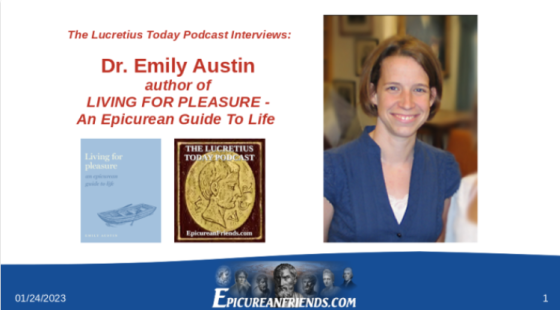
Interview With Dr. Emily Austin: "Living For Pleasure"
In Episodes 156 and 157, the Lucretius Today podcasters interviewed Dr. Emily Austin, author of 2022's "Living For Pleasure."
Cassius
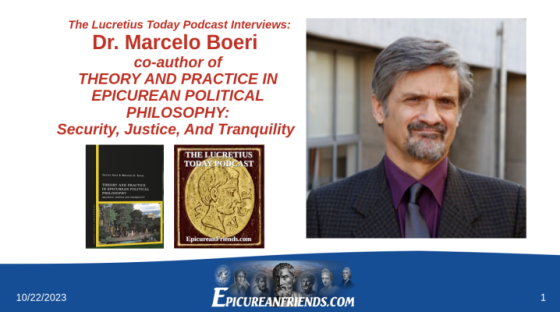
Interview With Dr. Marcelo Boeri: Theory and Practice In Epicurean Political Philosophy
In Episode 197 of the Lucretius Today Podcast, on October 19, 2023, we were privileged to speak with Dr. Marcelo Boeri, co-author with Javier Aoiz of Theory and Practice In Epicurean Political Philosophy - Security, Justice, and Tranquility.
Cassius
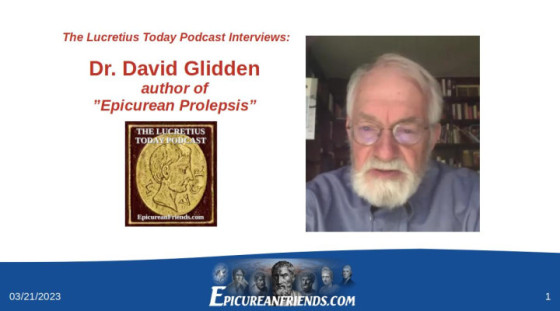
Interview With Dr. David Glidden: "Epicurean Prolepsis"
In Episode 166 the Lucretius Today podcasters interviewed Dr. David Glidden, professor emeritus from the University of California - Riverside, about his articles "Epicurean Prolepsis" and "Epicurean Thinking.
Cassius
A Gate To Be Burst: "Absence of Pain"
It is interesting to think about what Lucretius had in mind in Book One of “On The Nature of Things” when he spoke about Epicurus "yearning to be the first to burst through the close-set bolts upon the gates of nature." What kind of gates was he talking about? Who bolted them? How do those gates keep us from Nature?
I can't be sure which gates Lucretius had in mind, but I can suggest one "gate" that is particularly in need of bursting, as it stands directly in the way of a better understanding…
Cassius
Giving Credit Where It Is Due: Samuel Dunster, Likely Author of the 1743 Prose Translation of Lucretius
For over two hundred years, obscurity has surrounded the identity of the anonymous translator of one of the first readable prose editions of Lucretius in the English language. In this article, Joshua tracks down the evidence and concludes that it points in one direction.
Joshua
The Major Doctrines Of Classical Epicurean Philosophy
Nothing From Nothing
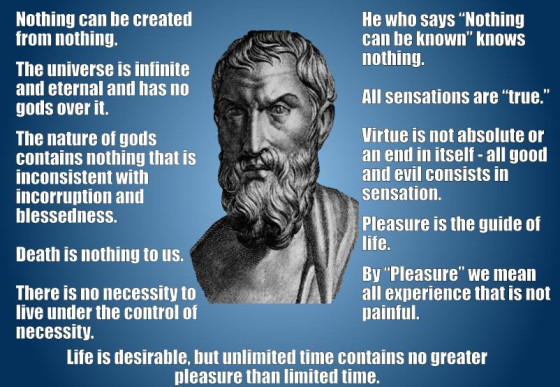
Nothing Can Be Created From Nothing
Working solely with the science available two thousand years ago, Epicurus observed that nothing ever arises from nothing, and nothing is ever completely destroyed to nothing. From this Epicurus deduced the existence of atoms - elemental particles moving through empty space from which over time all things are made…
Cassius
25 Mind Viruses Cured By Epicurean Philosophy
View on substack here.
Throughout history, philosophers, priests, and political authorities have promoted ideas about life, reality, and human nature that sound profound but are in fact deeply mistaken — and whose effect, whether intended or not, is to make ordinary people feel guilty, fearful, and dependent on outside authorities for guidance. These ideas spread from generation to generation the way a virus spreads through a population: not because they are true, but because they are…
Cassius
Questions? Ask The Epicureans
We recognize that not everyone who visits our page is ready, willing, or able to register a full account at EpicureanFriends.
For those who would prefer to submit questions to us by email, we've set up a "Question Line" at Questions@epicureanfriends.com .
Send us an email with your question, and if we find it to be of general interest we'll set up a thread and our participants here can discuss what they think might be the best answers to your topic.
We can't promise to respond to each one, but if…
For those who would prefer to submit questions to us by email, we've set up a "Question Line" at Questions@epicureanfriends.com .
Send us an email with your question, and if we find it to be of general interest we'll set up a thread and our participants here can discuss what they think might be the best answers to your topic.
We can't promise to respond to each one, but if…
Cassius
The Major Doctrines Of Classical Epicurean Philosophy
Nothing From Nothing
Nothing Can Be Created From Nothing
Working solely with the science available two thousand years ago, Epicurus observed that nothing ever arises from nothing, and nothing is ever completely destroyed to nothing. From this Epicurus deduced the existence of atoms - elemental particles moving through empty space from which over time all things are made…
Cassius
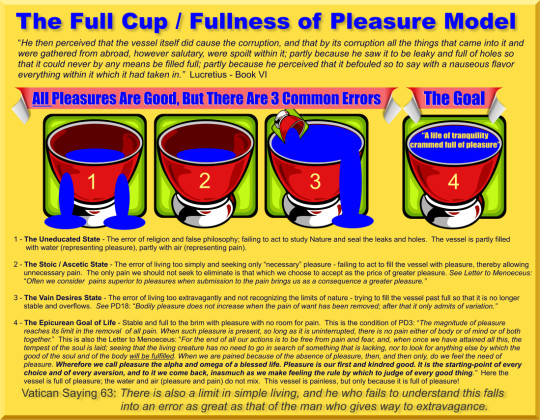
The Full Cup / Fullness of Pleasure Model
The following is a summary of citations relevant to the understanding of the pursuit of pleasure in Epicurean philosophy.
Cassius
Questions? Ask The Epicureans
We recognize that not everyone who visits our page is ready, willing, or able to register a full account at EpicureanFriends.
For those who would prefer to submit questions to us by email, we've set up a "Question Line" at Questions@epicureanfriends.com .
Send us an email with your question, and if we find it to be of general interest we'll set up a thread and our participants here can discuss what they think might be the best answers to your topic.
We can't promise to respond to each one, but if…
For those who would prefer to submit questions to us by email, we've set up a "Question Line" at Questions@epicureanfriends.com .
Send us an email with your question, and if we find it to be of general interest we'll set up a thread and our participants here can discuss what they think might be the best answers to your topic.
We can't promise to respond to each one, but if…
Cassius
On Pain, Pleasure, And Happiness
Brief: The feelings are only two, pleasure and pain—there is no third state such as neutral, and there are no “fancy pleasures” which are different from regular pleasures. Because there is no neutral, reducing pain in life is only possible if there is a corresponding increase in pleasure. The extent of pleasure can be maximized by making sure to attend to all parts of one’s body, including the brain. Happiness is comprised of a pleasurable life. The capacity for pain is a valuable warning system and should not be disabled except in unusual conditions. The experience of pain is to be avoided except when it is chosen for the sake of greater pleasure/ lesser pain over the lifespan. Humans have many shared responses of pain or pleasure to specific experiences, and they also have individual variations. The standard of pleasure in one’s life must be one’s own subjective feelings, not a generic advice. There are many pitfalls to avoid if one desires a happy, pleasure-filled life, such as a false belief in a neutral state, practices which attempt to disable the normal capacity to feel pleasure and pain, and failure to consider the long-term pains and pleasures resulting from actions. In discussing pain and pleasure, Epicureans stick to real life situations, not hypothetical philosophical puzzles.
Elayne
Interview With Dr. Marcelo Boeri: Theory and Practice In Epicurean Political Philosophy
In Episode 197 of the Lucretius Today Podcast, on October 19, 2023, we were privileged to speak with Dr. Marcelo Boeri, co-author with Javier Aoiz of Theory and Practice In Epicurean Political Philosophy - Security, Justice, and Tranquility.
Cassius
Interview With Dr. Emily Austin: "Living For Pleasure"
In Episodes 156 and 157, the Lucretius Today podcasters interviewed Dr. Emily Austin, author of 2022's "Living For Pleasure."
Cassius
Interview With Dr. David Glidden: "Epicurean Prolepsis"
In Episode 166 the Lucretius Today podcasters interviewed Dr. David Glidden, professor emeritus from the University of California - Riverside, about his articles "Epicurean Prolepsis" and "Epicurean Thinking.
Cassius
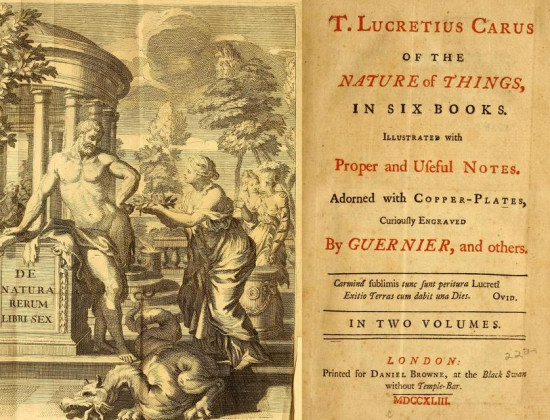
Giving Credit Where It Is Due: Samuel Dunster, Likely Author of the 1743 Prose Translation of Lucretius
For over two hundred years, obscurity has surrounded the identity of the anonymous translator of one of the first readable prose editions of Lucretius in the English language. In this article, Joshua tracks down the evidence and concludes that it points in one direction.
Joshua
A Gate To Be Burst: "Absence of Pain"
It is interesting to think about what Lucretius had in mind in Book One of “On The Nature of Things” when he spoke about Epicurus "yearning to be the first to burst through the close-set bolts upon the gates of nature." What kind of gates was he talking about? Who bolted them? How do those gates keep us from Nature?
I can't be sure which gates Lucretius had in mind, but I can suggest one "gate" that is particularly in need of bursting, as it stands directly in the way of a better understanding…
Cassius
25 Mind Viruses Cured By Epicurean Philosophy
View on substack here.
Throughout history, philosophers, priests, and political authorities have promoted ideas about life, reality, and human nature that sound profound but are in fact deeply mistaken — and whose effect, whether intended or not, is to make ordinary people feel guilty, fearful, and dependent on outside authorities for guidance. These ideas spread from generation to generation the way a virus spreads through a population: not because they are true, but because they are…
Cassius
"Free Will In Epicurean Philosophy" - by Dimitris Liarmakopoulos
Elli Pensa has translated for us the following article by a Greek student of Epicurus, Dimitris Liarmakopoulos.
Elli
Recent Articles (All Articles Sorted By Date)
Questions? Ask The Epicureans
We recognize that not everyone who visits our page is ready, willing, or able to register a full account at EpicureanFriends.
For those who would prefer to submit questions to us by email, we've set up a "Question Line" at Questions@epicureanfriends.com .
Send us an email with your question, and if we find it to be of general interest we'll set up a thread and our participants here can discuss what they think might be the best answers to your topic.
We can't promise to respond to each one, but if…
For those who would prefer to submit questions to us by email, we've set up a "Question Line" at Questions@epicureanfriends.com .
Send us an email with your question, and if we find it to be of general interest we'll set up a thread and our participants here can discuss what they think might be the best answers to your topic.
We can't promise to respond to each one, but if…
Cassius
25 Mind Viruses Cured By Epicurean Philosophy
View on substack here.
Throughout history, philosophers, priests, and political authorities have promoted ideas about life, reality, and human nature that sound profound but are in fact deeply mistaken — and whose effect, whether intended or not, is to make ordinary people feel guilty, fearful, and dependent on outside authorities for guidance. These ideas spread from generation to generation the way a virus spreads through a population: not because they are true, but because they are…
Cassius
The Major Doctrines Of Classical Epicurean Philosophy
Nothing From Nothing
Nothing Can Be Created From Nothing
Working solely with the science available two thousand years ago, Epicurus observed that nothing ever arises from nothing, and nothing is ever completely destroyed to nothing. From this Epicurus deduced the existence of atoms - elemental particles moving through empty space from which over time all things are made…
Cassius
Giving Credit Where It Is Due: Samuel Dunster, Likely Author of the 1743 Prose Translation of Lucretius
For over two hundred years, obscurity has surrounded the identity of the anonymous translator of one of the first readable prose editions of Lucretius in the English language. In this article, Joshua tracks down the evidence and concludes that it points in one direction.
Joshua
A Gate To Be Burst: "Absence of Pain"
It is interesting to think about what Lucretius had in mind in Book One of “On The Nature of Things” when he spoke about Epicurus "yearning to be the first to burst through the close-set bolts upon the gates of nature." What kind of gates was he talking about? Who bolted them? How do those gates keep us from Nature?
I can't be sure which gates Lucretius had in mind, but I can suggest one "gate" that is particularly in need of bursting, as it stands directly in the way of a better understanding…
Cassius
Interview With Dr. David Glidden: "Epicurean Prolepsis"
In Episode 166 the Lucretius Today podcasters interviewed Dr. David Glidden, professor emeritus from the University of California - Riverside, about his articles "Epicurean Prolepsis" and "Epicurean Thinking.
Cassius
Finding Things At EpicureanFriends.com
Here is a list of suggested search strategies:
- Website Overview page - clickable links arrranged by cards.
- Forum Main Page - list of forums and subforums arranged by topic. Threads are posted according to relevant topics. The "Uncategorized subforum" contains threads which do not fall into any existing topic (also contains older "unfiled" threads which will soon be moved).
- Search Tool - icon is located on the top right of every page. Note that the search box asks you what section of the forum you'd like to search. If you don't know, select "Everywhere."
- Search By Key Tags - curated to show frequently-searched topics.
- Full Tag List - an alphabetical list of all tags.