


Thanks for today everyone! Your perspectives were very helpful. Don, Bryan: It was great to finally meet you “in-person”.
I’m interested in hearing more about the epicurean perspective(s) on gods. Are there any recommended podcast episodes on this topic?
Posts by Rolf
-
-
This would be helpful and greatly appreciated!
-
Any suggestions for audio readings?
-
Loeb edition by Rouse, and revised by Smith, is great for the Latin facing text alone.
Verse translation? Rolfe Humphries.
I should make a tier list one of these days.
Thanks Josh - I’ll look into Humphries’ translation. I’d like to read something in verse, though I understand it might be less faithful than a more direct translation? He does have a great name, though.

-
LOL "Best" is a loaded question. Most literal? Most readable? Prose adaptation or poetic translation?
Haha, fair point! “Favourite” would’ve been a better word.
-
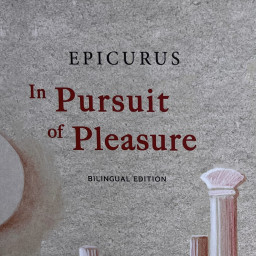
I’m looking to pick up a copy of Lucretius’ De rerum natura while I wait for DeWitt’s book to arrive. Does anyone have a recommendation for a translation?
-
This is excellent, thank you!
-
-
Another thing that rubs me the wrong way with these sorts of parapsychology investigation groups is that they start with a theory and then try to prove that it’s true - not how science should be carried out. In their minds, telepathy or whatever else exists, and they just have to prove that it’s true. In other words, they’re attached to their hypothesis. No matter how many experiments fail to show any concrete evidence, they stick with the same hypothesis.
That said, I’m no expert on this and I would love to hear your thoughts Patrikios! -
Institute of Noetic Science
Perhaps I’m missing something, but this organisation seems to be the antithesis of the Epicurean worldview: belief in the supernatural. After reading up on them a little, they seem to be widely regarded as pseudoscientific. I’ll also note that despite over a century of research into things like telekinesis, not one person has been able to demonstrate such abilities under controlled, repeatable condition.

-
Lol, I was thinking the other way around...lol, that you Rolf were coming from an ascetic view (due to your comment about ice-cream).
Not at all! I’m the furthest thing from ascetic and I don’t believe that Epicurus was one either. Ice cream is great and can certainly make life richer and more pleasurable. That said, I think we can both agree that ice cream is not necessary for a pleasant life.
All I’m talking about here is the classification of desires as laid out. My disagreement stems from your statement that we “only label something as natural/unnecessary when it is difficult/impossible to get or depleting/reckless to one’s resources.” I don’t think that something being unnecessary to happiness implies that it is always difficult or reckless to attain, and I don’t think that Epicurus meant it in this way either.I think that I talked about movies in another thread (but have forgotten exactly what I said, and forgotten what thread that was in). But this is a good time to talk about it again...because I would question whether or not harm might come about to an individual if they were to watch a lot of movies about people who desire and chase after great wealth, status, power, control, perfect beauty, perfect safety, or non-stop sensory variations...but it will depend on the person and the circumstances...so no absolute rules.
Haha, I was hesitant to use movies as an example but couldn’t come up with anything better in the moment - I remember that you’re not a fan. The word “movies” could be replaced here by practically any pleasure that is neither inherently harmful nor necessary for happiness.
-
I don’t know if I agree that natural/unnecessary desires are “difficult or impossible to attain”, or that they should be viewed negatively at all. From what I understand, this category simply refers to things that are pleasurable but not strictly necessary for happiness.
"pleasurable but not strictly necessary for happiness"... maybe the word "optional"?.
And yet I see it differently, as "unnecessary for survival" - and you only label something as natural/unnecessary when it is difficult/impossible to get or depleting/reckless to ones resources.
Something that causes pain would go into the "empty" category (as in empty of pleasure).
I would label something natural but unnecessary if it is a natural desire (ie. Not arising from false beliefs or fears) but not strictly necessary for my happiness.
Movies are clearly not necessary for happiness or survival - countless people have been happy and healthy without them. And yet watching movies is not an inherently harmful or empty desire. In which case, what are movies other than natural but unnecessary desires?Perhaps I’m misunderstanding you Kalosyni, and please correct me if I am, but it seems that your definition leads to an ascetic view of Epicureanism in which we should only pursue what is strictly necessary.
-
Okay, regarding my "mistaken" idea in post 22 above (of only two categories)...now revising back to three, lol:
- natural/necessary = necessary for life and for well-being
- natural/unnecessary = difficult or impossible to attain, and beyond ones means or recklessly depleting ones needed resources in order to attain
- empty = greed for status/wealth/power/control/perfection/non-stop sensory variations
I don’t know if I agree that natural/unnecessary desires are “difficult or impossible to attain”, or that they should be viewed negatively at all. From what I understand, this category simply refers to things that are pleasurable but not strictly necessary for happiness.
A can of soup and some bread will fulfil my hunger, but I won’t deny myself the pleasure of a steak dinner if the opportunity arises and it doesn’t cause an excess of pain.It is painful to not have any food at all, but I am not (or should not) be caused any pain by eating soup and bread rather than a steak dinner. The way understand it: Necessary desires cause pain in their absence, unnecessary desires do not (or should not).
-
Decided to look up some definitions on my beloved Wiktionary and found something interesting.
The third defintion of the word "luxury" is given as: "Something that is pleasant but not necessary in life."
This seems to fit perfectly with the Epicurean view of desires that are natural but unnecessary.
On the other hand, the defintions given for the word "extravagance" are markedly anti-Epicurean, aligning more closely with empty/corrosive desires, such as "excessive" and "prodigality".
I realise that dictionary defintions rarely represent concrete, objective meanings, but perhaps they can be useful in pointing us towards how words are most commonly used and interpreted.
-
Going back to the initial topic for a moment: I might add clouds in the sky above the mountain representing UU/empty/corrosive desires - no matter how much you climb, you will never reach them, and thus chasing them is imprudent.
-
How does the word "luxurious/luxuries" instead of "extravagant/extravagances" sound? Food is a necessary desire; ice cream is luxurious. Friendship is necessary for happiniess; romance is a luxury.
even then I doubt you can avoid explaining or giving examples
That said, I agree with this. No word or term is going to be able to fully put across the meaning that Epicurus intended by itself - but that's okay. For me, a term is more for my own use and understanding, and for reference in discussion with others who are familiar with Epicurean philosophy. For those who are not familiar, we must of course explain what we mean, just as we must often first explain what we mean by "pleasure". I'm still partial to using the NN, NU, UU abbreviations for internal discussions, simply because they're relatively neutral and clear if you know what they stand for.
-
I like this idea of only: "natural, necessary, and empty".
Actually it should just be:
--- natural and necessary = Is it natural? Does it come to us from nature? (We will need to be clear about what exactly are all the desires that nature gives to us). And... Do we need it to survive? Do we need it for our well-being (and to feel blessed/happy).
-vs-
--- empty = Is it actually unnecessary for both survival and well-being? Is it an opinion not from nature but generated by greed for massive riches, non-stop variations of sensation, massive power/control/status (all of which are empty opinions).
What about the desires that are natural but not strictly necessary for survival and well-being?
-
I can appreciate your desire for conciseness, but I'm not a fan of in-group abbreviations. I don't even like referring to Epicurean philosophy as EP.
That’s fair Don - I can see how it could be a bit exclusionary for anyone outside the loop.
The passage from Menoikeus you bring up is interesting. Would you say “natural”, “necessary”, and “empty” are suitable terms to use?
-
You know, this has me thinking: At least for those of us who are already familiar with the philosophy, using the abbreviations NN, NU, and UU would be a lot cleaner and clearer.

-
Finally, we have the snow sprinkled atop the mountain representing the natural but unnecessary "extravagant" desires. Once we have everything below, we may take joy in these pleasures and allow them to adorn our life, without feeling like we require them.
I personally would end up choosing a word other than "extravagent" (but not sure exactly what word).
Also, I wouldn't see this as a hierarchy, but instead that they can all occur at the same time.
I use the word "extravagent" as it's the word Emily Austin uses in her book to describe natural but unnecessary desires. I agree it's not the perfect word though - if I recall correctly, Austin doesn't think it is either.
Perhaps not a hierachy in the sense of some things being better than others, but in the sense of priority. Maslow's hierarchy of needs places self-esteem above safety and security - this doesn't mean that self-esteem is more important than safety, however. And in the same way, it's obviously possible for one to have both self-esteem and safety simultaneously. It's less about a ranking, and more about ordering needs from basic to complex, and thus giving us some kind of roadmap.
That said, this is more of a visual representation than an actual theory.
Finding Things At EpicureanFriends.com
Here is a list of suggested search strategies:
- Website Overview page - clickable links arrranged by cards.
- Forum Main Page - list of forums and subforums arranged by topic. Threads are posted according to relevant topics. The "Uncategorized subforum" contains threads which do not fall into any existing topic (also contains older "unfiled" threads which will soon be moved).
- Search Tool - icon is located on the top right of every page. Note that the search box asks you what section of the forum you'd like to search. If you don't know, select "Everywhere."
- Search By Key Tags - curated to show frequently-searched topics.
- Full Tag List - an alphabetical list of all tags.