

"The sweetest kind of life"!!! 
Posts by Pacatus
-
-

I'd to imagine him dancing happily and joyfully in the garden.
I think sometimes we might get caught up in the notion of philosophy involving only mental exercise: study and discussion, thoughts on how to apply a hedonic calculus (or a "virtue calculus" for the Stoics), mind-focused meditation practices (and practices to "condition the mind," as Nate says), etc. The physical comes up more in terms of food and drink, sometimes sex, maybe taking a walk in nature.
But physical exercise can be free (unconditioned) in practice -- and as a practice. Socrates thought that spontaneous dance was the best exercise. As a youth, I did wild, free-form dancing after discovering Zorba the Greek. Later, in middle age, I practiced Tai Chi (very form oriented as a moving meditation). Then I discovered Tandava Yoga, which is like s free-form Qigong (no postures/asanas or prescribed movements) -- and which can be done in a very light way, like Tai Chi -- in which you breathe and allow your body to move as it wishes (that, in itself, is a kind of discipline). I find that I enjoy that very much (as well as, still, the occasional spontaneous dancing).
As Alan Watts once said: "The point is sometimes to go out of your mind -- so you can come to your senses" (rough quote from memory). I have also discovered Laughter Yoga (without the need for jokes, or funny thoughts or gestures).
My problem is a tendency to get lost in my head. Pleasurable, non-directed physical practices are helpful -- once I remember to engage them.

-
As I contemplate it (not much, but sometimes) in my elder years now, I find that I am not afraid of death either. {Emphasis on that word "find" -- it doesn't really feel like a decision: I just find myself in agreement with Epicurus; but maybe I have internalized his teaching on the subject as just plainly making sense.}
______________________
EDIT: But I just recalled some lines I wrote a few years ago --
How tragic for the the single flame to fear
annihilation in the larger fire,or waterdrop to be afraid to fall
again into the vastness of the sea.______________________
Or maybe just "nothing, nothing, nothing -- nothing at all..." (With apologies to Archibald MacLeish, "The End of the World".) And thus nothing to fear ...
-
-
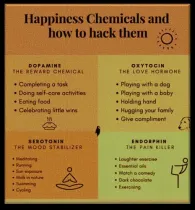
I recall that Haris Dimitriadis wrote in his book about neurotransmitters and chemical responses underlying pleasure/happiness. Here is a visual that I found along the way:
-

Here is a quick sketch of something less "woo-woo" -- though it leaves a lot out and would be open to hearing feedback or additional ideas for labels, etc. And may need to show how to integrate of feelings, emotions, sensations, desires, etc.
Epicurean chakras!

-
A rather sage therapist friend of mine (who both helped me through a really rough patch, and helped me to look into myself), said that anger and fear arise from the survival/defense response - fight, flight or freeze. And thus, in appropriate context, can be very helpful emotions. This seems to me to accord with your analysis here - of "natural anger".
But, partly through layers of socialization, many of our emotions can become maladapted: anxiety over future events that may never come to pass, anger at perceived slights, and the like.
The trick is to recognize the difference. And to practice "calm and awareness" before we get caught up, so that it is available to us when needed. (Still working on that ...) I have sometimes used a simple gesture: raising my hand in a ward-off position - just like a batter stepping out of the box - and sometimes actually say to myself "step out." If in the company of others, I might make the gesture very slight as to be unnoticeable (but I still feel it). The idea is just to create some mental/emotional space. (But, as I say, still working on it all ...)
-


as I recall Marcus Aurelius wrote a passage about dragging his butt out of bed in the morning.
Ah yes. But my pleasure-loving self enjoys those long, half-asleep morning-moments.
 (The Epicurean versus the Stoic?)
As Theodore Roethke wrote:
"I wake to sleep, and take my waking slow."
(Funny how that line is embedded in my memory ...
 )
-
Unfortunately, none of us may be "average." So I think that Kalosyni is right: we need to pay attention to our own (possibly variable) rhythms. My wife is sure that I operate on something like a 23 hour cycle,
and so adherence to clock-time doesn't work for me. Sometimes I'm up till the wee hours; sometimes I'm in bed at "dark-thirty." It's a bit like my ADHD: I've learned that the worst I can do is fight it. Following nature is also following my own nature, as best I can.Oh, and I do like naps!
-
My reading of the Pyrrhonists (eg. Sextus Empiricus; but maybe through the lens of modern neo-Pyrrhonians) is that they did not accept any other schools' claimed criteria for "truth" (nor the denial that there could be such a thing: Academic "skepticism"). But they did accept appearances/sensations as criteria for decision/action. Sometimes, it seems to me, that the Pyrrhonian criticism of Epicurus is confused -- but hinges on what is meant by "truth"* in each of the schools of thought involved. [But the distinction between deductive and inductive logic does not seem to have been well developed.]
_____________________
* Don, I seem to recall that aletheia (?) in Greek meant that which was unconcealed/unhidden -- or revealed?
-
This will take some time to peruse. But the opening reminded me of a comic photo I saw of two modern Stoics under arrest for throwing stones at Epicureans in the local park. Their complaint: "Why should they have all the fun?!"
(Though I think that Cicero was more an Academic Skeptic than a Stoic?)
-
if we aren't every day in awe, we aren't paying attention
Ah! Yes! (And yet I need to be reminded.)
-
-
Actually, the equivalent Latin (and English!) term would be "universe". From the Elementary Lewis Latin Dictionary:
Universus is surely the most direct and proper translation into Latin. From unus (one) and versus (turned, as in “turned into”). [From etymonline.com and Wiktionary.]
But another (more expansive, less literal) possibility, it seems to me, is mundus, apparently a calque from the Greek kosmos, which carries the further implication of order (cosmos as opposed to chaos). In my own playing with the Latin (for my own contemplation as a total schlock), I have used totus mundus: the whole world.
“Latin mundus "world" was used as a translation of Greek kosmos (see cosmos) in its Pythagorean sense of "the physical universe" (the original sense of the Greek word was "orderly arrangement").” [etymonline.com]
Re kosmos: “Pythagoras is said to have been the first to apply this word to "the universe," perhaps originally meaning "the starry firmament," but it later was extended to the whole physical world, including the earth.” (etymonline.com)
__________________________
NOTE: I am taking some time to read through older threads on here, to stimulate my own thinking.
-
A Personal Epicurean Outline
1. The nature of the Universe
The universe is physicalist in nature: matter and energy.
I rely on science, while realizing that empiricism is generally probabilistic and subject to revision, even paradigm shifts (the fear of which seems to mire many people in the supernatural promises of religion.)
The “atoms” of Democritus may well be sub-atomic particles and wave functions, or vibrational strings. The Epicurean “swerve” may well be understood in terms of the uncertainty principle in predicting subatomic events. Or the fugue-like patterns of chaos theory (complexity, interconnection, and sensitivity to initial and changing conditions).
I do not have the expertise in the physical sciences to side with one view as opposed to another when they are in disagreement, so I keep an open mind -- a kind of epistemological pluralism of possibilities. Anything else would seem to me to be presumption on my part (though perhaps not for others more knowledgeable).
2. The nature of knowledge
A valid deductive argument is one for which the conclusions follow necessarily from the premises. To loosely play on Wittgenstein, the opposite of logical (in this sense) is not “false” it is non-sense (e.g., the fallacy of affirming the consequent). A sound deductive argument is one for which the premises are also true.
Whether any proposition is true in any real-world sense is a factual, empirical question. Real-world knowledge is experiential, empirical and inductive. Although no number of observations can confirm a hypothesis as certain (there is always the possibility of a “black swan”), empirical observation (sometimes extended by technology: e.g. a medical MRI) based on the senses is still the best we have, and sufficient for making prudent decisions. At our level of existence, this means relying on senses (aisthesis), experiences and reasonable conclusions drawn from them.
Human knowledge is always perspectival (thinking of Jose Ortega y Gassett, rather than Nietzsche, here): we do not have access to any “view from nowhere” or “god’s eye view”).
This is not to deny intuition as a wholistic immediate grasp of phenomena and patterns (Epicurean proplepsis?). Nor is it to deny imagination in the exploration of possibilities.
I think it was the neuroscientist Antonio Damasio who wrote of “the feeling of what happens” affirming the role of feelings (pathe) as signals about reality.
There is no guarantee that the grammar of human consciousness is exhaustive of the syntax of the natural universe. Omniscience is unlikely no matter how far our knowledge progresses.
3. The nature of how to live
In our decisions, we exercise a version of “free will” that I call “constrained choice” (from my economics training): the fact that our ability to choose (or to have chosen differently, in the libertarian version) are constrained by circumstances, resources, our knowledge, our ability to analyze, etc. There is no coherent way to “have chosen differently” if none of those also changes -- unless we are “choosing” randomly. But we are still able to choose, to make decisions, to advance our understanding.
The ultimate human telos is eudaimonia: which I will translate as happy well-being (conflating two popular renderings) -- or sometimes just happiness.
Pleasure and pain are nature’s guide to well-being. That life is happiest which is the most pleasurable (pleasant), with the least amount of pain (suffering). Tranquility (ataraxia) is part of (even inherent to) the pleasurable/pleasant life -- but is not the telos: happiness is.
So, living well entails daily choosing to maximize pleasure and minimize suffering -- with attention to Epicurus’ astute breakdown of desires into natural and necessary, natural but unnecessary and unnatural (which may well be harmful). And part of that hedonic calculus involves prudential moderation: recognizing that overindulgence crosses the threshold from pleasure to pain (e.g. a hangover).
These are all, of course, personal choices based on our own understandings and observation of ourselves (self-reflection) and the senses: there is no-one-size fits all or cookie-cutter for this hedonic calculus.
For example --
I am by nature an introvert: that is, I restore my energy and serenity away from the pressures and stresses of the hurly-burly extroverted world (extroverts are opposite, but it is a continuum). That means that I need sufficient time in relative solitude. But I am not a total recluse, and I also treasure a few good friends. (My only respite in a crowd is relative anonymity.)
Thus, I am particularly amenable to Epicurus’ recommendation to, insofar as possible, live an obscure life (lathe biosas). It is only past programming and cultural conditioning that occasionally seduces me away from that.
I used to think that the notion of a daily hedonic calculus entailed a kind of (overly) effortful tension. But I am coming to realize that, following nature, it is a natural way to live that can be easy-flowing. And pleasant.
And, to borrow a quote from Saint Benedict: “Always, we begin again.”
-
That's helpful. My reading of the Pyrrhonists is that they took that to mean something like an absolutist or certain position (positive or negative), which it seems you are pointing out, may be a mis-reading? So many of those schools of philosophy had their own jargon and interpretations of others' concepts (e.g., the Stoics pathe versus eupathe).
-
Thanks, Cassius! One of the things that makes this site unique is that you have created (and sustain) an environment -- a virtual Garden? -- where people can feel safe "even if we aren't in the most complete possible agreement." That's special.
-
I recall the responses when two people who shared the Nobel Prize for physics for the “standard model” of particle physics were asked about string theory (note that I am not a physicist). Sheldon Glashow replied to the effect that it was all philosophy at best, and not science, since it could never be tested. Steven Weinberg responded that he would be surprised if there were not something to it, in part because the mathematics were so elegant. [As best as I can remember the clip from Brian Greene’s Nova series.]
I don’t have the quote, but I recall Epicurus saying something to the effect that, given multiple causal theories (say, multiple “alternative hypotheses”), none of them should be rejected until actually disproved.
Epicurus’ physics, though astute, was nevertheless timebound. But I have often found an openness in Epicurus that is at least equal to even that of the Pyrrhonists in their epistemological agnosticism, despite Sextus Empiricus’ denunciation of him as a “dogmatist.” Surely, one can be an Epicurean whilst acknowledging various possible scientific explanations (and without entering the fray).
-
I’ve had to be gone awhile, and will mostly just need to hang out for now and absorb the wisdom of others.
But this recurring “argument” over Epicurus’ “real” understanding of gods struck a chord that made me want to think it out by writing. I think the question is simply unnecessary for following a living Via Epicurea. Though, as scholarly debate it may have some merit, even there it is likely to never be settled.
I tend to believe that all discourse is inescapably interpretive, viz: “I know you believe you understand what you think I said, but you should be aware that what you heard is not what I meant.”
Interpreting written discourse is more fraught when one is unable to enter into actual extended conversation and query. Also (outside of pure mathematics and deductive logic, perhaps) all human communication ought to be taken (to my mind) as imperfect: subject to all sorts of vagaries inherent in the human condition. [Well, certain supernaturalist religions might assert the perfection of certain utterances and texts; but I don’t.]
Cassius once (or more than once) said something to the effect that (my words, not his) there are no litmus tests here for who is or is not a “True Epicurean (TM).” I likely hold some “neo-Epicurean,” as opposed classical Epicurean, beliefs; and am happy to. I do not want to impose them here, and hope that I am not. If I am, I hope you will correct and forgive.
-
I grew up steeped in Christianity, and in my adult years became a liberal Anglican. I read folks like Gregory of Nyssa and Clement of Alexandria; and Protestant theologians like Paul Tillich and Jurgen Moltmann; a bit of Karl Rahner and Hans Urs von Balthasar in the Roman Catholic tradition; and three of the five volumes of Jaroslav Pelikan's history of church doctrine; etc., etc. I realized in the end that I was searching for some way to believe (in terms of honest assent) the core truth claims. In the end, I could not.
At the same time, I realized I was deeply steeped aesthetically: the poetry, the art (especially Greek Orthodox icons), the "bells and smells," the eucharist, the music. I tried returning to church for all of that, sans the doctrine -- but they always intruded themselves. I can't do it (even though I think that Epicurus would not object).
And most of the Christians I knew -- including priests and deacons -- were wonderful people. (But I was mostly insulated from puritanical fundamentalists.) I do not argue with them, nor disparage their beliefs. If asked, I might speak my truth "quietly and clearly" (as the Desiderata says) as best as I understand it (knowing I might often be wrong), as I strive to "go placidly amid the noise and the haste."
I still listen to Gregorian chant sometimes, and even Taize music. When they are not in English, my mind does not busy itself with translating (even if I recognize some Latin words). I can take that as a lovely form of meditation. But the nostalgia is always there. I suspect it always will be. And that's okay.