

Exactly, Jason. Exactly.
Posts by Cassius
New Graphics: Are You On Team Epicurus? | Comparison Chart: Epicurus vs. Other Philosophies | Chart Of Key Epicurean Quotations | Accelerating Study Of Canonics Through Philodemus' "On Methods Of Inference" | Note to all users: If you have a problem posting in any forum, please message Cassius
-
-
Happy Twentieth! The accompanying graphic from Edward Snowden reminds me that two thoughts have been swirling in my mind as I move forward with my Epicurean thoughts:
(1) I have always considered the heart of PD39 to be its caution that it is NOT possible to make everyone into one family; that it is NOT possible to avoid treating some people as aliens, and that it is sometimes necessary to exclude some people from one's life. It concerns me greatly that our participation at Facebook in what is essentially a surveillance system may in the long run be very negative. 39. "The man who best knows how to meet external threats makes into one family all the creatures he can; and those he can not, he at any rate does not treat as aliens; and where he finds even this impossible, he avoids all dealings, and, so far as is advantageous, excludes them from his life."
(2) I strongly believe that were Epicurus here today he would embrace what Nietzsche wrote at the end of "Antichrist" to all of the Abrahamic religions that are so dominant today: 62: "—With this I come to a conclusion and pronounce my judgment. I condemn Christianity; I bring against the Christian church the most terrible of all the accusations that an accuser has ever had in his mouth. It is, to me, the greatest of all imaginable corruptions; it seeks to work the ultimate corruption, the worst possible corruption. The Christian church has left nothing untouched by its depravity; it has turned every value into worthlessness, and every truth into a lie, and every integrity into baseness of soul. Let any one dare to speak to me of its "humanitarian" blessings! Its deepest necessities range it against any effort to abolish distress; it lives by distress; it creates distress to make itself immortal… For example, the worm of sin: it was the church that first enriched mankind with this misery!—The "equality of souls before God"—this fraud, this pretext for the rancunes of all the base-minded—this explosive concept, ending in revolution, the modern idea, and the notion of overthrowing the whole social order—this is Christian dynamite… The "humanitarian" blessings of Christianity forsooth! To breed out of humanitas a self-contradiction, an art of selfpollution, a will to lie at any price, an aversion and contempt for all good and honest instincts! All this, to me, is the "humanitarianism" of Christianity!—Parasitism as the only practice of the church; with its anaemic and "holy" ideals, sucking all the blood, all the love, all the hope out of life; the beyond as the will to deny all reality; the cross as the distinguishing mark of the most subterranean conspiracy ever heard of,—against health, beauty, well-being, intellect, kindness of soul—against life itself… This eternal accusation against Christianity I shall write upon all walls, wherever walls are to be found—I have letters that even the blind will be able to see… I call Christianity the one great curse, the one great intrinsic depravity, the one great instinct of revenge, for which no means are venomous enough, or secret, subterranean and small enough,—I call it the one immortal blemish upon the human race…
And so on this Twentieth I am trying to absorb the implications of both.
In the meantime, Happy Twentieth! -

As the arguments are developed we can split each argument out into a separate thread, marked with its point of origin (e.g. Plato, Philebus....) to be followed by discussion of each argument. Therefore in this General thread, please suggest particular arguments and sources so that they can be organized by topic.
-
-
As to the historical setting at the time of Epicurus, this was offered on Facebook as a reference work, and looks pretty good:
https://archive.org/stream/athensh…ge/n25/mode/2up -
Example: Is there a relationship here? If not, what other questions might provide the context for PD3?
Plato (Philebus):
SOCRATES: Have pleasure and pain a limit, or do they belong to the class which admits of more and less?PHILEBUS: They belong to the class which admits of more, Socrates; for pleasure would not be perfectly good if she were not infinite in quantity and degree.
SOCRATES: Nor would pain, Philebus, be perfectly evil. And therefore the infinite cannot be that element which imparts to pleasure some degree of good. But now — admitting, if you like, that pleasure is of the nature of the infinite — in which of the aforesaid classes, O Protarchus and Philebus, can we without irreverence place wisdom and knowledge and mind? And let us be careful, for I think that the danger will be very serious if we err on this point.
Epicurus: PD 3. "The limit of quantity in pleasures is the removal of all that is painful. Wherever pleasure is present, as long as it is there, there is neither pain of body nor of mind, nor of both at once." -
An observation that describes why we should be sure we understand what questions and challenges Plato, Aristotle, and others had raised about pleasure prior to Epicurus: "... [T]he besetting vice of philosophy is to abstract propositions away from the context of the practical problems and questions that gave rise to them. Until we know the practical context of problems and questions to which a proposition is supposed to be an answer, we do not know what it means. ... Applying this doctrine to the interpretation of historical texts, Collingwood insists that you cannot know what a philosopher meant by a doctrine until you know the question to which the doctrine was intended as an answer and how that question arose."
http://www.academicroom.com/topics/r-g-col…89%E2%80%931943
-
-
I don't think there is any doubt but that the central formula is to avoid pleasures which will create more pain than the pleasures are worth. And as a result there is going to be a bias against pleasures that are bound to create huge problems, for example, the pleasure of becoming world dictator. The action of trying to become world dictator is pretty much bound to create so much negative reaction that the resulting pain is simply not going to be worth any exhilaration in trying, at least by the calculation of most people.
But who is to say how that calculation should be made in any individual case? There is clearly no god or central point of idealistic correctness from which one can say in a godlike manner: "Thou shall not seek to become world dictator" and conclude that the rule applies to everyone, everywhere, at all times. The reason the advice is so sweepingly valid comes from the nature of people we can expect to encounter, but as there is no central enforcing agency it is possible that under certain circumstances steps toward being world dictator might be appropriate (and in this analogy I am thinking of Maciej's earlier statements that an Epicurean would always reject participation in war, which I disagree with also).
So while we can say very clearly that (1) "pleasure is the goal" and, (2) since that is the case, we should avoid pleasures which are going to create more pain than pleasure" we are still left with the observation that there is no central authority as to what pleasure is "worth" to each individual in every context. It seems to me that that calculation is ALWAYS going to be an individual decision based on the totality of that person's circumstances, and the fact that there may be a bias toward actions which generate pleasures that are sustainable, we know that Epicurus said that the goal is not the life that is the longest, but the happiest. I take that to mean that if we can gain a very large degree of pleasure from actions which are risky, it's still valid Epicurean thinking to take that risk. It seems to me therefore very justifiable in Epicurean terms to conclude that living a day as a lion, enjoying the more intense pleasures that are available to a lion, could be chosen over living a decade as a sheep, presuming that the pleasures of a sheep are less intense than those of a lion.
Another factor to consider, though, is that coming from the point of view of "unity of pleasure," then "pleasure is pleasure" and the pleasure of living in a cave chewing tobacco is not entirely different in nature than the pleasure of being an astronaut on a rocket ship to the moon. Just as I can justify the choice of being the astronaut, I think an Epicurean could justify the option of chewing tobacco in a cave. But if an Epicurean was advising someone who had to choose between the two, he would still tell that person to choose the option which leads to the happiest life, not the longest life, and the Epicurean would leave the decision in that person's hands to judge individually.So in sum it seems to me that the important issue is to point out that the faculty of pleasure and pain is the ultimate arbiter of what to choose and to avoid, and that in itself is revolutionary and profoundly important for people to understand, so that they see that it is not gods and not abstract idealism which is the proper standard. It's much more important that people see that the choice is between "guides" to follow, and that the choice is religion vs logic vs pleasure/
pain, than it is to establish that there is a single best path among the various pleasures that can be chosen.
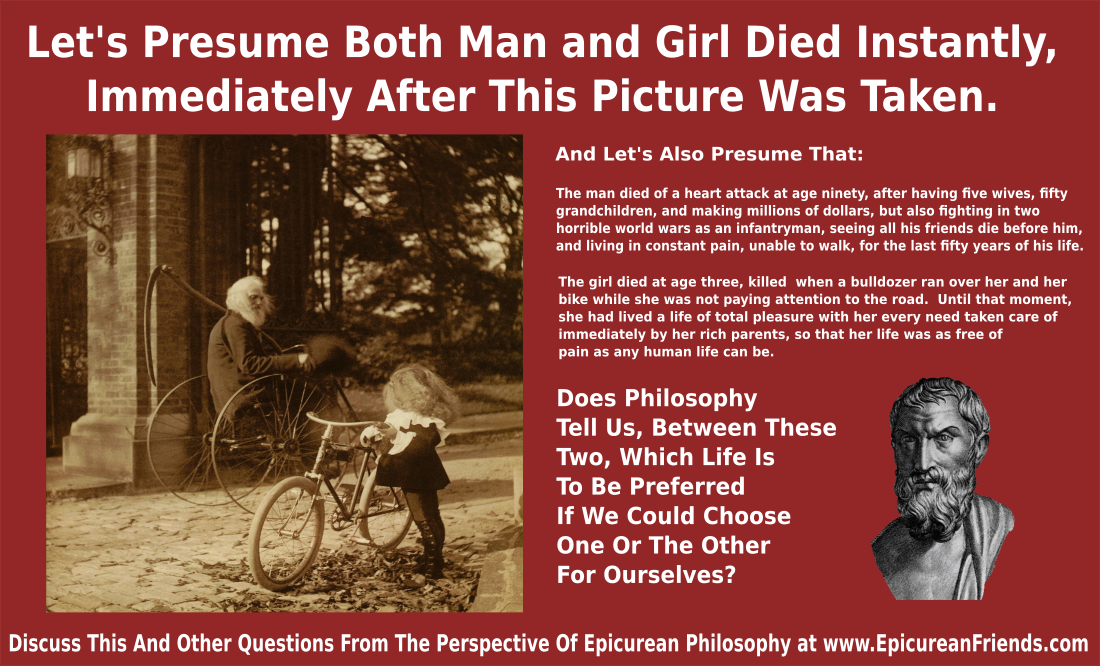
This is another place to mention the example of our departed friend from the Epicurean Facebook group Amrinder Singh, who died in an ultralight airplane accident. Amrinder chose to pursue his pleasure in a very risky hobby, and his life ended much sooner than it might have otherwise due to an accident. Can we look at his example and say that he should not have pursued ultrlights because of his accident? I would say "no" and that Amrinder lived the life that was for him not the longest, but the happiest: -
"Thus we need pleasure only when we are in pain caused by its absence; but when we are not in pain then we have no need of pleasure." Epicurus
And given tremendous evidence from the rest of the texts that passage clearly means one thing: We have no need of MORE pleasure when we are not in pain, because when we are not in pain our experience is full of the pleasures that have accumulated while we were in the process of eliminating pain. There is absolutely no inconsistency whatsoever between that passage and the many passages stating clearly that PLEASURE is the alpha and omega and the spring for all our actions. Every one of these passages that appear to cause a problem with the standard pleasure model are just truisms based on the quantity of one being the measure of the quantity of the other, since (1) pleasure and pain are the only two feelings that exist, and (2) there is a limit to what we are able to experience.
-
We can disagree on several of your points, especially as to Hermotimus, but in this context the only point in raising Lucian is that he was clearly familiar with the central contentions of the rival philosophies, and in presenting Epicurus' philosophy he makes no mention of absence of pain or a katastematic category of pleasure, which provides inferential evidence that those were not in fact central points of the philosophy.
-
Torquatus, from "On Ends" Book 1:
"The truth of the position that pleasure is the ultimate good will most readily appear from the following illustration. Let us imagine a man living in the continuous enjoyment of numerous and vivid pleasures alike of body and of mind, undisturbed either by the presence or by the prospect of pain. What possible state of existence could we describe as being more excellent or more desirable? One so situated must possess in the first place a strength of mind that is proof against all fear of death or of pain. He will know that death means complete unconsciousness, and that pain is generally light if long and short if strong, so that its intensity is compensated by brief duration and its continuance by diminishing severity. Let such a man moreover have no dread of any supernatural power; let him never suffer the pleasures of the past to fade away, but constantly renew their enjoyment in recollection, and his lot will be one which will not admit of further improvement.” -
Discussion of the graphical representation of two versions of "Absence of Pain"
-
No, I am not ignoring that, I am simply emphasizing that before he said that, he said this:
And for this cause we call pleasure the beginning and end of the blessed life. For we recognize pleasure as the first good innate in us, and from pleasure we begin every act of choice and avoidance, and to pleasure we return again, using the feeling as the standard by which we judge every good.He is saying that we avoid pain and fear because we want pleasure, not because our primary overriding goal is to avoid pain and fear. If our primary overriding goal were narrowly drawn to constitute avoidance of pain, which is the result of your construction, then the logical result would be suicide, because only through death can we avoid all pain. But the goal of life is pleasure, and we life for pleasure, not for nothingness.
As you say, everyone has to decide for themselves whether their goal is simply to avoid all pain, or whether it is to achieve pleasure even at the cost of some pain. And an excellent test of that question is that posed by Cicero in referencing Hieronymus of Rhodes, from whose doctrine Epicurus is very distinct, but which is the logical conclusion of your position. And that is because the pleasure you describe is only that which is needed to satisfy pains, rather than that pleasure which is the goal of life regardless of the pain required to attain it:
Do you remember, then,” I said, “what Hieronymus of Rhodes pronounces to be the Chief Good, the standard as he conceives it to which all other things should be referred?” “I remember,” said he, “that he considers the End to be freedom from pain.” “Well,” said I, “what is the same philosopher’s view about pleasure?” “He thinks that pleasure is not desirable in itself.” “Then in his opinion to feel pleasure is a different thing from not feeling pain?” “Yes,” he said, “and there he is seriously mistaken, since, as I have just shown, the complete removal of pain is the limit of the increase of pleasure.” “Oh,” I said, “as for the formula ‘freedom from pain,’ I will consider its meaning later on; but unless you are extraordinarily obstinate you are bound to admit that ‘freedom from pain’ does not mean the same as ‘pleasure.’ ” -
As for your contention about Torquatus implicitly being smarter than Epicurus and seeing a need to engage in "word-chopping" where Epicurus did not, I will simply reply that I consider Epicurus to have been much too smart than to go down the road of considering "absence of pain" to be a complete statement of the goal of his philosophy. By doing so, later Epicureans, if Cicero can be trusted on that point, fell into the trap that Epicurus himself did not and that has diverted us down this path toward Stoicism and back.
As for whether Lucian was an Epicurean himself that is not so important as the fact that he was familiar enough with his subjects to write articulately about him - people can read and judge for themselves where Lucian's sympathies really were. As to Cicero, Cassius, and Lucretius, there is little doubt as to their sympathies. -
Another way of stating this issue is this:
Rather than suggesting that "absence of pain" is a complete description of the highest and best life, my contention is that the highest and best life pointed to by Epicurus was this, also from Torquatus, which is clear and needs no interpretation through logic:
"The truth of the position that pleasure is the ultimate good will most readily appear from the following illustration. Let us imagine a man living in the continuous enjoyment of numerous and vivid pleasures alike of body and of mind, undisturbed either by the presence or by the prospect of pain. What possible state of existence could we describe as being more excellent or more desirable? One so situated must possess in the first place a strength of mind that is proof against all fear of death or of pain. He will know that death means complete unconsciousness, and that pain is generally light if long and short if strong, so that its intensity is compensated by brief duration and its continuance by diminishing severity. Let such a man moreover have no dread of any supernatural power; let him never suffer the pleasures of the past to fade away, but constantly renew their enjoyment in recollection, and his lot will be one which will not admit of further improvement.” -
Secondly. What do you mean by pleasure as is ordinary felt? Please give me examples.
All mental and bodily pleasures - "feelings" that are understandable without need for explanation or logical explanation. Bodily: Good food, good wine, sex, music Mental: All consciousness activities of the mind, whether reading a book, thinking about philosophy, or having a confident and pleased attitude toward life. All of these and many more are "felt" - these are all mental and bodily feelings that are "felt" by any ordinary person without need for explanation.
Recall that Torquatus admits that he does not agree with Epicurus on whether pleasure can or should be defended logically. This passage betrays that Torquatus was intentionally deviating from Epicurus, and shows that it should not be surprising that "Torquatus" (Cicero himself) would extend an argument about quantity to try to make a point that Epicurus was too wise to make himself:
“Some members of our school however would refine upon this doctrine. These say that it is not enough for the judgment of good and evil to rest with the senses. The facts that pleasure is in and for itself desirable and pain in and for itself to be avoided can also be grasped by the intellect and the reason. Accordingly, they declare that the perception that the one is to be sought after and the other avoided is a natural and innate idea of the mind. Others again, with whom I agree, observing that a great many philosophers advance a vast array of reasons to prove why pleasure should not be counted as a good nor pain as an evil, consider that we had better not be too confident of our case. In their view, it requires elaborate and reasoned argument, and abstruse theoretical discussion of the nature of pleasure and pain."
That passage is the tipoff to why Torquatus' logical extension of "absence of pain" to be a full description of the highest pleasure cannot be trusted. Epicurus was talking only quantity. Torquatus/Cicero misrepresented that statement of quantity to mean equality in every respect. The logical extreme is not representative of the original point (see nearby post on Cassius, Lucian, and Lucretius, who are contemporary or later than Cicero, and are not recorded to have made any analogous points). -
As time permits I am going to supplement this thread with other references and arguments, including this one: ** That Cicero's argument about "absence of pain" being the "highest pleasure" is not supported, and by not being addressed is not seen to be significant, by contemporary sympathetic Epicureans who had access to proper sources and therefore spoke with authority. Examples which support this observation are:
1 - The discussion of Epicurus and Pleasure in Lucian's "The Double Indictment," which makes no mention of such distinctions, found here: Lucian: The Case of Porch vs. Pleasure
2- The letter of Cassius Longinus to Cicero in which Cassius makes no reference to "absence of pain" but states that the desirability of pleasure "and" tranquility of mind is true and demonstrable and not "hard to convince" people of: "I am glad that our friend Pansa was sped on his way by universal goodwill when he left the city in military uniform, and that not only on my own account, but also, most assuredly, on that of all our friends. For I hope that men generally will come to understand how much all the world hates cruelty, and how much it loves integrity and clemency, and that the blessings most eagerly sought and coveted by the bad ultimately find their way to the good. For it is hard to convince men that "the good is to be chosen for its own sake"; but that pleasure and tranquillity of mind is acquired by virtue, justice, and the good is both true and demonstrable. Why, Epicurus himself, from whom all the Catiuses and Amafiniuses in the world, incompetent translators of terms as they are, derive their origin, lays it down that "to live a life of pleasure is impossible without living a life of virtue and justice". Consequently Pansa, who follows pleasure, keeps his hold on virtue, and those also whom you call pleasure-lovers are lovers of what is good and lovers of justice, and cultivate and keep all the virtues."
3 - Lucretius, who makes no reference to absence of pain being the highest pleasure.
In contrast, is there any example of an authoritative Epicurean figure who gives a similar argument to that which Cicero places in the mouth of Torquatus? [We have already listed the dispute in regard to the letter to the proper interpretation of the letter to Menoeceus.] -
When you refer to "agreeable perception of the senses" you are apparently trying to limit the discussion to "the five senses."
You do not seem to accept mental pleasures as agreeable perceptions of the senses at all. That would exclude all mental processes, including joy and delight, which are clearly considered to be "a delightful feeling—a positively agreeable perception of the senses."
If you do not consider joy and delight to be mental processes, then we have a long way to backtrack, back to the nature of death as the end of all sensation in PD2. I would contend it was clear to Epicurus that a person could still be alive while not experiencing any present stimulation of the five senses, but still experiencing mental processes, and so mental pleasures of joy and delight, as well as mental pains are clearly of the ordinary variety and something different is not indicated.
As for " sensation of complete emancipation and relief from uneasiness?" I am quite accepting that complete relief from one or more pains is a pleasurable feeling. I am rejecting that "absence" alone, without a positive experience of pleasures such as are ordinarily felt, does not equate in every respect to "the highest pleasure," except in a measure of quantity.
You are saying "absence of pain is the highest pleasure" and that is all anyone needs to know. I am saying "Far from it!" That is not only not all anyone needs to know, but without an explanation of the limited quantitative context, such as statement implies absence of all feeling, and in practical terms is the biggest "turn-off" to the philosophy imaginable, which is why Cicero employed it. -
Also, I want to repeat the essence of my position, which is to accept as fundamental the statement that is given in PD3, here in the Bailey version:
"The limit of quantity in pleasures is the removal of all that is painful. Wherever pleasure is present, as long as it is there, there is neither pain of body nor of mind, nor of both at once."
"Absence of pain" is extremely significant for precisely the reason stated here: it is the "limit of quantity in pleasures." "Absence of pain" is a term that describes "the limit of quantity" of pleasure; it is not a complete description of those pleasures that are being experienced while all pain is removed.No complete description of those pleasures being experienced by any individual when all pain is gone is in fact possible, because no complete description of the list of ordinary mental and physical pleasures is possible. There are innumerable ordinary mental and physical pleasures of the innumerable types, but the one thing we can say about ALL pleasures is that they are "positive agreeable perceptions of the senses," with "senses" being interpreted broadly to include mental pleasures, which can be more intense than physical ones.


Finding Things At EpicureanFriends.com
Here is a list of suggested search strategies:
- Website Overview page - clickable links arrranged by cards.
- Forum Main Page - list of forums and subforums arranged by topic. Threads are posted according to relevant topics. The "Uncategorized subforum" contains threads which do not fall into any existing topic (also contains older "unfiled" threads which will soon be moved).
- Search Tool - icon is located on the top right of every page. Note that the search box asks you what section of the forum you'd like to search. If you don't know, select "Everywhere."
- Search By Key Tags - curated to show frequently-searched topics.
- Full Tag List - an alphabetical list of all tags.