DeWitt's discussion of this part seems very interesting to me: "Further, if those which perish are innumerable, those which are preserved ought also to be countless.” It's not exactly the same point, but I gather what DeWitt is also observing is that while individual local bodies which comes together always end up destroyed / disassociating in the end, that is not true from the perspective of the universe as a whole, at which level the entirety is never destroyed / disassociated. Thus the forces of creation/sustenance prevail over the forces of destruction in the end. It's hard to know if this was what Epicurus was talking about, much less whether the idea would seem valid if we had a full discussion of it. But there clearly are several very subtle arguments going on here. All this does indeed in my mind spin around with the issues of eternity and infinity which Epicurus stressed we need to study in great detail. We've only scratched the surface of all this.
Posts by Cassius
-
-
I just read it again. There is a lot of speculation in there. I see DeWitt thinks "equitable apportionment" is the better phrase, and that he is talking about forces that prevail on a universal level rather than on a local level. There's just not a lot to work with here.
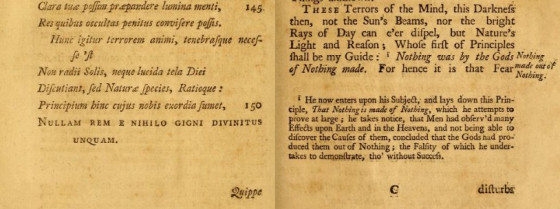
This is the paragraph from Cicero as translated by Yonge:“Surely the mighty power of the Infinite Being is most worthy our great and earnest contemplation; the Nature of which we must necessarily understand to be such that everything in it is made to correspond completely to some other answering part. This is called by Epicurus ισονμία (isonomia); that is to say, an equal distribution or even disposition of things. From hence he draws this inference, that, as there is such a vast multitude of mortals, there cannot be a less number of immortals. Further, if those which perish are innumerable, those which are preserved ought also to be countless.”
-
This is a thread for discussion the details of Isonomy, as found in Cicero's "On The Nature of the Gods" and discussed by Dewitt in his chapter On Piety
CassiusJanuary 22, 2018 at 1:51 PM -
Here is the best and really only information I have, which is from DeWitt. I've never seen anything else on the topic:
CassiusJanuary 22, 2018 at 1:51 PM -
"and in fact I think in our last conversation on the subject we proved it was an incorrect theory." < I will have to look back and see what you're referring to there, as I don't recall agreeing that it is an incorrect theory at all. To the extent that it means "equitable distribution" or "distribution along a spectrum from highest to lowest" I am perfectly fine with it and think that it makes perfect sense.
-
Another good catch Hiram. Dewitt explains the evidence of the gods through images and/or anticipations in his chapter on party. Also the argument from isonomia etc which I prefer is in that same chapter and in "on the nature of the gods"
-
Good point I did not pick up the first time. The first part of the sentence I think is good, but the word "true" doesn't fit, as you say. More applicable instead of "true" would be "what is to be pursued and avoided."
-
Excerpts from a discussion. This is highly edited so maybe some of the comments will be helpful to someone reading this thread / maybe not....
CassiusE THANK YOU! So in Epicurus himself there are two references in the letter to Menoeceus, and then in Doctrine 33? Is that a complete list from what we would consider Epicurus himself? Meaning it does not appear in the other letters, or in the other doctrines, or the Vatican sayings? I would eventually like to find the line and page numbers in this Bailey edition so I can put together a full list which shows both the English and Greek:https://archive.org/.../Epicurus-the-Extant-Remains...ManageE: Eudeamonia is happiness which cannot be augmented.2
Ma
CassiusGood point! "Happiness" in general does not imply that it cannot be augmented.
Eudaemonia cannot be augmented, and it is the best described word than the word "happiness" or in greek "eutychia" since the word happiness depends on many outer factors, as its meaning is connected with the word " fortune" and as Epicurus explains here : "He believes that the misfortune of the wise is better than the prosperity of the fool. [135] It is better, in short, that what is well judged in action should not owe its successful issue to the aid of chance".
Here is the description of an epicurean man and how he has achieved "eudaemonia" in his life!
[133] "Who, then, is superior in thy judgement to such a man ? He holds a holy belief concerning the gods, and is altogether free from the fear of death. He has diligently considered the end fixed by nature, and understands how easily the limit of good things can be reached and attained, and how either the duration or the intensity of evils is but slight. Destiny, which some introduce as sovereign over all things, he laughs to scorn, affirming rather that some things happen of necessity, others by chance, others through our own agency. For he sees that necessity destroys responsibility and that chance or fortune is inconstant ; whereas our own actions are free, and it is to them that praise and blame naturally attach. [134] It were better, indeed, to accept the legends of the gods than to bow beneath that yoke of destiny which the natural philosophers have imposed. The one holds out some faint hope that we may escape if we honour the gods, while the necessity of the naturalists is deaf to all entreaties. Nor does he hold chance to be a god, as the world in general does, for in the acts of a god there is no disorder ; nor to be a cause, though an uncertain one, for he believes that no good or evil is dispensed by chance to men so as to make life blessed, though it supplies the starting-point of great good and great evil. He believes that the misfortune of the wise is better than the prosperity of the fool. [135] It is better, in short, that what is well judged in action should not owe its successful issue to the aid of chance.3
This word has been rejected, as it comes from the ancient greeks who were pagans and they worshiped those statues that were not gods but daemons.
So, this word EU+DAEMON+IA has already something evil inside and has to be rejected from the vocabulary of greeks and non greeks.
The worse DAEMON of all was the god PAN. Pan became the devil.2
AR Yes. Christians have rejected it. We have not rejected it.2
AR Now Diogenes says this:
although pleasure is the first and a natural good, for this same reason we do not choose every pleasure whatsoever, but at many times we pass over certain pleasures, when difficulty is likely to ensue from choosing them.
CassiusOK here is my comment, so E you correct me: If Eudaemonia literally means "good demon" then Epicurus and the Greeks of the time were using the word "figuratively" as you say for the "highest .... what" - because Epicurus didn't believe in demons. Above you wrote: "Eudeamonia is happiness which cannot be augmented." To some extent that is circular, if we don't know the meaning of "happiness."
We know the meaning of Pleasure without being told. I don't think we know the meaning of happiness without it being defined. That's why pleasure, and not happiness, is the guide of life.
I like the word eudaemonia and think we should use it in context, but we probably need a detailed definition of how and why it is being used and why we would not in English simply say "happiness."
I continue to think that we should translate ALL words, giving detailed definitions, so that no one is left with the idea that we have a mystical idea that cannot be translated (which is exactly the situation I think the world is in with "ataraxia")
Manage
Cassius Amicus
CassiusLet me emphasize that last point. I think it is imperative that we always translate all words and state a precise definition, even if we use the Greek in shorthand. For the non-Greeks using the word in casual conversation is probably not a good idea, especially with new people who don't know the meaning and who think therefore that we are talking in secret code. I hate secret codes.
...
So there Torquatus is summarizing the goal in one sentence: "Let us imagine a man living in the continuous enjoyment of numerous and vivid pleasures alike of body and of mind, undisturbed either by the presence or by the prospect of pain. (What possible state of existence could we describe as being more excellent or more desirable?)...
-
Anyone who comes across this thread, please post if you have questions or comments about how the website is organized. Currently it is set up to balance two goals: (1) People who come here for the first time need quick access to samples of information that is here so they will dig further and return, and (2) People who return regularly need quick access to updated messages without having to scroll through too much of the same static content.
So the way this is currently set up is that the Home page has the most static content highlighting the features of the website, while the Dashboard and Timeline pages focus on a balance of the message and changing content and can be used for bookmarking the site to return to in the future.
If anyone has suggestions for better implementing this please comment.
-
Very interesting! I don't think there is any issue with the fact that the brain takes all its inputs and assembles a conclusion, as stated at 2:57 in the video. Of COURSE we can't always trust what we see or here or any other sense - that is the purpose of multiple exposures and examining the facts from as many different sides as we can. Epicurus absolutely knew that and taught to compensate for it, and it's just a fallacy of anti-Epicureans to suggest that he would be taken aback by this kind of things.
So in the end I think this is an excellent video for getting to the root of the issue - illusions do NOT invalidate the need for sensation, and that's just the point that Lucretius argues about sensations in Book IV.
-
And we look forward to having you with us Brendan!
-
There are indeed scary aspects of it and I agree that it is not a subject to bring up lightly - which is why we speak of it infrequently on facebook. And yet it is a good example of Epicurus carrying through the "atomistic universe" premise to its ultimate conclusions, and as we face death and other sobering aspects of reality, it's something else that has to be faced in its proper time. But certainly as not one of the first steps, and certainly not with strangers.

-
Mako that is an OUTSTANDING first draft. on the issue of the absence of pain, did you get a chance to read theNikolsky article yet? Every time I read It I realize that I picked up its argument and just say it in a different way. Also, I realize that I have internalized some material from Gosling & Taylor too. Now THAT is a book that is not so easy to find, and better access to it would help a lot. Although I say it this way all the time, I am not sure that this phrase is really all that helpful "The highest state of pleasure" --- I think that implies (to me, when I say it) that there is some single type of pleasure which is mysterious and needs to be found. I think rather the truth is exactly as stated in PD3 - the LIMIT OF QUANTITY OF PLEASURE..... meaning that the pleasure contained in the vessel can be an mixture of any type just so long as the vessel is full and pain has been crowded out.
Which is not to say that that is easy or even possible to do (effort from breathing?) but that seems to be the way the goal is defined. Nikolsky describes this response to the Academics in a somewhat different way than I do, but I think the result is the same. And the bottom line is that we have a philsophically defensible position in which we rely on nature for our goal and have no need to resort to gods or to false standards for something higher.
A lot of what we are doing here is trying to break free of the Stoic/Academic framework of false goals, and we have to rethink even the terminology to make sure we are not boxed in.
As you say it takes time to put these things together and time to analyze them, and over time you and I and others can come back here and comment on new things that jump out at us.
Nothing else really jumps out at me but I have a comment on this - this too is true "Justice is a contract not to cause pain to one another." I've been in some private conversations lately about how controversial this is - the implication being that "injustice" is nothing but breach of an express or implied agreement. There are plenty of things that are horrible in the world that we can and should want to take action to attack and to change, but unless there was a prior agreement between the parties which was breached, no matter how horrible we consider the problem, it's not a problem of "justice/injustice." It's a problem of "I personally find that intolerable and I am not going to put up with it, and I don't need a god or a false standard of virtue or "justice in the air" to tell me it's ok before i do it!"
-
Great point Mako thank you!
-
-
-
Welcome Christos_Yapijakis! It is a great pleasure and honor to welcome to the forum Christos Yapijakis, leader of the Athenian Garden of Epicurus! Welcome Christos - I hope you will find your stay here pleasurable!
-
My reading of Epicurus suggests to me that the ultimate question we should be concerned about is not "Where are we going?" but "Who or What is going to be our guide?"
In a world that is not set in motion and controlled by a supreme being or force, each individual is going to start at a different place and end up in a different place. In a universe of unplanned and purely natural forces it can be no other way.
To suggest that we all start in the same place, or that we should all end up in the same place, is fantasy - wishful thinking based on false religious or Platonic idealism. At birth we start individually at a unique place, at death we wind up individually at a unique place, and at every step in between our experience is unique to ourselves.
So the question "What is my destination?" is not nearly as important as the question "Who or What will I choose as my guide on my journey?" The choice is simple but all-important: We can choose to follow supernatural gods, which do not exist; we can choose to follow abstract ideals, which likewise do not exist except in the words fed to us by others; or we can choose to follow the only faculty given individually to us by Nature for the purpose: PLEASURE.
And it's up to us to study and understand that the faculty of "pleasure" is not limited simply to bodily needs and stimulations, as the opponents of Epicurus like to suggest, but includes every activity of mind and body that we experience in life and feel - to ourselves - to be desirable. -
Yes, I suspect that he probably either agreed with Epicurus exactly, but no matter what he really thought he knew that he better keep at least some of those views to himself in the interest of his politics. I seem to remember reading that Thomas Paine and some of the more radical deists resented this about Jefferson.
And that actually is another interesting topic. For a while I was reading a lot of Thomas Paine. Paine truly seems to have been a Deist, and as radical as he was I have never read that Paine talked about Epicurus directly. -
I should have addressed that point in my first post. Yes I agree that my understanding of "Deist" is a detached god, but I also understand the term to mean "supernatural" and also "created the universe." I associate the term Deist with the "clockmaker" model of the god who sets things in motion and steps back, and THAT would not be compatible with Epicurus. The part you describe is definitely compatible, but if "deist" also includes "supernatural" and "universe creater" then that part would not. Those are the issues I would like to see clarified in examining what Jefferson believed.
Finding Things At EpicureanFriends.com
Here is a list of suggested search strategies:
- Website Overview page - clickable links arrranged by cards.
- Forum Main Page - list of forums and subforums arranged by topic. Threads are posted according to relevant topics. The "Uncategorized subforum" contains threads which do not fall into any existing topic (also contains older "unfiled" threads which will soon be moved).
- Search Tool - icon is located on the top right of every page. Note that the search box asks you what section of the forum you'd like to search. If you don't know, select "Everywhere."
- Search By Key Tags - curated to show frequently-searched topics.
- Full Tag List - an alphabetical list of all tags.