

Posts by Cassius
New Graphics: Are You On Team Epicurus? | Comparison Chart: Epicurus vs. Other Philosophies | Chart Of Key Epicurean Quotations | Accelerating Study Of Canonics Through Philodemus' "On Methods Of Inference" | Note to all users: If you have a problem posting in any forum, please message Cassius
-
-
Interesting comments Condorcet, and I especially appreciate your cite to the Stephen Pinker book, about which I had not heard. The issue of anticipations is very difficult to be sure about, but I have always thought that the blank slate theory, which I gather is associated largely with Aristotle, is incomplete at best.
As you read DeWitt's book I will be interested in any comments you might have, and especially when you come to his discussion on anticipations it would be interesting to know how that compares with Pinker.
Thanks for posting!
-
Thank you Daryl!
"what is good for me may not be good for you?" <<I think that is a very key point that is something Epicurus considered carefully. How COULD 'what is good for me" be "good for everyone" unless some master-planning god had made everyone the same? No, there is no master-planning god, and our faculty of pleasure is a very individual thing, so I think Epicurus incorporates that truth better than most philosophies.
Also, especially in your learning mode, you should feel free to ask questions by starting threads in any of the forums that you see. That would be a great benefit to us, and hopefully as well to you!
Thanks again for coming by!
-
Welcome Daryl64 !
When you have the opportunity, please let us know a little about your background and interest in Epicurean philosophy. Enjoy your stay here!
-
AUDIO
by C. P. Cavafy. (Note: Not familiar with Cavafy? Check out his famous "Ithaca" as read by Sean Connery with music by Vangelis)
When I heard the terrible news, that Miris was dead,
I went to his house, although I avoid
going to the houses of Christians,
especially during times of mourning or festivity.
I stood in the corridor. I didn't want
to go further inside because I noticed
that the relatives of the deceased looked at me
with obvious surprise and displeasure.
They had him in a large room
and from the corner where I stood
I could catch a glimpse of it: all precious carpets,
and vessels in silver and gold.
I stood and wept in a corner of the corridor.
And I thought how our parties and excursions
wouldn't be worthwhile now without Miris;
and I thought how I'd no longer see him
at our wonderfully indecent νιγητ-long sessions
enjoying himself, laughing, and reciting verses
with his perfect feel for Greek rhythm;
and I thought how I'd lost forever
his beauty, lost forever
the young man I'd worshipped so passionately.
Some old women close to me were talking with lowered
voices
about the last day he lived:
the name of Christ constantly on his lips,
his hand holding a cross.
Then four Christian priests
came into the room, and said prayers
fervently, and orisons to Jesus,
or to Mary (I'm not very familiar with their religion).
We'd known of course that Miris was a Christian,
known it from the very start,
when he first joined our group the year before last.
But he lived exactly as we did:
more devoted to pleasure than all of us,
he scattered his money lavishly on amusements.
Not caring what anyone thought of him,
he threw himself eagerly into night-time scuffles
when our group happened to clash
with some rival group in the street.
He never spoke about his religion.
And once we even told him
that we'd take him with us to the Serapeion.
But -I remember now-
he didn't seem to like this joke of ours.
And yes, now I recall two other incidents.
When we made libations to Poseidon,
he drew himself back from our circle and looked elsewhere.
And when one of us in his fervour said:
"May all of us be favoured and protected
by the great, the sublime Apollo"-
Miris, unheard by the others, whispered: "Not counting me."
The Christian priests were praying loudly
for the young man's soul.
I noticed with how much diligence,
how much intense concern
for the forms of their religion, they were preparing
everything for the Christian funeral.
And suddenly an odd sensation took hold of me:
indefinably I felt
as if Miris were going from me;
I felt that he, a Christian, was united
with his own people and that I was becoming
a stranger, a total stranger. I even felt
a doubt come over me: that I'd been deceived by my passion
and has always been a stranger to him.
I rushed out of their horrible house,
rushed away before my memory of Miris
could be captured, could be perverted by their Christianity.
-
Excellent Hiram - good work!
-
Welcome Condorcet! I fully agree with everything you wrote. And especially I agree with how helpful it is to rewrite Epicurean passages in your own words as way to better understand the meaning. I have done a lot of that myself and I know that helps parse the meaning as well as any other technique. There's nothing magic about the translations we have and in many cases they use docreyionsy choices that may have rung true 100 years ago but are needlessly stilted now.
Given your first post I hope you will feel free to help start new threads and make comments on old ones -- that is the very best way you can help get the forum moving and spur new activity.
As opposed to social media, threads here are findable in the future, and every new comment and discussion helps build a database from which many others can profit.
We look forward to talking with you!
-
Glad to have you Brad and thanks for the Latin greeting! I am afraid my foreign language skills are very poor, but what classes I had in the distant past were in Latin, so that gives me a slightly closer personal feel when I read Lucretius rather than many of the other texts. At the very least I can usually go through a passage in Lucretius and get the idea whether the translator has the right sentence or some error has happened and some entirely different passage is translated! Anyway welcome to the forum!
-

Here Frances Wright answers in the name of Epicurus, as a good summary on several critical questions:
1. What is truth? 2. What is the guide in the search of truth if we discard the will of the gods? 3. Can a false opinion be a crime or a virtue?
From the ending of Chapter 14 of "A Few Days In Athens" (published 1822):
But what is a truth?” said Theon.
“It is pertinently asked. A truth I consider to be an ascertained fact; which truth would be changed into an error, the moment the fact, on which it rested, was disproved.”
“I see, then, no fixed basis for truth.”
“It surely has the most fixed of all — the nature of things. And it is only an imperfect insight into that nature, which occasions all our erroneous conclusions, whether in physics or morals.”
“But where, if we discard the gods, and their will, as engraven on our hearts, are our guides in the search after truth ?”
“Our senses and our faculties as developed in and by the exercise of our senses, are the only guides with which I am acquainted. And I do not see why, even admitting a belief in the gods, and in a superintending providence, the senses should not be viewed as the guides, provided by them, for our direction and instruction. But here is the evil attendant on an ungrounded belief, whatever be its nature. The moment we take one thing for granted, we take other things for granted: we are started in a wrong road, and it is seldom that we can gain the right one, until we have trodden back our steps to the starting place. I know but of one thing that a philosopher should take for granted; and that only because he is forced to it by an irresistible impulse of his nature; and because, without doing so, neither truth nor falsehood could exist for him. He must take for granted the evidence of his senses; in other words, he must believe in the existence of things, as they exist to his senses. I know of no other existence, and can therefore believe in no other: although, reasoning from analogy, I may imagine other existences to be.
This, for instance, I do as respects the gods. I see around me, in the world I inhabit, an infinite variety in the arrangement of matter; — a multitude of sentient beings, possessing different kinds, and varying grades of power and intelligence, — from the worm that crawls in the dust, to the eagle that soars to the sun, and man who marks to the sun its course. It is possible, it is moreover probable, that, in the worlds which I see not, — in the boundless infinitude and eternal duration of matter, beings may exist, of every countless variety, and varying grades of intelligence inferior and superior to our own, until we descend to a minimum, and rise to a maximum, to which the range of our observation affords no parallel, and of which our senses are inadequate to the conception. Thus far, my young friend, I believe in the gods, or in what you will of existences removed from the sphere of my knowledge. That you should believe, with positiveness, in one unseen existence or another, appears to me no crime, although it may appear to me unreasonable: and so, my doubt of the same should appear to you no moral offense, although you might account it erroneous. I fear to fatigue your attention, and will, therefore, dismiss, for the present, these abstruse subjects.”
But we shall both be amply repaid for their discussion, if this truth remain with you — that an opinion, right or wrong, can never constitute a moral offense, nor be in itself a moral obligation. It may be mistaken; it may involve an absurdity, or a contradiction. It is a truth; or it is an error: it can never be a crime or a virtue.”
-
An exchange from Facebook:
Poster1: First and foremost it's primary focus is pleasure. That is the means to which happiness is achieved, and happiness is the primary goal of life. But the word pleasure is often misunderstood and mistaken to mean purely physical or sensual gratification. Ataraxia, a state of mental tranquility free from disturbance, is the ultimate pleasure and maintaining it is how Epicureanism is applied. This means eliminating superstitious views that cause fear or disturbance and accepting your own mortality.Poster2: Can't fill your cup to the rim with pleasure if you're sloshing it all around like a maniac. Ataraxia isn't /the/ ultimate pleasure, it's how happiness is experienced. Happiness is pleasure without disturbance.
Poster3: First we have to say that the greek word "ataraxia" does not go alone, it has to follow and the greek word "aponia". Mental tranquility is in consistency with the body tranquility. Soul and body/mind is one and the same thing, and that means also that the dualism among soul and body does not exist. Second the ultimate pleasure is the pleasure itself, since ataraxia and aponia is only a description of pleasure, when we have to give explanations to those that they do not understand. And third is the term "Epicurean-ism". When someone sees any term with suffix -ism, he has to run away from it as fast as he/she can, since it denotes ideology (political, religious, economical etc etc). Thus, any ideology has nothing to do with Philosophy, and specially with the Epicurean. Thanks and welcome here !

Cassius: I was cheering Poster1's post too til he got to the wording of his sentence on ataraxia. Imbufe that is one of the issues everyone has to consider carefully. Most modern books will track exactly what Mike's sentence says on ataraxia, and if you know the technicalities then there is a sense in which his statement is fully correct: Once you have filled your life with pleasure and eliminated all pain, then you want to maintain that state as smoothly as you can without any disturbances. So yes that form of living IS the highest level of experiencing pleasure that you or any human can reach.
Just don't get confused and think that this description implies some different type of pleasure than what you already understand the word to mean. Like Mike gets at, but doesn't maybe state explicitly, the word "pleasure" includes every possible type of mental and physical sensation you find pleasurable, from sex to fine art to fine music to whatever. There are no "good" and "bad" pleasures - pleasure is a faculty which tells you what is pleasing - nothing more, nothing less - and it's up to you to weigh and judge the consequences and decide which pleasures to pursue.
All this is why Cicero summarized the Epicurean position as "a life of tranquility crammed full of pleasures" in his Defense of Publius Sestius 10.23 ("“…Nothing is preferable to a life of tranquility crammed full of pleasures.”)
However, if you check in at the philosophy department of most any college or philosophy group on the internet, and say "Ataraxia, a state of mental tranquility free from disturbance, is the ultimate pleasure and maintaining it is how Epicureanism is applied" you will get an A+
You just have to decide whether your goal is pleasing the philosophy professors, or having a realistic understanding of what Epicurus said about how to live.
Cassius: This is not "pile on Poster1 day" because I think this goes to the issue people see everywhere and not just his post. It's not just the technical use of the word ataraxia that I want to warn about but the combination with the following sentence that implies that all that is necessary to get to this ultimate state is to *subtract* something:"Ataraxia, a state of mental tranquility free from disturbance, is the ultimate pleasure and maintaining it is how Epicureanism is applied. This means eliminating
superstitious views that cause fear or disturbance and accepting your own mortality."
Again, yes it is absolutely true that we must eliminate superstition (PD1) and eliminate fear of death (PD2). Those are the two biggest false opinions we confront so that is why they are highlighted.
But there is a THIRD false opinion - and that is that there is some goal in life higher or better or to be preferred over pleasure. God and Death aren't the only demons to swat, you also have to swat the demons that there are absolute guides to life such as virtue or "being a good person" or "following god" that everyone must follow. That's where PD3 and PD4 come in, but they are written in a technical way that makes them well-suited for debating Plato, but poorly suited for new students of the philosophy.
Every animal at birth, including humans before they are corrupted by "virtue" or "religion", knows that nature calls them to pursue the various mental and physical pleasures of life. That is a premise of the entire conversation, so you don't get to the best life just looking for demons to swat and subtracting them from life. if you sit in your garden and close off your life with no contact with any ordinary pleasures of mind and body, you have NOT reached the best life. You get to the best life by finding and pursuing those pleasures that matter to you, even if that means accepting some pain as the price. You fill your life with pleasures, make sure you've eliminated the two biggest pains (fear of god and fear of death) and then you are well on your way. Depending on your other circumstances unique to you, your life is both peaceful (free of the worst fears/pains) and crammed full of pleasures.If someone wants to debate the issue and assert that "ataraxia" is some distinct goal which is separate and apart from the experience of normal physical and mental pleasures, please post here as this is a critical issue to discuss.
-
Welcome bradley.whitley !
When you have the opportunity, please let us know a little about your background and interest in Epicurean philosophy. Enjoy your stay here!
-
After almost ten years of dedicated study of Epicurean philosophy, the best summary of the most important points I can produce is:
1 - There are no supernatural gods.
2 - There is no life after death.
3 - Pleasure is the Guide of Life.
4 - Happiness Is the Goal of Life.
5 - Truth is found through the sensations, anticipations, and feelings, rather than through logic.
Let me explain my reasoning:
The first two so directly follow from PD1 and PD2 that I see little room for debate - they are the obvious conclusions.Some will probably argue that 3 and 4 are not so obvious, but I do think they are the logical extensions of PD3 and PD4. The distinction between "Guide" and "Goal" needs the most reflection. Lucretius specifically uses the phrase "divine pleasure guide of life" in his poem, so we have that textual basis for asserting that pleasure is best thought of as a faculty that serves as our constant guide while living. The letter to Menoeceus addresses both "pleasure" and "happiness," and it appears that the Epicureans did speak in terms of pleasure as being a "goal." Surely that means that they considered the clear meaning of happiness to be the predominance of pleasure over pain, so using pleasure and happiness interchangeably in many contexts makes sense. But the important distinction is that it is clear that Epicurus taught that we do not ALWAYS choose pleasure, when avoiding pleasure or choosing pain for the moment will lead to longer-lasting / more intense pleasure over time. We can legitimately say that choosing pain in the short run for the sake of choosing pleasure in the long run is still choosing pleasure, but it probably makes sense to assign the concept of "long-term pleasure" to another word - with that word being "happiness."
Also, I think that 3 and 4 as written here track what is considered to be PD3 and PD4. (Note: As I understand it, the division of the doctrines into 40 chunks cannot be traced to Epicurus himself, or even to as late as Cicero's time. It appears to be an overlay added for convenience some time well after the founding Epicurean period.)
PD3 states that the limit of pleasure is reached when all bodily and mental pain is removed. That is a philosophical argument aimed at the Platonic claim that pleasure cannot be the guide of life because it has no limit, and that anything that has no natural limit must itself be tempered and guided by some separate and outside force, which they assert to be "reason." So in other words, PD3 is the philosophic key to understanding that Pleasure is the Guide of Life.
PD4 states that bodily pain, which we fear most, is short when intense and manageable when of long duration, with manageable stated to mean "allowing an excess of pleasure over pain." What is this but a statement that "happiness" consists in a life in which we should pursue pleasure, and accept the pain that is necessary to achieve that pleasure, and that the resulting net of pleasure over pain over time is desirable: and is this not what "happiness" is all about at the last level of analysis? Considered in this way, "happiness", defined as the long-term predominance of pleasure over pain over time, can be seen as the goal of life.
Item 5 of this list is the most difficult to summarize in a few words, but this formulation I think addresses the most important point that we know from the Principle Doctrines and from Lucretius about Epicurean Canonics - that logic is at best a secondary aid to the sensations, anticipations, and feelings. A thing is what it is to us because of the way it is perceived by our sensations, our anticipations, and our feelings - not because our minds assign a word/concept to it as if it then partakes in some kind of mystical logos/logic.
I think it is useful to compare the first four of these to the "tetrapharmakon" found in the Herculaneum papyri. I have always considered that list to be murky at best, not the least because we do not have the full context to know what was being discussed before and after these few lines in the text. No doubt they were intended as a commentary on the first four doctrines, or at least as a memory device, but for all we know the text that was lost contained criticism of them or limits to their use. The form in which we have them is generally translated:
Don't fear the gods.Don't fear death.
Whats good is easy to get.
What's bad is easy to avoid.
Without the textual commentary that is now lost, it remains my view that these are very easy - too easy - for the modern mind to misinterpret. Yes they are literally true under the Epicurean viewpoint, but so much of that viewpoint is unfamiliar that the new reader is regularly confused.
"Don't fear the gods" leaves open to the modern mind that Supernatural Gods may exist. That viewpoint is prohibited in Epicurean philosophy, which repeatedly states that there are no supernatural gods."Don't fear death" leaves open to the modern mind that death is not to be feared because we all go forward to eternal bliss in heaven. That viewpoint too is prohibited in Epicurean philosophy by the clear and full text of PD2.
"What's good is easy to get" leaves open to the modern mind that the best life comes automatically by simplifying living standards to the bare minimum. That viewpoint too is prohibited in Epicurean philosophy - see VS 63.
"What's bad is easy to avoid" leaves open to the modern mind that pain is a concern to be lightly dismissed. That viewpoint too is prohibited by Epicurean philosophy - the entire course of study is aimed at pointing the way toward pleasure and away from pain, and no one asserts that the study of nature comes without effort.----------
I think it's good to go over and over these issues in one's mind, as that is the best way of understanding them more clearly and seeing their implications.
-
Epicurus As Teacher on Justice:
36. In general justice is the same for all, for it is something found mutually beneficial in men's dealings, but in its application to particular places or other circumstances the same thing is not necessarily just for everyone.
37. Among the things held to be just by law, whatever is proved to be of advantage in men's dealings has the stamp of justice, whether or not it be the same for all; but if a man makes a law and it does not prove to be mutually advantageous, then this is no longer just. And if what is mutually advantageous varies and only for a time corresponds to our concept of justice, nevertheless for that time it is just for those who do not trouble themselves about empty words, but look simply at the facts.
38. Where without any change in circumstances the things held to be just by law are seen not to correspond with the concept of justice in actual practice, such laws are not really just; but wherever the laws have ceased to be advantageous because of a change in circumstances, in that case the laws were for that time just when they were advantageous for the mutual dealings of the citizens, and subsequently ceased to be just when they were no longer advantageous.
Jefferson as Student Applying The Principle:
"A strict observance of the written laws is doubtless one of the high duties of a good citizen, but it is not the highest. The laws of necessity, of self-preservation, of saving our country when in danger, are of higher obligation. To lose our country by a scrupulous adherence to written law, would be to lose the law itself, with life, liberty, property and all those who are enjoying them with us; thus absurdly sacrificing the end to the means."
Thomas Jefferson. Letter to John B. Colvin, September 20, 1810, The Writings of Thomas Jefferson, ed. Paul L. Ford, vol. 9, p. 279 (1898)
-
Poster: I have a question concerning the 1st point; "there are no supernatural gods". As I've read, Epicurus never explicitly rejected the existence of gods, but he simply made them redundant and/or neutral as something related to our world. Maybe a modern account of Epicureanism, or what Epicurus had in mind entails or necessitates an account of atheism. Would you please elaborate more on this issue?
Cassius:
The issue centers on definitions. Epicurus definitely held (1) that "gods" exist, AND also (2) that "gods" are not supernatural. The key attributes of a god as Epicurus defined it are "perfect bliss" and "immortality." Nothing whatsoever about omnipotence or omniscience. People insist that the definition of "gods" must include "supernatural" but Epicurus explicitly held that the universe is all that there is, and that anything that exists is within the natural universe. This is discussed in greatest detail in Lucretius and in the Epicurean dialog in Cicero's "On The Nature of the Gods" but also by Epicurus himself in the letter to Herodotus:
"Nay more: we are bound to believe that in the sky revolutions, solstices, eclipses, risings and settings, and the like, take place without the ministration or command, either now or in the future, of any being who it the same time enjoys perfect bliss along with immortality. For troubles and anxieties and feelings of anger and partiality do not accord with bliss, but always imply weakness and fear and dependence upon one's neighbors. Nor, again, must we hold that things which are no more than globular masses of fire, being at the same time endowed with bliss, assume these motions at will. Nay, in every term we use we must hold fast to all the majesty which attaches to such notions as bliss and immortality, lest the terms should generate opinions inconsistent with this majesty. Otherwise such inconsistency will of itself suffice to produce the worst disturbance in our minds. Hence, where we find phenomena invariably recurring, the invariability of the recurrence must be ascribed to the original interception and conglomeration of atoms whereby the world was formed."
Also from the letter to Pythocles:
And further, let the regularity of their orbits be explained in the same way as certain ordinary incidents within our own experience; the divine nature must not on any account be adduced to explain this, but must be kept free from the task and in perfect bliss. Unless this be done, the whole study of celestial phenomena will be in vain, as indeed it has proved to be with some who did not lay hold of a possible method, but fell into the folly of supposing that these events happen in one single way only and of rejecting all the others which are possible, suffering themselves to be carried into the realm of the unintelligible,. and being unable to take a comprehensive view of the facts which must be taken as clues to the rest."
There are many more similar references in Lucretius, and explicit statements about how nothing comes from nothing at the command of gods.
As to "Atheism" it will again be a question of definitions. If you insist that "Gods" must be supernatural, then Epicurus was an atheist. If you accept Epicurus' viewpoint, which includes that there is life throughout the universe and not just on earth, the the definition of gods becomes one of beings which amount to beings which are postulated to exist that have developed the capacity to be self-sufficient and without pain.
Much of what is recorded to have been said amounts to speculation, such as the gods speak "greek or a language like greek" but I suggest a fair appraisal is generally that gods are the theoretical top of a scale with bacteria or the like at the bottom, humans much further up, and "gods" considerably further up than that and living somewhere elsewhere in the universe (since we don't see them here).
But definitely no Jehovah, no Allah, no Zeus in the way that most people describe them. And in fact, to add to that, Epicurus held that it is "IMPIOUS" to consider any true "god" to do the things that Jehovah and Allah and Zeus are alleged to do.
Impious based on the reasoning of PD1 - 1. A blessed and indestructible being has no trouble himself and brings no trouble upon any other being; so he is free from anger and partiality, for all such things imply weakness."
And also the letter to Menoeceus:
Those things which without ceasing I have declared unto you, do them, and exercise yourself in them, holding them to be the elements of right life. First believe that God is a living being immortal and blessed, according to the notion of a god indicated by the common sense of mankind; and so believing, you shall not affirm of him anything that is foreign to his immortality or that is repugnant to his blessedness. Believe about him whatever may uphold both his blessedness and his immortality. For there are gods, and the knowledge of them is manifest; but they are not such as the multitude believe, seeing that men do not steadfastly maintain the notions they form respecting them. Not the man who denies the gods worshipped by the multitude, but he who affirms of the gods what the multitude believes about them is truly impious. For the utterances of the multitude about the gods are not true preconceptions but false assumptions; hence it is that the greatest evils happen to the wicked and the greatest blessings happen to the good from the hand of the gods, seeing that they are always favorable to their own good qualities and take pleasure in men like themselves, but reject as alien whatever is not of their kind. -
I think it's important that we begin to present Epicurean philosophy through podcasts and other audio-video means, so as a test I put together this basic presentation. I haven't edited the sound and this includes all the unprofessional "uhs" that come with someone who has no podcasting experience. Despite that, however, I think this presentation might be useful, so I am making it available here. The slide presentation itself can be found and downloaded at https://www.epicureanfriends.com/fivestars -- it is in the free Libreoffice Impress format and you are welcome to reuse and modify it. Thanks for your time in watching.
-
Very pleased to have you Nkuilan! We're still in a growing phase so the best thing that you (or any other new user) can do to help is to start threads asking questions or commenting on new topics, so please feel free to do that!
-
Justice is Not Absolute. PD33 “33. There never was such a thing as absolute justice….”
Definitions Matter. One Man’s “Human Right” is another Man’s “Oppression”: “In the first place, Herodotus, you must understand what it is that words denote, in order that by reference to this we may be in a position to test opinions, inquiries, or problems, so that our proofs may not run on untested ad infinitum, nor the terms we use be empty of meaning.”
Need An Example Where These Two Come Together?
Need some food for further thought?
PD 39. The man who best knows how to meet external threats makes into one family all the creatures he can; and those he can not, he at any rate does not treat as aliens; and where he finds even this impossible, he avoids all dealings, and, so far as is advantageous, excludes them from his life.
-
Welcom nkuilan !
When you have the opportunity, please let us know a little about your background and interest in Epicurean philosophy. Enjoy your stay here!
-
-
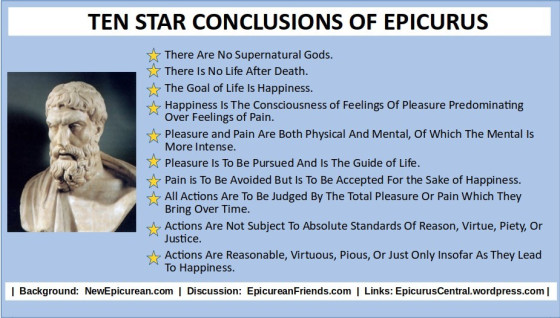
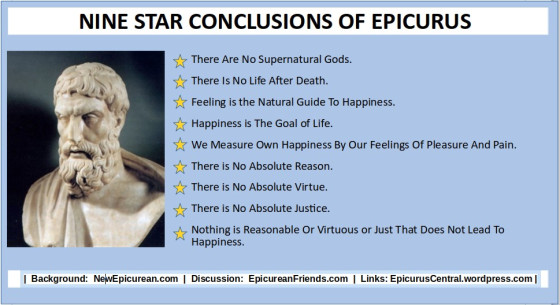
The usefulness of every bullet-point list has to be judged by its context and its target. The 40 Authorized Doctrines, for example, were clearly compiled for people who had a significant prior understanding both of Epicurean theory and general philosophical issues. The key Epicurean principles of physics that are necessary to the conclusions were not included at all, and canonics / epistemology is mentioned only briefly. With that background I want to prepare a graphic that summarizes in very brief but very clear terms some of the most important take-aways that a person who knows nothing about Epicurus would find most important. I have prepared this draft list as a start. Each item needs to be short but clear, and that's why I have not used any words like "canonics" or "anticipations" or even "truth," which are ambiguous at best and bewildering to most people.
As an example of my thinking, I have been considering including: "The Universe Is Eternal and Infinite, and Life Does Not Exist Only on Earth." However such a statement is long, not necessarily related to "ethics," and would probably appeal to more of a "geeky" audience (like myself maybe) rather than to a general reader.
There's no magic number, and I will probably mix and match lists according to the context in which I use them, but your thoughts and suggestions for pithy statements of key points would be appreciated! Think about the points that are most meaningful to you.
The current list is:
1- There Are No Supernatural Gods.
2- There Is No Life After Death.
3- Feeling is the Natural Guide To Happiness.
4- Happiness is The Goal of Life.
5- We Measure Our Own Happiness By Our Feelings Of Pleasure And Pain.
6- There is No Absolute Reason.
7- There is No Absolute Virtue.
8- There is No Absolute Justice.
9- Nothing is Reasonable Or Virtuous or Just That Does Not Lead To Happiness.

Finding Things At EpicureanFriends.com
Here is a list of suggested search strategies:
- Website Overview page - clickable links arrranged by cards.
- Forum Main Page - list of forums and subforums arranged by topic. Threads are posted according to relevant topics. The "Uncategorized subforum" contains threads which do not fall into any existing topic (also contains older "unfiled" threads which will soon be moved).
- Search Tool - icon is located on the top right of every page. Note that the search box asks you what section of the forum you'd like to search. If you don't know, select "Everywhere."
- Search By Key Tags - curated to show frequently-searched topics.
- Full Tag List - an alphabetical list of all tags.