
SeashellCollector it is my understanding that you have asked to participate in the Wednesday night Zoom session on Usener. Before we accept new video participants we ask people to identity their background and interest in Epicurus. Could you tell us about that please?
Posts by Cassius
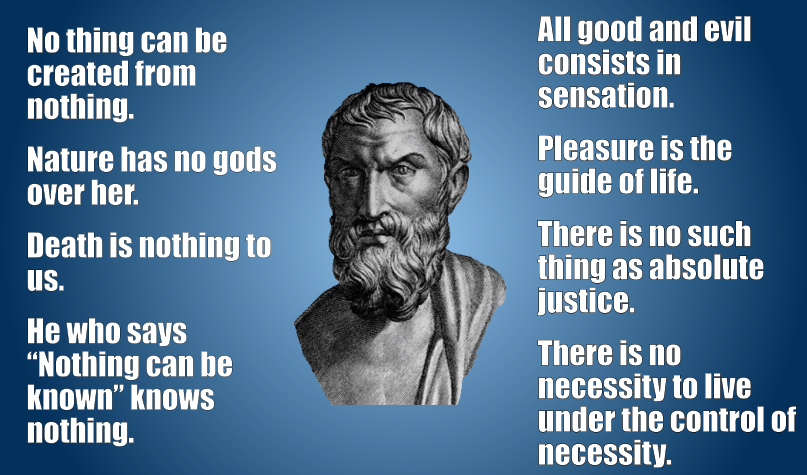
New Graphics: Are You On Team Epicurus? | Comparison Chart: Epicurus vs. Other Philosophies | Chart Of Key Epicurean Quotations | Accelerating Study Of Canonics Through Philodemus' "On Methods Of Inference" | Note to all users: If you have a problem posting in any forum, please message Cassius
-
-
Post
Daily Reflection from an Epicurean View
Hello all, Peace and Safety. I am new to this site; well, I have browsed a few times before, but newly a member. I have been following Epicureanism for about a year now after discovering Stoicism just wasn't for me. My collegiate career has brought me into a course on Stoicism since they lack a course of Epicureanism. To my pleasant surprise, Epicureanism is referenced in nearly every topic and lesson. This week we have to charge of daily reflections. Part of the reflections is to ask oneself… Chryso
April 2, 2024 at 12:11 AM -
Welcome Chryso !
There is one last step to complete your registration:
All new registrants must post a response to this message here in this welcome thread (we do this in order to minimize spam registrations).
You must post your response within 72 hours, or your account will be subject to deletion.
Please say "Hello" by introducing yourself, tell us what prompted your interest in Epicureanism and which particular aspects of Epicureanism most interest you, and/or post a question.
This forum is the place for students of Epicurus to coordinate their studies and work together to promote the philosophy of Epicurus. Please remember that all posting here is subject to our Community Standards / Rules of the Forum our Not Neo-Epicurean, But Epicurean and our Posting Policy statements and associated posts.
Please understand that the leaders of this forum are well aware that many fans of Epicurus may have sincerely-held views of what Epicurus taught that are incompatible with the purposes and standards of this forum. This forum is dedicated exclusively to the study and support of people who are committed to classical Epicurean views. As a result, this forum is not for people who seek to mix and match some Epicurean views with positions that are inherently inconsistent with the core teachings of Epicurus.
All of us who are here have arrived at our respect for Epicurus after long journeys through other philosophies, and we do not demand of others what we were not able to do ourselves. Epicurean philosophy is very different from other viewpoints, and it takes time to understand how deep those differences really are. That's why we have membership levels here at the forum which allow for new participants to discuss and develop their own learning, but it's also why we have standards that will lead in some cases to arguments being limited, and even participants being removed, when the purposes of the community require it. Epicurean philosophy is not inherently democratic, or committed to unlimited free speech, or devoted to any other form of organization other than the pursuit by our community of happy living through the principles of Epicurean philosophy.
One way you can be most assured of your time here being productive is to tell us a little about yourself and personal your background in reading Epicurean texts. It would also be helpful if you could tell us how you found this forum, and any particular areas of interest that you have which would help us make sure that your questions and thoughts are addressed.
In that regard we have found over the years that there are a number of key texts and references which most all serious students of Epicurus will want to read and evaluate for themselves. Those include the following.
"Epicurus and His Philosophy" by Norman DeWitt
The Biography of Epicurus by Diogenes Laertius. This includes the surviving letters of Epicurus, including those to Herodotus, Pythocles, and Menoeceus.
"On The Nature of Things" - by Lucretius (a poetic abridgement of Epicurus' "On Nature"
"Epicurus on Pleasure" - By Boris Nikolsky
The chapters on Epicurus in Gosling and Taylor's "The Greeks On Pleasure."
Cicero's "On Ends" - Torquatus Section
Cicero's "On The Nature of the Gods" - Velleius Section
The Inscription of Diogenes of Oinoanda - Martin Ferguson Smith translation
A Few Days In Athens" - Frances Wright
Lucian Core Texts on Epicurus: (1) Alexander the Oracle-Monger, (2) Hermotimus
Philodemus "On Methods of Inference" (De Lacy version, including his appendix on relationship of Epicurean canon to Aristotle and other Greeks)
"The Greeks on Pleasure" -Gosling & Taylor Sections on Epicurus, especially the section on katastematic and kinetic pleasure which explains why ultimately this distinction was not of great significance to Epicurus.
It is by no means essential or required that you have read these texts before participating in the forum, but your understanding of Epicurus will be much enhanced the more of these you have read. Feel free to join in on one or more of our conversation threads under various topics found throughout the forum, where you can to ask questions or to add in any of your insights as you study the Epicurean philosophy.
And time has also indicated to us that if you can find the time to read one book which will best explain classical Epicurean philosophy, as opposed to most modern "eclectic" interpretations of Epicurus, that book is Norman DeWitt's Epicurus And His Philosophy.
(If you have any questions regarding the usage of the forum or finding info, please post any questions in this thread).
Welcome to the forum!
-
Welcome @Seashell collector
There is one last step to complete your registration:
All new registrants must post a response to this message here in this welcome thread (we do this in order to minimize spam registrations).
You must post your response within 72 hours, or your account will be subject to deletion.
Please say "Hello" by introducing yourself, tell us what prompted your interest in Epicureanism and which particular aspects of Epicureanism most interest you, and/or post a question.
This forum is the place for students of Epicurus to coordinate their studies and work together to promote the philosophy of Epicurus. Please remember that all posting here is subject to our Community Standards / Rules of the Forum our Not Neo-Epicurean, But Epicurean and our Posting Policy statements and associated posts.
Please understand that the leaders of this forum are well aware that many fans of Epicurus may have sincerely-held views of what Epicurus taught that are incompatible with the purposes and standards of this forum. This forum is dedicated exclusively to the study and support of people who are committed to classical Epicurean views. As a result, this forum is not for people who seek to mix and match some Epicurean views with positions that are inherently inconsistent with the core teachings of Epicurus.
All of us who are here have arrived at our respect for Epicurus after long journeys through other philosophies, and we do not demand of others what we were not able to do ourselves. Epicurean philosophy is very different from other viewpoints, and it takes time to understand how deep those differences really are. That's why we have membership levels here at the forum which allow for new participants to discuss and develop their own learning, but it's also why we have standards that will lead in some cases to arguments being limited, and even participants being removed, when the purposes of the community require it. Epicurean philosophy is not inherently democratic, or committed to unlimited free speech, or devoted to any other form of organization other than the pursuit by our community of happy living through the principles of Epicurean philosophy.
One way you can be most assured of your time here being productive is to tell us a little about yourself and personal your background in reading Epicurean texts. It would also be helpful if you could tell us how you found this forum, and any particular areas of interest that you have which would help us make sure that your questions and thoughts are addressed.
In that regard we have found over the years that there are a number of key texts and references which most all serious students of Epicurus will want to read and evaluate for themselves. Those include the following.
"Epicurus and His Philosophy" by Norman DeWitt
The Biography of Epicurus by Diogenes Laertius. This includes the surviving letters of Epicurus, including those to Herodotus, Pythocles, and Menoeceus.
"On The Nature of Things" - by Lucretius (a poetic abridgement of Epicurus' "On Nature"
"Epicurus on Pleasure" - By Boris Nikolsky
The chapters on Epicurus in Gosling and Taylor's "The Greeks On Pleasure."
Cicero's "On Ends" - Torquatus Section
Cicero's "On The Nature of the Gods" - Velleius Section
The Inscription of Diogenes of Oinoanda - Martin Ferguson Smith translation
A Few Days In Athens" - Frances Wright
Lucian Core Texts on Epicurus: (1) Alexander the Oracle-Monger, (2) Hermotimus
Philodemus "On Methods of Inference" (De Lacy version, including his appendix on relationship of Epicurean canon to Aristotle and other Greeks)
"The Greeks on Pleasure" -Gosling & Taylor Sections on Epicurus, especially the section on katastematic and kinetic pleasure which explains why ultimately this distinction was not of great significance to Epicurus.
It is by no means essential or required that you have read these texts before participating in the forum, but your understanding of Epicurus will be much enhanced the more of these you have read. Feel free to join in on one or more of our conversation threads under various topics found throughout the forum, where you can to ask questions or to add in any of your insights as you study the Epicurean philosophy.
And time has also indicated to us that if you can find the time to read one book which will best explain classical Epicurean philosophy, as opposed to most modern "eclectic" interpretations of Epicurus, that book is Norman DeWitt's Epicurus And His Philosophy.
(If you have any questions regarding the usage of the forum or finding info, please post any questions in this thread).
Welcome to the forum!
-

You're welcome! Wanted to give everyone time to hear these two so we can prepare for our special episode with Don subbing for Joshua while he is watching the eclipse.
-
Lucretius Today Podcast Episode 221 - Cicero's On Ends - Book Two - Part 28 - "Cicero Alleges Pleasures Of The Mind Cannot Offset Pain In Epicurean Philosophy" Is Now Available -
Given the significance of the subject of memory in this episode, I have set up a new section so we can carry that discussion into the future and see its importance as an Epicurean virtue:
ThreadThe Art of Remembering
I the Lucretius Today podcast that we recorded today (Episode 221) we ran into a substantial passage where Cicero attacked Epicurus' stress on remembering the pleasures of the past as a means of offsetting pains in the present. Cicero went on at length questioning whether we can control our memories at all, and called into question both the possibility and the efficacy of the use of memories of past pleasures.
[…]
When combined with the regular meetings and birthday celebrations and use of… CassiusMarch 31, 2024 at 2:11 PM I the Lucretius Today podcast that we recorded today (Episode 221) we ran into a substantial passage where Cicero attacked Epicurus' stress on remembering the pleasures of the past as a means of offsetting pains in the present. Cicero went on at length questioning whether we can control our memories at all, and called into question both the possibility and the efficacy of the use of memories of past pleasures.
Quote from Cicero's On Ends Book 2XXXII. But to return to our theme (for we were speaking about pain when we drifted into the consideration of this letter) we may now thus sum up the whole matter: he who is subject to the greatest possible evil is not happy so long as he remains subject to it, whereas the wise man always is happy, though he is at times subject to pain; pain therefore is not the greatest possible evil. Now what kind of statement is this, that past blessings do not fade from the wise man’s memory, but still that he ought not to remember his misfortunes? First, have we power over our recollections? I know that Themistocles, when Simonides, or it may be some one else, offered to teach him the art of remembering, said: I would rather learn the art of forgetting; for I remember even the things I do not wish to re- member, while I cannot forget what I wish to forget. He had great gifts; but the truth is really this, that it is too domineering for a philosopher to interdict us from remembering things. Take care that your commands be not those of a Manlius or even stronger; I mean when you lay a command on me which I cannot possibly execute. What if the recollection of past misfortunes is actually agreeable? Some proverbs will thus be truer than your doctrines. It is a common saying: Fast toils are agreeable; and not badly did Euripides say (I shall put it into Latin if I can; you all know the line in Greek): Sweet is the memory of toils that are past. But let us return to the subject of past blessings. If you spoke of such blessings as enabled Gaius Marius, though exiled, starving, and immersed in a swamp, to lighten his pain by re-calling to mind his triumphs, I would listen to you and give you my entire approval. Indeed the happiness of the wise man can never be perfected, or reach its goal, if his good thoughts and deeds are to be successively effaced by his own forgetfulness,
But in your view life is rendered happy by the remembrance of pleasures already enjoyed, and moreover those enjoyed by the body. For if there are any other pleasures, then it is not true that all mental pleasures are dependent on association with the body. Now if bodily pleasure, even when past, gives satisfaction, I do not see why Aristotle should so utterly ridicule the inscription of Sardanapallus, in which that king of Syria boasts that he has carried away with him all the lustful pleasures. For, says Aristotle, how could he retain after death a thing which, even when he was alive, he could only feel just so long as he actually enjoyed it? Bodily pleasures therefore ebb and fly away one after another, and more often leave behind them reason for regret than for remembrance. Happier then is Africanus when he thus converses with his country: Cease, Rome, thy enemies to fear, with the noble sequel: For my toils have established for thee thy bulwarks. He takes delight in his past toils; you bid him delight in his past pleasures; he turns his thoughts once more to achievements, not one of which he ever connected with the body; you wholly cling to the body.
XXXIII. But how is this very position of your school to be made good, namely that all intellectual pleasures and pains alike are referable to bodily pleasures and pains? Do you never get any gratification (I know the kind of man I am addressing) - Do you, then, Torquatus, never get any gratification from anything whatever for its own sake? I put on one side nobleness, morality, the mere beauty of the virtues, of which I have already spoken; I will put before you these slighter matters; when you either write or read a poem or a speech, when you press your inquiries concerning all events, and all countries, when you see a statue, a picture, an attractive spot, games, fights with beasts, the country house of Lucullus (for if I were to mention your own, you would find a loop-hole, you would say that it had to do with your body) — well then, do you connect all the things I have mentioned with the body? Or is there something which gives you gratification for its own sake? You will either shew yourself very obstinate, if you persist in connecting with the body everything that I have mentioned, or will prove a traitor to the whole of pleasure, as Epicurus conceives it, if you give the opposite opinion.
But when you maintain that the mental pleasures and pains are more intense than those of the body, because the mind is associated with time of three kinds, while the body has only consciousness of what is present, how can you accept the result that one who feels some joy on my account feels more joy than I do myself? But in your anxiety to prove the wise man happy, because the pleasures he experiences in his mind are the greatest, and incomparably greater than those he experiences in his body, you are blind to the difficulty that meets you. For the mental pains he experiences will also be incomparably greater than those of the body. So the very man whom you are anxious to represent as constantly happy must needs be sometimes wretched; nor indeed will you ever prove your point, while you continue to connect everything with pleasure and pain.
When combined with the regular meetings and birthday celebrations and use of images and committing texts to memory, I think this highlights that the Epicureans likely *did* stress the importance of keeping a good memory of past pleasant experiences as a strategy for living happily.
And that means that the art of cultivating good memories is probably a very significant instrumentality that deserves its own section of the forum along with the other "virtues."
Joshua has noted that Cicero himself is identified with a memory technique involving associating items with places, and so it does seem there are records from the ancient world about the topic of cultivating the use of memory.
Let's use this thread (and this entire subforum) to discuss that topic.
Thanks Martin for pointing out to me that there is more to discuss here in terms of the empiricism aspect, which is also something to contrast to Epicurus (that he was not so extreme an empiricism.
Just for reinforcement the general topic we are discussing at the end of this epsisode contains all sorts of questions:
- As Joshua brought up in the episode yesterday there are lots of subquestions, such as:
- Is pain really the ultimate evil?
- Can the wise man be happy while still experiencing the ultimate evil?
- Is happiness being described by Torquatus when he said in book 1 that the wise man always has more reason for joy than for vexation?
- Was Epicurus on his last day equivalent to the wise man being tortured and are they both to be considered happy? If so, why?
Yes and earlier in the episode, if i recall correctly, i did the same thing to Joshua - finishing a thought that he started. What isn't heard in the final edit is the long pause that led to us completing the other person's thought.

I'd like to call attention to this question that we discussed at the end of podcast 220, because we will also pick it up again to begin episode 221, and anyone who has any comment on this is welcome to add to the discussion:
Is it a contradiction in Epicurean Philosophy for Epicurus to consider that Pain is the Greatest Evil, and yet to also old that the Happy Man will sometimes experience pain?
Here is the Reid translation from Section XXXII:
"XXXII. But to return to our theme (for we were speaking about pain when we drifted into the consideration of this letter) we may now thus sum up the whole matter: he who is subject to the greatest possible evil is not happy so long as he remains subject to it, whereas the wise man always is happy, though he is at times subject to pain; pain therefore is not the greatest possible evil."
Welcome to Episode 221 of Lucretius Today. This is a podcast dedicated to the poet Lucretius, who wrote "On The Nature of Things," the most complete presentation of Epicurean philosophy left to us from the ancient world. Each week we walk you through the Epicurean texts, and we discuss how Epicurean philosophy can apply to you today. If you find the Epicurean worldview attractive, we invite you to join us in the study of Epicurus at EpicureanFriends.com, where you will find a discussion thread for each of our podcast episodes and many other topics.
This week we continue our discussion of Book Two of Cicero's On Ends, which is largely devoted Cicero's attack on Epicurean Philosophy. Going through this book gives us the opportunity to review those attacks, take them apart, and respond to them as an ancient Epicurean might have done, and much more fully than Cicero allowed Torquatus, his Epicurean spokesman, to do.
Follow along with us here: Cicero's On Ends - Complete Reid Edition. Check any typos or other questions against the original PDF which can be found here.
Last week we started with the question raised by Cicero at the beginning of Section XXXII - Is it a contradiction in Epicurean Philosophy for Epicurus to consider that Pain is the Greatest Evil, and yet to also old that the Happy Man will sometimes experience pain? We will return to that question at the beginning of this episode and then proceed through Section XXXII:
XXXII. But to return to our theme (for we were speaking about pain when we drifted into the consideration of this letter) we may now thus sum up the whole matter: he who is subject to the greatest possible evil is not happy so long as he remains subject to it, whereas the wise man always is happy, though he is at times subject to pain; pain therefore is not the greatest possible evil. Now what kind of statement is this, that past blessings do not fade from the wise man’s memory, but still that he ought not to remember his misfortunes? First, have we power over our recollections? I know that Themistocles, when Simonides, or it may be some one else, offered to teach him the art of remembering, said: I would rather learn the art of forgetting; for I remember even the things I do not wish to re- member, while I cannot forget what I wish to forget. He had great gifts; but the truth is really this, that it is too domineering for a philosopher to interdict us from remembering things. Take care that your commands be not those of a Manlius or even stronger; I mean when you lay a command on me which I cannot possibly execute. What if the recollection of past misfortunes is actually agreeable? Some proverbs will thus be truer than your doctrines. It is a common saying: Fast toils are agreeable; and not badly did Euripides say (I shall put it into Latin if I can; you all know the line in Greek): Sweet is the memory of toils that are past. But let us return to the subject of past blessings. If you spoke of such blessings as enabled Gaius Marius, though exiled, starving, and immersed in a swamp, to lighten his pain by re-calling to mind his triumphs, I would listen to you and give you my entire approval. Indeed the happiness of the wise man can never be perfected, or reach its goal, if his good thoughts and deeds are to be successively effaced by his own forgetfulness,
But in your view life is rendered happy by the remembrance of pleasures already enjoyed, and moreover those enjoyed by the body. For if there are any other pleasures, then it is not true that all mental pleasures are dependent on association with the body. Now if bodily pleasure, even when past, gives satisfaction, I do not see why Aristotle should so utterly ridicule the inscription of Sardanapallus, in which that king of Syria boasts that he has carried away with him all the lustful pleasures. For, says Aristotle, how could he retain after death a thing which, even when he was alive, he could only feel just so long as he actually enjoyed it? Bodily pleasures therefore ebb and fly away one after another, and more often leave behind them reason for regret than for remembrance. Happier then is Africanus when he thus converses with his country: Cease, Rome, thy enemies to fear, with the noble sequel: For my toils have established for thee thy bulwarks. He takes delight in his past toils; you bid him delight in his past pleasures; he turns his thoughts once more to achievements, not one of which he ever connected with the body; you wholly cling to the body.
XXXIII. But how is this very position of your school to be made good, namely that all intellectual pleasures and pains alike are referable to bodily pleasures and pains? Do you never get any gratification (I know the kind of man I am addressing) - Do you, then, Torquatus, never get any gratification from anything whatever for its own sake? I put on one side nobleness, morality, the mere beauty of the virtues, of which I have already spoken; I will put before you these slighter matters; when you either write or read a poem or a speech, when you press your inquiries concerning all events, and all countries, when you see a statue, a picture, an attractive spot, games, fights with beasts, the country house of Lucullus (for if I were to mention your own, you would find a loop-hole, you would say that it had to do with your body) — well then, do you connect all the things I have mentioned with the body? Or is there something which gives you gratification for its own sake? You will either shew yourself very obstinate, if you persist in connecting with the body everything that I have mentioned, or will prove a traitor to the whole of pleasure, as Epicurus conceives it, if you give the opposite opinion.
But when you maintain that the mental pleasures and pains are more intense than those of the body, because the mind is associated with time of three kinds, while the body has only consciousness of what is present, how can you accept the result that one who feels some joy on my account feels more joy than I do myself? But in your anxiety to prove the wise man happy, because the pleasures he experiences in his mind are the greatest, and incomparably greater than those he experiences in his body, you are blind to the difficulty that meets you. For the mental pains he experiences will also be incomparably greater than those of the body. So the very man whom you are anxious to represent as constantly happy must needs be sometimes wretched; nor indeed will you ever prove your point, while you continue to connect everything with pleasure and pain.
Hence, Torquatus, we must discover some other form of the highest good for man; let us abandon pleasure to the beasts, whom you are accustomed to summon as witnesses about the supreme good. What if even beasts very often, under the guidance of the peculiar constitution of each, shew some of them kindness, even at the cost of toil, so that when they bear and rear their young it is very patent that they aim at something different from pleasure ? Others again, rejoice in wanderings and in journeys; others in their assemblages imitate in a certain way the meetings of burgesses; in some kinds of birds we see certain signs of affection, as well as knowledge and memory; in many also we see regrets. Shall we admit then that in beasts there are certain shadows of human virtues, unconnected with pleasure, while in men them-selves virtue cannot exist unless with a view to pleasure? And shall we say that man, who far excels all other creatures, has received no peculiar gifts from nature?
Lucretius Today Podcast Episode 220 - Cicero's On Ends - Book Two - Part 26 - "Cicero Attacks Epicurus' End-Of-Life Decisionmaking" Is Now Available -

For Epicurus the ultimate pleasure ideal is a continuous mental state that we have to fully immerse ourselves in and then perpetually remain in it.
Do we have evidence that the Epicurean ideal of stative and permanent pleasure is attainable?
I don't have the time to respond at length at the moment but in my view the premises of these statements, while often stated by commentators, have to be approached very cautiously.
The thrust of the first one is that Epicurus held that there was in fact an "ultimate pleasure ideal" in the form of a "continuous mental state." My understanding of the epicurean texts is that Epicurus held the goal of life to be "pleasure," which can best be experienced without any accompanying pain, so that the correct expression of the limit of pleasure is the total absence of pain. The suggestion that this limit of pleasure is only or primarily mental would not be consistent with the thrust of the philosophy. Both mental and bodily pleasures and pains are important, and ultimately the mental pleasures are associated with the body as well
The thrust of the second statement is that Epicurus' goal of pleasure is "statiive" That might be an abstract way of talking about it but Epicurus' descriptions revolve around the *experiences* of various feelings of pleasure, rather than something that can be sufficiently described as a "state," and certainly not a mental-only state.
The example of Epicurus' last days shows that Epicurus viewed that it was possible for him to be happy even while experiencing intense physical pain, but those experiences were moment to moment and not the result of a "state" that is self-perpetuating.
QuoteThe ideal life for the Cyrenaics consists in successfully chasing concrete experiences that cause direct pleasure.
For the Epicureans the ideal life consists in doing what's necessary to achieve a permanent state of pleasure and not allowing yourself to stray from it.
Epicurus too was experiencing "concrete experiences" on his last day. He held that his mental pleasures could be offset against his physical pains, and as Torquatus says the wise man is always going to find more reason for joy than for vexation.
I suppose that the "always" means that the net positive balance of pleasure over pain could be described as "permanent," but the implication of a "permanent state" is that it can never be lost once gained. I doubt that stressing the aspect of it being permanent, rather than stressing the aspect that it needs to be continually maintained, would be a very good idea.
So I don't mean this to be a flat disagreement, but I would say that the better way to describe the Cyreniac/Epicurean difference is more by focusing on Epicurus' expansion of the term pleasure to encompass every experience that is not painful, rather than by trying to consider the existence of a "plateau" that constitutes a state which, once attained, is never losable.
(Posted at Facebook on 3/26/24 by Elli )
What was the main cause of the causes that Hellenic-Roman Civilization was collapsed?
-But of course, the paralyzed stoicism (see also and Plato)!
For the paralyzed stoicism who was considered the main obstacle and red flag?
But of course, the Epicurean Man!
Claudius Aelianus ( c. 175 – c. 235 AD), commonly Aelian born at Praeneste, was a Roman author and teacher of rhetoric who flourished under Septimus Severus and probably outlived Elagabalus, who died in 222. He spoke Greek so fluently that he was called "honey-tongued" (μελίγλωσσος meliglossos); Roman-born, he preferred Greek authors, and wrote in a slightly archaizing Greek himself. Aelianus the “honey-tongued” was the one that once boasted that he had never been outside Italy, never been aboard a ship though he had seen the bull Serapis with his own eyes.
And now, from that “honey-tongued”, Aelianus, we read:
«There was a man named Euphronius, he was a miserable man who delighted in listening to the nonsense of Epicurus, and he got two evils from this nonsense. He became an atheist and an intemperate (1). In this wretched state, (Euphronius) did not forget that vile and godless treatise (2) which the man from Gargettus (i.e. Epicurus), as the seed of the seed of the Titans (3) he left as a stigma on people's lives. And that “honey-tongued” continues saying... the merciful Euphronius fell seriously ill and when he was on the brink of death his friends brought him to the temple of Asclepius (4). When he fell asleep, one of the priests appeared to tell him that there was only one way of salvation and only one remedy for his afflictions. To burn the books of Epicurus, to mix the ashes of godless, impious and effeminate books with melted wax and after spreading this patch on his stomach and chest to bind them around with bandages. Αnd then, Euphronius when he confessed to his household servants what he heard, they were filled at once with an excessive joy at not having expelled (the priests) a man who had been demeaned and dishonoured by the god (due to his studies of Epicurus and his philosophy). And after drawing some instruction from him they then imitated [him] with a view to [behaving] well and nobly>>
So, in the last paragraph and in a few words Euphronius became a noble master because, he was honored by a god. And when you honored by a god your servants are more obedient to behave to you well and nobly. Because when a master is honored by a god, so then he becomes wise, noble and just with his servants. So, the morality of a master comes from a moral code with a list that has been given by a god and his representatives the priests! No, this not a master, this is not a wise free man, and this is not an epicurean man. This is a stupid man, and I, as an epicurean, do not accept this tale of Aelian as absolutely true. Because this tale hides a deceitful purpose: To become the mega phronon (the high spirited, free, and proud man) as an obedient, humble man who fears god and death, and similar with the mob and all the stoic servants.
(1) Intemperate, possibly with the meaning of "a hunter of pleasures".
(2) Probably he means Epicurus’ treatise "on Nature" which has inspired Lucretius for writing his masterpiece DRN.
(3) This is very nice characteristic, Epicurus is not just Megas, he is a Titan, as we say something very Huge e.g. Titanic.
(4) Asklepiia as sanatoriums, were usually located at some distance from the cities, so as to ensure the required tranquility and comfort of space for the addition of new buildings to meet the needs of the patients. In addition, the sanctuaries had to be surrounded of pine grove which was associated with the healing process, as it seems that meditation and the self-submission achieved by the patient as he tried to communicate with the god played a big role in the healing. The main feature of most Asclepius’ healing temples was the existence of a spring, as contact with water was considered therapeutic. From an architectural point of view, most Asklepiia followed the models of Epidaurus and Kos. In addition to the sanctuary, which consisted of the main temple, in front of which several altars were usually erected, it also included one or more buildings (often two-storey), in which the patients and their accompanying family members were accommodated. There they were provided with medical care, so as to facilitate treatment, but also to recover from the fatigue of the journey to which they had been subjected. It was also necessary to rebuild a place of sleep, a type of a stoa, where the patient-believer came to sleep, often wrapped in the carcass of the animal he had sacrificed, in order for the god to show him in his sleep the way of his healing. In addition, the facilities of the Asklepiia were complemented by baths.
(5) From Aelianus and his "various history", we read: «Plato called Aristotle a foal: What is meant by that name is manifest: a foal as soon as it is satisfied with the milk of dam kicks at her. Plato therefore hereby signified some Ingratitude of Aristotle; for he having received the greatest seeds of Philosophy from him, and introduction thereto, as soon as he was replenished and satisfied with the best things thereof, revolted from him, and, getting his friends together, set up against him Peripateticism, professing himself Plato's adversary». (my note: That means for Aelianus things are absolute, unchanged, immovable and the same till the end of all times, as well as in life and philosophy beyond Plato, nothing should go further.)
Given what we have been reading Cicero say in the podcast, apparently it was a major position at the time that one can't be deemed happy until a life is over and in retrospect. That's pretty clearly different than the "upbeat feeling" I think most of us first default to with "happy" today.
So somehow we have to set some terms on what is meant at a basic level. Are we talking something short term or much longer?
I can't say which approach is most in line with the original meaning of eudaimonia.
Passing comment not meant to claim correctness: I think I remember from college philosophy that Socrates actually spoke about hearing or feeling the prompting of his personal "daemon" - perhaps I am wrong. But I wonder if it is getting far afield from the way the word was originally used to exclude connotations of "blessedness" from a "divinity" point of view. Or the opposite - was the whole meaning of the word just an "idiom" for them, with no specific clear meaning, just many of these words are for us?
I have no real clue, but then again I probably couldn't easily pin down what it means to be "happy" today either, without going off on all sorts of excursions into various perspectives and definitions.
To say a little more about the plan for the Usener material, I have gone through the material at Attalus.org and Epicurism.info and pulled out from the full set of entries those items which have the most interest and which are not simply cites to Diogenes Laertius or to passing comments that are so short as to not have much meaning standing alone. The result of that so far is here.
So for example, the first session will be on the collection entitled "testimonials concerning Epicurus' style and language." After that we will do a select a group of U-numbers for each night.
We'll probably still want to keep the complete version in front of us, but having the most substantive ones pulled out will enable us to cut through the repetitive stuff and be sure we have several significant topics to talk about each week.
However I am not pleased with the way this material is organized. It's not nearly enough "by topic" for my taste.
I am also looking at how we can do more organization of the material as we go through this. The topics which Usener and Bailey chose for their organizational scheme are often not particularly interesting to us. Topics like "Letters to Unknown Persons" don't tell us much about the content, and I think we need a better reference system to find things by content.
I'm looking into how we might implement a "tagging" system here at EpicureanFriends and probably also post the material somewhere in the public domain so that we can develop better reference sources.
Welcome shamalamadingdong
There is one last step to complete your registration:
All new registrants must post a response to this message here in this welcome thread (we do this in order to minimize spam registrations).
You must post your response within 72 hours, or your account will be subject to deletion.
Please say "Hello" by introducing yourself, tell us what prompted your interest in Epicureanism and which particular aspects of Epicureanism most interest you, and/or post a question.
This forum is the place for students of Epicurus to coordinate their studies and work together to promote the philosophy of Epicurus. Please remember that all posting here is subject to our Community Standards / Rules of the Forum our Not Neo-Epicurean, But Epicurean and our Posting Policy statements and associated posts.
Please understand that the leaders of this forum are well aware that many fans of Epicurus may have sincerely-held views of what Epicurus taught that are incompatible with the purposes and standards of this forum. This forum is dedicated exclusively to the study and support of people who are committed to classical Epicurean views. As a result, this forum is not for people who seek to mix and match some Epicurean views with positions that are inherently inconsistent with the core teachings of Epicurus.
All of us who are here have arrived at our respect for Epicurus after long journeys through other philosophies, and we do not demand of others what we were not able to do ourselves. Epicurean philosophy is very different from other viewpoints, and it takes time to understand how deep those differences really are. That's why we have membership levels here at the forum which allow for new participants to discuss and develop their own learning, but it's also why we have standards that will lead in some cases to arguments being limited, and even participants being removed, when the purposes of the community require it. Epicurean philosophy is not inherently democratic, or committed to unlimited free speech, or devoted to any other form of organization other than the pursuit by our community of happy living through the principles of Epicurean philosophy.
One way you can be most assured of your time here being productive is to tell us a little about yourself and personal your background in reading Epicurean texts. It would also be helpful if you could tell us how you found this forum, and any particular areas of interest that you have which would help us make sure that your questions and thoughts are addressed.
In that regard we have found over the years that there are a number of key texts and references which most all serious students of Epicurus will want to read and evaluate for themselves. Those include the following.
"Epicurus and His Philosophy" by Norman DeWitt
The Biography of Epicurus by Diogenes Laertius. This includes the surviving letters of Epicurus, including those to Herodotus, Pythocles, and Menoeceus.
"On The Nature of Things" - by Lucretius (a poetic abridgement of Epicurus' "On Nature"
"Epicurus on Pleasure" - By Boris Nikolsky
The chapters on Epicurus in Gosling and Taylor's "The Greeks On Pleasure."
Cicero's "On Ends" - Torquatus Section
Cicero's "On The Nature of the Gods" - Velleius Section
The Inscription of Diogenes of Oinoanda - Martin Ferguson Smith translation
A Few Days In Athens" - Frances Wright
Lucian Core Texts on Epicurus: (1) Alexander the Oracle-Monger, (2) Hermotimus
Philodemus "On Methods of Inference" (De Lacy version, including his appendix on relationship of Epicurean canon to Aristotle and other Greeks)
"The Greeks on Pleasure" -Gosling & Taylor Sections on Epicurus, especially the section on katastematic and kinetic pleasure which explains why ultimately this distinction was not of great significance to Epicurus.
It is by no means essential or required that you have read these texts before participating in the forum, but your understanding of Epicurus will be much enhanced the more of these you have read. Feel free to join in on one or more of our conversation threads under various topics found throughout the forum, where you can to ask questions or to add in any of your insights as you study the Epicurean philosophy.
And time has also indicated to us that if you can find the time to read one book which will best explain classical Epicurean philosophy, as opposed to most modern "eclectic" interpretations of Epicurus, that book is Norman DeWitt's Epicurus And His Philosophy.
(If you have any questions regarding the usage of the forum or finding info, please post any questions in this thread).
Welcome to the forum!
Finding Things At EpicureanFriends.com
Here is a list of suggested search strategies:
- Website Overview page - clickable links arrranged by cards.
- Forum Main Page - list of forums and subforums arranged by topic. Threads are posted according to relevant topics. The "Uncategorized subforum" contains threads which do not fall into any existing topic (also contains older "unfiled" threads which will soon be moved).
- Search Tool - icon is located on the top right of every page. Note that the search box asks you what section of the forum you'd like to search. If you don't know, select "Everywhere."
- Search By Key Tags - curated to show frequently-searched topics.
- Full Tag List - an alphabetical list of all tags.