


This post is also available on Substack.
One of the deepest and most consequential divisions in the history of philosophy runs not between optimism and pessimism, or between free will and determinism, but between two fundamentally different answers to a single question: what makes something real?
On one side stands a tradition stretching from Plato through the Stoics, through medieval theology, through Kant, and into much of modern religion and academic philosophy: the view that what is genuinely real must be eternal, unchanging, and accessible not through the senses but through some higher faculty — pure reason, divine revelation, or the intellectual intuition of necessary truths. On this view, the world we actually experience through our senses — the world of growth and decay, of particular things in particular places at particular times, of tastes and textures and feelings — is at best a pale approximation of reality, and at worst a systematic deception. Truth, on this account, requires permanence. What changes cannot be fully trusted. What the senses report is mere appearance.
On the other side stands Epicurus. His answer to the same question is grounded, concrete, and radical in its implications: what is real is what actually exists and acts in the natural world, and what is true is what the faculties Nature has given us — the senses, the anticipations, and the feelings — reliably report. Truth does not require eternity. Reality does not require unchanging permanence. The world that is born and grows and changes and dies is not a shadow of some higher world. It is the only world there is, and it is entirely sufficient for a life of genuine knowledge and genuine happiness.
The Platonic Error and Its Stakes
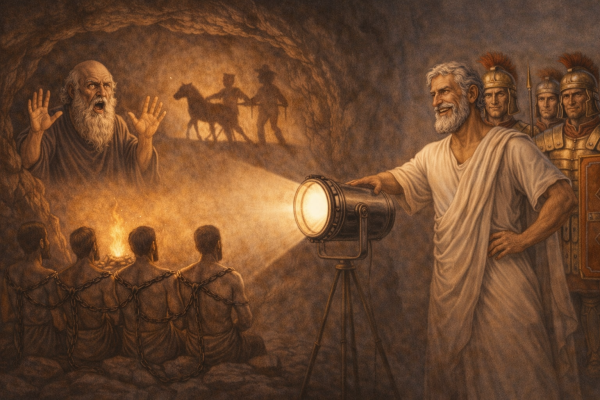
To understand what Epicurus was doing, it is necessary to understand what he was refuting. Plato argued that the objects of genuine knowledge must be eternal and unchanging — what he called the Forms or Ideas. The Form of Beauty is not any particular beautiful thing, which fades and alters and one day ceases to be beautiful. The Form of Justice is not any particular just arrangement, which varies across cities and changes as circumstances change. The Forms are perfect, timeless archetypes of which particular things are merely imperfect, temporary instances. The philosopher’s task is to turn away from the unreliable reports of the senses and ascend, through dialectic and pure reason, to intellectual contemplation of these eternal originals.
The implications of this framework are enormously consequential and dangerous. If only the eternal is fully real, then the natural world of change and sensation is demoted. If truth is accessible only through pure reason operating independently of the senses, then the senses are at best unreliable guides and at worst active sources of error. If justice and goodness are eternal Forms rather than practical arrangements serving real human needs, then ethics becomes the attempt to conform to timeless absolutes rather than to reason contextually about the flourishing of actual humans. And if the soul’s highest activity is contemplation of the eternal, then the body, with its pleasures and pains and desires, is an obstacle to philosophy rather than its natural foundation.
Epicurus recognized this structure and rejected it completely — not as a minority opinion or an alternative interpretation, but as a fundamental error about the nature of reality that made living well impossible. His entire philosophy can be read as an answer to Plato: a systematic account of what is real, how we know it, and how we live well in light of that knowledge — without any appeal to eternal Forms or supernatural gods, without any higher faculty beyond what Nature has given us, and without any demotion of the sensory world in which we actually live.
The Three Criteria: Nature’s Own Tests for Truth
Epicurus did not merely reject Platonic epistemology. He replaced it with a positive and carefully worked out account of how genuine knowledge is possible. This account rests on what the Epicureans called the Canon — the three criteria of truth that Nature itself provides to every living creature.
The first criterion is sensation. Every sense report is true in the sense that it accurately conveys what is happening at the sense organ at the moment of contact. The eye reports light striking it. The hand reports pressure. The tongue reports chemical contact. These reports, taken as reports of what is occurring at the organ itself, never lie — because they involve no act of judgment or interpretation. Error enters only when the mind adds its own contribution: when we leap from “I see something small and round in the distance” to “that is a small round thing,” when in fact the object is later found through additional evidence to be large and far away. The sensation was accurate; the inference was hasty. The cure for error is therefore not to distrust the senses but to accumulate more and better sensory evidence, to check reports against each other, and to be careful about what we infer from them.
This is a profound philosophical move. The entire Platonic tradition on which most of Western philosophy is built depends on the premise that the senses are fundamentally unreliable — that they give us only opinion (doxa), not knowledge (episteme). Epicurus denies this premise directly. Sensation is not the problem; hasty judgment about sensation is the problem. The senses are not a prison from which reason must escape. They are the foundation on which all genuine knowledge must be built.
The second criterion is the anticipations (prolepseis in Greek). An anticipation is a pre-conceptual pattern that the mind builds up through repeated sensory experience. When you have encountered dogs many times, your mind forms a general expectation — a recognition template — that allows you to immediately categorize a new animal as a dog before you have consciously analyzed its features. This is not the same as Plato’s innate Forms, which are eternal archetypes present in the soul from birth and remembered through philosophical recollection. Epicurean anticipations are built up from actual experience. They are natural, empirically formed, and revisable in light of further experience. They are the mind’s practical intelligence working with the materials nature provides, not a window onto a higher world.
The anticipation of “dog” is formed by encounters with actual dogs. The anticipation of “justice” is formed through repeated experience of social arrangements that benefit or harm real people. The Epicurean is therefore not committed to saying that justice is purely arbitrary or merely conventional. The anticipation of justice is real and shared precisely because human beings have the same nature, the same needs, and the same experiences of benefit and harm. But it is not a Platonic Form. It is a natural pattern formed by natural creatures through natural experience — and it is revisable when the facts demand it.
The third criterion is the feelings of pleasure and pain. Nature has equipped every living creature with two and only two fundamental feelings: pleasure and pain. These are not merely subjective reactions without cognitive significance. They are evaluative signals that Nature itself has built into living creatures to guide them toward what benefits and away from what harms them. Pleasure signals that something is congenial to our nature. Pain signals that something is working against it. These signals are reliable — not because they always tell us what is good in some abstract metaphysical sense, but because they are Nature’s own method of communicating with the creatures she has made.
This is why Epicurus says that pleasure is “the beginning and end of the blessed life” — not as a statement of momentary physical stimulation, but as a philosophical claim about the nature of value. If you want to know what is genuinely good for a human being, ask what genuinely brings more pleasure than pain when all aspects are considered. If you want to know what is genuinely harmful, ask what produces more pain than pleasure. You do not need to consult an eternal Form of the Good, a divine command, or a categorical imperative generated by pure reason. Nature has already given you the measuring instrument. The task is to use it carefully, taking into account all relevant pleasures and pains, present and future, bodily and mental — and this is precisely what Epicurean practical wisdom (phronesis) does.
What This Means for “Truth” and “Reality”
The implications of the Epicurean Canon for questions of truth and reality are direct and consequential.
Reality, for Epicurus, is not stratified. There is no “true world” behind the world of experience, no higher domain of being that the senses cannot reach and only pure reason can access. The universe consists of matter and void. Matter exists in the form of atoms combining and separating to form the things we experience. Everything that exists — every rock, every animal, every thought, every pleasure, every city — is a product of atomic combination and therefore subject to change, growth, and dissolution. There is no exception to this. Not the soul, not the gods, not justice, not beauty.
This means that change is not a mark against reality. A flower is no less real for being temporary. A pleasure is no less genuine for being brief. A just law is no less valid for being revisable when circumstances change. The assumption that what is real must be eternal — that temporariness is a form of inferiority or unreality — is precisely the Platonic error that Epicurus identified and attacked. The world of becoming is not a shadow world. It is the only world, and its impermanence is not a defect but simply what the natural world is.
Truth, accordingly, is not a matter of correspondence to eternal Forms but of accurate and well-reasoned contact with the natural world through the faculties Nature has given us. A belief is true when it is confirmed by repeated experience through sensation, consistent with our accumulated anticipations, and when it is not contradicted by other well-established sensory evidence. This confirmation process is the standard for empirical knowledge: not “absolute” certainty in the rationalist sense, not access to a higher realm, but convergent, reliable contact with what actually exists and acts.
This framework also explains why Epicurus insisted that natural science — the study of the physical universe — is the necessary foundation of ethics. If you want to know how to live, you must first know what kind of thing you are and what kind of world you live in. A being with an immortal soul inhabiting a universe governed by divine providence should live one way. A mortal creature of atoms in an infinite natural universe should live quite differently. You cannot get the ethics right until you get the physics right. And you cannot get the physics right by consulting eternal Forms rather than the world itself.
An Illustration: Nietzsche Fighting The Same Battle, Two Millennia Later
It is not an accident that Friedrich Nietzsche, one of the 19th century’s most powerful critic of the same Platonic tradition Epicurus had attacked, identified Epicurus as a kindred spirit. In Twilight of the Idols, Nietzsche traces what he calls “How the True World Finally Became a Fable” — a six-step history of the error that began with Plato’s invention of the “true world” of eternal Forms and culminated in the abolition of that fiction. His language is direct: “The true world — we have abolished it. What world has remained? The apparent one perhaps? But no! With the true world we have also abolished the apparent one.” The distinction itself was always false, Nietzsche argues. There is only the world — the world of becoming, of the senses, of life.
This is precisely what Epicurus had argued more than two thousand years earlier: not that the sensory world is “merely apparent” in contrast to a higher reality, but that the distinction between a “true world” and an “apparent world” is itself a philosophical fabrication with no basis in nature. There is only the natural world, known through natural means.
In The Antichrist, Nietzsche makes the parallel explicit. What he calls the “chandala values” of Platonism and Christianity — the demotion of the body, the denigration of pleasure, the elevation of an imaginary “true world” over the only world that exists — are for him symptoms of a philosophy in the service of life-denial. Against this, he consistently invokes Epicurus as the philosopher who said yes to the world as it actually is. In his private notebooks and in The Gay Science, Nietzsche returns repeatedly to Epicurus as a philosopher of natural existence — one who found in the actual world of sensation and friendship and intellectual pleasure sufficient ground for genuine happiness, without recourse to any fiction of the eternal.
On the specific question of the senses, Nietzsche is unambiguous. In Twilight of the Idols he writes that what the Platonic tradition calls the “testimony of the senses” is falsified not by the senses themselves but by reason adding what the senses do not contain: permanence, substance, thingness. “The senses do not lie,” Nietzsche writes. “What we make of their testimony, that alone introduces lies.” This is almost word-for-word the Epicurean position. The senses report accurately; the error enters in the mind’s interpretation. The cure is not to flee the senses but to discipline the reasoning that works with their reports.
Both thinkers agree, further, that the concept of “being” as opposed to “becoming” — the idea that what is truly real must be static and unchanging — is not a discovery but a grammatical and cultural habit projected onto the world. Nietzsche traces it to the structure of language, which forces us to posit subjects behind actions, things behind processes. Epicurus traces it to the false cosmologies that posit eternal divine beings and ideal Forms behind the natural processes physics reveals. The conclusion is the same: the world of becoming — the world that grows and changes and dies — is not deficient reality. It is reality.
The Significance for How We Live
The philosophical stakes of these epistemological questions are not academic. They determine how we live.
If truth requires eternity and reality requires permanence, then genuine knowledge and genuine value are inaccessible to ordinary human beings in ordinary human life. The philosopher must turn away from the senses, suppress the body, ascend through reason or revelation to something beyond the natural world. And from that elevation, everything natural — pleasure, change, the particular joys of particular friendships, the beauty of things that do not last — looks diminished, secondary, suspect.
If, on the other hand, the senses, anticipations, and feelings that Nature has given us are genuine and sufficient tests of what is true and real, then everything changes. Knowledge is possible. Happiness is achievable. The good life is not a philosophical ideal to be approached asymptotically through renunciation of the natural — it is a practical project available to real human beings in the natural world, pursued through honest reasoning about the pleasures and pains that Nature itself uses to communicate with its creatures.
The flower is real. The friendship is real. The pleasure of understanding something truly, or of sitting with a friend, or of seeing clearly what the universe actually is — these are real. They do not become more real by lasting forever. They do not become less real by being temporary. To be true and real does not require being eternally the same.
This is what Epicurus taught. It is what Nietzsche, arriving by a different road through a very different century, confirmed. And it remains, against the whole weight of the Western philosophical and theological tradition that tried to replace it, the most honest account of what it means to be a natural creature seeking to live well in a natural world.
Comments 1