

There Is No Necessity To Live Under the Control Of Necessity
-
Cassius -
August 25, 2026 at 8:15 AM -
- Physics - General
-
226 Views -
0 Comments
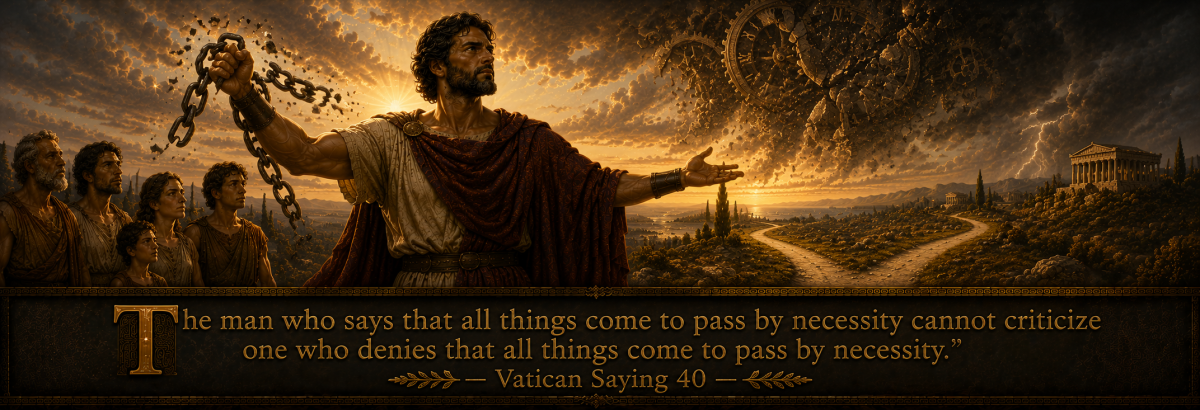
There Is No Necessity To Live Under the Control Of Necessity
During the brief span of life that is available to us there are no supernatural commandments to follow, and it is necessary for us to act wisely to identify the best life available to us. Therefore Epicurus held that there could be nothing more demoralizing than to think that we have no power over our actions and our future.
Epicurus therefore singled out two belief systems as particularly false and harmful. The first falsehood is "Determinism" — the view that due to fate, supernatural forces, or even a purely mechanistic understanding of the nature of atoms, we have no control whatsoever over our lives. Epicurus realized that Determinism is not only damaging, but demonstrably false. Against such mechanistic views of the universe Epicurus advanced not only the physics of "the swerve of the atom," but he also pointed out the self-contradictory nature of Determinism.
Epicurus, Vatican Saying 40
The man who says that all things come to pass by necessity cannot criticize one who denies that all things come to pass by necessity: for he admits that this too happens of necessity.
And as a practical matter, Epicurus pointed out that we do clearly have control over the supreme choice in life: we have the ability to end our lives at any time, so nothing can compel us to continue to live under necessity. Epicurus held that if we have the power to make this most important decision in life, we also have the power to control many other lesser aspects of life.
Epicurus
For, indeed, it were better to follow the myths about the gods than to become a slave to the destiny of the natural philosophers: for the former suggests a hope of placating the gods by worship, whereas the latter involves a necessity which knows no placation.
Full Podcast Transcript: Episode 257 - There Is No Necessity To Live Under Necessity - Part 1
Lucretius Today Podcast — discussion thread
Cassius: Welcome to episode 257 of Lucretius Today. This is a podcast dedicated to Lucretius, who wrote On the Nature of Things, the most complete presentation of Epicurean philosophy left to us from the ancient world. Each week we walk you through the Epicurean text and we discuss how Epicurean philosophy can apply to you today. If you find the Epicurean worldview attractive, we invite you to join us in the study of Epicurus at EpicureanFriends.com, where we have a thread to discuss this and all of our podcast episodes.
Last week we had a special episode devoted to the discussion of the Epicurean gods and whether Epicurus held them to be real or thought constructs or some combination of the two, and that episode served as sort of a cap for our discussion of Book One of Cicero's On the Nature of the Gods. Just like when we went through Cicero's On Ends — where we stayed with the Epicurean section, not only the positive section presented by the Epicurean speaker but also the first initial response to it given by Cicero — we did that in On Ends in regard to ethics. We've now done that in On the Nature of the Gods in regard to the Epicurean view of gods and divinity. And rather than continue on to hear the Stoic and Academic Skeptic viewpoints, we're going to go back to a more general level of general questions about Epicurean philosophy that are of daily concern to the majority of people who study Epicurus and take it seriously, much as we have it presented on the EpicureanFriends forum.
On the first page of the forum, we have a list of key doctrines of Epicurus that we've seen over the years are of continuous interest to people who are studying Epicurus. What we've done is pull out some of the most controversial, the most directly applicable issues in Epicurean philosophy to highlight how Epicurean philosophy is different from Stoicism and other philosophies of the Greek and non-Greek worlds.
Epicurus's view of the gods is of course one of the most controversial doctrines that he's known for, and we've now covered that. We'll now go through the rest of the list that we've put together, with this week being devoted to another of his doctrines that people who are initially attracted to Epicurus for his ethical views sometimes find difficult to accept. This week will be devoted to the question of fate — or necessity, or determinism — which Epicurus was known for, again in the ancient world, for taking an unconventional viewpoint. The majority of other Greek philosophers took a standard approach: that the universe either has a supernatural God over it or is an intelligent entity itself, and that everything that happens takes place because of some kind of design — that everything that happens is preordained, determined, or fated to happen. With that being the conventional view of most of the other Greek philosophers of Epicurus's time, and even today being a majority view in many areas, people often are surprised to find that Epicurus took a view against that, which takes explanation and discussion to understand.
We picked the necessity argument to go through first because what we've been doing in recent months is using Cicero's reviews of classical philosophy as a basis for our discussions — using Cicero's On Ends for ethics, On the Nature of the Gods for the gods. And in turn, we can now refer to Cicero's On Fate for the discussion of necessity. But again, rather than go through a single text in a lot of detail, what we're going to do today is stay at a higher level and discuss the issues from a very practical point of view. Necessity and determinism being an issue that very often turns people off when they start studying it, because it becomes so technical that it appears to be a word game in the hands of many people who discuss it. People simply want to know a general answer to a general question without feeling like they have to be experts in philosophy in order to understand what the issue is even about.
As we go through this issue today and similar high-level issues in coming weeks, that's something that we have to wrestle with ourselves as we present this in our podcast. None of us have read each and every one of the ancient authorities — or modern authorities either, for that matter — and so we're not by any means ultimate experts on all of the different arguments that people can make. And yet we, being ordinary people like our listeners, have a need to live our lives and apply Epicurean philosophy in a way that's productive every day that goes by. We don't have the time and the ability to read everything that's out there on all of these issues, and so we just simply have to do the best we can — and that's what we're going to be doing in this and coming episodes.
In fact, stating the problem that way is a part of the philosophical issue that's involved in the discussion of necessity. One of the books that I'm hoping we'll be able to devote some time to in the future — in addition to Cicero's On Fate — is Cicero's Academica. The reason that work is of particular interest is that the part of it that survives starts out by giving us a very general introduction to the principles of Socrates and how they developed in the generations after Socrates — through Plato, through Aristotle, through the Stoics in different directions, but largely staying consistent to the Socratic core. One of the hearts of that core was Socrates's position that the only thing he was really sure of was that he didn't know anything.
The criticism that can be made — and that Cicero did make in his essay on academic questions — is: how do you know that what you're saying is right? This is a topic that we discussed last week in terms of prolepsis and the problem posed by Plato in his Meno dialogue, which Plato resolved by saying that we know something to be true when we remember it from a past life. Cicero said in his Academica about others: "For as to their assertion that the teacher whom they judge to have been a wise man commands their absolute trust — I would agree to that if to make that judgment could actually have lain within the power of unlearned novices." And then he says: "For to decide who is a wise man seems to be a task that specially requires a wise man to undertake it." In other words, you've got a regression problem: unless you are already wise, it is very difficult — or impossible in fact — for you to judge that a person that you're listening to is wise. But if you're already wise, where did that knowledge come from?
Cicero argues: "But granting that it lay within their power for a novice to pass judgment on who is wise, it was only possible for them after hearing all the facts and ascertaining the views of all the other schools as well, whereas they gave their verdict after a single hearing of the case and enrolled themselves under the authority of a single master." The point there — which is similar to a point that Lucian makes in his Hermotimus dialogue — is that from a logical point of view, unless you have read all of the authorities, unless you have covered all the arguments, can you really say with confidence that you have considered everything and come to a conclusion that incorporates all the possible objections? Logically speaking, of course, you can't. If you have not taken the time to read all of the sources, then there's going to be some doubt in your mind about whether you have incorporated all of the issues in your conclusion or not.
Again, though, that takes us back to the question that we have to live today. We cannot postpone the decisions that have to be made until we have time to read all the arguments of every philosopher who's ever lived. One way that people in most of the other schools in Epicurus's time — and even today — deal with that kind of a question of having to live today even though they haven't got all of the experience and knowledge they'd like to have, is that they take the position that things that happen in the world are fated, or are necessary, or are determined ahead of time.
And that's why questions like necessity remain important to us today. Even though many people in educated circles no longer follow the traditional Abrahamic religion viewpoints and consider the idea that there is some supernatural God controlling everything that happens to be obsolete, there is still a prevailing view that even in the absence of a supernatural God, there are other forces which limit us in what we can and cannot do — which is of course an obvious point. Even under Epicurean philosophy, we do not have the ability to live forever; we do not have the ability to defeat death. There are many things that we are limited in doing, and in the Epicurean worldview, even though there are no supernatural commandments, no ideal forms, no absolute notions of virtue, there are still decisions that have to be made about how we're going to live our lives in the time that we have.
And that leads us to this threshold question: do we have any control over the things that we do in our lives, or is everything subject to forces which are beyond our control? So as we discuss necessity today, again, it's a continuing question that is not just of historical interest, because this issue of fate can be a major psychological problem for many people who feel like they're helpless and therefore develop anxiety and pain just because they think that there's nothing they can do to control or influence any aspect of their future. That kind of an idea leads people to basically throw up their hands and do nothing to attempt to take charge of their own lives or to influence their own future. And it creates conditions in which many people just simply give up trying, and in default of trying themselves, they end up accepting what other people tell them to do — without thinking that if they themselves have no control over their own willpower, then these other people also are in the same boat that they are.
And so the idea that Epicurus was addressing when he confronted the consensus of Plato and Socrates and Aristotle and the Stoics — the people who were leading into Stoicism in his time — was the consensus that there was a fate that controlled the future and controlled everything that everybody does, that controls even the gods. When Epicurus saw that this was the prevailing notion, he rebelled against it, despite the fact that it was so deeply embedded into the culture and the religions and the philosophies of his time. And that's the situation that I think we still find ourselves in today.
Joshua: Fate in the ancient world was one of the bedrock cultural assumptions of most of the ancient people around the Mediterranean, and we find the cultural expression of their belief in fate all over the place. Perhaps the most obvious example would be the oracles — the oracles of Delphi and Dodona — because when you consult an oracle, what you're really trying to do is shine some light on a map that you can only see backwards. But the map is already drawn, and the oracle is merely there to reveal information about what's on that map, because that's the ground that's right in front of you — the ground that you're going to be walking through, but you can't see it forward as you're walking through it. And we know from Lucian's essay on Alexander the Oracle Monger that these oracles were enormously popular, to the extent that even Marcus Aurelius himself, the emperor of Rome, sent a delegation to consult the oracle in his name regarding an important battle.
But to me, the expression of this foundational aspect of Greek culture is in looking at the epics of Homer — the Iliad and the Odyssey — and then looking at the epic of Virgil, the Aeneid. And what we find in these epic poems is that not only are humans bound by fate, not only are humans bound by destiny, but the gods themselves have no power to countermand the edicts of fate — they have no power to prevent what is fated from happening.
One of the more interesting prophecies leading up to the Trojan War, described in the Iliad, is a prophecy concerning the mother of Achilles, who was a Nereid named Thetis. It was prophesied by Prometheus — this Titan, whose name means "foresight" — that any son born to her would be greater than his father. And this presented a huge problem, because as we know, the Greek gods often fathered children by other kinds of beings, including Nereids and nymphs or the other Olympians. The idea that Zeus might accidentally have a son by Thetis, and that that son would grow to be stronger than Zeus and overthrow him in exactly the same way that Zeus overthrew his father Kronos — who in turn had overthrown his father Ouranos — was a terrifying prospect for an Olympian god. This would mean the end of the reign of the gods. And so they have to be very careful to stay away from this woman.
And so when a hero named Peleus caught her eye while he was on the journey with Jason — the Argonautica, it's a very famous story, the most well-known telling I think is by Apollonius of Rhodes — while he's on that journey, he looks into the water and Thetis catches his eye. And then later he's training under the centaur Chiron, who is sort of a mentor to heroes in these stories, and he's still thinking about this Nereid that he saw so many years ago. And Chiron says, "well, she happens to be my cousin — I can probably find her." They meet, and eventually they marry. And this is very pleasing to the gods, because now they know she's off limits and Zeus doesn't have to worry about fathering a son by her who will be stronger than him. Of course, the son that does get fathered by Peleus is Achilles — and Achilles goes on in the Trojan War to become the greatest hero of the age.
The second prophecy concerning Achilles was that if he went to Troy, he would die there, but his name would live forever. If he didn't go to Troy, he would live a long life, he would father many children, he would have many grandchildren, but soon after his death, his name would die with him.
And so wrapped up into this idea of fate, you now have the idea of fama — reputation — and the idea of the search for fame among these heroes, because it was this search for fame that would ultimately lead to them being sorted off into the happy isles in the underworld rather than into the place where everybody else goes. And that is very famous among literary sources all the way up through today.
Anyway, to make a long story short here — Achilles, greater than his father, prophesied to have victory at Troy. It was prophesied by Nestor to Agamemnon that they could not take Troy without Achilles — even though Agamemnon and Achilles didn't get along and he didn't really want him. Achilles eventually — after the death of Patroclus — has a new suit of armor made by Hephaestus himself, dons it, and in a duel with Hector he kills him. And this is about where the story of the Iliad ends. After the events of the Iliad, they go through this whole business of building the Trojan horse and pretending to flee, but actually they come back and finally they do conquer the city. Achilles is shot in the heel and he dies. You have the story of Odysseus, who is fated, prophesied to be delayed in getting home by ten years. And the whole story of the Odyssey is a story of all of the absurd and ridiculous events that have to happen in order for him to be delayed from getting home for ten years.
And you might think that that was the end of the story, but Virgil — writing in the late first century BC and the early first century AD — is now trying to tap into fate as a cornerstone of Greek and now Roman culture. He's trying to tap into fate and the idea that Rome will be a great power. Now of course, at the time Rome was already a great power. It didn't have as much land as it would go on to control under Trajan and Hadrian, but it was already a great power. So he's sort of rewriting the history of Rome and plugging it in — and he wasn't the first to do this — plugging it into this story of fate as it came down through Homer, through the Iliad and the Odyssey.
And in Book Five of the Aeneid, we have Venus offering a prayer to Neptune trying to get Neptune to intervene, to provide safe passage for Aeneas and his crew to get to the Tiber so they can found the city of Rome. And this is what she says:
"Stern Juno's wrath and breast implacable compel me, Neptune, to abase my pride in lowly supplication. Lapse of days, nor prayers nor virtues her hard heart subdue — nor Jove's command." Even Jupiter cannot command another god to change their mind about something — this is one of the rules of the magic of the gods. "Nor will she rest or yield at Fate's decree."
Well, this is different — the gods themselves are powerless before fate. So even though Venus is saying here to Neptune that Juno will not rest or yield at fate's decree, we know — because we know that fate is infallible in these stories — that Juno is ultimately going to lose that argument. But Venus is trying to do a workaround here by getting Neptune to open up a sea lane so that Aeneas and his crew can get to the Tiber. And she continues:
"Her execrable grudge is still unfed, although she did consume the Trojan city, Jove's mid-most throne, and though she has accomplished stroke on stroke of retribution. But she now pursues the remnant" — this last group or ship or crew of Trojan nobility trying to make a life for themselves elsewhere — "the ashes and bare bones of perished Ilium," Ilium being Troy. And she goes on to say, "behold, but now goading to evil deeds the Trojan dames" — she basically burned his ships — "he in strange lands must leave the crew of his lost fleet behind. Oh, I entreat thee, Neptune — let the remnant sail in safety o'er the sea, and end their way in Tiber's holy stream, if this my prayer be lawful and that city's rampart proud be still what Fate intends."
This one scene in the fifth book of the Aeneid tells a whole story about how fate works in these myths and legends — and to the extent that one Olympian god has to supplicate another Olympian god in order to find a way to, number one, get around what a third Olympian god has intended, but also to ensure that what fate has decreed is carried out. And Venus, of course, goes on to be the patron goddess not just of Rome, but also of Julius Caesar and his family, who was thought to have been descended from Aeneas.
And of course, she figures centrally as a feature in Lucretius's prologue to Book One, the Invocation to Venus. Okay, that probably went on a little longer than I intended to. But that sets up the story of fate in the ancient world. We see it in drama — you see it in the Oedipus cycle, the Theban plays. You see it in the story of Jason and the Argonauts. All of these stories from the ancient world are crossed by destiny, they're crossed by fate, and what fate decrees, no one — not even Zeus himself — has the power to countermand. And certainly humans have no power to countermand it.
And one of the themes of fate in all of these stories is that the more you try to avoid it, the more you run right into its arms. This comes from W. Somerset Maugham — I think was his name — he was an English writer and he wrote a story called "Appointment in Samarra." There was a rich man who sent his servant into town to the market to buy provisions. And when the servant returned, he had this horrified look on his face and he didn't have the provisions. And so the master of the house asked him what had happened at the market, and the servant said he was buying provisions in the market and he turned around and he saw the face of Death itself. And the master, reading this as a bad omen, puts the servant on his fastest horse and sends him to the far-off town of Samarra. And then the master himself goes back to the marketplace to confront Death. And when he gets there, he finds Death in the marketplace and he says to Death, "what are you doing — you're scaring my servant." And Death says to him, "it wasn't my intention to scare him. I was just surprised to see him here, because I have an appointment with him tomorrow in the far-off town of Samarra."
That's how these stories normally go. And the Oedipus cycle works very similarly — you have two prophecies, one for the parents of Oedipus and one for Oedipus himself. Both of them — principally Oedipus and his father — try to avoid the horrible prophecy. The prophecy was: Oedipus will kill his father and marry his mother. And so in both of them trying to avoid the prophecy, they end up running into a scenario where it gets fulfilled.
Because Oedipus was exposed — which is a method of getting rid of unwanted children in the ancient world, leaving them out in nature to die of exposure or predation, a very horrifying practice. Oedipus gets his name from his swollen feet because stakes were driven through his feet to stake him to the ground on the side of a mountain. But as these stories usually go, he was found by a shepherd and taken to another king and queen of another city-state. And that's how he grows up thinking that those two are his parents, but they're not. And then he goes on a journey to get away from them so that the prophecy doesn't get fulfilled. Ends up going to what he doesn't know is his original hometown, kills the Sphinx, he's the savior of the people, he's presented to the palace, and he gets there and the woman who is ruling the city tells him that her husband died a few months ago. And so they get married — Oedipus and the queen — and then he finds out that on his road to this city, he had killed his father who was the king of the city, and now he's married to his mother.
And the way the story gradually unfolds, it's meant to horrify you, it's meant to disturb you — because the queen ends up killing herself, she goes into a back room off the stage and ends her own life, and Oedipus ends up gouging his own eyes out. So a lot of these stories are quite horrifying when it comes to the question of fate, because it is kind of a horror story. Some things that are beyond your control — you are caught in a very real web and you have no hope. That's the main theme: there's no hope of escaping.
Cassius: Okay, Joshua. So that helps us set the stage for the Greek mythology background. We probably don't need to go into a long discussion of Judeo-Christian, Abrahamic-type religions and viewpoints about fate involved in that source. What I think about is predestination and John Calvin and views within the church about how everything has been happening as it was set in motion from the beginning of time.
Joshua: I made the point at the beginning of my earlier discussion about prophecy — and again, with prophecy, you're trying to reveal a future that has already been fated to exist. And to some extent this is kind of a difference I see in the Old Testament versus the New Testament, but I'm sure that any Christian theologian would dispute everything I'm about to say. But what I see in some of these stories — particularly in the way that the coming of Jesus is said to have been prophesied in the earlier books, the way in which the coming of Jesus is claimed to have been prophesied already in the Old Testament — it kind of taps into this broader culture around the Mediterranean at the time, which is: you go to prophets and oracles because they've been given the power of foresight, they've been given the power to reveal the path that is already in front of you. You just don't know it.
And so what I see Christianity doing in that respect is essentially kind of trying to have it both ways. You have prophecy, which to me implies some level of fate — some level of "things are already determined, God has a plan" and so forth. But they coupled this with a sort of radical view of free will: you are responsible not only for your own sin, but for this heritage of sin that started with Adam. And what you need to do now is believe the claims of the gospels — apparently absurd though they may be — in order to secure an eternity of bliss beyond the grave. And the alternative, of course, is an eternity of pain and torment and punishment beyond the grave. And so in making free will a central part of Christian theology, you kind of see that fate has a diminished role compared to the role that it has among the Greeks and the Romans. You do have schools like John Calvin's, but even with that, you'll go on the internet and see people trying to explain every inch of predestination or double predestination out of his theology while still holding to the doctrine themselves. So I find that a very difficult and thorny question.
Cassius: Logically, it would seem to me that you can't predict the future unless there's some force of fate or necessity that's bringing it into effect — the two seem to go hand in hand. Which is why Cicero had a separate work on divination along with his work on fate, because they do seem to go hand in hand. And so in addition to what you're talking about there, Joshua, in terms of the major religions that still are influential today, you've got people who believe in astrology, who think that the stars have an influence over the future.
Going back to the Roman and Greek periods, we have Cicero in On Fate saying: "Hints — if, while it is consistent for the Stoics who say that all things happen by fate to accept oracles of this sort and all the other things connected with divination, yet the same position cannot be held by those who say that the things which are going to happen in the future have been true from all eternity. Observe that their case is not the same as that of the Stoics, for their position is more limited and narrow."
So we have this idea of a force of fate or necessity embedded within Greek culture from the Homeric myths and the other aspects of mythology that we're familiar with from the Greek world. Those were carried into the philosophies of the time through this idea that the elements which make up everything that we see around us are not themselves the source of what happens, but that there is an external force that acts on the elements to cause things to happen. Cicero said it this way in his Academica: "And since the force that we have called quality moves in this manner, and since it vibrates to and fro, they think that the whole of matter also is of itself in a state of complete change throughout and is made into things which they term 'qualified,' out of which in the concrete whole of substance a continuum united with its parts has been produced. One world, outside of which there is no portion of matter and no body, while all the things that are in the world are parts of it, held together by a sentient being in which perfect reason is imminent and which is immutable and eternal since nothing stronger exists to cause it to perish. And this force they say is the soul of the world, and is also perfect intelligence and wisdom, which is entitled God and is a sort of providence knowing the things that fall within its province, governing especially the heavenly bodies and then those things on earth that concern mankind. And this force they also sometimes call necessity, because nothing can happen otherwise than has been ordained by it under a fated and unchangeable concatenation of everlasting order, although they sometimes also term it fortune because many of its operations are unforeseen and unexpected by us on account of their obscurity and our ignorance of the causes."
So that's sort of a summary of the standard position that all of the other Greeks were holding — including also Democritus, Heraclitus, Empedocles, and Aristotle according to Cicero's On Fate. So again, the philosophical and religious consensus of Epicurus's time was that there was an overriding force of fate or necessity — we call it today determinism, but whatever word you use to describe it — that there is a force that sweeps us along as if we're caught in a flood of a river, against which we have no ability to fight. Perhaps we could influence our mind's attitude towards these events — and that seems to be the direction that the Stoics went in, thinking that we have some control over our assent, the way we deal with and think about things that happen to us. But the general overriding point of all of this is that under the standard philosophical positions, God or necessity controls what is going to happen, and we are not in control over our lives.
Epicurus, on the other hand, rejected that, along with the whole framework of the nature of the universe. And that rejection came through Epicurus's adoption and then modification of the atomic theory from Democritus and Leucippus. While Democritus and Leucippus had been Atomists, they had also been determinists — taking the position that the atoms move mechanically and that there is no way to break out of the mechanical back-and-forth type of actions of the atoms. One of Epicurus's most distinctive doctrines is to reject that point of view and say that there is a swerve of the atom — the clinamen — which allows at least intelligent beings to break free of this source of necessity.
And so Epicurus says in his Letter to Menoeceus at line 133: "For indeed, who thinks he was a better man than he who holds reverent opinions concerning the gods, and is at all times free from fear of death, and has reasoned out the end ordained by nature? He understands that the limit of good things is easy to fulfill and easy to attain, whereas the course of ills is either short in time or slight in pain. He laughs at destiny, whom some have introduced as the mistress of all things — as a scholion has it, it is recorded. He thinks that with us lies the chief power in determining events, some of which happen by necessity and some by chance and some are within our control. For while necessity cannot be called to account, he sees that chance is inconstant, but that which is in our control is subject to no master, and to it are naturally attached praise and blame."
Now, that section I just quoted is a combination of what Epicurus said versus a scholion that has been attached to it over the intervening years, but there's a lot of evidence that this is what Epicurus's position was.
Some things are caused by necessity, but not everything — and that's really the big distinction that has to be thought about. Those who advocate determinism and necessity in its truest form are taking the position that everything happens by necessity. Epicurus is not taking the position that nothing happens by necessity, because he readily admits that some things do happen by necessity. But he also says that some things are not caused by necessity, and here we can begin to deal with a common issue that's brought up in many of these discussions about necessity.
When you go to YouTube, when you go read common discussions, you'll find that the issue is often framed as all or nothing. Those who advocate determinism are absolutist in taking the position that everything happens by necessity. In arguing against the other position, those determinists will frequently caricature Epicurus's position as calling it "free will" — as if everything is open to our control. That of course is not Epicurus's position. Everything is not open to our control. We cannot live forever — so death is an example of something that clearly, within Epicurean philosophy, is beyond our ability to control. Epicurus talks in his Letter to Herodotus that there are many things about the way the universe operates that were set in motion from the beginning, when the worlds were first created, and that those things do happen mechanically. So in contrasting the Epicurean position to the standard determinist position, it's not an all-or-nothing proposition.
In responding to the determinist, Epicurus is not saying "I disagree with you. You're saying that everything happens by necessity. I'm saying that nothing happens by necessity." That is not Epicurus's position. Epicurus is saying: "You're wrong, determinist, in saying that everything happens by necessity, because there are in fact some things that do not happen by necessity. And in fact some things are under our control, and some things are purely accidental. But you're wrong in saying that everything happens of necessity."
Joshua: Yeah. What I connect this to — and what I'm thinking of right now, at least — is: you used to go to the mall and there would be this big cylinder, and on the top of it there was a dish that funneled into a hole at the bottom, and you would put a coin into a track and it would roll down and it would just circle the hole for quite a while, but eventually we know it's going into that hole, right?
When Epicurus, in the Letter to Herodotus, starts talking about the heavenly bodies: "Their turnings and eclipses and risings and settings and kindred phenomena to these — we must not think that these are due to any being who controls and ordains or has ordained them and at the same time enjoys perfect bliss together with immortality, nor again must we believe that they, which are but fire agglomerated in a mass, possess blessedness and voluntarily take upon themselves these movements."
And then he goes into his discussion of the gods and then he concludes this way. He says: "Therefore, we must believe that it is due to the original inclusion of matter in such conglomeration during the birth process of the world that this law of regular succession is also brought about."
When I think back to those gravity-well coin-donation machines, we can say that things like that happen in nature because they're following a few basic laws of physics. What we don't have — and what we shouldn't make — is an analogy to human life and say that just like the coin and the gravity well, human life unbeknownst to us follows the same kind of course, that we're just going around in circles not realizing that we are ultimately fated to arrive at a specific place, like the coin falling into the hole. That would be a mistaken view of human life.
I think Epicurus is a very careful thinker on this point when he says some things happen by chance, some things by necessity, and some things happen out of our own free will. You can ascribe it to the clinamen of the atoms, as Lucretius does, but however it comes about, there is a distinction — and we should not erase the distinction between mere mass in nature, the atoms themselves and their movements. We should not erase the distinction between the movements and the behavior of the atoms, and of the compound bodies that are made of atoms, in response to gravity, inertia, friction, and so forth. We should not erase the distinction between that and human life. Human life for Epicurus was not subjected to fate or predestination or determinism in the same way that some aspects of nature are merely mechanical.
Cassius: Yeah, so where we are currently in our discussion is that Epicurus makes clear in his Letter to Menoeceus: some things happen by chance, some things happen by necessity, and some things happen because it is within our control that it does. That is the basic Epicurean position. Now, there are many arguments in support of why this is the case, and that's what we'll go through next as we proceed in this discussion.
First of all, as everyone knows, Epicurus held that the universe has no supernatural gods over it. The supernatural God hypothesis, of course, being the primary way in which those who believe in religion and supernatural things maintain that necessity takes place — that it's all been put in motion because of the actions of the gods. Epicurus, in his Letter to Herodotus, said that certainly a perfect being who's enjoying perfect bliss is not going to be managing the details of how many hairs you have on your head and all the different actions of animals and so forth. That's not the way a perfect being is going to spend its time. He made the same statement to Herodotus: that you don't ascribe the regularity of the heavenly bodies to the gods, as that would be burdensome for them to have to attend to. But we should understand that the regularity of the movement of the heavenly bodies should be compared to the way that regular things happen here on earth — you don't jump to the conclusion that there's a divine nature that is controlling those things. As Lucretius says, "nature has no master over her, but always acts of her own will and has no part of any godhead whatsoever."
So the first and most obvious response of an Epicurean to the idea of fate and necessity would be that there's no supernatural force bringing it into effect. Now, what about the question of whether there are non-supernatural forces that bring fate into effect? And that's where we have to go back and deal with Democritus and the Epicurean criticism of Democritus's position — because even though Democritus and Leucippus had been Atomists, they had also been determinists.
Before we get to the explanation of the swerve, which Epicurus deduced in order to deal with Democritus, there's an interesting argument that is also preserved in Lucretius that Dr. David Sedley talks about in an article that's forming the basis of much of our discussion, which is called "Epicurus's Refutation of Determinism." Dr. Sedley points out that it would of course be farfetched to give Epicurus much credit for anticipating 20th-century quantum physics and the Heisenberg uncertainty principle and things that go along with that. But on the other hand, he deserves more admiration than he usually receives for arriving at the possibility of physical indeterminism within Atomism on purely observational grounds during the long reign of Newtonian physics. Only one thinker — C.S. Peirce — had the wisdom to point out that its overwhelming predictive success did not and indeed never could rule out the existence of indeterminism at a level below the range of the most accurate measuring instruments.
Epicurus's insight was a comparably bold one when he reasoned in defense of the swerve that no amount of observation of falling objects' trajectories could establish that they were perfectly rectilinear to any degree of accuracy. Now, that's contained in Lucretius, Book Two, around line 246. But the point is this: even when we think about the billiard-ball model, what we're talking about is that we observe with our eyes the movement of the billiard balls on the table and how they knock against each other and move off in different lines. And we think that when we drop something from a height, it's going to fall straight to the earth. The point is that our eyes are not so accurate that they can really eliminate the possibility that there is some swerving or non-perfectly linear motion involved — in the billiard balls or any other example that you want to come up with. You can say "I observe every time I drop something, it drops straight to the ground, absent wind or some other factor from the outside." But your eyes are not accurate enough to really be sure that what is happening is that they're falling straight to the ground. Lucretius's discussion of the swerve makes clear that the swerve is a very minor motion at no fixed time and no fixed place, and a very minor motion is not something that your eyes are going to be able to detect.
Now, the observation that our eyes can't detect whether there is a swerve or not is not a proof of the swerve, but it's a proof that those who deny the swerve does not exist are not standing on firm ground simply by saying "well, I don't see a swerve."
Let me again state that our discussion from here will be based significantly on points that Dr. Sedley has made in his article. It's very interesting to follow Dr. Sedley's argument on this point, because Dr. Sedley does not believe that the swerve was Epicurus's primary reason for rejecting the claims of determinism. As we know, of course, from the Letter to Menoeceus — the Letter to Menoeceus says nothing about the swerve or the reason for the rejection, even while it firmly rejects necessity. Dr. Sedley's contention is that the swerve was actually developed later, and that Epicurus's primary arguments against determinism are not because of the physical existence of the swerve, but for other reasons that we'll be developing as we go forward in this discussion. And as we compare those other arguments to what we also know from the swerve, I think we'll begin to get a deeper understanding of how all of Epicurus's arguments come together.
We'll reserve the remainder of that argument for our next episode as we conclude next week our discussion of this aspect of determinism. But for today, let's just summarize where we are so far. By emphasizing that this is an extremely important issue for Epicurus — it mirrors Epicurus's rejection of skepticism — but the contention of other philosophers, and the contention of religions, that God or necessity controls everything that happens — or even that atoms alone necessitate everything that happens — is something that would pose an insurmountable obstacle towards your taking action to live happily if in fact it were true. It's therefore necessary to have confidence that it's not true. And Epicurus developed a series of arguments that allow anybody who's concerned about this issue of necessity to have a reasonable and reasoned argument about why they can and should in fact act to take control of their own experiences, to take control of their lives and act to live happily — and not just be swept along by the floods of life.
So what we've discussed today, again: why does this question of fate, necessity, determinism matter? We've pointed out today that it was deeply embedded in the religion, the philosophy, the mythology of the Greek and Roman world. We've also pointed out today that Epicurus rejected it — that he held that not everything is controlled by necessity. What we still have to do is point out the details of additional arguments that Epicurus raised to support his contention that some things are not controlled by necessity. We're aware of the swerve, but there are other aspects and other arguments in addition to simply the existence of the swerve that need to be discussed. But before we close, is there anything else that makes sense to talk about today on what we've discussed so far?
Joshua: So today we've dealt with one aspect of the problem of determinism, which is this idea of a mechanistically determinist, billiard-ball universe — the phrase you used, Cassius. We're going to have to find a way also to deal with modern ideas surrounding this issue, in part because nobody ever thinks, "well, I was trying to go to the grocery store this morning, but due to a series of blows of atoms on my car, I ended up at the McDonald's drive-through instead." Right? Nobody, seriously, I don't think, thinks that happens. Modern theories of determinism are far more sinuous, aren't they? They're far more difficult to get a handle on, and because they're more difficult to get a handle on, they're also more difficult, I think, to refute. Dr. Sedley's article does a very good job of dealing with the problems of determinism that Epicurus is partially solving with the swerve and partially solving with other arguments. And you've introduced a few of them, but these modern theories of determinism I find are more challenging, and so as we go into next week, we're going to have to find some way to deal with that — and that's going to require more reading on my part, I think. So it's a call to action for next week.
Cassius: Joshua, that's a great way of describing the problem, and I think it really encapsulates where Dr. Sedley is coming from with his position and why. Interestingly enough, for those of us who've read a lot of Lucretius and followed the swerve as so much a part of Epicurean philosophy — why I think Dr. Sedley is right that the swerve may have been almost an afterthought for Epicurus in regard to determinism — the more interesting, the more far-reaching arguments are not a matter of thinking about how atoms move. Because as Dr. Sedley points out, you really cannot explain, by thinking that the atoms swerve, how in fact that really brings about any amount of free will. There's always going to be a disconnect between attempting to describe the mechanisms in detail with the final result, which is what we often call the emergent property of the way the atoms are moving. There are truths at both levels, as Dr. Sedley points out.
And Epicurus, it seems, was not primarily focused on the swerve as the explanation for his position. That's where we're going to be going next week, because there are logical and reasonable inconsistencies with the determinist position that are more persuasive in dealing with these arguments than the issue of the swerve. Epicurean philosophy is an optimistic perspective on life in which you can control to a large degree what is going to happen to you. You do have influence. You're not a total plaything of the universe — neither of mechanistic forces, nor of supernatural gods. And Epicurus provides a way of understanding this at a practical level that allows you to go out — even if you've not read every philosopher who's ever talked about determinism — to see that there is a very practical perspective that you can adopt and then follow to make decisions that influence the course of your life and lead you to live more happily than you would if you just decided to be tossed along the riverbed by the onrushing waters.
That's what we'll deal with next week. In the meantime, drop by the forum and let us know if you have any comments or questions about our discussion this week or anything else in regard to Epicurus. As always, thanks for your time. We'll be back soon. See you then. Bye.
Full Podcast Transcript: Episode 258 - There Is No Necessity To Live Under the Control of Necessity - Part 2 (Conclusion)
Lucretius Today Podcast — discussion thread
Cassius: Welcome to episode 258 of Lucretius Today. This is a podcast dedicated to Lucretius, who wrote On the Nature of Things, the most complete presentation of Epicurean philosophy left to us from the ancient world. Each week we walk you through the Epicurean texts and we discuss how Epicurean philosophy can apply to you today. If you find the Epicurean worldview attractive, we invite you to join us in the study of Epicurus at EpicureanFriends.com, where we discuss this and all of our podcast episodes.
This week we're completing our discussion of the issue of fate, necessity, and determinism, which we began last week in episode 257. And this is going to be one of those episodes which turns out much differently than I thought would be the case at the end of the last episode, because in the time since last week, I've discovered that there's a book by Tim O'Keefe entitled Epicurus on Freedom, which is something that we're going to want to mention in today's episode without resolving some of the controversies that arise from it.
We're in a situation much as we were when we were discussing the ideal versus real attitude towards the gods and the assessment that modern commentators have about Epicurus's true views on that — because just as we found in that discussion that Dr. David Sedley had written an excellent article on the idealist view of the gods, and Dr. David Konstan had written an article on the realist view of the gods, we have a similar duel in the discussion of Epicurus on freedom and determinism: Dr. Sedley's article is entitled "Epicurus's Refutation of Determinism," and then Tim O'Keefe released a book entitled Epicurus on Freedom which substantially disagrees with Dr. Sedley's assessment of some of the grounds of Epicurus's views on the subject.
So as we go through this today, we are going to follow up on last week's discussion — because last week we talked about the significance and the importance of the problem and why Epicurus was concerned about it in the first place, why he brought it up, and what he was attempting to deal with.
One of the sources that we're also consulting in this discussion is Norman DeWitt's book Epicurus and His Philosophy. He has a chapter ten entitled "The New Freedom," and one of the comments that Norman DeWitt says is: "It may be interposed that the concept of determinism is not offensive to the intellectualism. It was consequently the duty of Epicurus, as a moralist, a reformer, and hence a pragmatist — or in ancient parlance, as a truly wise man who will be more powerfully moved by his feelings than other men — to declare the significance of determinism for human conduct. His verdict" — meaning Epicurus's verdict — "was that it meant paralysis."
That's from page 175 of DeWitt's book, and that's really the reason we're spending the time we are on this question — because there are people who will take the issue of necessity or fate and determinism and believe that it leads to the conclusion that there's nothing they can do to improve their lives, that they are the plaything of the Fates, being driven along by the winds and the waves, and there's nothing that's within their control. And that is a feeling of helplessness that is extremely detrimental to living a successful and happy life.
It seems obvious to us today — and it apparently seemed obvious to Epicurus as well — and thus it's something that he dealt with in his Letter to Menoeceus and is a key aspect of Epicurean philosophy.
Now, when we left off last week, we were about to turn to some of the more detailed questions about exactly where Epicurus was coming from in his reasoning against theories of fate, necessity, and determinism — and of course the big issue that we touched on last week and will go further into this week is the role of the swerve in dealing with that. That's where we're going to find that Dr. Sedley takes one position about the role of the swerve while Tim O'Keefe and others take an opposite position about its significance.
One of the things that I think is most interesting to observe at the very beginning is that when we think about what we know for sure through the works of Epicurus himself — we have the Letter to Menoeceus and even the Letter to Herodotus on physics that do not mention the swerve as even existing. Now there's little doubt, based on other information we have, that the concept of the swerve did originate with Epicurus. But in explaining to Menoeceus how important it is to not give into determinism, he does not mention the swerve as being the reason for that. And in talking to Herodotus about the way the universe operates, he does not mention the swerve as being a key — which you would think would be there if Epicurus thought that it was central to someone's knowledge about how to actually live your life.
So there's a very interesting absence of the argument about the swerve in Epicurus's discussion about fate, necessity, and determinism. What we have instead — in the Letter to Menoeceus, and then in the Vatican Sayings — is Vatican Saying 9: "Necessity is an evil, but there is no necessity to live under the control of necessity." Now unfortunately we don't have a lot of context for that, but we have that statement.
We have Vatican Saying 40: "The man who says that all things come to pass by necessity cannot criticize one who denies that all things come to pass by necessity, for he admits that this too happens of necessity." Now based on that kind of commentary, and also on an extended passage from On Nature — which is available through the David Sedley material, and is included in the Tim O'Keefe book — there is a relatively long passage that unfortunately has lots of missing words, so there's doubt about how to reconstruct it exactly. But that passage in On Nature talks about issues of fate and necessity, and it too talks in terms of the logical problems with people who advocate necessity, and does not focus at all on the swerve.
So while we are not going to be able today to resolve any kind of controversies between Sedley and O'Keefe — or anybody else, and of course there are also other good articles that I don't mean to overlook here, that are cited in the O'Keefe and in the Sedley articles — anyone who's interested in this subject has a lot of material they can go out and dig into. But the general lines seem to be: whether the swerve is at the center of the rejection of determinism, or whether it is a coequal or maybe even slightly subordinate argument in this mix of issues in which Epicurus was telling his students to reject the fatalistic implications of determinism.
Also, last week we mentioned something that is an interesting example of the prominence of this position — because Virgil in the Georgics 2.490 is recorded to have said: "Happy is he who is able to know the causes of things, and who has trampled beneath his feet all fear, inexorable fate, and the din of the devouring underworld." So whether Virgil's talking about Lucretius, whether he's talking about Epicurus, or just Epicurean philosophy in general — Virgil, who is a very perceptive person from that Roman period, is suggesting that among the great accomplishments of the Epicureans was their defeat of the fear of the devouring underworld in particular — meaning hell — and also their defeat of inexorable fate. So this is clearly a major issue that deserves the attention that we're giving to it.
So Joshua, before we go further in discussing the role of the swerve — do you have any thoughts on the absence of the swerve from the Letter to Menoeceus, or from the Vatican Sayings, or even from the Letter to Herodotus, given that the issues of necessity and determinism are obviously of concern to Epicurus? Why would he not have mentioned the swerve if it was his primary argument against determinism?
Joshua: Yeah, I think that's a very good question, Cassius, because you're right — it doesn't show up in Epicurus's surviving works. Now, he wrote a lot and we have only a very small part of it, and so if we had Epicurus's thirty-seven books On Nature, it would almost certainly feature in those books. But as it stands, our main source for this of course is Lucretius. But you're right to point out that in the Letter to Menoeceus, if Epicurus is going to broach the subject of determinism in the Letter to Menoeceus as he does in Section 133 — in that text, when he's describing the life of the happiest person on earth, the person who understands that the limit of good things is easy to fulfill and easy to attain, whereas the course of ills is either short in time or slight in pain, who laughs at destiny whom some have introduced as the mistress of all things — he thinks that with us lies the chief power in determining events, some of which happen by necessity and some by chance and some are within our control. For while necessity cannot be called to account, he sees that chance is inconstant, but that which is in our control is subject to no master, and to it are naturally attached praise and blame.
You're right to ask the question, Cassius — if Epicurus thought that the swerve was his best argument against determinism, it's fair to ask why he doesn't include that here in the Letter to Menoeceus. What he does do is he goes on in Section 134 to say this: "For indeed it were better to follow the myths about the gods than to become a slave to the destiny of the natural philosophers. The former suggests a hope of placating the gods by worship, whereas the latter involves the necessity which knows no supplication. As to chance, he does not regard it as a god, as most men do, for in a god's acts there is no disorder; nor as an uncertain cause of things, for he does not believe that good and evil are given by chance to man for the framing of a blessed life, but that opportunities for great good and great evil are afforded by it."
Cassius: Yeah, that's a mixture in what you've just read of course of Epicurus's own words plus commentary that's been added in over the generations after Epicurus. But it's very clear what the direction is — that Epicurus is rejecting this viewpoint, even to the extent of implying it would be better to believe the lies about the gods and then at least have hope of being able to affect your future than to think that you are trapped by inexorable necessity and that no matter what you did, you were doomed to unhappiness and a painful life.
Joshua: Exactly, yeah. If you go back to the Virgil quotation from the Georgics that you cited, you would almost be better in that passage to choose the risk of the devouring underworld than to accept inexorable fate — because Epicurus's argument here in the Letter to Menoeceus is that at least with undergoing the risk of punishment after death, at least with that, you have the hope of placating the gods and of having something better after death. What's worse than risking punishment after death is accepting determinism in this life. So that citation is certainly on point.
Cassius: Yeah, there are a couple of different things that we really need to be sure we cover today. And maybe before we go much further, let me go ahead and point us in the direction of what I've mentioned already, but it applies on the general level that we're talking about right now. Because again, Epicurus is concerned about the practical effects of his philosophy. He wants to be right, he wants to be correct about the way he's analyzed the world. But at the same time, because he thinks he's correct, he has concluded that there is no supernatural realm. There is no heaven and hell after death. There's no existence of any kind after death. So you've got to get it right while you are alive. You don't have the time, you don't have the ability to go out and read everything — consider everything that's ever been written or said about deep issues like causation and necessity and determinism.
You've got to basically live your life. You've got to make hay while the sun shines. You've got to live your life while it's available to you, and the conclusion that Epicurus comes to is that you must act yourself while you have the time and the ability to obtain whatever pleasure in life that is available to you. You can't just sit back and hope for the best. Hope is not a strategy. A strategy involves analyzing the world and then taking action to pursue it.
There's a parallel here, I think, in the relationship between Epicurus's attitude towards the gods, Epicurus's attitude towards Atomism, and Epicurus's attitude towards necessity. At the end of this podcast episode today, you're not going to be absolutely certain about the mechanism by which you have free will. But at the end of this episode, you're still going to be alive, and you're going to want to live your life and use your mind productively and make choices to produce the best result available to you.
It is not necessary for you to, by the end of this podcast episode, have an explanation in your mind as to how the atomic swerve may or may not be involved in allowing you to make some decisions. It's not necessary by the end of this episode to have a position on every aspect of the nature of the gods, any gods that might exist. What's necessary is for you to have a general attitude towards divinity that it's not a problem for you because you're not a problem for them — and all sorts of different other arguments that are associated with that.
That's where the atom itself actually comes in: not by the end of this episode, nor by the end of the time you live your life, will you be able to see or touch an atom. You will never have a direct experience of being able to say that in front of your eyes is an atom. The theory of Atomism gives you an understandable explanation of the way the world works that is sufficient for the rational person to realize that nature operates without supernatural forces over it. And even though we do not understand everything that happens when the atoms come together — just the fact that we say that the universe operates through atoms doesn't tell us how to design a rocket ship or how to do brain surgery or anything. It simply tells us that if we had what would essentially be an unlimited amount of time and effort to put into it, we could step by step learn more and more detail about it and gain a greater understanding, a greater ability to manipulate things ourselves. But we're never going to come to a complete understanding of the way atoms operate. We're never going to come to a complete understanding of the way gods exist. And we're never going to come to a complete understanding of the way the circuits within our mind are firing off between the synapses — or doing whatever they're doing chemically or electrically or any other way — to actually provide us what some people want to say is free will or not.
In fact, I will say that one of the benefits I think of the Tim O'Keefe book is that he points out that this entire issue of determinism, necessity, and so forth is a very slippery set of terms in the first place. The whole effort to set it up as a question is extremely deep and ambiguous, and it turns into a rabbit hole of rabbit holes. And if you go down it too far without coming up, then you certainly can run into the problem of paralysis that Norman DeWitt has mentioned earlier in his commentary about what Epicurus was concerned about. And so to avoid that paralysis, you don't need — and you should not look for — a complete medical, chemical, physical explanation of whether the swerve or any other aspect of the way your body works is the source of what you perceive to be free will.
That's where we get into this issue of reductionism that is discussed by Dr. Sedley and Dr. O'Keefe, and on which they take separate positions. My reading of this is that Tim O'Keefe says that Epicurus really is essentially properly thought of as a reductionist, but that Epicurus's reductionism does not lead to the kind of paralytic thinking that people are concerned about. Dr. Sedley's article, on the other hand — which I'm more familiar with — takes a different position about that, that I want to mention here in greater detail because I would suggest it's a very interesting thread of analysis that can be applied to several aspects of Epicurus's philosophy and leads to a lot of productive results.
I think as we know, Epicurus was critical of Democritus for taking a position that a mechanistic reading of Atomism leads to inexorable fate and the inability to change things. Here's what Dr. Sedley has to say about that:
"Epicurus's response to this — democracy and necessity — is perhaps the least appreciated aspect of his thought. It was to reject reductionist Atomism. Almost uniquely among Greek philosophers, Epicurus arrived at what is nowadays the unreflective assumption of almost anyone with a smattering of science: that there are truths at the microscopic level of elementary particles and further very different truths at the phenomenal level; that the former must be capable of explaining the latter, but that neither level of description has a monopoly of truth. The truth that sugar is sweet is not straightforwardly reducible to the truth that it has such and such a molecular structure, even though the latter truth may be required in order to explain the former. By establishing that cognitive skepticism — the direct outcome of reductionist Atomism — is self-refuting and untenable in practice, Epicurus justifies his non-reductionist alternative, according to which sensations are true and there are therefore bona fide truths at the phenomenal level accessible through them."
"The same will apply to the pathē which Epicurus also held to be infallible. Pleasure, for example, is a direct datum of experience. It is commonly assumed that Epicurus must have equated pleasure with such and such a kind of movement of soul atoms, but although he will have taken it to have some explanation at the atomic level, I know of no evidence that he — any more than most moral philosophers or psychologists — would have held that an adequate analysis of it could be found at that level. Physics are strikingly absent from Epicurus's ethical writings, and it is curious that interpreters are so much readier to import them there than they are when it comes to the moral philosophy of Plato or Aristotle."
Basically, Dr. Sedley is suggesting that in parallel with the fact that we accept pleasure and pain to be essentially axiomatic — if we find something to be pleasurable or painful, that's the starting point of all choice and avoidance — we do not take the time, we do not worry about whether our pleasure and pain translates into a particular atomic configuration. The atomic theory gives us an explanation by which we can come to terms with the idea that whatever is going on is going on through natural means and not supernatural intervention, but it doesn't give us the ability to explain it in the kind of detailed way that those who are advocating determinism are attempting to get us to do.
The idea that the atomic swerve should somehow explain how free will operates is not going to happen. It's not going to happen for an Epicurean, it's not going to happen for a determinist. But it's not intended to happen — that's what Dr. Sedley is saying. It gives us a framework, but it is not detailed analysis, because that level of detailed analysis is not available to us — just as it's not available to us to actually see, observe, or touch an atom directly.
We have to be satisfied at our own level of experience and sensation, not seeking what would essentially be a supernatural level of explanation that is not available to us. And so this is really the take-home conclusion that I think we come to when we study Epicurus. We can get a reasonable understanding of the way things work that we can be confident about, without twisting ourselves into knots, without staying forever inside the rabbit holes looking for something that is not available to us in the first place.
As we discussed last week, Lucretius makes the point that the eyes can't see whether the atoms are swerving or not. We deduce that they are swerving because it is helpful to us to break the bounds of necessity. It's also cited in Lucretius that the reason for our deducing the swerve is because it assists in the collisions of the atoms that bring events into occurrence in the first place. But as Dr. Sedley points out, it's not even logical in an infinite universe to look for a first swerve to bring everything else into place. There are other explanations for why atoms collide that have nothing to do with the swerve.
So while there's no reason to deprecate or disparage the idea of the swerve — if Epicurus didn't think it was important enough to include in the Letter to Herodotus, or important enough to ethics to include in the Letter to Menoeceus, then it's not the primary basis for his argument. The modern determinist attempt to trap us into thinking that determinism must be true — and that you don't have a good argument against determinism because you can't explain to me how the atoms create free will — that is an invalid argument. It is not logical from the Epicurean point of view. We don't demand such an explanation as to pleasure, we don't demand such an explanation as to pain. We should not demand such an explanation as to fate and determinism as well.
It is sufficient for us to observe that there are no supernatural forces that would create a force of fate — and that observation, that there are no supernatural forces that could lead to fate, is the kind of level at which you can have confidence that fate in the traditional sense does not exist.
Now, all of that is not to undercut the fact that Epicurus also said that some things happen by necessity. Some things happen by accident and some things happen according to our own actions. Clearly some things happen mechanically. We discussed that last week and nobody should forget that Epicurus fully acknowledges that there is a mechanistic operation going on in the universe. But it does not control everything that happens.
And unfortunately we don't have any surrounding commentary around Vatican Saying 9, but I would take the position that the implication of Vatican Saying 9 is very clear when he says "necessity is an evil, but there is no necessity to live under the control of necessity." It has always seemed to me very clear that he's saying that there is always the choice of ending your life. Now, you're never going to want to do that — Epicurus says only that a small person is going to have many reasons for ending his life — but again, remember that the determinists are all-or-nothing in their position. They want to say to you that everything is controlled by necessity. We, from the Epicurean position, don't have to show that everything is not controlled by causes beforehand. All we have to show is that some things are not under the control of necessity to validate Epicurus's position. And Vatican Saying 9 strikes me as a very clear example of this.
In the end, no one can force you to continue to live — as a practical matter, you have the ability, as Torquatus cites in Book One of On Ends, the ability to exit the theater when the play ceases to please us. Again, what I'm saying is not something that is intended to highlight suicide as a great way of proceeding in life, but what I think is the point is that all we have to show is that some things are under our control, and hard determinism is invalidated.
Everybody admits that there are so many aspects of your life that are determined by your genetics, by your background, by your learning, by your political system, by the condition of your body in terms of disease or other disorders that can take over and make you do things that you don't really want to do. All of those things are possible and very frequently do happen. But at the same time, there are choices that are open to you in your life at the level that we perceive it — just as we perceive pleasure and pain, we perceive that we have the ability to look left or right, look up or down, decide what to eat next or when to eat, what to drink, when to drink — all sorts of possibilities that are open to us. But again, Epicurus is taking the position that some things are within your control, and that's the key aspect of the Epicurean position.
Joshua: As I listen to that explication, Cassius, one thing becomes clear to me — and that is that some of the arguments that are made in favor of determinism rely on us not noticing that the argument itself is essentially unfalsifiable. I've seen this on YouTube. I see people make arguments, for example, that if you had a computer that could track the motion of every atom, particle, photon, et cetera in nature, you could predict perfectly everything that was going to happen next. Well, it's not possible to build a computer that can track every atom in nature. This argument is unfalsifiable because it's not possible to build that computer, right? We cannot test this claim.
And so there's a very real question for me, which is: to what extent do I need to take this seriously? We talked last week about why the question is important, but for someone like me who historically has just thought of free will as more or less axiomatic in my life — I just think, yeah, of course I make my own choices, and that's about as far as I go into it, and that's as far as I think I need to go into it.
I guess the question would be: is there a compelling argument for why I should climb out of that shell and engage more directly with this problem? Even though, as I see it, the people who are arguing in favor of determinism are not resting their argument on anything more solid than what I am resting mine on against determinism.
Cassius: Yeah, Joshua, you're exactly right. And what I would bring out in what you just said is: when you said "is it necessary for you to take it seriously," what is the it that we're talking about? We're not talking about the mechanistic operation of genetics and chemistries of the brain and things like that. We obviously take seriously that many things in our existence are caused by influences that are out of our control.
What is necessary to take seriously is the contention of the determinist that nothing you do can change your future — that you are not an agent at all in what happens to you, that you are basically the plaything of the universe, depending on how far you want to take the metaphorical analysis of how these things work.
It is very important for the advancement of science that we do gain more and more understanding of the way the body and the mind operates, because we want to live in a healthy way. We want to live happily and we want to continue to expand the knowledge of how these things operate. But to take the fact that our knowledge can expand to the conclusion that "well, in the end, of course, nothing you do or don't do should be praised or blamed because it was out of your control" — that's the direction that I've always thought is the real motivating issue behind this deterministic argument.
The ancients, and these people who are talking about the fate established by God and so forth, are pushing these arguments because they want you to submit to the will of the gods and think that your life is ultimately controlled by these supernatural forces out of your control. There are others who are not necessarily pushing a supernatural agenda, but who — for whatever reason, and we won't go into that kind of speculation here — believe it is in their interest to argue that you should not consider yourself and your actions to be praiseworthy or blameworthy in any respect whatsoever. You should just sit back and accept what has come to you and accept your existence as it is, and accept whatever future the fates may have for you, and sit back and do nothing to try to change what is about to happen in the future. And that is the kind of paralysis that I think DeWitt is correctly observing that Epicurus is totally against — whether it comes from supernatural gods or whether it comes from some kind of mechanistic determinism. It's equally destructive to the individual person's ability to live happily, to act aggressively, and to take charge of his life.
And that's something that does need to be taken seriously because it's a very common position for a lot of people to take. One of the YouTube videos I watched last night was a physicist who just stood there and takes the position: "It's obviously true that once we get the computers that are strong enough, we will understand everything that happens. It's obviously true that all it is is a matter of gaining more knowledge about the way the atoms are operating together, and once you get all that knowledge, then you can predict exactly what's going to happen — which means if you can predict it, then it's necessitated, and you don't have a role yourself in what happens."
And again, this is such a rabbit hole of describing the different aspects of things, but again, we don't live in a rabbit hole. We don't live in this constant turmoil caused by this infinite regression of causes that people want to talk about. We have to live in the here and now — just like we experience pleasure and pain in the here and now — and the way to live happily is not to give up your actions to some force beyond your control, whether it's gods or whether it's some kind of mechanistic determinism. The way to live happily is to take control of your circumstances, not give them up to anyone or anything else.
Joshua: I keep coming back to this quote by Edward Abbey — who was a park ranger in the American Southwest — and he said in his book Desert Solitaire: "To refute the solipsist or the metaphysical idealist, all you have to do is take him out and throw a rock at his head. If he ducks, he's a liar. His logic may be airtight, but his argument — far from revealing the delusions of living experience — only exposes the limitations of logic."
And this is precisely the kind of conversation where I find my mind going back to Edward Abbey and this quotation, because I see the application of this in so many things. I see it in this position of antinatalism, of this guy we've talked about sometimes from the ancient world — Hegesias, the death-persuader — the philosopher who's trying to convince people that it would be better if they had never been born, but that the only real worthwhile thing to do now is to end your life. To which the only possible reply is "you first," right? I mean, this is basically what Epicurus says about people who take this view: we shouldn't take them seriously because they're not even taking their own advice.
Cassius: That's exactly the direction, Joshua, I think is so important. You just talked about the limitations of logic, and that is a major aspect of the analysis that's discussed by Dr. Sedley and Tim O'Keefe as well — and it goes all the way back to Cicero. It's discussed in On Fate, but there's a quote in particular from Academica 2.97 by Cicero that I'd like to include here now. And that quote is this:
"Epicurus, who despises and ridicules the whole of dialectic, cannot be got to admit a proposition of the form 'Either Hermarchus will be alive tomorrow or he will not be alive' is true, despite the dialectic's rule that all disjunctions of the form 'either P or not P' are not only true but also necessary. Notice how circumspect is this man whom your Stoics considered dull-witted. For if he says, 'I admit that one or the other is necessary,' it will be necessary either for Hermarchus to be alive tomorrow or for him not to be alive. But there is no such necessity in the nature of things."
Now, that's the end of the quote, but that's the relatively well-known position that Epicurus took about logical propositions about the future: that you should not agree to even accept that there is a necessity involved in that question. "Don't you admit that Hermarchus will either be alive tomorrow or he won't be alive?" Epicurus was so concerned about the way logic can be used to imply that there is a force of necessity that he rejected such a question as being a reasonable thing to ask — and he refused to answer it on the grounds that there is no necessity.
Again, this is something we're not going to be able to go into to the level of detail that would be desirable, but there is this intersection between the rules of logic and the propositions of hard determinism and necessity that have lots of implications. Simply because you can construct a proposition in the form of a syllogism — you can assemble an array of words that make perfect logical sense — that does not mean that that syllogism has properly accounted for all of the facts of reality. And your attempt to say that the future must be the way that your syllogism implies that it will be is not a reliable way of analyzing something. You always have to be looking at the specific circumstances, the specific details of what you're talking about in order to get a correct conclusion.
This is a discussion that we have regularly on the forum about the use of hypothetical questions. People want to use hypothetical questions to suggest that there is a necessary answer to a problem. The question of the experience machine — would Epicurus wish to be hooked up to an experience machine that guaranteed him to experience nothing but pleasure for the rest of his life? — it can be interesting to use hypotheticals to discuss a problem, but you cannot include within a hypothetical all of the circumstances that have to be analyzed. You can get useful information by discussing a hypothetical when you discuss the limitations of the hypothetical. But if you take the hypothetical as some kind of an absolute conclusion that is necessary and has been necessary from the beginning of time, then you go completely off the rails and allow this necessity of logic to overcome your rational common sense and your senses.
This is where "all sensations are in fact true" — we take them as givens, and we don't allow a logical analysis of what the sensation should be to override the fact that the sensation is what it is. So again, I just can't say enough about Dr. Sedley's article on Epicurus's refutation of determinism, because I think it does reveal a lot of the common threads that explain so many different aspects of Epicurean philosophy — his relationship to the Atomists, his relationship to logic, his relationship to determinism, necessity, and free will. This self-refutation argument — this method of saying, as Lucretius does, that the man who says that nothing can be known knows essentially nothing, that he's standing on his head, that he's being ridiculous — that's a similar self-refutation argument. And understanding how that works is a key, I think, to getting confidence in where Epicurus is coming from in his entire philosophy.
Joshua: We are starting to run out of time for today, but I do see, Cassius, in your outline, one of the things that is left to discuss is this distinction between fortune and fate. And Norman DeWitt takes this up in Epicurus and His Philosophy on pages 176 through 178, and he says this:
"For the sake of clearness, there is need however of separating the sphere of fortune from that of fate or necessity. For instance, let it be assumed that fate had decreed the death of a man by shipwreck. It still remained for fortune or chance to determine the time and place. Again, it is the work of fortune if a man should be captured by pirates and sold into slavery, but the compulsions under which a slave must live are a form of necessity. Similarly, so far as individuals are concerned, it is the play of fortune if their city is sacked by an enemy, but the compulsions to which beleaguered citizens are subject is a form of necessity."
And then on page 178, he goes on to say: "Nature teaches us to appraise as of minor value the gifts of fortune, and to recognize that when fortunate, we are not unfortunate, and when faring ill, not to set great store by faring well, and to accept without emotion the blessings of fortune, and to remain on guard against the seeming evils from her hand. For everything that to the multitude seems good or bad is but ephemeral, and under no circumstances does wisdom enter into partnership with fortune."
So he's drawing a distinction here between fate, necessity, and fortune — all of the key terms here — and there's a lot of overlap with some of these. But the position that he gives to fortune in this passage I think is an interesting one. "If fate decreed the death of a man by shipwreck, it still remained for fortune or chance to determine the time and place." What is your take on fortune versus fate?
Cassius: Yeah, I think you've got it right, Joshua. As DeWitt goes into it, it seems like the ancient Greeks and Romans considered that at the same time that there is fate, there is also fortune, which they distinguished from fate. I believe there was a temple of Fortune in Rome and so forth, and there was this coexistence between the two that doesn't entirely make sense. But again, this is one of those issues with the different attitudes we have today regarding the gods than they had back then, because they saw the gods in sort of a much more human aspect than we think about them today. We tend to think, of course, of omnipotence, omniscience, and all these monotheistic things — and the idea of the gods interacting with humans directly. I guess they saw that there might be a force of fortune that could intervene in the way that fate is applied.
The really important aspect of it here for the Epicurean perspective is that Epicurus is very clear that we should not look to luck in the way we organize our affairs — that we need to use reason to take control of our circumstances and organize the things around us and reduce any kind of input from chance to the minimum that's possible. You can say that it's always going to be possible to be hit by a meteor or be struck by lightning or something that's really virtually impossible to take precautions against. But nevertheless, in most things in life you can arrange your affairs so that chance is going to be only a minimal part of what happens to you, and that's the essential thing that I think Epicurus is suggesting.
This is the way that Lucretius says it at the beginning of Book Six, and I've always thought that this was an excellent way of describing the situation. Around line 9, he starts talking about how mortals had attained all sorts of happiness and so forth but were still within their hearts unhappy because they didn't have basically a correct philosophy. And he says this: "And so with his discourse of truthful words, he purged the heart and set a limit to its desire and fear, and set forth what is the highest good towards which we all strive, and pointed out the path whereby along a narrow track we may strain on towards it in a straight course. He showed what there is of ill in the affairs of mortals everywhere, coming into being and flying abroad in diverse forms, be it by chance or the force of nature because nature had so brought it to pass. He showed from what gates it is meet to sally out against each ill, and he proved his vain — for the most part — that the race of men, set tossing in their hearts the gloomy billows of care."
The analogy that I've always thought was very good there was that of showing from what gates it's appropriate to forge out and attack the ills that sometimes nature brings in your direction, sometimes other men bring in your direction, sometimes you cause for yourself — but that's what Epicurus is showing: how to fight these things, not how to simply accept them and think that they're part of life and that life is suffering and there's nothing you can do about it. I think that's really the core lesson of this entire discussion of determinism and necessity.
One more thing I want to add though before we begin to close is another section that DeWitt brings up very close to what you were reading before, Joshua — entitled "The Double Choice" on page 173. And I think that's a very important part as well, because we all know the standard objection and the standard argument that there are so many things in life that are beyond our control, that there really is an oppressively huge number of problems that everyone is confronted with, and that very few people have the ability to really fight back against.
We all know that there are hard cases that would tend to lead you to a bad conclusion that everything is out of your control. But here's something that DeWitt points out: "The first and foremost refinement of the topic in the hands of Epicurus was to draw a clear distinction between choosing an attitude — diathesis — towards action in a given sphere, and choosing to do or not to do a given thing within the field. For example, a man must first choose what attitude he shall assume towards death and the gods, pleasure and pain, necessity, fortune, political life, monarchy, fame, friendship, diet, and other things. To exemplify from this list: the right attitude towards necessity is to deny it; towards fortune, is to defy her; toward political life, to avoid it; toward fame, to ignore it; and towards friendship, to look upon it as the most precious of all the acquisitions of the wise man. The famous collection known as the Principal Doctrines is rightly understood as a guide for the choice of attitudes towards the essential things in the art of living happily. The first, for instance, advises the disciple that the gods are not to be feared. This is an attitude which is first to be chosen and then cultivated."
The point there being that even people who are confronted with extremely adverse circumstances do have a choice of attitude. Now, I don't want to go in a Stoic direction and think that your assent to things and your attitude towards things can override the realities and the pains that we confront. But you do have a choice over the attitude that you can take when you confront these problems, and I think DeWitt does a very good job in this section of summarizing that Epicurean philosophy is largely a matter of attitude in how to deal with life.
Is life suffering, as some would say? Or is life a pleasure and something to be treasured for the benefits that it brings, as Epicurus argues? Is pleasure limited to sex, drugs, and rock and roll, or is life itself something to be valued as pleasure? You can look at that as a philosophical position or you can look at that as an attitude. And that attitude — of seeing in life the guidance of pleasure and pain as opposed to the guidance of supernatural forces — is a huge part of the effectiveness of the philosophy. If you don't understand the attitude toward the world and nature that Epicurus was conveying, then it's easy to get confused about what he's really talking about and what his advice really leads to.
Epicurus is fighting necessity because he wants everyone to achieve a life of pleasure and a life of happiness. You're fighting necessity, you're fighting these adverse circumstances, because your life is all that you have. The time that you live is all you're going to have. And you're going to have essentially this attitude that today we often think of in terms of "you only live once" or "live like you were dying" and so forth. When you get the proper understanding of your place in the universe — and that at the time of your death you will cease to exist forever — I think you get a sense of urgency and valuation of the time that you do have that makes you want to make the best of that time and doesn't make you want to just sit back, give in, and take whatever comes to you.
I think we reconcile the difference between Dr. Sedley's interpretation and Tim O'Keefe's interpretation in the same way that in the end everyone agrees that Epicurus is talking about pursuing a pleasurable life. The detail of how you get to that conclusion can be debated — whether you want to go down the Atomistic swerve road, whether you want to go down the road of logical analysis, or some other road — in the end, the destination of the road is very clear.
Cassius: We have come to the end of today's episode. If anyone has any final thoughts —
Joshua: I just have one word of caution for people who are drawn to determinism because of its effect on culpability — retribution versus rehabilitation in punishing wrongdoers, so to speak. And I think there can be a motive of compassion here: you look to someone who has committed a crime and you say, "hold on, rather than immediately condemning them, let's stand back and let's look at all the factors that have led to this person behaving in the way that they have behaved." And for someone who believed in determinism, you would say, "actually, there's no point at which we could tear layers off the onion and finally come down to a kernel of a choice that they've made — this is entirely out of their hands, and therefore punishing them with a view to retribution, with a view to revenge, this would be an utterly pointless practice because they didn't choose to do what they did in the first place."
Like I say, I think that this is motivated by compassion. But what people need to realize is that it's not like determinism is a new idea that developed in the 1960s and we're still working out how society will react to this problem. The fact is, fate, determinism, necessity — the idea that everything is in the lap of the gods — these are the most ancient ideas that humanity has ever had. And if we want to look to where ideas motivated by determinism can lead in societies based on them, we look at these ancient societies, and what we find is that you have people marked out for death, people who are scapegoated. And it's not the case that society at large — even though they might believe in fate, even though they might believe that this is a choice not made by the individual but made by the gods, even though they might believe that fortune has a role in this — it's not the case that what they do in these situations is rally around this unlucky person.
Someone in the words of Friar Lawrence from Romeo and Juliet — he says of Romeo: "Affliction is enamored of thy parts, and thou art wedded to calamity." When you look at people in these old stories who are wedded to calamity, who are seen as unlucky or marked for death or marked for a bad fate by the gods or by necessity — what you don't see in those stories is greater compassion from the people around them for the person who has been marked out. What you see instead is people piling all the evils of the village onto this person and driving them out into the wilderness to get rid of the bad luck and to get rid of the evil. And so this position that exists in the modern age motivated by compassion actually, I think, has the opposite effect — it makes people ultimately, in a society that really accepts the conclusions of this determinism argument, it makes people less compassionate, I find. But that's my reading of history. So that's a word of caution as we come to an end today on this question of determinism. It's very alluring, and I think that's why it's become so popular in philosophical circles in the 21st century. But determinism does have this other dark side to it.
Cassius: Joshua, those observations are a great way to end the podcast today because they take us back to some of the things that we discussed at the very beginning. And I'm particularly reminded of what Norman DeWitt said: that "the concept of determinism is not offensive to the intellectualism. It was consequently the duty of Epicurus, as a moralist, a reformer, and hence a pragmatist — or in ancient parlance, as a truly wise man who will be more powerfully moved by his feelings than other men — to declare the significance of determinism for human conduct. And his verdict was that it meant paralysis."
And I think that's the point that you're raising there — that even though people, for the best of motivations, for compassion for other people, have a motivation to think that determinism is a way out of the problems that we have, and that determinism gives an excuse for people acting in the terrible ways that they sometimes act — that is a false option, and it leads to worse than the evils that they're trying to correct through their compassion. As DeWitt says, as Epicurus was pointing to: determinism leads to paralysis, and the only way to move forward in having a happier life and helping the people that you want to help is to take control of your actions and to take action to improve the situation.
These intellectuals, as DeWitt is referring to them, think that they can exempt themselves from the operation of determinism, and they think that somehow they are able to step outside the rules that they impose on other people — and that's absolutely a false alternative.
And to some extent, that's why some people seem to embrace the swerve and ask it to do more than Epicurus himself asked it to do. They think that indeterminism is something that plays into their views of skepticism and necessity, and that it removes the personal responsibility to act to make your life better. And it doesn't.
In addition to the article that we've been talking about from Dr. David Sedley, there's a companion article from about the same time period from A.A. Long, which is entitled "Chance and Natural Law in Epicureanism," and it makes the excellent point that the swerve was the minimal necessary condition to accomplish the goal of indeterminism. But as Long points out, all things constantly happening absolutely randomly would totally undercut the entire philosophy and theory of atoms in the first place — because what Atomism shows is how the regularity of the universe operates without supernatural forces behind it. If the swerve were causing chaotic and random events to constantly be happening, then the whole rest of the Atomistic theory would fall apart, and it obviously was not meant that way by Epicurus.
As Long points out: if that had been Epicurus's intent, if the swerve were so pervasive a force in the world, then surely his critics like Cicero and Plutarch and others would have pointed out how the swerve makes everything in the world absolutely unpredictable. But that's not an argument that they raised about the swerve — and given, of course, that they would have raised any argument that they could if it had actually been present in Epicurus's work, that absence of that argument is an indication that the swerve was never interpreted by Epicurus in the expansive way that people are interpreting it today.
So I think Dr. Sedley and Dr. Long are clearly on the right track. Epicurus was attacking necessity and determinism because of the logical implications to which it leads, and that's the primary problem that we're all addressing — looking at the issue of determinism and coming to a rational understanding of why we are not absolutely bound by necessity, and why we can, using Epicurean philosophy, act to improve our lives and the lives of those around us.
And one of the ways we'd suggest that you act to improve your life is to come visit us at the EpicureanFriends forum. We're happy to have you pursue with us the reconstruction of the work of — as Cicero says — the master builder of human happiness. Thanks for your time today. We'll be back soon. See you then. Bye.