
The Deep-Set Boundary Stone: Epicurus and the Perils of Applying the Principles of Geometry to Ethical Philosophy
-
Joshua -
August 24, 2026 at 9:03 PM -
- Physics - General
-
304 Views -
0 Comments

The Deep-Set Boundary Stone: Epicurus and the Perils of Applying the Principles of Geometry to Ethical Philosophy
By Joshua
Two or three years ago, I was employed as a crew chief in a land surveying and civil engineering firm in the state of Florida. My day was spent in the field, and while the work we did was diverse — woodland, swampland, and coastal topography, boundary surveys, section breaks, and so on — nearly all of it was reducible to geometry. Using the traditional method, land surveying starts by occupying a given point, taking a backsight to a second point to establish a baseline, and then pulling angles and distances off that line to measure the land, the improvements made to it (buildings and fences and the like), and most importantly, the boundary lines that circumscribe it. Even though field computers do most of the math these days, and GPS-based systems have introduced an added layer of complexity, land surveying is rooted in a branch of mathematics using axioms largely unchanged since the days of Euclid in the 4th century BC.
But I was also spending much of my free time in the study of the ancient Epicureans, and there came a moment when I began to realize that there might be a fundamental conflict between my passion and my work. While Lucretius was happy to evoke the land surveyor’s language of the deep-set boundary stone no fewer than four times in his poem, as a metaphor for the limits of nature — limits to what can be and what cannot — Epicurus, it seemed, had little patience for the discipline of geometry.
What the Critics Said
In the 5th century AD, the Neoplatonist scholar Proclus Lycius makes the point explicit:
Proclus Lycius, A Commentary on the First Book of Euclid's Elements, translated by Glenn R. Morrow
Now that we have summed up these matters, it remains for us to examine the propositions that come after the principles. Up to this point we have been dealing with the principles, and it is against them that most critics of geometry have raised objections, endeavoring to show that these parts are not firmly established. Of those in this group whose arguments have become notorious, some, such as the skeptics, would do away with all knowledge, like enemy troops destroying the crops of a foreign country — in this case, a country that has produced philosophy — whereas others, like the Epicureans, propose only to discredit the principles of geometry. Another group of critics, however, admit the principles but deny that the propositions coming after the principles can be demonstrated unless they grant something that is not contained in the principles. This method of controversy was followed by Zeno of Sidon, who belonged to the school of Epicurus, and against whom Posidonius has written a whole book and shown that his views are thoroughly unsound.
Cicero, and this is typical of him, is even more scathing:
Cicero, On the Ends of Good and Evil
Nor is it proper, in a natural philosopher, to believe in a least possible body — a hypothesis Epicurus certainly never would have formed if he had chosen to learn mathematics of his friend Polyaenus rather than to make him actually unlearn what he knew himself.
It is difficult to know what Epicurus really thought about geometry, because it was a very long time ago, and the texts that he and his friends wrote on the subject are sunk without trace. Diogenes Laertius, in Book 10 of his Lives and Opinions of Eminent Philosophers, records that Epicurus wrote a work On the Angle of the Atom, and that Hermarchus wrote an essay on mathematics. There is no royal road to geometry, as Euclid was said to have quipped in response to Ptolemy I, when the latter complained that it was too difficult to learn. Fair enough, Euclid — but when it comes to ascertaining what Epicurus thought about it, there doesn’t appear to be any road at all.
Three Approaches
In attempting to explain the Epicurean response to geometry, scholars studying the question have basically come up with three different approaches.
Approach number one. As proposed a moment ago by Proclus, it was suggested that Epicurus rejected the axiomatic foundations, or first principles, of geometry. This disagreement partially turned on the question of infinite divisibility, and its opposing claim, the least possible body — that is, the atom, as mentioned by Cicero.
Approach number two. The problem that geometry contributed nothing to the art of living, or what Professor Norman DeWitt calls “the conduct of life.” If the purpose of philosophy was to teach us how to live, geometry could add nothing to that. Understanding how to solve for the hypotenuse of a right triangle is very useful, but its use is practical and mathematical, not philosophical.
Approach number three. On the other hand, some of Epicurus’s contemporaries really did seem to think that geometry could inform ethics. Perhaps it was the misuse of geometry — a practical science for portioning land and building roads and aqueducts and digging tunnels and so forth — now being corrupted to cover for unfounded ethical claims. I suspect that would really rankle. I don’t have a great deal of evidence from the texts, because again, most of them are lost, but I really think Epicurus would have disapproved.
Let’s take a closer look at each of these proposals.
Approach One: False First Principles
I quoted earlier from Cicero’s On Ends, and in the first book of that dialogue, Cicero has his Epicurean interlocutor, Lucius Manlius Torquatus, touch on the question of geometry in his final, rousing paragraph:
Cicero, On the Ends of Good and Evil (Torquatus)
And though you think Epicurus ill-educated, the reason is that he held no education of any worth but such as promoted the ordered life of happiness. Was he the man to spend his time in conning poets, as I and Triarius do on your advice, when they afford no substantial benefit, and all the enjoyment they give is childish and slight? Or was he the man to waste himself, like Plato, upon music, geometry, mathematics, and astronomy, which not only start from false assumptions, and so cannot be true, but if they were true, would not aid us one whit towards living a more agreeable, that is, a better life? Was he, I ask, the man to pursue those arts, and thrust behind him the art of living — an art of such moment, so laborious too, and correspondingly rich in fruit? Epicurus then is not uneducated, but those persons are uninstructed who think that subjects which it is disgraceful to a boy not to have learned are to be learned through life into old age.
Now, as you may have noticed, Torquatus actually addresses two out of the three points under consideration. Geometry, he says, starts from false assumptions, and so cannot be true. But even if it were true, it wouldn’t lead to a more agreeable life. If you think he’s being harsh on geometry here, I suggest taking a look at Principal Doctrines 11 and 12:
Principal Doctrine 11
If we had never been troubled by celestial and atmospheric phenomena, nor by fears about death, nor by our ignorance of the limits of pains and desires, we should have no need of natural science.
Principal Doctrine 12
It is impossible for someone to dispel his fears about the most important matters if he doesn’t know the nature of the universe, but still gives some credence to myths.
So, without the study of nature, there is no enjoyment of pure pleasure. Epicurus’s magnum opus was a work called On Nature, written in thirty-seven books. I regret to say that this text survives only in fragments. But in his letter to Herodotus, he says this:
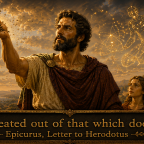
Epicurus, Letter to Herodotus
Wherefore, since the method I have described is valuable to all those who are accustomed to the investigation of nature, I who urge upon others the constant occupation in the investigation of nature, and find my own peace chiefly in a life so occupied, have composed for you another epitome on these lines, summing up the first principles of the whole doctrine.
Epicurus was a devoted student of nature, but as he says right there in Principal Doctrine 11, there would be no need to study nature at all if doing so failed to relieve our anxiety about death and the gods. It wouldn’t be bad to study nature, necessarily — it would just be fruitless. It would furnish nothing for the art of living. This is his baby, the study of nature. But if it wasn’t real, he’d have no problem dumping the metaphorical bathwater.
Approach Two: Nothing for the Art of Living
Somewhat ironically, neither would the Stoic Seneca. There’s a surprising level of agreement on this point — geometry is useful and all, but let’s not lose our heads:
Seneca, Letters to Lucilius, translated by Margaret Graver and A. A. Long
The geometrician teaches me to figure the size of a plantation, but he doesn’t teach me how to figure what quantity of wealth is sufficient for a human being. He teaches me to do computations, adapting my fingers to the purposes of greed, but he doesn’t teach me that such computations are beside the point, that it doesn’t make one any happier to have accountants wearing themselves out over one’s income — indeed, that a man who would find it a misfortune to have to compute his own net worth possesses nothing but superfluities. How does it help me to know how to divide up a field if I don’t know how to divide it with my brother? How does it help me to figure out the precise size of a garden plot down to the tenth part of a foot if it upsets me that my unruly neighbor is shaving a little off my land? He teaches me how to keep from losing that strip near my property line, but what I want to know is how to lose all my property and yet remain cheerful.
Now, while Epicurus would probably disagree with some of the direction Seneca is taking that, it does help to address the second point under consideration.
But back to the first point. Why did Epicurus think geometry was based on false assumptions in the first place? Well, as I said before, this primarily turns on the question of infinite divisibility. In the Epicurean cosmos, there is, according to Lucretius, a deep-set boundary stone — a least possible size, a minimum. And that minimum is the atom. The idea of infinite divisibility is directly antithetical to atomism, partly because the word atom is Greek for “uncuttable.” Under no circumstance can the Epicurean atom be divided. This aspect of geometry, where a line segment can be subdivided continually without end, meant that geometry was incompatible with nature. And if geometry’s most basic rules don’t work in nature, what possible recourse could we have to her higher-level conclusions?
Approach Three: Geometry Corrupted Into Ethics
Epicurus may have been annoyed that his fellow philosophers were making frivolous ethical claims based on their study of geometry. The following excerpt from an Encyclopaedia Britannica article gives some idea of where things were heading:
Encyclopaedia Britannica
The Pythagoreans invested specific numbers with mystical properties. The number one symbolized unity and the origin of all things, since all other numbers can be created from one by adding enough copies of it. The number two was symbolic of the female principle, three of the male; they come together in two plus three equals five as marriage. All even numbers were female, all odd numbers male. The number four represented justice. The most perfect number was ten, because ten equals one plus two plus three plus four; this number symbolized unity arising from multiplicity. Moreover, it was related to space: a single point corresponds to one, a line to two, a triangle to three, and space, or volume, to four. Thus ten also symbolized all possible spaces. The Pythagoreans recognized the existence of nine heavenly bodies — sun, moon, Mercury, Venus, Earth, Mars, Jupiter, Saturn, and the so-called central fire. So important was the number ten in their view of cosmology that they believed there was a tenth body, counter-earth, perpetually hidden from us by the sun.
Now, I’m familiar with the story about John Maynard Keynes purchasing a trunk of papers belonging to Isaac Newton at a Sotheby’s auction, as well as his later poetic description of what those papers implied:
John Maynard Keynes, Newton the Man
Newton was not the first of the age of reason. He was the last of the magicians, the last of the Babylonians and Sumerians, the last great mind which looked out on the visible and intellectual world with the same eyes as those who began to build our intellectual inheritance rather less than ten thousand years ago. Isaac Newton, a posthumous child, born with no father on Christmas Day 1642, was the last wonder-child to whom the Magi could do sincere and appropriate homage.
Look, it’s fine. It’s all fine. But if Cicero and others are going to mock Epicurus for his alleged ignorance of mathematics, I think we should allow ourselves a moment to step back and examine the disparity between two widely divergent claims. On the one hand, you have Euclid making proposals in an abstract mental space about how many lines can be drawn through a point parallel to a given line. On the other hand — and yes, I think it matters — you have a plausible-seeming philosopher in Pythagoras using numerology in what basically sounds like a religion.
In his book Epicurus and His Philosophy, Norman DeWitt furnishes another example of the crossover between geometry and ethics:
Norman DeWitt, Epicurus and His Philosophy
Geometry, in particular, though itself a positivistic study, inspired in the minds of men a new movement that was genuinely romantic. It was the romantic aspect of the new knowledge that captivated Plato, who was no more than up-to-date as a mathematician himself. In geometry he seemed to see absolute reason contemplating absolute truth, perfect precision of concept joined with finality of demonstration. He began to transfer the precise concepts of geometry to ethics and politics, just as modern thinkers transferred the concepts of biological evolution to history and sociology. Especially enticing was the concept which we now know as definition. This was a creation of the geometricians. They created it by defining straight lines, equilateral triangles, and other regular features. If these can be defined, Plato tacitly reasoned, why not also justice, piety, temperance, and other virtues? This is reasoning by analogy, one of the trickiest of all logical procedures. It holds good only between sets of true similars. Virtues and triangles are not true similars. It does not follow, therefore, because equilateral triangles can be precisely defined, that justice can be defined in the same way. Modern jurists warn against defining justice; it is what the court says it is from time to time.
Plato’s Cave
But what does Plato himself say about these matters? In Book 7 of his Republic, Plato has Socrates continue the dialogue by presenting the well-known allegory of the cave. In this allegory, we are to imagine a group of people chained to the wall of a cave. Out of sight of these people, perhaps on a ledge high up in the cave wall behind them, are two things: first, a fire, far back in the recess of the ledge; in front of the fire, on the edge of the ledge, are figurines and other objects. The light of the fire casts the shadows of these objects onto the cave wall in front of the people on the floor. This little world of flickering light and shadow is all they know.
Now we are to suppose that one of these people manages to escape the microcosm of the cave and ascend up into the world of sunlight and fresh air. For Socrates, this person represents the philosopher — one who has seen through and escaped the illusory world of sense perception, with its constant change and flux, like so many flickering shadows on the wall. He has now left the little world of endless becoming and risen up into the pure world of perfect being. Socrates suggests that if this man, enlightened as he has become by his experience of truth, were to descend back down into the cave, he would never be able to express what he has seen. Indeed, his eyes, which were dazzled by the sun above, would take some time to adjust to the darkness of the cave, and those down below would think him blind in comparison to themselves.
It’s an engaging little story. In the world of the allegory, the senses are not merely unreliable — they are presenting an illusion, indeed an outright lie. Things really start to get weird here. You see, only those who can escape the cave and ascend to the world of pure being — that is, the world of the good — should be permitted to rule in this ideal state. But here’s the rub: those who are permitted to rule, having ascended to the good, must now make a descent back into the world of the cave.
Plato, Republic, Book 7
Wherefore each of you, when his turn comes, must go down to the general underground abode and get the habit of seeing in the dark. When you have acquired the habit, you will see ten thousand times better than the inhabitants of the den, and you will know what the several images are and what they represent, because you have seen the beautiful and just and good in their truth.
For Socrates, descending into the darkness signifies a willing sacrifice on the part of the ruler. Like a man with sight going among the blind in order to help them, the ruler reluctantly sets down his own desire for the upper world in order to serve the needs of those in the lower. Socrates then moves on to the all-important question: how does one learn the way out of the cave? With his interlocutor Glaucon, he discusses several branches of study among the Greeks and judges whether each one will help the philosopher to make the ascent. The arts of war, gymnastics, and music are each discussed in turn, but all of them are found wanting on the most essential question — none of these arts may lead the philosopher from the flickering cave of becoming into the world of pure being. It is Socrates himself who supplies the answer: arithmetic and geometry are the arts which lead on to truth. Dispensing almost entirely with the practical aspects of these arts, Socrates sums up the whole discussion in a well-known passage:
Plato, Republic, Book 7
The knowledge at which geometry aims is knowledge of the eternal.
Where the senses lie, geometry leads on to truth. Where the pleasures of the body are like leaden weights dragging us into darkness, Socrates says that geometry is a ladder to the pure realm of perfect being.
A Modern Coda
In the 2012 film Lincoln, directed by Steven Spielberg and starring Daniel Day-Lewis in the title role, there is a scene in which the president is mulling over an important decision in the telegraph room. While he’s thinking, he falls into conversation with the telegraph operators about Euclid and the ancient axioms of geometry. The script was written by Tony Kushner, and in this scene, Lincoln says:
Lincoln (2012), screenplay by Tony Kushner
Euclid’s first common notion is this: things which are equal to the same thing are equal to each other. That’s a rule of mathematical reasoning. It’s true because it works, has done, and always will do. In his book, Euclid says this is self-evident. You see, there it is — even in that two-thousand-year-old book of mechanical law, it is a self-evident truth that things which are equal to the same thing are equal to each other. We begin with equality — that’s the origin, isn’t it? That balance. That’s fairness. That’s justice.
Now remember what I quoted above from Norman DeWitt: “This is reasoning by analogy, one of the trickiest of logical procedures. It holds good only between sets of true similars. Virtues and triangles are not true similars. It does not follow, therefore, because equilateral triangles can be precisely defined, that justice can be defined in the same way.” Now, I will admit that the analogy Lincoln uses in that scene makes for really engaging cinema. But using geometry in service of ethical claims like human equality puts him on shaky ground. Justice cannot be defined in the same way the transitive property in mathematics can be defined, and pretending that these are similar when they are not just muddies the waters around important ethical questions.
In a separate scene from that film, the president seems to agree with that view. When his interlocutor in a negotiation makes an analogy by reference to a moral compass, Lincoln explains the flaws in this analogy from his own experience:
Lincoln (2012), screenplay by Tony Kushner
A compass, I learned, when I was surveying, it’ll point you true north from where you’re standing, but it’s got no advice about the swamps and deserts and chasms that you’ll encounter along the way. If, in pursuit of your destination, you plunge ahead heedless of obstacles and achieve nothing more than to sink in a swamp… what’s the use of knowing true north?
Now, if you spend any time in the land surveying profession, you’re likely to hear a canned joke about the four faces carved into the rock at Mount Rushmore. Those faces, the joke goes, represent three surveyors and one other guy. Like most jokes that circulate professionally, it isn’t particularly funny. It isn’t supposed to be. It circulates because it’s a point of pride: the map is not the territory, and no one knows that better than the people who map the territory. It’s one thing the Lincoln film got right. It’s something we should all keep in mind.