

Posts by DevinH
-
-
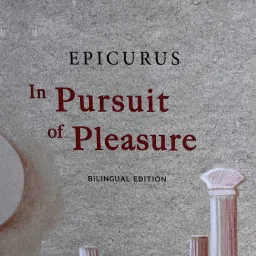
Enjoy your reading!
Hi Patrikios! Wow, I just started skimming through these, I really will enjoy this reading! I had no idea he existed and this really speaks to me. Epicurus feels like a natural fit, his philosophy as far as I understand it (still growing of course) just keeps making intuitive sense. For me, after a long time working in the field, the only other area of study that feels similarly natural is biology. The pairing of the two truly excites me. Thank you so much for this!
-

Welcome, @Devin!
Hi Godfrey!
Since our time and our pleasure are both finite, it makes sense to maximize them to the best of our ability. Once we're gone, we're gone. Mathematically speaking, infinite time has no effect on our finite lives.
I really like this. Both the core that the rest grows from, and the point about time. Any time philosophy, physics, and math get blended, that's when I know I'm in the right place!

-

What I mean by full vitality is enjoying things that support or increase bodily and mental well-being and that don't bring unpleasant consequences. I don't like using the term "moderation" because that word doesn't fully capture the active use of reason for evaluating one's choices (and "everything in moderation" is an unwise way to think, imo).
I really love the concept of full vitality that you've put forward, I think it makes a tremendous amount of sense!
(But eventually they may either run short on finances or get ill, and likely the endless novelty isn't as pleasurable without also having good social connections).
Too true!
"But the many at one moment shun death as the greatest of evils, at another (yearn for it) as a respite from the (evils) in life. (But the wise man neither seeks to escape life) nor fears the cessation of life, for neither does life offend him nor does the absence of life seem to be any evil."
This again shows as evidence of how Epicurean philosophy is put forward as a mental remedy.
I have found it hard to find as much remedy from the philosophy around death as I have other areas. Mostly the death of those I love rather than myself. This quote, if I apply it to assessing the lives of others, does start to shed light on that part of the salve it offers.
-

This is an area where it is particularly helpful to expose yourself to what the various types of skeptics had (have) to say. I find that people have a hard time accepting that the various leaders (Pyrrho, Carneades) were as extreme as they were. And people today tend to view skepticism in a "loose" way (viewing it as "challenging authority") rather than in the philosophical way of being committed to the view that knowledge is effectively impossible no matter how much evidence one has. So the question really has to be focused on the logical extreme - What does it mean to say that something is known? When we say that something is "known," have we accepted a viewpoint that only an omnipotent and omnipresent god could meet? If we have accepted such a view - and many seem to do that, because anything is possible isn't it? - then we have a big problem. Epicurus didn't accept such a standard as the correct one.
This is really interesting, I'll need to read more, but it seems like I don't have a full grasp of just how extreme this position is. Yeah, very much not a skeptic it sounds like. What is it to be known? To me, at least at this point in my journey, to be known means a good deal of evidence to support a thought or fact. Because nothing to me can be 100% certain, I end up going the other way, as I think many scientists do, and realizing to move ahead and function, things have to be treated as known, otherwise you are lost forever.
At one and the same time
Life is desirable, which means all things being equal (you have the ability to experience more pleasure than pain) a longer life is better, and it is desirable to continue to live.
But all things aren't equal. Even in best cases with current technology, humans get old and infirm and sick and even continuing to live becomes painful.
And more important than that, we very legitimately do not value all non-painful experiences as holding the same amount of pleasure for us. Most of us are going to instinctively agree that we would rather live X number of years in freedom than X+Y number of years as a slave. (Insert here your preferred example of extremely good vs extremely bad.) So quality of life matters - a lot.
Epicurus was well aware of these issues. He wrote in the letter to Menoeceus about the desirability of life and that the time factor (length of life) does not override all other factors. The wise man whether young or old does not make haste to end his life because life is desirable, and the same standard (pleasure) applies at any age. Likewise, a wise man at a banquet chooses not the most food, but the most pleasant food, and so the wise man doesn't seek to live the longest life, but the most pleasant.
So we have to consider that while all pleasure is pleasing because it is desirable, all pleasure is not equally pleasing to us (in every respect), so we have to determine what "most pleasant" means, and choose the "most pleasant," not merely the largest quantity. So when Epicurus talks about the "limit of pleasure" we have to think very carefully about what that means. It clearly does not simply mean "that which lasts the longest."In my view a lot of people have a problem balancing these considerations. They can't keep in mind both that (1) pleasure is a general umbrella concept that (2) cannot be separated from individual real-life instances of pleasure. "Orange" does not exist except when considered as what is common between "things that are orange." This is where discussion of the "sorites" / heap question helps focus the mind on this issue.
So yes "pleasure" as a concept cannot improve past "pure pleasure." 100% pleasure is indeed the limit of pleasure - "nothing can be more true than this" as Torquatus said to Cicero -- because when you categorize all experience into pleasure or pain, then when you have no pain you be definition have the purest pleasure.
But identifying "pure pleasure" as you goal - as helpful as it is philosophically - does not tell you directly what to do when you get out of bed in the morning. You have to apply that viewpoint - which you should hold confidently as a matter of something that you know to be true - to your individual circumstances, many of which you may only have a vague grasp of at any particular moment.
This is extremely helpful. If I understand correctly, thinking of it more as an optimization problem between the two factors of quality as defined by pleasure and length playing a lesser but still present role makes sense, if I am understanding you correctly. The aspect that must be maximized is % pleasure of max, is that accurate?
Noting that "pure pleasure" frequently does not lend itself to a clear "do X and then Y" in terms of your day makes a lot of sense as well. In that sense is it more of a framework than a set of detailed directions for living ones life?
The only part of that paragraph I'd comment on at this point is that it is very important to be clear what you (anyone) means by "state of ataraxia." What some people think that term means is something that I personally would not want for a day or a year or a lifetime, and I would argue Epicurus wouldn't and didn't want either.
Every conversation has a context and in general I am at the point where use of an untranslated Greek word to describe the goal of life is a red flag to me, Unless I know the context of the discussion very clearly I usually think that the conversation at that point needs to drop back immediately and make very clear what is being discussed.
Even here at EpicureanFriends it is not safe at all to think that any two people have the same mental concept of what "ataraxia" really means. "Absence of disturbance" sounds fine until you remember that many people (especially Stoics) explicitly or implicitly hold the view that pleasure itself is a disturbance. It's less true here than elsewhere, but much writing about Epicurus is so shot-through with Stoicism and Platonism that it's not safe to take this issue for granted.
This is a really helpful criticism. In terms of the word itself, I clearly don't have a deep enough or nuanced enough view of it yet. Its vagueness would clearly break any discussion given its subjective nature. It was easy to assume that my understanding of the word was universal, although upon reflection I have no idea why I would have thought that.
Yeah, on the pleasure as disturbance point, its a good one. I very much do not hold that pleasure is a disturbance, except to I suppose to someone who wanted an unpleasant life. I find the stoics whole basis so amazingly flawed as to recoil at the thought of being mistaken for one! I understand that people sometimes merge some parts of stoicism into their understanding of Epicurean thought, but for the life of me I don't see why.
Eventually a lot of the discussion of ethics can start to sound like a word game. I don't think it is, but what is certainly not a word game is that Epicurus takes a firm position that there are no supernatural gods and that there is no life after death. Within that context no one has the luxury to debate ethical questions endlessly and suspend judgment on every question indefinitely. You have only a set amount of time to live, and you cannot be born again. Unless your goal is "quietude" - which is the problem with some definitions of the word "ataraxia" - then you need to ability to take a confident and firm position about what your real goal is. While being "quiet" or "undisturbed" is sometimes a pleasure, it is certainly not the only pleasure, nor is it always a pleasure. You don't want to be undisturbed while taking a nap on a railroad track in front of an oncoming train. "Pleasure" is the wider term and the most accurate statement of the ultimate goal, not "quietude" or "calmness" or "absence of disturbance."
Epicurus points to "pleasure" as the best umbrella-term-way to look at it. But there are people who will tell you that you should accept their definition of all sorts of other words (piety, logic, virtue, meaningfulness, etc) as what you should do with your life. It's not just a word game when you realize how important it is for you to get the answers to these questions right.
I am really curious why the word comes up as much as it does? I very much see your point, and while I think a never ending state of pure lobotomized neutrality of thought would be a nightmare, I can see how some people might see the word as suggesting that. Maybe it does given its vagueness, regardless of its original role. Do you think its just a word that should never be used, or one only either clear descriptions underneath, or only between close friends who understand the other's usage?
-

In working on my own I've developed some readings that I suspect drift from the classical positions, most notably around PD 19 and 20 and whether more time at the fullness of pleasure adds anything. I'd like to test those against people who know the texts far better than I do, and be corrected where I'm wrong.
Devin this would be an excellent topic to discuss whenever you are ready. Approach it however you wish here in this thread and we can move it later into a more appropriate forum if/when it gets long enough. Discussions of the meaning of limits of pleasure and how that relates to how to assess length of life are always of key interest.
Your read is spot on. I touched on it above, but yeah, life, its length as a factor, and death, are areas I'm looking for guidance on, and discussion around!
-
Display More
Again, welcome DevinH - Your background indicates that you have lots to offer the discussions here. Take your time and weigh in on whatever areas interest you first and most.
Your science / technical background gives you expertise that will be particularly useful in our "canonics" discussions on the nature of truth and reality, and how and when we move from the accumulation of evidence to the decision that we have enough information to take a firm position on a topic.
That's what we've been discussing for many weeks on the podcast, but I freely admit that it is a topic that most people aren't immediately familiar with or see the relevancy of.
Also given your orientation I think you will find the DeWitt book the most helpful way you could proceed to dig deeper. You won't agree with all of it by any means, but it is almost alone among the "modern" books that attempts to give you an overview of the entire philosophy and how it fits together. That integrative perspective will color every detail that you read as time goes by, and like most of us you'll probably go through many revisions of how you view the more advanced topics like prolepsis or the nature of "gods."
I'll also particular point toward the academic articles of Dr. David Sedley. If he's written an article on a specific focus you'll likely find his research to be among the most thorough and his reasoning to conclusions to be the soundest.
There's a tremendous amount of information to digest and it's helpful to all of us to talk about it in a friendly and constructive way, among people who are largely (but of course to differing degrees) on board with the full sweep of Epicurean philosophy.
Cassius, thanks for such a thoughtful welcome! The canonics around reality is an area I find really interesting, and more than a little bit tricky. One area where I wonder how far off I am from the community is the blending of my scientific non-absolutism with a pragmatic need to find a way to live a content life. In science we avoid the word "proven" at all costs. For much of my life I have been certain that nothing is ever formally proven, not even evolution, yet I live my life by evolution and do so with complete confidence, personally and professionally. I'm certainly not a skeptic by any means, since that just leads to paralysis, but I wonder what folks' feelings are on the matter?
Regarding DeWitt, that is really helpful advice! I find myself both wanting to mete out my reading (a bit like a desire to savor each new level of understanding) and really needing to start digging into aspects of the philosophy that Lucretius doesn't go super deep on. I think my next stop, before I let myself get sucked into Philodemus, should indeed be DeWitt. Sedley also appears to be quite prolific!
Ah, prolepsis, maybe the pillar I find myself flip-flopping on the most. At this point I agree that it's a real thing and supportable. Humans certainly are not blank slates, and we come with brain structures and inclinations that are very much in line with the concept. I see them as evolved priors, but I am as yet unsure how they impact one's ability to determine truth. I've also seen a spread of views on what they encompass, and that's another area I'm really excited to talk with folks about.
I think of myself as fully on board at this point, but with some points I still need to understand better. I'm curious where the community, given what I've said here, would put me in terms of "on-boardness."
For example, I mentioned PD19/20, and it's an area I struggle with. If I measure a life by the fraction of it spent in pleasure, a short life at 100% equals a long one at 100%, and I can follow PD19/20 that far. But I also personally feel the pull to have more time within my lifetime (so long as life is pleasurable). Lucretius touches on it in book 5 ("Whoever has been born must want to continue in life, so long as fond pleasure shall keep him..."). That's the pull I feel, even if PD19/20 says more time doesn't add anything.
I've used this thought experiment to test this: what happens as our medical technology improves? Let's say my grandchildren can live 500 years. Today I would say a long 90-year lifespan lived in a state of ataraxia would pretty much max out both the % quality and the length criterion, an ideal one might aspire to. However, in this new world, if 90 years is no longer a long, full life, does the assessment change? I honestly don't know, and it's an area I have not been able to really work out on my own in a vacuum.
Really excited to finally have a "garden," as it were, to discuss and consider, and of course to be challenged when not living up to the ideals.
-
Hi All! I’m excited to join the community, and I look forward to the discussions to come!