

Posts by Rolf
ALL CURRENT AND PROSPECTIVE PARTICIPANTS SHOULD READ THE FOLLOWING STATEMENT OF FORUM EDITORIAL POLICY: "Against Katastematic Supremacy - Pleasure Is A Unified Good, Not A House Divided Against Itself."
New Graphics: Are You On Team Epicurus? | Comparison Chart: Epicurus vs. Other Philosophies | Chart Of Key Epicurean Quotations | Accelerating Study Of Canonics Through Philodemus' "On Methods Of Inference" | Note to all users: If you have a problem posting in any forum, please message Cassius
-
-
Interesting video, but I doubt she’d align herself with Epicurus - she’s a hard determinist.
I don't believe in free will. This is why.Learn more about differential equations (and many other topics in maths and science) on Brilliant using the link https://brilliant.org/sabine. You can get st...youtu.beDoes Superdeterminism save Quantum Mechanics? Or does it kill free will and destroy science?Check out the math & physics courses that I mentioned (many of which are free!) and support this channel by going to https://brilliant.org/Sabine/ where you ...youtu.beYou don't have free will, but don't worry.In this video I explain why free will is incompatible with the currently known laws of nature and why the idea makes no sense anyway. However, you don't need...youtu.be -
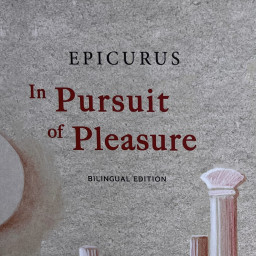
Does this seem meaningful?
That’s a great way of phrasing it, thanks Patrikios. It’s an ideal, just as reaching a complete absence of pain (100% pleasure/0% pain) is an ideal. Epicureanism is still useful even if we never reach this idyllic place.
-

Now "wise" has many shades to it, and i don't think there's an absolute definition that applies to everyone.
You’re right, defining the term “wise” is important here. The way I understand it, the word “wise” here is used to mean having a full grasp on Epicurean philosophy and the prudent pursuit of pleasure.
But there are in my view clearly lines of clinical issues where it's going to be unreasonable to say that such and such a person is "wise."
I’m talking more about whether such people have the capability to become “wise” (ie. “Fill their vessel” and experience continuous pleasure through prudent choice and avoidance). Not whether or not we would fall them are wise in their current state.
What kind of “clinical issues” would discount somebody from achieving a proper grasp on Epicurean philosophy, in your view? -
I see where you’re coming from, and I agree with what you’re saying, but I don’t necessarily interpret the quote the same way. Are you saying that Epicurus means that there are only 1) those with the “right physical constitution” and 2) those who have no hope of a pleasurable life? The way I understand the quote, there is a lot in between - I take it to mean that there are people who can experience pleasure, but lack the “physical constitution” to be truly wise and prudent due to circumstances outside of their control. There are many people with chronic physical or mental illnesses that can be mitigated but not removed - would Epicurus say that these people lack the “physical constitution” to be wise?
-
I'd call that realistic rather than pessimistic, and I'd call it much preferable to imagining that there is a better life after death, or a magic pill that overrides nature, becaus those things just don't exist, and I'd rather know the truth about my situation rather than spend whatever time I have under fake pretenses.
I agree, well said.
"A man cannot become wise with every kind of physical constitution, nor in every nation."
This one has always been a bit prickly for me. If Epicureanism is a philosophy that is beneficial for everyone, and wisdom is so vital for prudently pursuing pleasure, then the idea that certain people are involuntarily unable to work towards this feels rather deflating. What is one to do if they lack the “physical constitution” or live in the “wrong nation”? Does Epicureanism still have something to offer such people, or are they better off looking elsewhere for pleasure and the reduction of pain?
-

I don't think Epicurean philosophy would say Harry Potter is satanic, ...however Harry Potter it is promoting "superstition" and that the material can be affected in a non-material way ...and so it is really the same as Christianity, just packaged differently.
Sure, but I can watch and enjoy Harry Potter and other fantasy media without genuinely believing in the supernatural. It’s fiction. I find the Christian argument against engaging with such media incredibly silly, and I would think it’s equally silly if Epicurean philosophy made the same argument - which for reference, I don’t think it does. I don’t have to believe in the existence of magic and trolls and dragons in order to enjoy watching Harry Potter, just as I don’t have to endorse violence to enjoy watching action movies.
-
In post number 12 above Rolf you wrote something that I was unclear about what exactly you were trying to convey -- I'm not sure what "extravagant desires" has to do with this??
Ah, apologies! I was using Emily Austin’s phrasing for necessary and unnatural desires.
We can only choose for ourselves what feels like the best actions.
I agree 100%.
-
I have a general concern in philosophical discussion that - under the influence of Stoicism or similar views - people "accept" far too many things that could be changed with the right effort.
This is a wise and helpful perspective, thank you Cassius. It’s gotten me thinking how deeply engrained the glorification of acceptance is within myself and modern society. Even before reading up on stoicism, and after disregarding it, I’ve placed great value in so-called “radical acceptance”. Of course acceptance can be useful at times, but you’re right that we mustn’t lose site of the bigger, fundamental picture - it’s all about pleasure and pain. If I accept something that’s causing me pain, it might minimise the pain slightly, but it’s always going to be better to root out of the source of the pain entirely if possible.
That said, painful chronic conditions are something I’m still struggling to reconcile with the philosophy. I’ve heard arguments against Epicureanism that “it’s a philosophy only for healthy, happy people”. While I disagree, I’m not entirely sure how I’d respond to the criticism. -
Yes, and there are certainly movies that do not use gratuitous violence or other unpleasant aspects or characters - for those like myself who tends toward "high emotional absorption" (empathy).
But that’s only your preference in extravagant desires, right? I enjoy watching movies about unpleasant characters from time to time, despite not wanting to associate with such things in reality. I can enjoy a movie about a violent mob boss or a war documentary. I don’t think it’s possible or healthy to make a blanket statement about what media an epicurean should or should not engage with (so long as it does not lead to more pain than pleasure). It reminds me of the Christians who refuse to let their kids read Harry Potter because magic is satanic.
-
Rolfe you have not been exposed to my deep reservations about the Tetrapharmakon, which you can read here.
Interesting, I’ll read through this. Thanks Cassius.
With that intro I'd say "enjoy what you can" seems correct to me, but "accept what you cannot" strikes me as too ambiguous -- cannot what? Cannot enjoy? Why?
Accept what you cannot enjoy, yeah.
I think I'd have to ask "why can't you enjoy it? Because it was totally beyond your power? Or because you didn't try?
This is a fascinating question, and something I’ve been thinking about a lot lately: The role of reframing and other such “mental tricks” in reducing pain and increasing pleasure, even in tough situations. Do you think that most things are able to be enjoyed with the right effort? I have a few health issues that cause me fairly consistent pain, and I cannot say that I enjoy them, but I have learned and am learning to accept them and thus reduce the associated pain. Interested to hear your further thoughts on this.
-
Would you say that the imperative phrasing 'Enjoy what you can, accept what you cannot' accurately reflects the meaning of parts 3 and 4 of the Tetrapharmakos — that what is good is easy to obtain, and what is bad is easy to endure?"
-
I collaborated with The Dude to compose a "Dudeist" version of the Letter to Menoeceus: https://dudeism.com/the-dudes-letter-to-menoeceus/
Fuckin' A!

-
As Epicureans, if we lived in communites with other Epicureans, then we would not have time for movies - we would be busy doing "barn-raisings" and helping each other out to be self-sufficient, and having potlucks dinners together.
Each to their own, but for me this edges a little too close to the ascetic view of Epicureanism and judging certain pleasures as wrong. As long as watching movies leads to more pleasure than pain, and for many (myself included) it does, then what's the harm? Why must an Epicurean community necessarily have no time for movies, instead "raising barns"? It seems that one could dismiss a vast number of unnecessary but enjoyable pastimes using this rationale.
I think movies are "sold" to the masses by the few who are the "movie-makers". And you really need to ask yourself: What kinds of messages are they conveying? What thoughts are they "telling" you to think? And are they ramping up your internal fears of death?
Also, most movie plots are the opposite of this:
VS72: "He who is as peace within himself also causes no trouble for others."
Sure, not every movie is going to contain an Epicurean message, but why does that mean we should avoid them? By that logic, should we also avoid the majority of music and (non-Epicurean) literature?
I hope this doesn't come off too harsh. Perhaps I'm misunderstanding your perspective on this. But if I understand correctly, then I must vehemently disagree.
-
Hey folks! I’m back from my trip and thought I’d jump into a fun discussion. As a big film geek, I’ve recently been reflecting on movies from an Epicurean perspective, and I wanted to share a couple of key points to kick things off:
1) While movies can be valuable tools for exploring philosophy, they are rarely a perfect depiction of Epicurean principles unless that’s the filmmaker's intention. I believe it’s crucial that we acknowledge where a movie and its characters align with the philosophy and where they diverge. Not all elements of a film will resonate with Epicurean thought.
2) At the same time, I believe that almost any movie can be analyzed through an Epicurean lens, particularly if we operate under the assumption of psychological hedonism. After all, most characters are in pursuit of pleasure and avoiding pain, though they may differ in how effectively they navigate that pursuit. Examining this aspect of characters’ motivations can provide insights into the challenges they face in seeking pleasure—whether it's through their choices, desires, or failures.
With that out of the way, let's dive in!
The Big Lebowski (SPOILERS BELOW)
The Big Lebowski centers around Jeff Lebowski, better known as the Dude. Despite being an easy-going slacker, the Dude gets wrapped up in a convoluted kidnapping plot along with his bowling buddies.
Where it aligns
- The Dude enjoys the natural pleasures of life. He values necessary pleasures such as his friendship with Walter and Donny and resting at home. He also partakes in "extravagent" pleasures such as bowling, White Russians, and music without becoming overly attached to them.
- The Dude also rejects unnatural & unnecessary or "corrosive" desires, such as wealth and status. This is exemplified by his juxtaposition to the other Lebowski, a wealthy and renowned man, who the former is notably uninterested in. He drives a beat-up old car and often wears a ragged bathrobe.
- Friendship is a core aspect of this movie. Throughout the film, the Dude attempts to ease conflict diplomatically and keep the peace. When all is said and done, he is back at the bowling alley with Walter.
Where it doesn't (or examples of what not to do)
- While unfortunate that he is beaten up by thugs and has his rug pissed on, the Dude's real conflict stems from corrosive desires, specifically his friend Walter's desire for wealth. When the wealthy Lebowski offers the Dude money to bring back his kidnapped wife Bunny, the Dude refuses, preferring not to get wrapped up in unnecessary conflict and stress. However, his friend Walter convinces him otherwise, setting off the chaotic events of the movie.
- I'd like to say more about Walter's rage, Bunny, and the Nihilists, but it's getting late so I'll have to save it for another day!
-

don't think there are unnatural but necessary desires (per Epicurus' categories).
Ah sorry, I meant natural but unnecessary
-
I’m on holiday right now and have yet to read through the whole thread, but I’ve been thinking about this conundrum and would like to add this quick thought: The classifications are like priorities. We should probably rarely, if ever, sacrifice natural necessary desires for unnatural necessary ones, when keeping long term pleasure in mind.
-
Do you agree that you can pursue only necessary pleasures and reach 100% pleasure (or happiness)? If you can pursue only necessary pleasures and reach the target, why would you pursue any others than those which are easiest to obtain?
This is a good, concise way to sum up my point of confusion - thanks Cassius.
But while we are helping them see the right way to approach that question, we need to avoid stating things in a loose way that is logically confusing to those who are closely trying to follow the logical consistency of the philosophy.
I agree. I can understand the intention of the philosophy based on what I hear from you, the other fine people on this forum, and Emily Austin, among others. But I want to be able to follow the logical steps laid out by Epicurus himself, so that I may understand the philosophy more innately.
-

It enables us to enjoy and enrich ourselves with all that tiny little good influences around us. Good food (especially food!), a nice breeze under a blue sky, a vibrant talk with a friend while walking a thriving urban landscape or a magnificent peace of nature. There are so many good things around all the while, hence I'm not seeking for more, for the better, for the Everest. I am just satisfied and happy.
Beautifully written, Titus.
I know Cassius' is fighting the image of the minimalist frugal Epicurean who lives on bread and water but I would like to see more sensitivity as to why there is a category of"unnecessary desires" in the first place.
I agree - I could definitely benefit from deeper discussion of the necessary/unnecessary split. That said: I forget where I read this, but I’ve heard it said that necessary desires are those that cause pain when not fulfilled (eg. Hunger, tiredness), while unnecessary desires do not cause pain when not fulfilled (eg. A fancy meal). Correct me if I’m wrong on this.
-
Further, I agree with you that the natural and necessary analysis is not as clear in our texts as it should be, and it's not something I focus on. I think Torquatus gives a reasonable explanation as to why it exists, as a tool of analysis, but it strikes me as rather obvious and so not something I find that important. The getting to 100% and then the rest being variation is important for logical reasons, but to me this natural / necessary division is not as much philosophical as it is practical advice. It's good practical advice too - if you need need help to see that the harder pleasures to obtain come at higher cost.
Ah, that makes sense. It’s less of a hard-and-fast philosophical tenet and more of an example of how to look at things - a tool, as you say. I suppose at the end of the day Epicurean ethics comes down to using prudence to maximise the ratio of pleasure to pain, with much of the rest being tools to help one do this. Would you agree with this evaluation (oversimplified as it may be)?
I don't think you're missing something obvious however. This analysis is a prime tool used by the Stoics to argue that Epicurus was a minimalist, so it's a major thing to fight over. Yes it can be read to mean "you should be satisfied when you have just enough to keep you alive." But was it interpreted by Epicurus himself that way? No, so it's either not meant in that way, or Epicurus was a hypocrite. I don't think he was a hypocrite, so I think it was meant in the practical way of meaning "Watch out if you go for the more difficult pleasures in life, because that may cause more pain that it's worth. There's a lot of pleasure available in things that are easier to get, but jt's up to you to decide what's best for you. And he of all people - driven as he was - would have known that if you forgo something that you really want to do then that regret can be among the most painful.
That’s a good point. Knowing of these arguments against Epicureanism and the epicurean responses to them really helps me to understand the philosophy.
On that note, I’d probably say to such as a stoic that it is important to remember that boredom and regret, too, are pains. They must be factored in when deciding on which pleasures to pursue.
Finding Things At EpicureanFriends.com
Here is a list of suggested search strategies:
- Website Overview page - clickable links arrranged by cards.
- Forum Main Page - list of forums and subforums arranged by topic. Threads are posted according to relevant topics. The "Uncategorized subforum" contains threads which do not fall into any existing topic (also contains older "unfiled" threads which will soon be moved).
- Search Tool - icon is located on the top right of every page. Note that the search box asks you what section of the forum you'd like to search. If you don't know, select "Everywhere."
- Search By Key Tags - curated to show frequently-searched topics.
- Full Tag List - an alphabetical list of all tags.