

As should be expected, the usefulness of this is limited almost immediately into the discussion by Gassendi's insistence that there is both a Providential god whom we should worship and an eternal soul that survives death.
Posts by Cassius
-
-
The opening section right at the beginning about how to judge the man who is roasted in the bull of Phalaris as still happy is an excellent extrapolation of Epicurus and right on point with our discussion in the Zoom today!
Possibly the best explanation of Happiness as I personally think Epicurus would define it that i have seen.
-
Note: This will be the thread to post about Gassendi's commentary on Epicurus from the "Happiness" section of his 1699 Three Discourses On Happiness - Virtue -Liberty.
Almost offhandedly Robert wins the award for the day, probably the week, and possibly for the month for bringing something we've not discussed before to our attention. I highly recommend his link on Gassendi on Happiness. I suspect we're not going to agree with everything that Gassendi has to say but this is VERY interesting. Thanks Robert!
You'll probably want to start reading from page one, but i'm clipping the following just to show how it's directly on point with our discussions.
-
Welcome to Episode 307 of Lucretius Today. This is a podcast dedicated to the poet Lucretius, who wrote "On The Nature of Things," the most complete presentation of Epicurean philosophy left to us from the ancient world. Each week we walk you through the Epicurean texts, and we discuss how Epicurean philosophy can apply to you today. If you find the Epicurean worldview attractive, we invite you to join us in the study of Epicurus at EpicureanFriends.com, where we discuss this and all of our podcast episodes.
This week we continue covering Cicero's "Tusculan Disputations" from an Epicurean perspective. Today we continue our discussion with the second half of section 9 of Part 5 where Cicero criticizes Metrodorus and Epicurus for allegedly making high-sounding statements by being inconsistent for involving pleasure and pain in them.As Joshua said last week, Cicero is criticizing Aristotle and Theophrastus for admittedly being consistent but at the same time being ignoble, while he allows that Epicurus and Metrodorus sound noble but at the same time being inconsistent for involving pleasure and pain in their formulations.
Cicero would prefer both consistency and noble langue, and he finds that in the Stoics.
Epicurus would respond that there is nothing ignoble about pleasure and pain, as they are the guidance that Nature herself provides. Further, Epicurus is being consistent when he realistically assesses that human happiness best defined as a life in which we always have more pleasure than pain ("more reason for joy than for vexation") not an idealistic state of pure virtue from which all evil is absent.
[media]https://www.spreaker.com/episode/68543264/media
-

Episode 306 of the Lucretius Today Podcast is now available. This week our episode is entitled: "Is A Life That Is 99 Percent Happy Really Happy?'"
[media]https://www.spreaker.com/episode/68467118/media
-
Lots of good information in that article, which I don't remember seeing before -- it's apparently from 2024.
I'd say it's a generally very good presentation and to repeat contains lots of good citations. I particular appreciate the references to the author of Quo Vadis.
But after reading through it quickly I'd say it has the flaw of giving the impression that Epicurus was focused on a general subtraction of bodily pleasures rather than the addition of mental pleasures to those bodily pleasures that do not cause more harm than good.
Of the common threads of analysis of Epicurus for 2000 years it seems that most either veer off into (1) asceticism (the implication of this article) or (2) into saying that he was a reprobate obsessed with sensual pleasure(more the focus of Plutarch, and much also of Cicero).
I don't get the impression that for example Emily Austin's book veers off into either extreme, so hopefully things will get better.
-
This episode will be out soon.
One aspect that is referenced in the second half is how the "all or nothing" attitude of Stoicism carries over into Christianity. This is an important point to focus on in Epicurus. Was Epicurus' life "not happy" because he suffered from terrible kidney disease at the end (and no doubt suffered other pains and dissapointments earlier as does any normal person)?
The way you answer that question is critical, because the Stoics and Christians have a different answer:
“Almost persuaded,” harvest is past!
“Almost persuaded,” doom comes at last!
“Almost” cannot avail; “Almost” is but to fail!
Sad, sad, that bitter wail— “Almost,” but lost!
Words and Music by: Philip P. Bliss -
If you get it please be sure to let us know your thoughts. I don't remember reading myself.
-
Cicero is speaking through Velleius, and using him as a literary tool, ultimately to persuade his audience to his cause, not necessarily provide an objective survey of history. So, I think that anything that the character Velleius proposes in Cicero's narrative needs to be referenced against the established doctrines set by Epíkouros and preserved by Philódēmos. There are a few things Cicero records that are surprising, so I read him cautiously.
Eikadistes I agree with this general concern, but as of yet I have not (to my memory) run into anything spoken by Velleius that I have found reason to question as being in actual or potential conflict with any other authoritative texts. Have you seen anything in particular to question from that section? If any occur to you over time and you remember this thread I hope you'll point them out so we can include those caveats in future discussions.
Same goes for the statements of Torquatus in On Ends. Elli and others tell me that they do not agree that Torquatus should have defended his ancestor who executed his son for violating the rules of battle. I don't share that view, because I think as extreme as the situation is, it's an example of how context has to be taken into account in all situations, and I can imagine that in a military family if someone blunders and jeopardizes the whole army then they would expect to give and receive the same punishment as anyone else. But that's definitely a hard case. It's an example of something I'd like to make a list of. If there's a reasonable argument that Velleius or Torquatus say something that can be challenged as potentially not good Epicurean philosophy, I'd like to keep a list and address those issues over time, if they exist. While Frances Wright is not in the same category as an authentic ancient Epicurean text, I definitely have trouble with some of her formulations and we have a thread here going through those.
And this reminds me that these two long narrations by reputed Epicureans stand out in my mind for their contribution to our knowledge of Epicurus. I have been for the last couple of days trying to remember if there are any other extended presentations like these two in other works of Cicero, or similar sections in other writers. if anyone is aware of anything comparable to these Torquatus and Velleius speeches please let me know. Just to be clear of course I am not talking about Lucretius or Diogenes of Oinoanda or fragments from Philodemus, etc. -- I am talking about well-preserved extended narrations by someone in the ancient world claiming to be an Epicurean that have been preserved by someone else, as Cicero has preserved these two. I am thinking at the moment that there is nothing quite like these two long narrations given in the names of Torquatus and Velleius.
-
Looks like at the moment that we don't have any RSVP's for tomorrow night, and now we have the additional factor that Kalosyni is not feeling well. For that reason it's looking very unlikely that we will have a session tomorrow night (November 3, 2025). If anyone was waiting to the last minute to say that they'd like to come let us know and we'll come up with a substitute plan.
-
That question comes at an opportune time so in addition to discussing it here we'll address it in today's podcast recording!
-
Welcome to Episode 306 of Lucretius Today. This is a podcast dedicated to the poet Lucretius, who wrote "On The Nature of Things," the most complete presentation of Epicurean philosophy left to us from the ancient world. Each week we walk you through the Epicurean texts, and we discuss how Epicurean philosophy can apply to you today. If you find the Epicurean worldview attractive, we invite you to join us in the study of Epicurus at EpicureanFriends.com, where we discuss this and all of our podcast episodes.
This week we continue covering Cicero's "Tusculan Disputations" from an Epicurean perspective. Today we continue our discussion with section 9 of Part 5 as to virtue alone allegedly being sufficient for happiness.
We'll start with this on Theophrastus, who was apparently one of the most famous to take the position that "I'd rather be lucky than smart"!
QuoteThis is the point which Theophrastus was unable to maintain: for after he had once laid down the position, that stripes, torments, tortures, the ruin of one's country, banishment, the loss of children, had great influence on men's living miserably and unhappily, he durst not any longer use any high and lofty expressions, when he was so low and abject in his opinion. How right he was is not the question; he certainly was consistent. Therefore I am not for objecting to consequences where the premises are admitted. But this most elegant and learned of all the philosophers, is not taken to task very severely when he asserts his three kinds of good; but he is attacked by every one for that book which he wrote on a happy life, in which book he has many arguments, why one who is tortured and racked cannot be happy. For in that book he is supposed to say, that a man who is placed on the wheel, (that is a kind of torture in use among the Greeks,) cannot attain to a completely happy life. He nowhere, indeed, says so absolutely, but what he says amounts to the same thing. Can I, then, find fault with him; after having allowed, that pains of the body are evils, that the ruin of a man's fortunes is an evil, if he should say that every good man is not happy, when all those things which he reckons as evils may befal a good man? The same Theophrastus is found fault with by all the books and schools of the philosophers, for commending that sentence in his Callisthenes:
Fortune, not wisdom, rules the life of man.
[media]https://www.spreaker.com/episode/68467118/media
-
Thanks for the input Steve, It's my intent to lower expectations to reduce disappointment, but yes it's already much better than the older TTS i used some years ago. And it's just going to get better over time. In the meantime, as we listen to this one, I am hoping we can catch significant errors or questionable word choices in the text so that the text part gets better over time too.
And it's also relevant that I am targeting this for easy access by "newcomers" who want an introduciton perhaps while they are driving or have time to listen to something rather than sitting down to pore through a book. -
Episode 305 of the Lucretius Today Podcast is now available. This week our episode is entitled: "Shall We Stoically Be A Spectator To Life And Content Ourselves With 'Virtue?'"
[media]https://www.spreaker.com/episode/68378726/media
-
Thanks for letting us know, and hope to see you another time.
-
That is an excellent question Matt and I like that you posted the link that Joshua mentioned in the podcast.
It's a deep subject that I suspect others are better equipped than me to deep dive on, but in the last analysis it seems to me that the Stoics have decided that "reason" and "logic" are the hill that they are going to die on, and just as with Mr. Spock no emotion of any kind is going to be approved of as all emotion is illogical if logic itself is the highest good.
They can dance all they like around phrasing that arguably indicates that they are ok with some types of emotions, but for someone who thinks that the summit of virtue is the only part that counts, and focused on how you can down even just below the surface of the water, the implications of the bottom line are clear - there is no kind of pleasure that that are going to consider as good, and no kinds of pain that they are going to consider go be evil.
-
This week we have updated the Side-By-Side Lucretius, which contains the Latin along with translations by Bailey, Dunster, and Munro. The old topical guide page will remain available, but now that outline has been incorporated into the side by side version. Pick the columns you wish to see using the "hamburger" menu icon at the top right. Also added is the ability to resize the columns, so now you can pick the ones you want and then resize them for best reading. Let us know in this thread if you have any issues using the page.
-
We've had numerous request about what self-study materials are available here, and in this thread i will pull together what is available now in other threads, plus maintain this first post in this thread as a marker of several key points.
First, we've had numerous past questions about reading lists, and we've had several organized "book study" Zoom meeting series, such as we did on "A Few Days In Athens" and Emily Austin's "Living For Pleasure" and DeWitt's "Epicurus and His Philosophy." The threads discussing those are scattered across the forums, and while they contain some interesting material they aren't organized in a fashion I would recommend someone go to for the best way to organize their study.
Of the material we have on the forum, the best organized relates to the list of major Doctrines of Epicurus that we feature on the front page. For each of those, we have a specific Lucretius Today podcast episode devoted to the topic, as well as some written outline materials. As a result that forms the best basis from which we could begin to pull together a more organized presentation.
Those materials are summarized on the page below. Under each section is a link both to the Podcast devoted to that topic and a Discussion Guide of materials to review on each topic. If we were going to announce an "Epicurean Introductory Course" next month - and maybe we should - if would be very logical to simply devote one session to each of these topics, suggest that the podcast be reviewed beforehand, and then use the Discussion Guides to organize a Zoom discussion of each one.
ArticleMajor Doctrines Of Classical Epicurean Philosophy
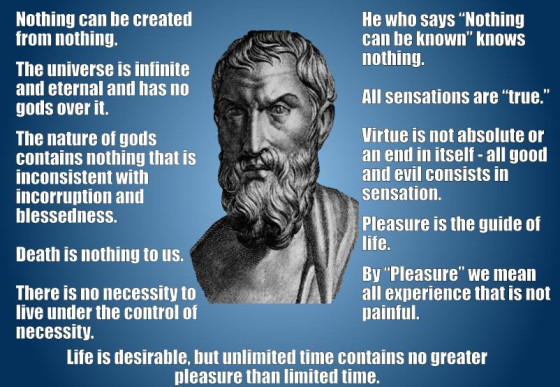
This page presents a summary of Classical Epicurean Philosophy . For additional citations to Epicurean texts, click here. Nothing Comes From Nothing Or Goes To Nothing Supernaturally
Working solely with the science available two thousand years ago, Epicurus observed that nothing ever arises from nothing, and nothing is ever completely destroyed to nothing. From this Epicurus deduced the existence of atoms - elemental particles moving through empty space from which over time all things are made… CassiusMay 24, 2025 at 3:30 PM - EpicureanFriends Introductory Course Outline
- Session One - Nothing Can Be Created From Nothing
- Session Two - The Universe Is Infinite In Size and Eternal In Time And Has No Gods Over It
- Session Three - The Nature of Gods Contains Nothing That Is Inconsistent With Incorruption And Blessedness.
- Session Four - Death Is Nothing To Us.
- Session Five - There Is No Necessity To Live Under the Control Of Necessity
- Session Six - He Who Says "Nothing Can Be Known" Knows Nothing
- Session Seven - All Sensations Are True
- Session Eight - Virtue Is Not Absolute Or An End In Itself. All Good And Evil Consists In Sensation.
- Session Nine - Pleasure Is The Guide Of Life
- Session Ten - By Pleasure We Mean All Experience That Is Not Painful (The Absence of Pain)
- Session Eleven - Life Is Desirable, But Unlimited Time Contains No Greater Pleasure Than Limited Time
- Session Twelve - In Summary: The Epicurean View Of The Best Life
- The best life results when we hold firmly and consistently to the major doctrines of Epicurus, and when we reject all that is inconsistent with them. This requires study and effort, and in a world full of anti-Epicurean opinions, it is not for the faint-hearted. But for those who are persuaded by Epicurus' teachings the path is clear.
- As the Torquatus summarized for us: "The truth that pleasure is the supreme good can be most easily apprehended from the following consideration. Let us imagine an individual in the enjoyment of pleasures great, numerous and constant, both mental and bodily, with no pain to thwart or threaten them; I ask what circumstances can we describe as more excellent than these or more desirable? A man whose circumstances are such must needs possess, as well as other things, a robust mind subject to no fear of death or pain, because death is apart from sensation, and pain when lasting is usually slight, when oppressive is of short duration, so that its temporariness reconciles us to its intensity, and its slightness to its continuance. When in addition we suppose that such a man is in no awe of the influence of the gods, and does not allow his past pleasures to slip away, but takes delight in constantly recalling them, what circumstance is it possible to add to these, to make his condition better?"
- For ease of reference, here is a summary list of the above doctrines:
- Nothing Can Be Created From Nothing.
- The Universe Is Infinite And Eternal And Has No Gods Over It
- Gods Have No Attributes Inconsistent With Blessedness And Incorruptibility
- Death Is Nothing To Us.
- There Is No Necessity To Live Under The Control Of Necessity.
- He Who Says That Nothing Can Be Known Knows Nothing
- All Sensations Are True
- Virtue Is Not Absolute Or An End In Itself - All Good And Evil Consists In Sensation.
- Pleasure is The Guide of Life.
- By Pleasure We Absence Of Pain (All Experience That Is Not Painful)
- Life Is Desirable, But Unlimited Time Contains No Greater Pleasure Than Limited Time.
- The best life results when we hold firmly and consistently to the major doctrines of Epicurus, and when we reject all that is inconsistent with them. This requires study and effort, and in a world full of anti-Epicurean opinions, it is not for the faint-hearted. But for those who are persuaded by Epicurus' teachings the path is clear.
- EpicureanFriends Introductory Course Outline
-
MarkJW to you or anyone else who is not in an American time zone, we'll work to set up another more suitable time to accomplish the same thing. If anyone else has a time zone issue please let us know.
-
Today we're introducing the second new home page attraction - a media presentation of Velleius' speech explaining Epicurus' view of divinity from Cicero's On The Nature of The Gods. I'll repeat what I said about the current state of both this and the other text-to-speech production:
- This audio voice is far from perfect. {Actually, I think this one is better than the Torquatus version, for some strange reason, as they were produced in the same way.) Much effort has been put into this version, but the AI voice has a long way to go, so lower your expectations. We want the best, but we also want to reach as many people with this information as possible. If we wait for perfection, some will miss having this available to him that might otherwise see it.
- The text is adapted from the same versions that we already have on the website, but it needs to be improved. i will be placing this text on "Github," a public site where text can be edited in a collaborative manner. I will appreciate submissions for corrections and will get them up as soon as possible. Again, the tradeoff here is that if we wait for perfection before we publish this, some will miss it who might otherwise profit from it.
- One merit of this audio voice is that it is entirely in the public domain. We can continue to work on improving it and distribute this with no copyright concerns whatsoever.
- It will be desirable to add graphics throughout the video to illustrate the text. That will be a huge task , and suggestions on how to do that will be appreciated.
- As this text is not copyrighted, anyone who wants to proceed on their own to produce a better version is welcome to do so. Our goal is to promote the philosophy of Epicurus with the best material available, not to promote the graphics skill of me (which are obviously poor) or of anyone else.
- Check THIS POST for more technical info.
- We will be regularly updating this to improve the text and presentation quality. One side effect of that, however, is that it is not possible to proofread a new version, without watching the whole thing. That means regression errors may creep into another part of the file as a result of editing an existing error. Please feel free to report any and all errors anytime you observe one, as we may not already be aware of it for this reason.
Finding Things At EpicureanFriends.com
Here is a list of suggested search strategies:
- Website Overview page - clickable links arrranged by cards.
- Forum Main Page - list of forums and subforums arranged by topic. Threads are posted according to relevant topics. The "Uncategorized subforum" contains threads which do not fall into any existing topic (also contains older "unfiled" threads which will soon be moved).
- Search Tool - icon is located on the top right of every page. Note that the search box asks you what section of the forum you'd like to search. If you don't know, select "Everywhere."
- Search By Key Tags - curated to show frequently-searched topics.
- Full Tag List - an alphabetical list of all tags.