

Kalosyni , in another thread in the Gallery, made the important point that it depends very much on the individual UU congregation and pastor as to whether they would be open to exploring Epicureanism within their organization. Fully agree! My intent for bringing them up was that they were the only organization that came to mind that would seem to be receptive - if the interest is in exploring the "spiritual" aspects (for lack of a better term than "piety") of Epicurus's philosophy if we don't want to start from scratch.
Posts by Don
New Graphics: Are You On Team Epicurus? | Comparison Chart: Epicurus vs. Other Philosophies | Chart Of Key Epicurean Quotations | Accelerating Study Of Canonics Through Philodemus' "On Methods Of Inference" | Note to all users: If you have a problem posting in any forum, please message Cassius
-
-
I would be very curious if anyone else has had any experience with Unitarian Universalist congregations and Epicureanism. I haven't personally, just using those links as background.
-
I must say I kind of liked the "Epicurean liturgy" they link to in the first site.
-
Anyway, maybe I'll drop in tomorrow.
If you do, keep us posted on your experience. I for one am curious. I've seen some mention of UUs having Epicurean dinners for philosophical conversation and eating. Ex.
A second "Epicurean Gathering" and a little bit of it's historyUpdate 26 June 2014. Please click on this link to go to a page where you will find the most recent revision of the Epicurean Liturgy and a...andrewjbrown.blogspot.comThe Swerve: How the World Became Modern | Unitarian Universalist Church of Canton
Epicurus Archives - Cambridge Unitarian ChurchA Non-Prophet Organisationwww.cambridgeunitarian.org -
@Root304 , if you're interested in exploring "spiritual" outlets for your kids: Do you have any Unitarian Universalist churches in your area. We attended one when our daughter was young. My only misgiving(?) was that they were almost too welcoming. Anything goes. That was during my Buddhist period, too. So, they'd be more than open to an Epicurean. But it gave structure for our daughter and she had fun.
-
forgive me for always mentioning that I am thinking about my kids in every post.
Nothing to forgive there

-

the well-known "Captain Kirk" alternative of changing the rules of the game rather than giving in to defeat without every last possible exertion.
Ah, the Kobayashi Maru...
Also to the tiger example, and Epicurean might say: "What the heck are you doing hanging out around cliffs where tigers are everywhere?
Well, if you live somewhere where tigers are an actual not uncommon danger (which is I believe the origin of this story), you don't really get a choice of hanging around where tigers are a danger. You're already there.
(I realize your comment was mostly tongue in cheek, but just saying.)
-
Quote from Cassius
But in most cases, even if you were actually on the Titanic, I think it would make the most sense to use every second...
In these contexts, I harken back to a Tibetan Buddhist saying:
QuoteIf you were to fall to your death from a very great height it would be a shame not to enjoy the view as you fell, or to appreciate the wind in your hair or warmth of the sun on your face.
So, yes, if there's a chance of survival, work on surviving. If you fall out of an airplane, squeeze the last iota of pleasure from your life.
-
Welcome aboard, DavidN !
-
I wanted to note - even though we all know it, it bears repeating - that Epicurueanism was over well over 300 years old when Christianity was just beginning to be established:
In around 311 BC, Epicurus, when he was around thirty years old, began teaching in Mytilene. (Wikipedia)
Jesus' ministry ended around 30 CE. Paul's conversion is around the same time. Epicurus started teaching around 311 BCE... Over 340 prior to the beginnings of Christianity.
In light of that, I just want to say that - for me - it's only makes sense if the flow of similarities flows from Epicurueanism to Christianity. Just like Christmas, Easter, building churches on ground holy to existing faiths. Just like one theory of mine that the church of St George in the Kerameikos district in Athens is built on top of the Garden. That's just a theory of mine, not currently backed up by anything other than a hunch. If there are similarities, it's because the Garden was seen as a threat, and the followers of Christ stole from it to make their religion more popular. Tantum religio potuit suadere malorum.
-

The current understanding of the word "saviour" comes to us by the Christian faith in Jesus being eternal/immortal and all powerful. I would doubt Epicureans felt that way about Epicurus.
I would agree that the Epicurueans didn't see Epicurus as *that* kind of savior, but I have no problem thinking they saw him as a savior figure. He literally saved humanity from ignorance and fear. One doesn't have to be immortal or omnipotent to be a saviour. It was also a popular epithet for gods and heroes:
PS:
Early AD 121 – Plotina writes to Hadrian on behalf of the Epicurean school in Athens (#Hadrian1900) FOLLOWING HADRIANIn the early year of AD 121, Pompeia Plotina, the greatly respected widow of the emperor Trajan, sent Hadrian a letter asking him to help the Epicurean school…followinghadrian.comboth the preservation of the dignity of that place which contains the (…) will be firmly secures and equally the opinion concerning the successor of our saviour, which… when… became master of the school, since Epicurus…
Saviour in her letter is ΣΩΤΗΡ:
Fourth line from the bottom on the right.
PS: That word is in the phrase ΚΑΘΗΓΕΜΟΝΙΑΣ ΤΟΥ ΣΩΤΗΡ which is kathēgemonias which I'm assuming the translator gives as "successor" but it is similar (identical?) to the terms used in DeWitt and elsewhere to refer to the teachers of the Garden.
-
Thanks for these references, @Nate .
For anyone who's interested...
52. Friendship dances around the world, announcing to each of us that we must awaken to happiness.
ἡ φιλία περιχορεύει τὴν οἰκουμένην κηρύττουσα δὴ πᾶσιν ἡμῖν ἐγείρεσθαι ἐπὶ τὸν μακαρισμόν.
κηρύττω Attic form of κηρῠ́σσω
Henry George Liddell, Robert Scott, A Greek-English Lexicon, κηρύσσω
G2784 - kēryssō - Strong's Greek Lexicon (kjv)G2784 - κηρύσσω kērýssō, kay-roos'-so; of uncertain affinity; to herald (as a public crier), especially divine truth (the gospel):—preacher(-er), proclaim,…www.blueletterbible.orgAlso note:
ἐγείρεσθαι (middle/passive infinitive) "to wake, keep watch; to rouse oneself, be excited"
μακαρισμόν. Note that those is the exact word used to describe the gods. "Happiness" is a little underwhelming here. In fact, friendship dances round the known world (http://www.perseus.tufts.edu/hopper/text?do…try=oi)koume/nh) heralding to each and every one of us to awaken to the blessed life of the gods.
-
@Root304 , *that* would be an interesting exercise. The Greek gods were just as supernatural as the Christian god and theology is, and as embedded in the modern culture. The omnipresent cultural milieu in the US and other nations is Christianity.
"lighten my own ill-feelings" Good luck with that... And I'm not trying to be sarcastic or tongue in cheek. Honestly, that's not necessarily easy (speaking from personal experience).
But an Epicurean reimagining or mental approach to the cultural gods could be an interesting discussion

-

OK I recognize that the circles in the diagram above don't intersect, so maybe it's not really a Venn diagram.

-
Okay, done! That was fun! I didn't do Plato since Joshua did a good job above.
Enjoy!
Nausiphanes:
‘The mollusk,’ πλεύμονά (pleumona "lung-fish, jellyfish"> related etymologically to English "pleurisy")
Henry George Liddell, Robert Scott, A Greek-English Lexicon, πλεύμων
Hicks note: Cf. Sext. Emp. Adv. math. i. 3 νῦν πλεύμον α καλῶν τὸν Ναυσιφ άνην ὡς ἀναίσθ ητον; Plato, Phil. 21 c ζῆν δὲ οὐκ ἀνθρώπο υ βίον ἀλλά τινος πλεύμον ος; Hesychius, s.v. ; whence it appears that obtuseness and insensibility, not weakness or pliability, were the qualities imputed by this term.
‘The illiterate,’ ἀγράμματον (agrammaton)
Henry George Liddell, Robert Scott, A Greek-English Lexicon, ἀγράμμ-α^τος
Don note: It's an even better insult than simply "illiterate" because one connotation is "of animals, unable to utter articulate sounds."
‘The cheat,’ ἀπατεῶνα (apateōna "a cheat, rogue, quack.")
Henry George Liddell, Robert Scott, A Greek-English Lexicon, ἀπα^τ-εών
Don note: Follow that LSJ link for some other uses of the term in Hippocrates, Plato, and Xenophon
‘The harlot.’ πόρνην (pornēn, related to English "pornography.")
Don note: The pornai were at the bottom of the ancient Greek social structure, always slaves living at the whim of pimps. There is a solid article on "Prostitution in ancient Greece" on Wikipedia that is heartbreaking (and graphic, NSFW). The recent fiction book "The Wolf Den" by Elodie Harper does an excellent job in portraying the lives of the women enslaved in the (excavated) brothel in Pompeii.
Aristotle:
‘The debauchee,' ἄσωτον (asōton)
Don note: It's very important to realize that this is the *exact* same word Epicurus used in describing the pleasure of the *profligate/prodigal* in the letter to Menoikeus: "Therefore, whenever we say repeatedly that "pleasure is the τέλος," we do not say the pleasure of those who are prodigal..." I highly recommend people taking a look at verse 131 in my Letter to Menoikeus translation at
FileEpicurus's Letter to Menoikeus - A New Translation with Commentary
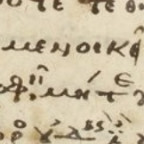 An in-depth translation and commentary of Epicurus's Letter to Menoikeus. Don
July 19, 2023 at 11:25 PM he devoured his inheritance and then enlisted and sold drugs.
καταφαγόντα τὴν πατρῴαν οὐσίαν (kataphagonta "eat up, devour" the last part is the English suffix "-phage")
στρατεύεσθαι (strateuesthai "serve/enlist/email in the army")
φαρμακοπωλεῖν (pharmakopōlein LSJ "to be druggist"; a dealer in drugs)
Protagoras:
‘Porter’ φορμοφόρον (phormorphoron "porter", also name of a play by Hermippus)
Related https://kaikki.org/dictionary/Anc…F%8C%CF%82.html
‘Copier of Democritus,’ γραφέα (graphea, "private secretary, copyist, scribe") Δημοκρίτου (Demokritou)
he taught in the village schools. ἐν κώμαις γράμματα διδάσκειν
Heraclitus:
‘The Muddler,’ κυκητὴν (kykētēn, LSJ "stirrer, agitator") from κῠκᾰ́ω "to stir up, mix; to stir up, throw into confusion, confound"
Henry George Liddell, Robert Scott, A Greek-English Lexicon, κυ^κ-άω
Democritus:
Lerocritus (‘judge of nonsense’)
Ληρόκριτον (Lērokriton, kriton "judge, see English "critic")
λῆρος "silly talk, nonsense, trumpery, Ar.:—of persons, nonsense, a trifler, Plat.; λῆροι λεπτότατοι, of sophists, Ar.; as an exclamation, λῆρος, nonsense! humbug! id=Ar."
Henry George Liddell, Robert Scott, A Greek-English Lexicon, λῆρος
Don note: I'm curious of the context of this one. Is Democritus "judging nonsense" or is he a "silly-talking judge". I could see Lerocritus being positive under one context and an insult under another. Context is everything here. Hicks translates it "the nonsense-monger". I don't see the sense of monger or dealer or trader in nonsense in the -kriton part
Henry George Liddell, Robert Scott, A Greek-English Lexicon, κρι^τ-ής
So I wish we knew from where Diogenes got that reference.
Antidorus: Ἀντίδωρον
Sannidorus (‘Maniac’) Σαννίδωρον (Sannidorōn .. Sannidorus)
Don note: My bet is that the name is a play on Antidorus' name itself: Ἀντίδωρον so Σαννίδωρον. His name itself literally means return-gift "anti-gift" so the job would be what does Σαννί- refer to. What kind of "gift" is Epicurus word-playing here? σᾰ́ννᾱς is "zany, fool, buffoon" but also σάννιον "membrum virile, Eup.440" which reminds me in this context of a now-classic Saturday Night Live skit with Justin Timberlake. Enough said on that.
This Antidorus must be:
the Cynics:
‘Enemies of Hellas,’ ἐχθροὺς τῆς Ἑλλάδος (ekhthrous tēs Hellados ("Greece/Hellas")
Henry George Liddell, Robert Scott, A Greek-English Lexicon, ἐχθρός
Don note: I found this connotation interesting in that definition: "ἐχθρός is one who has been φίλος ("friend"), but is alienated." It's still "enemies" but provides a shade of meaning.
the Logicians: διαλεκτικοὺς (dialektikous, specifically those skilled in dialectic)
Henry George Liddell, Robert Scott, A Greek-English Lexicon, διαλεκτ-ικός
‘The destroyers,’ πολυφθόρους (polyphthorous, "destroying many (poly-), fraught with death"
Pyrrho:
‘The uneducated fool.’
Don note: It's actually two words: ἀμαθῆ καὶ (&) ἀπαίδευτον. Hicks: "ignorant boor"
ἀμαθῆ (amathē, "ignorant, stupid") but see LSJ for some intriguing alternative connotations
Henry George Liddell, Robert Scott, A Greek-English Lexicon, ἀμαθ-ής
ἀπαίδευτον apaideuton, literally means uneducated (paidaea)
Henry George Liddell, Robert Scott, A Greek-English Lexicon, ἀπαίδ-ευτος
-
You know I'm going to post the original Greek for all these at some point, right?

As promised too long ago:
Diogenes Laertius, Book X.8:
[8] καὶ αὐτὸν Ἐπίκουρον ἐν ταῖς ἐπιστολαῖς περὶ Ναυσιφάνους λέγειν: "Ταῦτα ἤγαγεν αὐτὸν εἰς ἔκστασιν τοιαύτην, ὥστε μοι λοιδορεῖσθαι καὶ ἀποκαλεῖν διδάσκαλον." πλεύμονά τε αὐτὸν ἐκάλει καὶ ἀγράμματον καὶ ἀπατεῶνα καὶ πόρνην: τούς τε περὶ Πλάτωνα Διονυσοκόλακας καὶ αὐτὸν Πλάτωνα χρυσοῦν, καὶ Ἀριστοτέλη ἄσωτον, <ὃν> καταφαγόντα τὴν πατρῴαν οὐσίαν στρατεύεσθαι καὶ φαρμακοπωλεῖν: φορμοφόρον τε Πρωταγόραν καὶ γραφέα Δημοκρίτου καὶ ἐν κώμαις γράμματα διδάσκειν: Ἡράκλειτόν τε κυκητὴν καὶ Δημόκριτον Ληρόκριτον καὶ Ἀντίδωρον Σαννίδωρον: τούς τε Κυνικοὺς ἐχθροὺς τῆς Ἑλλάδος: καὶ τοὺς διαλεκτικοὺς πολυφθόρους, Πύρρωνα δ᾽ ἀμαθῆ καὶ ἀπαίδευτον.
Diogenes Laertius, Lives of Eminent Philosophers, Ι, ΕΠΙΚΟΥΡΟΣ
Step one, Check.
The parsing will have to wait
-
@Root304 , I'll admit I was unfamiliar with the topics you mentioned. At the risk of simplifying things, for myself and others, here are relevant Wikipedia articles:
Internal Family Systems Model - Wikipedia
Somatics - Wikipediaen.wikipedia.orgPlease feel free to tell me if these are off the mark!
My sense is that anything that truly and honestly makes us more aware of our bodies, our reactions to stimuli, and our feelings of pleasure and pain will make us more able to apply the faculty of choice and rejection. That's a good thing. I get the impression that we all try to lie to ourselves and try to make ourselves believe and/or behave in ways counter to our well-being (eudaimonia) all too often. That's what I believe one of the benefits of the practice of frank speech and correction in the ancient Epicurean community was. You may fool yourself, but you can't necessarily fool your friends or your teacher. You have to be open to correction and direction. Being able to do this yourself would be a boon.
I look forward to hearing more and hope this was helpful.
PS. This is also where the work of Dr. Lisa Feldman Barrett and others comes in, too. Cultivating our sense of interoception allows us to listen closer to our body's signals. I'd suggest checking out her books as well.
-
@Root304 , I initially joined the forum seriously intending to simply read and learn. I found myself intrigued and curious. Now, I can't shut up.
I hope you'll find some encouragement in that to ask questions and be active on the forum. Welcome. -
To me, this looks like another endorsement for the Tetrapharmakos as a *very* abridged summary of the philosophy since that is just an abridgement of PD1 through PD4. Just sayin'
-
Well said! Thanks for this.
I especially like this...I have found that a genuine feeling of gratitude does not depend on knowing its source. Gratefulness is its own reward as it can neutralize poisons like resentment, envy, jealousy, etc. It has to be genuine though and only the individual can ever know whether it is or not.
Finding Things At EpicureanFriends.com
Here is a list of suggested search strategies:
- Website Overview page - clickable links arrranged by cards.
- Forum Main Page - list of forums and subforums arranged by topic. Threads are posted according to relevant topics. The "Uncategorized subforum" contains threads which do not fall into any existing topic (also contains older "unfiled" threads which will soon be moved).
- Search Tool - icon is located on the top right of every page. Note that the search box asks you what section of the forum you'd like to search. If you don't know, select "Everywhere."
- Search By Key Tags - curated to show frequently-searched topics.
- Full Tag List - an alphabetical list of all tags.