
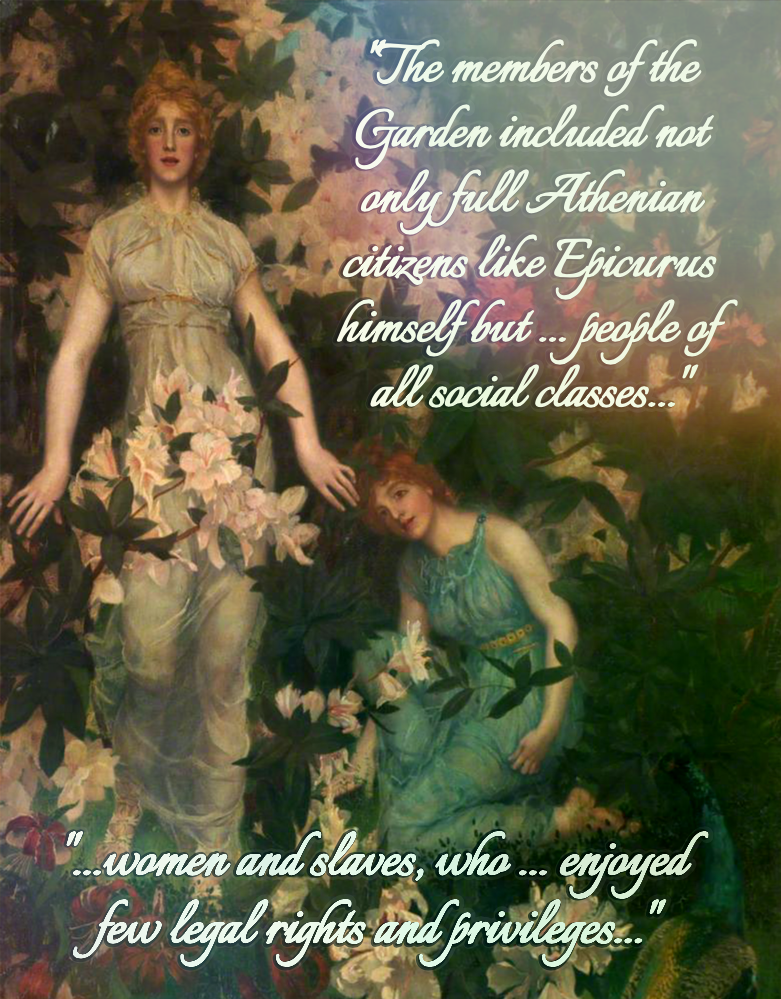
Looks like Eikadistes has come across it though.
It's a great image! (I made it) 


Looks like Eikadistes has come across it though.
It's a great image! (I made it)


Symmetresis" is the word I prefer to use in the place of "hedonic calculus."
That post cries out for explanation, Nate!
ΣYMMETPHΣIΣ – συμμέτρησις – symmétrēsis – Epicurus uses the word as συμμετρήσει (symmetrēsei) when describing “measuring things side by side and looking at both the advantages and disadvantages” (Ep. Men.)
In Epicurus’ Epistle To Herodotus, he uses several inflections of the word to refer to the process of arriving at correct judgments about sensation: σύμμετρον (47, 50), σύμμετροι (54), συμμετρότερον; and then several more times in his Epistle To Pythocles: (91), συμμετρίας (107), συμμέτρως (110), συμμέτρως (111), συμμετρήσει (130).
συμμέτρησις is the word I prefer to use in the place of "hedonic calculus."
Seems to me you're right. In the distant past I read some into the Essenes in regard to the Dead Sea scrolls and so forth. I don't recall whether the Essenes were into life after death or against it (was that the Sadducees?) but that would seem to be another potential point of crossover influence.
Pro-death. The Essenes were mystics.
I am curious if their social structure resembled Gardens, because they are opposed, ideologically.
I am sure that others ( Eikadistes ? ) have better ideas for illustrating this, but it seems to me that there can never be too many ways of arguing and showing that the undisturbed pursuit of pleasure is ultimately why we seek to avoid pain, not the other way around.
I like anything to do with Star Trek. 
I am flirting with the idea that Epicurus stumbled over the concept of spacetime without realizing it.
Lucretius :“Epicurus […] he who outshone the human race in genius and obscured the luster of all as the rising of the sun extinguishes the stars.” (III:1043-45)
“For if we are to speak as the majesty of his revelations demand, a god he was, a god […] who first discovered that principle of life which is now identified with wisdom, and who by his genius saved life from such mighty waves and such deep darkness and moored it in such calm water and so brilliant light. […] so we have the more justification for deifying the author of the sweet consolations of life that, disseminated throughout might nations, even now are soothing people’s minds.” (V:7-12, 19-21)
“And will not the man who, using words instead of weapons, subdued all these monsters and banished them from the mind rightly be considered worthy of a place among the gods? Especially since it was his wont to present many precepts in a good and godlike manner about the immortal gods themselves, and to reveal the whole nature of things in his discourse.” (V:49-54)
“[…] a man endowed with such genius, whose lips once gave utterance to true pronouncements on every subject. And even now, though his life’s light is extinguished, the godlike nature of his discoveries ensures that his fame, spread far and wide long ago, is raised to the skies.” (VI:4-8)
Diogenes Laertius: “There are plenty of witnesses of the unsurpassable kindness of [Epicurus] to everybody; both his own country which honored him with brazen statues, and his friends who were so numerous that they could not be contained in whole cities; and all his acquaintances who were bound to him by nothing but the charms of his doctrine.”
Just linking my "Epicurean Verses When You're Feeling..." post/file to this thread:

His sweetest quote on pain management is useful to me in acknowledging the power of remembrance,
it could be a very individualized process. Perhaps everyone should make their own collection of what they find helpful, as an exercise and to assist in learning.
Everyone is definitely welcome to do so (I recommend it), and, as mentioned, if anyone has any peer feedback with specific, constructive suggestions to improve my work, I am openly asking for it.
His sweetest quote on pain management is useful to me in acknowledging the power of remembrance,
As for myself...there is now so much on the internet. And all I have to do is type in whatever problem I am encountering and then lots of practical advice comes up for me on various websites.
As an Epicurean, I recommend taking Epicurus' advice over Wikipedia's. 
I do not have immediate access to On Anger in its entirety. If anyone has a link, or else, meaningful quotations they may have documented, I would appreciate if you could share. (I am still looking, myself).
Eikadistes, as I look over it some more:
1. my concern continues to be that these will end up dealing with "symptoms" and not "causes" of feelings and emotions. Also, you'll want to have your sense of anger working correctly, so it is there for you when you need it, and you should not be trying to tamp it down. So a truly emotionally healthy person will feel a rainbow of feelings and emotions, but they will not be perplexed, overwhelmed by, or stuck in their feelings/emotions. There will be a healthy flow. And healthy anger when it does arise won't be a big blowout, but a recognition of bodily feelings. And so...We need not the appearance of health but actual true health (VS54)
2. Verses taken out of context: -- the first listing under "persecuted" from Letter to Menoeceus; -- VS62 under "anger" is specifically between parents and children (perhaps there are others).
3. Some of words you use as "feelings" are in actuality evaluations/judgements and not feelings/emotions -- insecure, rejected, persecuted, injured, poor, weak.
Thanks for that – what I'm reading is that (1.) I should probably include more quotes from Philodemus' On Anger to better flesh out the nuances of anger, and not to frame it as something negative, merely something worth caution; (2.) While I did intentionally removed some of the items from their context for a purpose (the quote is still meaningful and more available to people without children in their lives) it is a good note to reflect that the context of some of these might be really important; (3.) That is a good point that not all of the items in the list are actually emotions, some are just conditions. I am open to replacing those conditional words with emotional words.
Still, it is important to me to keep some context. When I say "poor" I mean, "feeling dejected due to economic circumstances", economic safety being an instrument to happiness, as opposed to the general feeling of "jealousy", which might be vain (desire for fame). There are some nuances in terms of prescriptions that Epicurus provides to deal with conditions, and, I will just add, all of those quotes, thus far, strike me, within those labels, as being emotionally impactful, so if it isn't striking you, I am wondering where you might move the quote, or just get rid of it.
His sweetest quote on pain management is useful to me in acknowledging the power of remembrance, not a "How To Deal With Kidney Stones: For Men" guide. Likewise, the quote on dealing with childish anger is useful as a non-parent. At the same time, the quotes dealing with "hurtful-feelings caused by economic marginalization" is a nuance that I do not want to abstract to mere "jealousy" ... I think it could be re-organized under "hopelessness", or, better yet, I could add "frustrated". Immediately, that strikes me as the better option.
Kalosyni I think you brought up a great point that the condition feeling-ish words I used would be better address with nuances, if you have some suggestions. I think "frustrated" might be a better replacement for "poor", and so on.
Greetings, friends. As I mentioned in another post, Hiram inspired me a while ago to begin working on an Epicurean equivalent to the "Verses when you're feeling..." section found at the end of selected copies of the Christian New Testament.
The intention of this document is to be used as a functional instrument toward reinforcing the health of one's soul.
I am looking for feedback (ask yourself, if this were re-arranged differently, what changes could be help my own, personal needs?). I am looking for suggestions to (a) rename emotions I have selected, (b) merge sections, for example, "Guilty" and "Regretful" are similar and there is an argument in my head to be made that they can be merged; still, I chose to keep them separate; you will notice others that are similar, (c) Omitting misleading or inappropriate quotations, (d) moving quotations beneath a different emotional category, (e) general formatting notes, bookmarks, hyperlinks, margins, etc.
This is just a First Draft and I hope to continue sculpting it into something that can be shared.
You can find the file here: Epicurean Verses For When You're Feeling...
This thread can be used as a place to share recommendations for improving this document.
Riffing off of Don's observations, I'd like to re-designate the Stoics as "the Stoop Kids", the Peripatetics as "Ramblers", the Academics as "Gold-Diggers", the Cynics as "Growlers", and ... I suppose the Skeptics would still, appropriately be called "Pyrrhonists" as followers of Pyrrho. And while we could refer to ourselves as "Gardeners", I much prefer the designation that Athenaeus provides in Deipnosophistae (5:3), that we are ΠPOΦHTAΣ ATOMΩN, or, "Atom Prophets".
It seems fitting here to remember that W. B. Yeats considered Lucretius' fourth book to contain "the greatest description of sexual intercourse ever written". He responded to it by writing that "the tragedy of sexual intercourse is the perpetual virginity of the soul"--in other words, that, try as they might, lovers never can succeed in becoming two in one.
(RE-POST): I wanted to include a few classical references (or direct theft) of Epicurus. We'll start with Virgil's ode:
"He sung the secret seeds of Nature's frame –
How seas, and earth, and air, and active flame
Fell through the mighty void, and in their fall
Were blindly gathered in this goodly ball.
The tender soil then stiffening by degrees
Shut from the bounding Earth the bounding seas.
Then earth and ocean various forms disclose,
And a new sun to a new world arose.
And mists condensed to cloud obscure the sky:
And clouds dissolved the thirsty ground supply.
The rising trees the lofty mountains grace,
The lofty mountains feed the savage race,
Yet few, and strangers in the unpeople place.
From hence the birth of man the song pursued,
And how the world was lost and how renewed." (Virgil, Eclogues, vi.31)
Following this (much, much later), Edmond Halley wrote an ode to Newton in the forward of Philosophiae Naturalis Principia Matematica (1687). While it is not necessarily Epicurean, the historical link is interesting:
"...Then ye who now on heavenly nectar fare,
Come celebrate with me in song the name
Of Newton, to the Muses dear; for he
Unlocked the hidden treasuries of Truth:
So richly through his mind had Phoebus cast
The radiance of his own divinity.
Nearer the gods no mortal may approach." (Edmund Halley, Ode To Isaac Newton)
And I may as mention Horace, since Virgil made the list:
"Treat every day that dawns for you as the last.
The unhoped-for hours' ever welcome when it comes.
When you want to smile then visit me: sleek, and fat
I'm a hog, well cared-for, one of Epicurus' herd." (Horace, The Epistles 1.4.13-16)
Next, Edmund Spenser steals Lucretius' invocation to Venus from the beginning of Book I, and then, later, in the same poem, makes an allusion to DRN V:747.
"Great Venus, Queene of beautie and of grace,
The ioy of the Gods and men, that vnder skie
Doest fayrest shrine, and most adorne thy place,
That with they smyling looke doest pacifie
The raging seas, and makst the stormes to flie;
Thee goddesse, thee the winds, the clouds doe feare,
And when though spreadst thy mantle forth on hie,
The waters play and pleasant lands appeare,
And heauens laugh, & al the world shrews ioyous cheare." (Edmund Spenser, The Faerie Queene 4.10.44)
"Lastly, came Winter cloathed in all frize,
Chattering his teeth for cold that did him chill." (Spenser, The Faerie Queene 7.7.31.1-2)
The following is Lord Byron's rendering of DRN I-33-41:
"In all thy perfect goddess-ship, when lies
Before thee thy own vanquished Lord of War?
And gazing in thy face as toward a star,
Laid on thy lap, his eyes to thee upturn,
Feeding on thy sweet cheek! while thy lips are
With lava kisses melting while they burn,
Showered on his eyelids, brow, and mouth, as from an urn!" (Lord Byron, Childe Harold's Pilgrimage 4.51)
I am now convinced that Shakespeare was quite familiar with ancient Greek philosophy:
"LEAR: Why, no, boy: nothing can be made out of nothing." (King Lear 1:4.106)
"MERCUTIO: She is the faeries' midwife, and she comes
In shape no bigger than agate-stone
On the forefinger of an alderman,
Drawn with a team of little atomi
Over men's noses as they lie asleep." (Romeo and Juliet 1.4.52-56)
"CELIA: It is as easy to count atomies as to resolve the
propositions of a lover. But take a taste of my
finding him, and relish it with good observance. I
found him under a tree like a dropped acorn." (As You Like It 3.2.1332-1335)
"OTHELLO: ...like to the Pontick Sea,
Whose icy current and compulsive course
Ne'er feels retiring ebb, but keeps due on
To the Propontick at Hellesport." Othello 3.3.453-456; allusion to DRN V:506-508)
There are a number of contemporary thinkers who have translated parts of DRN into English prose. For example, the French metaphysician Gilles Deleuze translates lines 633-634 from De Rerum Natura:
"...out of connections, densities, shocks, encounters, occurrences, and motions." (Deleuze [1990a] 267)
In The Advancement of Education the English philosopher Francis Bacon translated DRN II:1-10:
"In is a view of delight ... to stand of walke vpon the shoare side, and to see a shippe tossed with tempest vpon the sea; or to bee in a fortified Tower, and to see two Battailes ioyie vppon a plaine. But is a pleasure incomparable for the minde of man to be setled, landed, and fortified in the certaintie of truth; and from thence to descrie and behould the errours, perterbations, labours, and wanderings up and downe of other men." (1605)
Of special note, French philosophy Denis Diderot invoked a line from De Rerum Natura as his personal motto. He paraphrases DRN IV:338 as an emblematic, rallying cry for the entire Enlightenment period:
"Now we see out of the dark what is in the light." (Philosophical Thoughts 1746)
While they do not provide direct translation, we have notable reflections on Lucretian evolution from Erasmus Darwin (the less-famous grandfather of Charles) in The Temple of Nature, or the Origin of Society (1803) as well as David Hume in Dialogues Concerning Natural Religion (1779), regarding the poetry of DRN V:772-878.
Even one of my personal heroes, Carl Sagan makes commentary on DRN II:1090-1092.
"As Lucertius summarize [the Ionian philosophers'] views, 'Nature free at once and rid of her haughty lords is seen to do all things spontaneously of herself without the meddling of the gods." (Carl Sagan, The Demon-Haunted World)
The English poet George Sandys offers a translation of DRN II:14-19.
"O wretched minds of men! Depriued of light!
Through what great dangers, o[n] hou dark a night,
Force you your weary lives! and cannot see
How Nature onely craues a body free
From hated paine; a chearefulle Mind possest
Of safe delights, by care not feare opprest." (1632)
Of the beginning Book III, Frederick II is posthumously recorded as having said that "There are no better remedies for maladies of the mind." We then note that Lord Tennyson translated DRN III:18-24.
"...The Gods, who haunt
The lucid interspace of world and world,
Where never creeps a cloud, or moves a wind,
Nor ever falls the least white star of snow,
Nor ever lowest roll of thunder moans,
Nor sound of human sorrow mounts to mar
Their sacred, everlasting calm!" (Lord Tennyson, Lucretius 104-110)
England's first Poet Laureate, John Dryden provides a brief reflection of DRN III:831.
"What has this Bugbear death to frighten Man,
If Souls can die, as well as Bodies can?"
The poet Thomas Grey seems to appropriate the tone and imagery of DRN III:895-897.
"For them no more the blazing hearth shall burn,
Or busy housewife ply her evening care:
No children run to lisp their sire's return,
Or climb his knees the envied kiss to share." (Elegy Written in a Country Churchyard 21-24)
The poet Percy Shelley provides a beautiful rendition of DRN IV:415-420.
"We paused beside the pools that lie
Under the forest bough,
Each seemed as 'twere a little sky
Gulfed in a world below;
A firmament of purple light
Which in the dark earth lay." (Shelley, To Jane: The Recollections 53-58)
William Wordsworth provides us with a version of DRN V:222-227.
"Like a shipwrecked Sailor tost
By rough waves on a perilous coast
Lies the babe, in helplessness
And in tenderest nakedness
Flung by laboring Nature forth
Upon the mercies of the earth
Can its eye beseech? No more
Than the hands are free to implore:
Voice but serves for one brief cry;
Plaint was it? or prophesy
Of sorrow that will surely come?
Omen of man's grievous doom!" (William Wordsworth, To-Upon the Birthday of Her First-Born Child 1-12)
In Book VII of Paradise Lost, John Milton elaborates on Lucretian evolution from DRN V:772-878. I recommend reading further in Book VII because Milton (to my surprise) appropriates a significant amount of Lucretian imagery.
"Then Herbs of every leaf, that sudden flour'd
Op'ning thir various colours, and made gay
Her bosom smelling sweet..." (Paradise Lost, Book VII)
Diogenes of Oinoanda borrows heavily, directly from Lucretius. While he does not write in verse, the fact that he cites lines from DRN justify to me that he should be included in this list.I will just list the connections:
- Diogenes' fr. 47.III.10-IV.2 corresponds with Lucretius' DRN III:953-955
- Diogenes' NF 126-127.VI-IX, fr. 20 corresponds with DRN V:156-173
- Diogenes' fr. 12.II.11-V.14 corresponds with DRN V around line 1040.
This is what I have compiled in terms of Lucretian references in my most recent read-through.
There was one other discovery I wanted to share (somewhat off-topic, but just humor me...). In Book VI, Lucretius alludes to the largest seismic event in Antiquity (besides the earlier eruption of Mt. Etna and the later eruption of Mt. Vesuvius). This event occurred on the North side of the Peloponnesian peninsula, almost directly West of Athens. Presumably, a number of Athenians would have experienced this event ... Athenians like Plato. This occured in c. 373 BCE, and lead to the complete destruction of the ancient city of Helike as well as all of its inhabitants. So what exactly happened? From records, ancient authors describe what we might call as a "collapse" of a plate. In this instance, such an event would lead to the complete collapse of land above the event. Uniquely, it would have appeared that an entire mass of land fell straight downward, dozens of feet over the duration of only a few seconds. As I mentioned, we would have expected Athenians (like Plato), who were just East of this event, to have been very aware of it. Exactly 13 years later, Plato published his dialogue Timaeus in which he (and he alone) describes the fabled allegory of Atlantis, which collapses into the sea.
Coincidence? I propose that the destruction of the fictional city of Atlantis was inspired by the collapse of Helike.
We do have this thread going, which is an excellent resource, and great for compiling this kind of information. I generally like to keep tidy formatting there and limited conversation, but Nate, your post would be a great addition.
Thanks, Joshua ! I will do that. I thought you had a post like this around here somewhere...
Epicurus taught that “The occurrence of certain bodily pains assists us in guarding against others like them" (VS 73). He seems to have had a lot to say about the potential pitfalls of unrestrained sexuality ...
History may justify both characterizations, the sinner and the saint: Epicurus may have pursued a less-restrained sexual path as a youth (considering he was renown to have an attractive and beloved personality), and may have run into some of the undesirable side effects that helped shape his sense of selective sexual prudence.
I have been subjectively trying to convey this to my psychiatrists for years.
I call that old model the "Paint Bucket" model (that's just me). In the "Paint Bucket" model, the healthy brain is a perfect shade of purple, equal parts red (mania) and blue (depression). If you have too much of one color, you need to balance it out with the other color, thus, serotonin and dopamine seem to be the primary neurotransmitters psychiatrists try to regulate with the use of medication that specifically affects the "color" of your mind.
This is really limiting.
Take me. I have Bipolar I (manic-heavy side of BP), and they tend to treat me with things that counter-act mania, so, they try to eliminate insomnia, intrusive thoughts, obsessive behaviors, etc. Overall, the basic mood stabilization is a good place to start. It keeps me from passing a red line that leads to dangerous, physically-harmful behavior.
That's just a fraction of the story. The average Bipolar brain (in addition to people with Major Depressive Disorder) tend to have enlarged amygdalas, which manage emotions. That means anyone with a mood disorder (regardless of serotonin and dopamine levels) is more emotionally reactive and more emotionally affective. We get more emotional faster, we stay emotional longer, and it takes longer to return to a baseline. Medication cannot change the fact that I have a larger amygdala. Bipolar patients also tend to uniquely possess smaller-than-average pre-frontal cortecies, so while those of us with the stereotypical and ancient "Melancholic" personality exhibit brilliant phases of creativity and achievement, the shrunken pre-frontal cortex leads to a hinderance on a Bipolar patient's ability to clearly identify cause-and-effect, to make healthy, long-term plans, and to minimize risky-taking behaviors. Again, anti-depressants, mood-stabilizers, benzodiazepines, and even cannabinoids don't really address that issue. The closest treatment we provide to physically altering the structure of the brain is a lobotomy, and it is h-o-r-r-i-f-i-c.
Psychotherapy is needed to help patients ... learn to work with their limitations (and unique advantages). But even then, a supportive environment is crucial. Birds need sky, fish need lakes, basketball players need hoops, and Bipolar patients need friends with a LOT of patience and strong senses of self. Being surrounded by enemies can make the other treatments so ineffective that the patient begins wondering if there is any hope at all. And there is. Quite a lot.
I wanted to include a few classical references (or direct theft) of Epicurus. We'll start with Virgil's ode:
"He sung the secret seeds of Nature's frame –
How seas, and earth, and air, and active flame
Fell through the mighty void, and in their fall
Were blindly gathered in this goodly ball.
The tender soil then stiffening by degrees
Shut from the bounding Earth the bounding seas.
Then earth and ocean various forms disclose,
And a new sun to a new world arose.
And mists condensed to cloud obscure the sky:
And clouds dissolved the thirsty ground supply.
The rising trees the lofty mountains grace,
The lofty mountains feed the savage race,
Yet few, and strangers in the unpeople place.
From hence the birth of man the song pursued,
And how the world was lost and how renewed." (Virgil, Eclogues, vi.31)
Following this (much, much later), Edmond Halley wrote an ode to Newton in the forward of Philosophiae Naturalis Principia Matematica (1687). While it is not necessarily Epicurean, the historical link is interesting:
"...Then ye who now on heavenly nectar fare,
Come celebrate with me in song the name
Of Newton, to the Muses dear; for he
Unlocked the hidden treasuries of Truth:
So richly through his mind had Phoebus cast
The radiance of his own divinity.
Nearer the gods no mortal may approach." (Edmund Halley, Ode To Isaac Newton)
And I may as mention Horace, since Virgil made the list:
"Treat every day that dawns for you as the last.
The unhoped-for hours' ever welcome when it comes.
When you want to smile then visit me: sleek, and fat
I'm a hog, well cared-for, one of Epicurus' herd." (Horace, The Epistles 1.4.13-16)
Next, Edmund Spenser steals Lucretius' invocation to Venus from the beginning of Book I, and then, later, in the same poem, makes an allusion to DRN V:747.
"Great Venus, Queene of beautie and of grace,
The ioy of the Gods and men, that vnder skie
Doest fayrest shrine, and most adorne thy place,
That with they smyling looke doest pacifie
The raging seas, and makst the stormes to flie;
Thee goddesse, thee the winds, the clouds doe feare,
And when though spreadst thy mantle forth on hie,
The waters play and pleasant lands appeare,
And heauens laugh, & al the world shrews ioyous cheare." (Edmund Spenser, The Faerie Queene 4.10.44)
"Lastly, came Winter cloathed in all frize,
Chattering his teeth for cold that did him chill." (Spenser, The Faerie Queene 7.7.31.1-2)
The following is Lord Byron's rendering of DRN I-33-41:
"In all thy perfect goddess-ship, when lies
Before thee thy own vanquished Lord of War?
And gazing in thy face as toward a star,
Laid on thy lap, his eyes to thee upturn,
Feeding on thy sweet cheek! while thy lips are
With lava kisses melting while they burn,
Showered on his eyelids, brow, and mouth, as from an urn!" (Lord Byron, Childe Harold's Pilgrimage 4.51)
I am now convinced that Shakespeare was quite familiar with ancient Greek philosophy:
"LEAR: Why, no, boy: nothing can be made out of nothing." (King Lear 1:4.106)
"MERCUTIO: She is the faeries' midwife, and she comes
In shape no bigger than agate-stone
On the forefinger of an alderman,
Drawn with a team of little atomi
Over men's noses as they lie asleep." (Romeo and Juliet 1.4.52-56)
"CELIA: It is as easy to count atomies as to resolve the
propositions of a lover. But take a taste of my
finding him, and relish it with good observance. I
found him under a tree like a dropped acorn." (As You Like It 3.2.1332-1335)
"OTHELLO: ...like to the Pontick Sea,
Whose icy current and compulsive course
Ne'er feels retiring ebb, but keeps due on
To the Propontick at Hellesport." (Othello 3.3.453-456; allusion to DRN V:506-508)
There are a number of contemporary thinkers who have translated parts of DRN into English prose. For example, the French metaphysician Gilles Deleuze translates lines 633-634 from De Rerum Natura:
"...out of connections, densities, shocks, encounters, occurrences, and motions." (Deleuze [1990a] 267)
In The Advancement of Education the English philosopher Francis Bacon translated DRN II:1-10:
"In is a view of delight ... to stand of walke vpon the shoare side, and to see a shippe tossed with tempest vpon the sea; or to bee in a fortified Tower, and to see two Battailes ioyie vppon a plaine. But is a pleasure incomparable for the minde of man to be setled, landed, and fortified in the certaintie of truth; and from thence to descrie and behould the errours, perterbations, labours, and wanderings up and downe of other men." (1605)
Of special note, French philosophy Denis Diderot invoked a line from De Rerum Natura as his personal motto. He paraphrases DRN IV:338 as an emblematic, rallying cry for the entire Enlightenment period:
"Now we see out of the dark what is in the light." (Philosophical Thoughts 1746)
While they do not provide direct translation, we have notable reflections on Lucretian evolution from Erasmus Darwin (the less-famous grandfather of Charles) in The Temple of Nature, or the Origin of Society (1803) as well as David Hume in Dialogues Concerning Natural Religion (1779), regarding the poetry of DRN V:772-878.
Even one of my personal heroes, Carl Sagan makes commentary on DRN II:1090-1092.
"As Lucertius summarize [the Ionian philosophers'] views, 'Nature free at once and rid of her haughty lords is seen to do all things spontaneously of herself without the meddling of the gods." (Carl Sagan, The Demon-Haunted World)
The English poet George Sandys offers a translation of DRN II:14-19.
"O wretched minds of men! Depriued of light!
Through what great dangers, o[n] hou dark a night,
Force you your weary lives! and cannot see
How Nature onely craues a body free
From hated paine; a chearefulle Mind possest
Of safe delights, by care not feare opprest." (1632)
Of the beginning Book III, Frederick II is posthumously recorded as having said that "There are no better remedies for maladies of the mind." We then note that Lord Tennyson translated DRN III:18-24.
"...The Gods, who haunt
The lucid interspace of world and world,
Where never creeps a cloud, or moves a wind,
Nor ever falls the least white star of snow,
Nor ever lowest roll of thunder moans,
Nor sound of human sorrow mounts to mar
Their sacred, everlasting calm!" (Lord Tennyson, Lucretius 104-110)
England's first Poet Laureate, John Dryden provides a brief reflection of DRN III:831.
"What has this Bugbear death to frighten Man,
If Souls can die, as well as Bodies can?"
The poet Thomas Grey seems to appropriate the tone and imagery of DRN III:895-897.
"For them no more the blazing hearth shall burn,
Or busy housewife ply her evening care:
No children run to lisp their sire's return,
Or climb his knees the envied kiss to share." (Elegy Written in a Country Churchyard 21-24)
The poet Percy Shelley provides a beautiful rendition of DRN IV:415-420.
"We paused beside the pools that lie
Under the forest bough,
Each seemed as 'twere a little sky
Gulfed in a world below;
A firmament of purple light
Which in the dark earth lay." (Shelley, To Jane: The Recollections 53-58)
William Wordsworth provides us with a version of DRN V:222-227.
"Like a shipwrecked Sailor tost
By rough waves on a perilous coast
Lies the babe, in helplessness
And in tenderest nakedness
Flung by laboring Nature forth
Upon the mercies of the earth
Can its eye beseech? No more
Than the hands are free to implore:
Voice but serves for one brief cry;
Plaint was it? or prophesy
Of sorrow that will surely come?
Omen of man's grievous doom!" (William Wordsworth, To-Upon the Birthday of Her First-Born Child 1-12)
In Book VII of Paradise Lost, John Milton elaborates on Lucretian evolution from DRN V:772-878. I recommend reading further in Book VII because Milton (to my surprise) appropriates a significant amount of Lucretian imagery.
"Then Herbs of every leaf, that sudden flour'd
Op'ning thir various colours, and made gay
Her bosom smelling sweet..." (Paradise Lost, Book VII)
Diogenes of Oinoanda borrows heavily, directly from Lucretius. While he does not write in verse, the fact that he cites lines from DRN justify to me that he should be included in this list.I will just list the connections:
- Diogenes' fr. 47.III.10-IV.2 corresponds with Lucretius' DRN III:953-955
- Diogenes' NF 126-127.VI-IX, fr. 20 corresponds with DRN V:156-173
- Diogenes' fr. 12.II.11-V.14 corresponds with DRN V around line 1040.
This is what I have compiled in terms of Lucretian references in my most recent read-through.
There was one other discovery I wanted to share (somewhat off-topic, but just humor me...). In Book VI, Lucretius alludes to the largest seismic event in Antiquity (besides the earlier eruption of Mt. Etna and the later eruption of Mt. Vesuvius). This event occured on the North side of the Peloponnesian peninsula, almost directly West of Athens. Presumably, a number of Athenians would have experienced this event ... Athenians like Plato. This occured in c. 373 BCE, and lead to the complete destruction of the ancient city of Helike as well as all of its inhabitants. So what exactly happened? From records, ancient authors describe what we might call as a "collapse" of a plate. In this instance, such an event would lead to the complete collapse of land above the event. Uniquely, it would have appeared that an entire mass of land fell straight downward, dozens of feet over the duration of only a few seconds. As I mentioned, we would have expected Athenians (like Plato), who were just East of this event, to have been very aware of it. Exactly 13 years later, Plato published his dialogue Timaeus in which he (and he alone) describes the fabled allegory of Atlantis, which collapses into the sea.
Coincidence? I propose that the destruction of the fictional city of Atlantis was inspired by the collapse of Helike.
This is awesome! I've been playing with the idea (once suggested to me by Hiram , which I still think is a great idea), of creating an Epicurean equivalent to the "Bible Verses When You're Feeling..." Section at the end of many modern copies of the New Testament ... you've already started it with the references to the Key Doctrines!
I have been reading and (attempting) to move through De Rerum Natura in the original Latin, and I am finding a lot of really excellent, poignant, insightful, eloquent lines that I would like to begin organizing into something comparable.
Please keep adding to this list and I will eventually have more to share.