

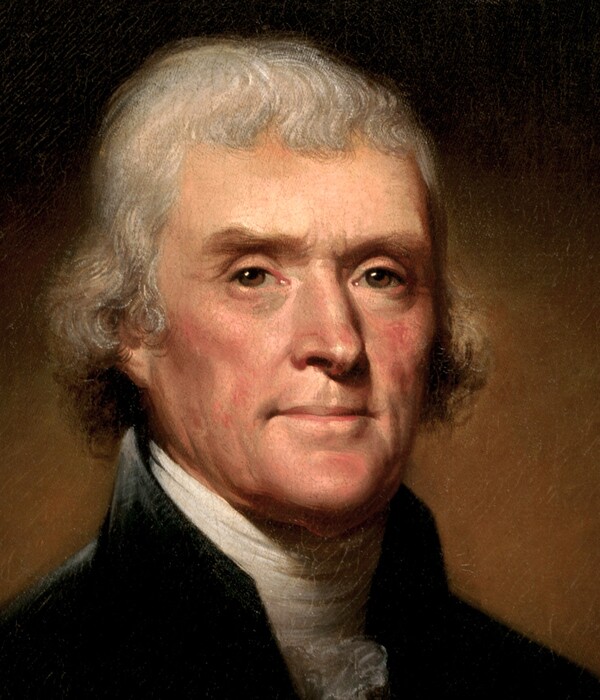
 Thomas Jefferson, to William Short, October 31, 1819
I take the liberty of observing that you are not a true disciple of our master Epicurus, in indulging the indolence to which you say you are yielding. One of his canons, you know, was that “that indulgence which prevents a greater pleasure, or produces a greater pain, is to be avoided.” Your love of repose will lead, in its progress, to a suspension of healthy exercise, a relaxation of mind, an indifference to everything around you, and finally to a debility of body, and hebetude of mind, the farthest of all things from the happiness which the well-regulated indulgences of Epicurus ensure; fortitude, you know is one of his four cardinal virtues. That teaches us to meet and surmount difficulties; not to fly from them, like cowards; and to fly, too, in vain, for they will meet and arrest us at every turn of our road. Weigh this matter well; brace yourself up....
Epicurean Quote of the Day
- That which is blessed and indestructible has no troubles itself, nor does it give trouble to anyone else, so that it is not affected by feelings of anger or gratitude. For all such things imply weakness. (tr. Long & Sedley)
- Death is nothing to us. For what has been dissolved has no sensation, and what has no sensation is nothing to us. (tr. Long & Sedley)
- The removal of all pain is the limit of the magnitude of pleasures. Wherever pleasure is present, as long as it is there, pain or distress or their combination is absent. (tr. Long & Sedley)
- Pain does not last continuously in the flesh: when acute it is there for a very short time, while the pain which just exceeds the pleasure in the flesh does not persist for many days; and chronic illnesses contain an excess of pleasure in the flesh over pain. (tr. Long & Sedley)
- It is impossible to live pleasantly without living prudently, honorably and justly; nor is it possible to live prudently, honorably and justly without living pleasantly. And whoever lacks this cannot live pleasantly. (tr. Long & Sedley)
- To secure protection from men anything is a natural good, by which you may be able to attain this end. (tr. Bailey)
- Certain people wanted to become famous and admired, thinking that they would thus acquire security from other men. Consequently, if such people's life was secure, they did obtain nature's good; but if it was not secure, they are not in possession of the objective which they originally sought after on the basis of nature's affinity. (tr. Long & Sedley)
- No pleasure is something bad per se: but the causes of some pleasures produce stresses many times greater than the pleasures. (tr. Long & Sedley)
- If every pleasure were condensed in ⟨location⟩ and duration and distributed all over the structure or the dominant parts of our nature, pleasures would never differ from one another. (tr. Long & Sedley)
- If the causes of the pleasures of the dissipated released mental fears concerning celestial phenomena and death and distress, and in addition taught the limit of desires, we should never have any reason to reproach them [i.e. the dissipated], since they would be satisfying themselves with pleasures from all directions and would never have pain or distress, which constitutes the bad. (tr. Long & Sedley)
- Were we not upset by the worries that celestial phenomena and death might matter to us, and also by failure to appreciate the limits of pains and desires, we would have no need for natural philosophy. (tr. Long & Sedley)
- There is no way to dispel the fear about matters of supreme importance, for someone who does not know what the nature of the universe is but retains some of the fears based on mythology. Hence without natural philosophy there is no way of securing the purity of our pleasures. (tr. Long & Sedley)
- There is no benefit in creating security with respect to men while retaining worries about things up above, things beneath the earth, and generally things in the infinite. (tr. Long & Sedley)
- The most unalloyed source of protection from men, which is secured to some extent by a certain force of expulsion, is in fact the immunity which results from a quiet life and the retirement from the world. (tr. Bailey)
- Nature's wealth is both limited and easy to achieve; but the wealth defined by groundless opinions falls into an infinite abyss. (tr. Long & Sedley)
- In but few things chance hinders a wise man, but the greatest and most important matters reason has ordained and throughout the whole period of life does and will ordain. (tr. Bailey)
- The just ⟨life⟩ is most free from disturbance, but the unjust life is full of the greatest disturbance. (tr. Long & Sedley)
- The pleasure in the flesh does not increase when once the pain of need has been removed, but it is only varied. And the limit of pleasure in the mind is produced by rationalizing those very things and their congeners which used to present the mind with its greatest fears. (tr. Long & Sedley)
- Infinite time and finite time contain equal pleasure, if one measures the limits of pleasure by reasoning. (tr. Long & Sedley)
- The flesh places the limits of pleasure at infinity, and needs an infinite time to bring it about. But the intellect, by making a rational calculation of the end and the limit which govern the flesh, and by dispelling the fears about eternity, brings about the complete life, so that we no longer need the infinite time. But neither does it shun pleasure, nor even when circumstances bring about our departure from life does it suppose, as it perishes, that it has in any way fallen short of the best life. (tr. Long & Sedley)
- He who knows the limits of life knows how easy it is to obtain that which removes pain caused by want and that which makes the whole of life complete. He therefore has no need for competitive involvements. (tr. Long & Sedley)
- We must consider both the real purpose and all the evidence of direct perception, to which we always refer the conclusions of opinion; otherwise, all will be full of doubt and confusion. (tr. Bailey)
- If you fight against all sensations, you will not have a standard against which to judge even those of them you say are mistaken. (tr. Long & Sedley)
- If you reject any single sensation and fail to distinguish between the conclusion of opinion as to the appearance awaiting confirmation and that which is actually given by the sensation or feeling, or each intuitive apprehension of the mind, you will confound all other sensations as well with the same groundless opinion, so that you will reject every standard of judgment. (tr. Bailey)
- If on each occasion, instead of referring your actions to the end of nature, you turn to some other nearer standard when you are making a choice or an avoidance, your actions will not be consistent with your principles. (tr. Long & Sedley)
- Those desires which do not bring pain when unfulfilled are not necessary, and the longing for them is easily dispersed, when to achieve them seems difficult or when they seem likely to produce harm. (tr. Long & Sedley)
- Of the things wisdom acquires for the blessedness of life as a whole, far the greatest is the possession of friendship. (tr. Long & Sedley)
- Confidence that nothing terrible lasts for ever or even for a long time is produced by the same judgment that also achieves the insight that friendship's security within those very limitations is perfectly complete. (tr. Long & Sedley)
- Of desires, some are natural and necessary, others are natural and not necessary, and others are neither natural nor necessary but are due to idle imagination. (tr. Long & Sedley)
- Whenever intense passion is present in natural desires which do not lead to pain if they are unfulfilled, these have their origin in empty opinion; and the reason for their persistence is not their own nature but the empty opinion of the person. (tr. Long & Sedley)
- Nature's justice is a guarantee of utility with a view to not harming one another and not being harmed. (tr. Long & Sedley)
- Nothing is just or unjust in relation to those creatures which were unable to make contracts over not harming one another and not being harmed: so too with all peoples which were unable or unwilling to make contracts over not harming and not being harmed. (tr. Long & Sedley)
- Justice was never anything per se, but a contract, regularly arising at some place or other in people's dealings with one another, over not harming or being harmed. (tr. Long & Sedley)
- Injustice is something bad not per se but in the fear that arises from the suspicion that one will not escape the notice of those who have the authority to punish such things. (tr. Long & Sedley)
- No one who secretly infringes any of the terms of a mutual contract made with a view to not harming and not being harmed can be confident that he will escape detection even if he does so countless times. For right up to his death it is unclear whether he will actually escape. (tr. Long & Sedley)
- Taken generally, justice is the same for all, since it is something useful in people's social relationships. But in the light of what is peculiar to a region and to the whole range of determinants, the same thing does not turn out to be just for all. (tr. Long & Sedley)
- What is legally deemed to be just has its existence in the domain of justice when ever it is attested to be useful in the requirements of social relationships, whether or not it turns out to be the same for all. But if someone makes a law and it does not happen to accord with the utility of social relationships, it no longer has the nature of justice. And even if what is useful in the sphere of justice changes but fits the preconception for some time, it was no less just throughout that time for those who do not confuse themselves with empty utterances but simply look at the facts. (tr. Long & Sedley)
- Where, provided the circumstances have not been altered, actions which were considered just, have been shown not to accord with the general concept in actual practice, then they were not just actions. But where, when circumstances have changed, the same actions which were sanctioned as just no longer lead to advantage, there they were just at the time when they were of advantage for the dealings of fellow-citizens with one another; but subsequently they are no longer just, when no longer of advantage. (tr. Bailey)
- The man who has best ordered the element of disquiet arising from external circumstances has made those things that he could akin to himself and the rest at least not alien: but with all to which he could not do even this he has refrained from mixing, and has expelled from his life all which it was of advantage to treat thus. (tr. Bailey)
- Those who had the power to eliminate all fear of their neighbors lived together accordingly in the most pleasurable way, through having the firmest pledge of security, and after enjoying the fullest intimacy, they did not grieve over someone's untimely death as if it called for commiseration. (tr. Long & Sedley)
- It is hard for an evil-doer to escape detection, but to obtain security for escaping is impossible. (tr. Bailey)
- Remember that you are of mortal nature and have a limited time to live and have devoted yourself to discussions on nature for all time and eternity and have seen 'things that are now and are to come and have been.' (tr. Bailey)
- For most men rest is stagnation and activity madness. (tr. Bailey)
- We value our characters as something peculiar to ourselves, whether they are good and we are esteemed by men, or not; so ought we to value the characters of others, if they are well-disposed to us. (tr. Bailey)
- No one when he sees evil deliberately chooses it, but is enticed by it as being good in comparison with a greater evil and so pursues it. (tr. Bailey)
- Blessed is not the young man but the old one who has lived honourably. For the young man keeps changing his mind and veers about under the influence of fortune. But the old one has lowered his anchor in old age as though in harbor, and with secure gratitude has clamped the good things he hardly hoped for previously. (tr. Long & Sedley)
- Remove sight, association and contact, and the passion of love is at an end. (tr. Bailey)
- Forgetting the good that has been he has become old this very day. (tr. Bailey)
- One should not force nature but persuade it. And we will persuade it by fulfilling the necessary desires, and the natural ones too if they do not harm us, but sharply rejecting the harmful ones. (tr. Long & Sedley)
- All friendship is an intrinsic virtue, but it originates from benefiting. (tr. Long & Sedley)
- Dreams have no divine character nor any prophetic force, but they originate from the influx of images. (tr. Bailey)
- Poverty, when measured by nature's end, is great wealth, but unlimited wealth is great poverty. (tr. Long & Sedley)
- You must understand that whether the discourse be long or short it tends to the same end. (tr. Bailey)
- In other pursuits the reward comes at the end and is hard won. But in philosophy enjoyment keeps pace with knowledge. It is not learning followed by entertainment, but learning and entertainment at the same time. (tr. Long & Sedley)
- Neither those who are over-eager for friendship nor those who are hesitant should be approved, but it is also necessary to take risks for the sake of friendship. (tr. Long & Sedley)
- I would rather speak with the frankness of a natural philosopher, and reveal the things which are expedient to all mankind, even if no one is going to understand me, than assent to the received opinions and reap the adulation lavishly bestowed by the multitude. (tr. Long & Sedley)
- Against other things it is possible to obtain security. But when it comes to death we human beings all live in an unwalled city. (tr. Long & Sedley)
- The veneration of the Wise man is a great blessing to those who venerate him. (tr. Bailey)
- The flesh's cry is not to be hungry or thirsty or cold. For one who is in these states and expects to remain so could rival even Zeus in happiness. (tr. Long & Sedley)
- It is not our friends' help that we need so much as the confidence of their help. (tr. Long & Sedley)
- One should not spoil what one has by wanting what one has not, but should remember that what one has was also wished for. (tr. Bailey)
- Epicurus' life when compared to other men's in respect of gentleness and self-sufficiency might be thought a mere legend. (tr. Bailey)
- Nature is weak towards evil, not towards good: because it is saved by pleasures, but destroyed by pains. (tr. Bailey)
- He is a little man in all respects who has many good reasons for quitting life. (tr. Bailey)
- One who is always looking for help is not a friend, nor is one who never associates help with friendship. For the former trades sentiment for recompense, while the latter cuts off confident expectation in regard to the future. (tr. Long & Sedley)
- The man who says that all events are necessitated has no ground for criticizing the man who says that not all events are necessitated. For according to him this is itself a necessitated event. (tr. Long & Sedley)
- We should laugh, philosophize, and handle our household affairs and other personal matters, all at the same time, and never cease making the utterances which stem from correct philosophy. (tr. Long & Sedley)
- It takes just the same time for the greatest good to be created and for it to be enjoyed. (tr. Long & Sedley)
- The love of money, if unjustly gained, is impious, and, if justly, shameful; for it is unseemly to be merely parsimonious even with justice on one's side. (tr. Bailey)
- The wise man when he has accommodated himself to straits knows better how to give than to receive: so great is the treasure of self-sufficiency which he has discovered. (tr. Bailey)
- Natural philosophy does not make people boastful and loud-mouthed, nor flaunters of culture, the thing so hotly competed for among the multitude, but modest and self-sufficient, and proud at their own goods, not at those of their circumstances. (tr. Long & Sedley)
- Let us completely rid ourselves of our bad habits as if they were evil men who have long done us great harm. (tr. Long & Sedley)
- I have anticipated thee, Fortune, and entrenched myself against all thy secret attacks. And we will not give ourselves up as captives to thee or to any other circumstance; but when it is time for us to go, spitting contempt on life and on those who here vainly cling to it, we will leave life crying aloud in a glorious triumph-song that we have lived well. (tr. Bailey)
- We must try to make the end of the journey better than the beginning, as long as we are journeying, but when we come to the end, we must be happy and content. (tr. Bailey)
- [Letter from Metrodorus to Pythocles] You tell me that the movement of your flesh is too inclined towards sexual intercourse. So long as you do not break the laws or disturb proper and established conventions or distress any of your neighbors or ravage your body or squander the necessities of life, act upon your inclination in any way you like. Yet it is impossible not to be constrained by at least one of these. For sex is never advantageous, and one should be content if it does no harm. (tr. Long & Sedley)
- Friendship dances round the world announcing to us all that we should wake up and felicitate one another. (tr. Long & Sedley)
- We must envy no one: for the good do not deserve envy and the bad, the more they prosper, the more they injure themselves. (tr. Bailey)
- One should not pretend to philosophize, but actually philosophize. For what we need is not the semblance of health, but real health. (tr. Long & Sedley)
- We must heal our misfortunes by the grateful recollection of what has been and by the recognition that it is impossible to make undone what has been done. (tr. Bailey)
- We must liberate ourselves from the prison of routine business and politics. (tr. Long & Sedley)
- What is insatiable is not the stomach, as people say, but the false opinion concerning its unlimited filling. (tr. Long & Sedley)
- Most beautiful too is the sight of those near and dear to us, when our original kinship makes us of one mind; for such sight is a great incitement to this end. (tr. Bailey)
- There can be refinement even on slender means, and one who fails to take account of it is in a similar position to someone who goes astray through ignoring limits. (tr. Long & Sedley)
- Let us feel for our friends not by mourning but by thinking of them. (tr. Long & Sedley)
- A free life cannot acquire great wealth, because this is not easy without servitude to mobs or monarchs; yet it possesses all things in unfailing abundance, and if it does achieve great wealth, this too it can share so as to win the goodwill of one's neighbors. (tr. Bailey)
- Nothing is enough for the man to whom enough is too little. (tr. Bailey)
- The ungrateful greed of the soul makes the creature everlastingly desire varieties of dainty food. (tr. Bailey)
- Let nothing be done in your life which will bring you fear if it should be known to your neighbor. (tr. Long & Sedley)
- This question should be applied to all desires; what will happen to me if the object of my desire is achieved and what if it is not? (tr. Long & Sedley)
- The occurrence of certain bodily pains is a help to protecting oneself against similar ones. (tr. Long & Sedley)
- In a philosophical discussion he who is worsted gains more in proportion as he learns more. (tr. Bailey)
- Ungrateful towards the blessings of the past is the saying, 'Wait till the end of a long life.' (tr. Bailey)
- The greatest fruit of self-sufficiency is freedom. (tr. Bailey)
- The man of noble character is chiefly concerned with wisdom and friendship. Of these the former is a mortal good, but the latter is immortal. (tr. Long & Sedley)
- The undisturbed man causes no stress to himself or to anyone else. (tr. Long & Sedley)
- The first measure of security is to watch over one's youth and to guard against what makes havoc of all by means of pestering desires. (tr. Bailey)
- What releases the soul's disturbance and produces worthwhile joy is neither possessing the greatest wealth, nor public recognition and respect, nor anything else which is dependent on indeterminate causes. (tr. Long & Sedley)
Recent Activity

Kalosyni posted the thread Using AI to create flow charts of Lucretius' De Rerum Natura.
Prompt: make a text based flow chart that consolidates Lucretius' theory of the nature of the soul in De Rerum Natura, starting with atoms and void and ending with what happens to the soul at death.
ChatGPT result:
Lucretius’ Theory of the Soul in De Rerum Natura: Text-Based Flowchart
(Code, 86 lines)
Central Argument
Lucretius argues that the soul is material, mortal, and inseparable from the functioning body. Since it is composed of atoms, it cannot exist eternally. At death, the soul's…

Joshua replied to the thread Happy Halloween 2026 - Death is Nothing to Us!.
And among the Romans, an analogous festival was Parentalia [URL:https://en.wikipedia.org/wiki/Parentalia], held in February in honor of family ancestors, culminating in the Feralia [URL:https://en.wikipedia.org/wiki/Feralia], when offerings were made to appease the spirits of the dead.
A second festival called Lemuria [URL:https://en.wikipedia.org/wiki/Feralia] was held in May, for purging malevolent, restless, or vengeful spirits. These were the ghosts of those who were not given proper…

Godfrey replied to the thread Happy Halloween 2026 - Death is Nothing to Us!.
Sounds very similar to the Mexican Dia de los Muertos 🤔
Kalosyni replied to the thread Happy Halloween 2026 - Death is Nothing to Us!.
[…]
I had to look that up...internet says: "The Festival of the Dead in Japan is known as Obon, a Buddhist celebration that honors deceased ancestors and is typically observed in mid-August. Families welcome the spirits of their ancestors back home, perform rituals, and conclude the festival by sending the spirits back to the afterlife with lanterns and bonfires."

Cassius posted the thread Episode 358 - EATAQ40 - Continuing in Part 18 of Book 2 of Academic Questions.
Welcome to Episode 358 of Lucretius Today. This is a podcast dedicated to the poet Lucretius, who wrote "On The Nature of Things," the most complete presentation of Epicurean philosophy left to us from the ancient world. Each week we walk you through the Epicurean texts, and we discuss how Epicurean philosophy can apply to you today. If you find the Epicurean worldview attractive, we invite you to join us in the study of Epicurus at EpicureanFriends.com, where we discuss this and all of our…
Joshua replied to the thread Happy Halloween 2026 - Death is Nothing to Us!.
Halloween doesn't mean much to me, but my favorite line from the English subtitles of the 2010 remake of the samurai film 13 Assassins is relevant:
Wife: "When will you return?"
Shinzaemon: "Soon. But if I'm late... I'll be at the Festival of the Dead.
Cassius replied to the thread Happy Halloween 2026 - Death is Nothing to Us!.
Happy Halloween!
Kalosyni posted the thread Happy Halloween 2026 - Death is Nothing to Us!.
Happy Halloween Everyone!
I just posted this image in the image gallery:
Kalosyni uploaded the image Happy Halloween 2026 - Death is Nothing to Us!.

Cassius replied to the thread Episode 357 - EATAQ39 - A Brief Word On Sextus Empiricus And The Goal of Skepticism.
Lucretius Today Podcast Episode 357 is now available: "A Brief Word On Sextus Empiricus And The Goal Of Skepticism"
https://www.spreaker.com/episode/76101222/media
Summary
With Joshua and Kalosyni away this week, Cassius records a short solo episode to tie up a couple of loose ends before Section 19 of Book Two of Cicero's Academic Questions. First, background on Antiochus of Ascalon and Philo of Larissa from David Sedley's 1981 review of John Glucker's Antiochus and the Late Academy:…
Cassius replied to the thread Welcome Thomas Karion!.
[…]
i think this is a subset of how we have to deal with concepts as well as particulars simultaneously. As I read Epicurus, he acknowedges the reality of BOTH (1) atoms and void and (2) things that are made of atoms and void. Epicurus is not a radical reductionists who ththeinks that atoms and void are the only reality. Pleasure and pain as concepts are considered to be neither atoms nor void, but they do not exist as concepts apart from the individual examples of their existence. If you…

Thomas Karion replied to the thread Welcome Thomas Karion!.
Thanks for your insightful message, Cassius.
1/ As for boredom, I’m not feeling it right now, so it’ll be hard for me to talk about it at length. But I imagine I must have been “unconsciously” troubled by something.
2/ Regarding health as experienced by a conscious being, I understand better what you mean.
3/ Regarding the fact that you “interpret (…) pleasure and pain as being felt simultaneously, but in different places, with the pleasure of the mind outweighing the pain of the body.” I…
Cassius replied to the thread Welcome Thomas Karion!.
Great questions and will take some time to address them in detail. But first I want to be sure you have seen the book recommendation to Norman DeWitt's "Epicurus and His Philosophy" which is in my view the best general reference that addresses these issues in the most detailed way. As to your specific points I can start with this below:
As to the role of consciousness we have this from Torquatus:
[…]
Just before this: "When we are released from pain, the mere sensation of complete…
Thomas Karion replied to the thread Welcome Thomas Karion!.
Hello Cassius,
I just read your text, which I found very interesting.
1. My Own Situation
To start with my own situation, I think I don’t feel pleasure because I feel a bit of boredom, however slight it may be.
Consequently, I’m not in a neutral state but in a state of slight unease that prevents me from feeling pleasure. I feel like something is missing. It’s true that I’m currently reevaluating how I manage my own desires and learning to moderate them. And I think this is starting to pay…
Kalosyni replied to the thread Welcome Thomas Karion!.
[…]
It's important to be clear about what you mean by "suffering". It could be referring to physical pain or to mental pain.
For physical pain we see that there is this Principal Doctrine:
PD04 - "Continuous pain does not last long in the flesh; on the contrary, pain, if extreme, is present a very short time, and even that degree of pain which barely outweighs pleasure in the flesh does not last for many days together. Illnesses of long duration even permit of an excess of pleasure over…
Cassius replied to the thread Welcome Thomas Karion!.
[…]
I think that's true. Whether this is clear to people will probably depend on how they view the meaning of "pleasure," and someone new to the philosophy not realize that there is a question as to the meaning of the word.
Thomas Karion replied to the thread Welcome Thomas Karion!.
[…]
Thanks, Cassius, for the FAQ. I'm going to play tennis, but I can't wait to read it as soon as I get back!
Thomas Karion replied to the thread Welcome Thomas Karion!.
Thanks, Cassius. I’ve found the answer to my question. If I don’t feel pleasure, it’s indeed because I’m experiencing suffering, however slight it may be. I don’t have any other questions for now, but I won’t hesitate to post here as soon as I do. I think that’s actually one of the key points of Epicurus’s philosophy. Many people think they’re in a neutral state when in fact they’re experiencing suffering without realizing it, however slight it may be. But that’s another topic we may have the…
Cassius replied to the thread Welcome Thomas Karion!.
Here is a draft synthesis of what you will find in much greater detail in the references listed above:
https://www.epicureanfriends.com/wcf/faq-question/57-why-if-i-am-not-feeling-pain-am-i-feeling-pleasure-draft-answer-as-of-10-29-26/
Cassius replied to the thread Welcome Thomas Karion!.
Also Thomas:
I personally find most discussions of katastematic pleasure on the internet to be worth very little. They seem to think that repeating "Epicurus said the highest pleasure is absence of pain" is self-explanatory and needs no further elaboration or defense. Or maybe they think that statement can't be explained satisfactorily. I do not believe most of those discussions are helpful at all, and I don't believe an adequate answer can be given without digging into the details of…
Cassius replied to the thread Welcome Thomas Karion!.
Please keep asking as you think about this. I will probably create a specific FAQ on this after we go through it.
Cassius replied to the thread Welcome Thomas Karion!.
[…]
These are very deep subjects, especially getting into the details of "katatestematic" pleasure, which I do not personally recommend you try to do at the beginning.
The place to start is that Epicurus held that there are only two categories of feeling - pleasure and pain - and that if you are not feeling one you are feeling the other.
The justification for that classification scheme is the issue, because it widens the nature of pleasure into both being stimulated from the outside (the…
Thomas Karion replied to the thread Welcome Thomas Karion!.
Are you perhaps referring to “pleasures in motion” and “catastematic pleasure”?
Or perhaps simply to the fact that either pleasure or suffering exists?
Cassius replied to the thread Welcome Thomas Karion!.
Thomas that is definitely an issue to to pursue til you understand the reason for Epicurus' position, so let us know as you read further about it. Epicurus' definition of pleasure is wider than the normal view, and his philosophy can't really be understood - nor can you decide whether you agree with it or not, without examining why Epicurus held that there are only two classes of feelings. Keep reading and asking until you are satisfied. You may not agree with the point but you can't be sure…
Thomas Karion replied to the thread Welcome Thomas Karion!.
Ok, thank you !
Cassius replied to the thread Discussion of Article - "Aristotle - Introduction From An Epicurean Perspective".
Thanks Bryan - i will be looking at that for adjusting....
Kalosyni replied to the thread Welcome Thomas Karion!.
@Thomas Karion please see this forum regarding your second question:
The Term "Pleasure" Means The Same As "Absence of Pain," And Includes All Experience Which Is Not Painful [URL:https://www.epicureanfriends.com/board/395-the-term-pleasure-means-the-same-as-absence-of-pain-and-includes-all-experience/]
Thomas Karion replied to the thread Welcome Thomas Karion!.
I have a second question.
In his third important maxim, Epicurus says that the removal of all suffering is the limit of the magnitude of pleasures.
Now, I am not experiencing any fear, physical pain, or mental distress at this moment.
However, I am not feeling any pleasure right now.
From an Epicurean perspective, can you explain why?
Thomas Karion replied to the thread Welcome Thomas Karion!.
Thank you Kalosyni.
So I'll keep posting in this thread.
Kalosyni replied to the thread Welcome Thomas Karion!.
[…]
Yes, entry level (Level 1) is granted posting permissions only in their Welcome thread.
[…]
To add to what Cassius wrote, I would say "free will vs determinism".
Bryan replied to the thread Discussion of Article - "Aristotle - Introduction From An Epicurean Perspective".
[…]
This is a great article! I found this part a bit difficult, because I can see Epicurus agreeing that the senses are the starting point, but critical judgments come from our mind. After all -- although the senses are the foundation of our philosophy -- nevertheless, the structure of the philosophy is made through reason and judgment.
Letter to Herodotus 10. 52a:
"And regarding this [mental activity of judgment in us], if it is not attested or is contested [by sensation], falsity is…
Cassius replied to the thread Welcome Thomas Karion!.
[…]
That's in the context of:
[…]
Reason, piety, and virtue are means to the end of pleasure, not ends in themselves, and that's a real key to Epicurean philosophy clarifying how things are prioritized.
Thomas Karion replied to the thread Welcome Thomas Karion!.
[…]
Thank you Martin !
Kalosyni replied to the thread Welcome Thomas Karion!.
@Cassius this phrase is way too vague, and so I personally wouldn't state the following:
[…]
We see in PD16 the following:
PD16 [URL:https://www.epicureanfriends.com/wcf/tagged/207-pd16/]. "In but few things chance hinders a wise man, but the greatest and most important matters, reason has ordained, and throughout the whole period of life does and will ordain."
So...a possible alternative would state:
Because of pleasure we choose virtue/just actions (which are not to harm or be harmed)…
Cassius replied to the thread Welcome Thomas Karion!.
Thinking further about this question - even if we stick to "ethics," we know Epicurus' own approximate ranking of problems when he left:
1 - People life hoping for divine assistance or trying to escape divine punishment for their actions, thinking that there is divine influence on our lives. Is that a problem that has gone away over the last two thousand years? Maybe in terms of raw superstition, but in more "respectable" terms (the major religions) I would say those problems are every bit…

Thomas Karion replied to the thread Welcome Thomas Karion!.
Thank you Kalosyni !
Kalosyni replied to the thread Welcome Thomas Karion!.
Welcome to the forum! @Thomas Karion
Cassius replied to the thread Welcome Thomas Karion!.
Welcome to the forum and that's a very interesting question.
[…]
I suppose it would be necessary to evaluate the context in which one might imagine Epicurus appearing and how he would arrive.
If you were to literally have a time machine and transport the literal Epicurus, he would have a lot to do to pick up where he left off and decide how to evaluate what had happened in the intervening 2000 years. And if you allowed him time to investigate the history of the intervening time, I…
Thomas Karion replied to the thread Welcome Thomas Karion!.
Hello,
I have a question. I’m not sure if this is the right forum, or even if I’m in the right section of the forum. I hope you’ll forgive me if that’s the case.
My question is this:
What do you think Epicurus would write about today if he were alive in our time?
I’ve calculated that Epicurus wrote mostly on physics, particularly in his work *On Nature* (37 books, according to Diogenes Laertius), and then about (or for) his many friends (especially in his numerous letters). He also wrote on…
Pacatus replied to a comment by Pacatus on blog article Why Pleasure as a Unified Whole is the Telos in Classical Epicurean Philosophy.
I also just posted the link to this essay on my wall, so I am always reminded. :saint:
Pacatus commented on blog article Why Pleasure as a Unified Whole is the Telos in Classical Epicurean Philosophy.
I was thinking of this just yesterday (maybe I was subconsciously remembering this essay :) -- or maybe it just finally sunk in). This is such a critical point, which cannot be over-stressed or repeated often enough. Thank you (and thanks to Cassius as well, for his longer article on the subject).
Cassius posted the thread Discussion of Article - "Aristotle - Introduction From An Epicurean Perspective".
This thread is for discussion of the article below, which - like the Sextus article - focuses on providing citations rather than just providing broad generalizations -
Cassius wrote the article Aristotle - Introduction From An Epicurean Perspective.
Many readers think of Aristotle as the down-to-earth empiricist who turned away from Plato toward nature and the senses. His own words show otherwise: knowledge from first principles rather than the senses, a finite world with no void, a divine unmoved mover, and happiness as virtue and contemplation instead of pleasure. A guide to eight of Aristotle's core works and the passages that matter to Epicureans.
Cassius posted the thread Welcome Thomas Karion!.
Welcome @Thomas Karion !
Thomas tells us:
[…]
Thank you for registering at EpicureanFriends.com, and for writing to us about your background and interest in Epicurus. We look forward to hearing more from you!
As a reminder, all posts are subject to our Community Standards, Rules, and Terms of Use [URL:https://www.epicureanfriends.com/wcf/terms-standards-rules/].
Welcome to EpicureanFriends!
Pacatus replied to the thread Discussion of Article - "Sextus Empiricus - Introduction From An Epicurean Perspective".
No matter how far afield my untethered mind might wander, I always end up returning to the Garden. And that always brings a feeling of ataraxia. 😊
Cassius replied to the thread Discussion of Article - "Sextus Empiricus - Introduction From An Epicurean Perspective".
[…]
And therefore as such you are clearly NOT a Pyrrhonist and therefore are always welcome here! :-)
Cassius replied to the thread Heads up: New Book Coming in 2027.
[…]
At least, that's not their present issue......
Pacatus replied to the thread Discussion of Article - "Sextus Empiricus - Introduction From An Epicurean Perspective".
I have read chunks of Sextus (I have two translations in paperback, both of which, unfortunately, have such small print that I now have difficulty reading them – even with my bifocals; if I had to make a recommendation, I’d recommend Benson Mates’ translation over Annas and Barnes). I have also read a number of the neo-Pyrrhonians, such as Machuca and Fogelin. Adrian Kuzminski's Pyrrhonism is by far the best introduction in terms of scholarship accessible to the lay reader.
“Pyrrhonan…
Pacatus replied to the thread Heads up: New Book Coming in 2027.
I suspect you're right. And it's also tied to particular socio-economic cultures. Perhaps the vast majority of people in the world are not susceptible.