


The test is: "How often and how clearly and how strongly does the discussion mention pleasure?"
Cassius I wonder if you somehow conceive of happiness being an unpleasant state??
The test is: "How often and how clearly and how strongly does the discussion mention pleasure?"
Cassius I wonder if you somehow conceive of happiness being an unpleasant state??
Same question - must one be totally free of mental suffering in order to be happy?
Thanks for asking...
No, but free from unnecessary mental suffering.
In regard to "free from suffering" that does not mean totally free, right, because we have the example of Epicurus bring happy on his last days while still under great pain?
I just now added in the word "mental"...so now it reads: free from mental suffering.
This thread is for cross-referencing and further discussion on the blog article:
This thread is to cross-reference and provide a place for discussion of the following blog article:
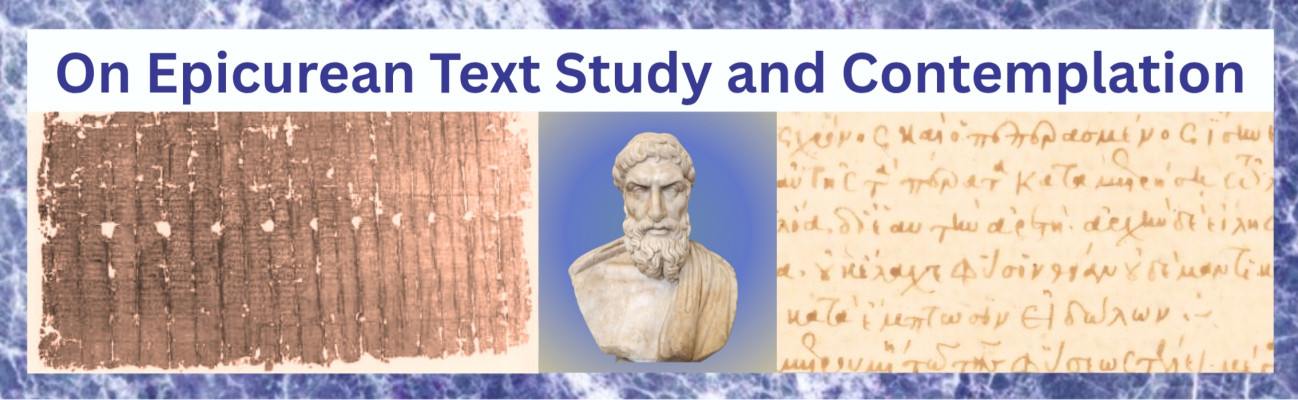
Don thank you for your tips and advice regarding this, and you gave some helpful links for further research.

This word is connected to αταραξία (ataraxia)
When investigating the word ταράττεσθαι (tarattesthai), I wanted to get as far away as possible from the word ataraxia. Ataraxia says nothing about what is to be removed or avoided.
Apologies, but found this to be of interest... (and after this I will refrain from further posting using AI translation).
Query: how many times is the word αταραξία found in the text of the Letter to Menoeceus ?
Google AI response:
The word αταραξία (specifically in its accusative form, ἀταραξίαν) appears exactly one time in the original Greek text of Epicurus's Letter to Menoeceus. [1]
Where It Appears
The single occurrence is found in Section 128 of the text: [1, 2]
Why Is It Only Used Once?
It is a common misconception that the word repeats constantly implying that ataraxia is the central pillar of Epicurean philosophy. However, Epicurus preferred to describe the concept of tranquility using descriptions of what is absent rather than repeating the abstract noun itself: [1, 2, 3, 4]
- Verbal Descriptions: He frequently writes about "not suffering pain" or "not being alarmed". For instance, immediately following his single use of ataraxia, he uses the phrase "ὅπως μήτε ἀλγῶμεν μήτε ταρβῶμεν" ("so that we may neither suffer pain nor feel fear"). [1]
- Alternative Terms: He often relies on words like ἀπορία (lack of physical pain) or shifts to general discussions of ἡδονή (pleasure), defining it purely as the baseline state when all bodily and mental distress is cleared away. [1, 2, 3]
I know there are mixed feelings for some regarding the use of AI, but I have just discovered that it is quite easy to use Google AI to translate ancient Greek words (but of course we know that errors may surface).
I was working on a particular section of the Letter to Menoeceus, and found this on one of the words...
query: translate into english from ancient greek the following word: ταράττεσθαι
AI response:
The Ancient Greek verb ταράττεσθαι (tarattesthai) translates to "to be troubled," "to be disturbed," "to be agitated," or "to be thrown into confusion." [1, 2]
It is the present passive/middle infinitive of tarassō (ταράσσω), which literally means to stir up or agitate liquids (like muddying water) and metaphorically refers to unsettling the mind or emotions. [1]
And then I queried (just for fun and comparison):
is this word used in the bible ?
AI response:
Yes, the underlying verb ταράσσω (tarassō) is used in the New Testament.
While the exact grammatical form ταράττεσθαι (the present passive infinitive) does not explicitly appear in the finalized textual tradition of the New Testament, other inflected variations of the exact same passive verb are used in some of the Bible's most famous passages to describe deep emotional or spiritual distress. [1]
Notable New Testament Uses
In the New Testament, the verb describes profound emotional turmoil, fear, or a troubled mind: [1]
- Jesus' Deep Emotion: When Jesus is deeply moved by the death of Lazarus in John 11:33, the text says he "troubled himself" (ἐτάραξεν ἑαυτόν). Later, facing his impending crucifixion in John 12:27, he cries, "Now my soul is troubled" (ἡ ψυχή μου τετάρακται).
- Comforting the Disciples: In John 14:1, Jesus delivers his famous reassurance: "Do not let your hearts be troubled" (μὴ ταρασσέσθω ὑμῶν ἡ καρδία)—which is the imperative passive form of the exact same word.
- The Disciples' Terror: When the disciples see Jesus walking on water in Matthew 14:26, the text notes they "were terrified" (ἐταράχθησαν). [1, 2]
Welcome to the forum h.nur beyaz erkizan
Bryan
Quote from Bryan
For example:
"ómnis énim Cólor omnī́nō mūtā́tur ín ómnīs"
...for every Color is altogether changed into every [color]
However, given Lucretius uses "mūtā́tur," the word "mutated" is a direct descendant:
...for every Color is altogether mutated into every [color]
Bryan, would it then be correct to say that: "when every color changes it is a completely different color" ?
Here is a conversation moved over from private discussion of translation work:
Raphael Raul said:
Bryan, as I mentioned at today's Epicurean Friends meeting, the translation reads very smoothly in English.
I does not have that structural stiffness that older translations do... Also, your color coding and placing the translation below the Latin, so both are visible together, allows the reader to see your choices clearly... excellent work!... Bravo!
Bryan said:
Quote from TauPhi
start learning Latin
Gratias tibi ago, TauPhi-- I really appreciate that!! I have greatly benefited from your encouragement over the years.
Quote from Raphael Raul
does not have that structural stiffness
Thank you, Raphael Raul-- it is a balance. I have also tried, where possible, to use English words that are etymologically related to the Latin. Sometimes, this requires using less common English words...
For example:
"ómnis énim Cólor omnī́nō mūtā́tur ín ómnīs"
...for every Color is altogether changed into every [color]
However, given Lucretius uses "mūtā́tur," the word "mutated" is a direct descendant:
...for every Color is altogether mutated into every [color]
Even though "mutated" carries some baggage in English, it pairs better with the Latin, and is technically not incorrect as "mutated" just means "undergoing alteration or change." There are many such cases!
Occasionally, I feel as though I have no choice but to use an uncommon word... I am not too happy that the first word of the entire work is "Ancestress."
Most translators just use "mother" -- but Lucretius consistently uses a different word that means mother, and "Génetrīx" clearly means "a female ancestor from whom a person is descended"
Don said:
Bryan Fantastic work! Very impressive.
Bryan said:
Quote from Don
work
Thank you, Don. As you know, the text of De Rerum Natura is very stable compared to our Greek sources. There are only a few locations where the two main manuscripts leave us with lacunas. We are on solid ground here... [ ] ...in contrast to the P.Hercs., which leave us drowning in a pool of papyrus dust.
This is my cheeky but sincere apology for what comes next: a standalone On Nature, Περὶ Φύσεως ΛΖ.
Don said:
Quote from Bryan
in contrast to the P.Hercs., which leave us drowning in a pool of papyrus dust.
Well put. That's a bit of nice wordsmithing there On a serious note, I remain excited about the opportunity and potential of the "read without unrolling" technology. I just hope whatever comes out of that is made publicly available.
Happy Twentieth Everyone!
Welcome to the forum! RoseQuartzAxolotl
In a recent Zoom meeting we presented this question for discussion:
"Do you think that the study of modern psychology should play a role in the lives of those who study Epicurean philosophy? Why or why not?" ...I would reframe and give more detail: "Should someone who studies Epicurean philosophy also include the study of modern psychology and implement evidence based "self-help" and positive psychology"?
Anyone with thoughts on this?
I will soon post more, but in the meantime please add your thoughts, thanks!
Don Regarding the formating of the Principal Doctrines, I just looked that up and found this (AI Google):
Modern translators and classical scholars determine where one doctrine ends and the next begins by evaluating four primary lines of evidence: grammatical shifts, thematic unity, historical manuscript markers, and 19th-century precedent. [1, 2, 3, 4]
Because ancient Greek text lacked clear punctuation and numbering, separating the continuous script into 40 distinct Kyriai Doxai relies on specific linguistic and contextual clues: [1, 2, 3]
1. Grammatical Transitions and Connecting Particles
Ancient Greek relies heavily on transitional particles to indicate a shift in thought. Translators watch for specific word cues that naturally reset a sentence: [1]
2. Micro-Spaces and Scribal Punctuation
While the manuscripts do not contain numbers, medieval scribes did leave subtle visual hints while copying the text: [1, 2]
3. Structural and Thematic Shifts
Translators look at the internal logic of the philosophy to find natural conceptual boundaries: [1, 2]
PD25. "If on each occasion, instead of referring your actions to the end of nature, you turn to some other, nearer, standard, when you are making a choice or an avoidance, your actions will not be consistent with your principles."
Here is my interpretation:
If on each occassion, instead of referring your actions to the natural pursuit of a life of happiness (as guided by pleasure and pain) if you turn too quickly to a simplistic standard such as skepticism (suspension of Judgment (Epoché)), when you are making a choice or an avoidance, your actions will not be consistent with achieving the best life.
and Bryan
At the end of the Letter to Menoeceus we see:
"Meditate therefore on these things and things akin to them night and day by yourself; and with a companion like to yourself, and never shall you be disturbed waking or asleep, but you shall live like a god among men. For a man who lives among immortal blessings is not like unto a mortal being."
For me, it seems clear in my imagination that the gods are living in a state of joy.
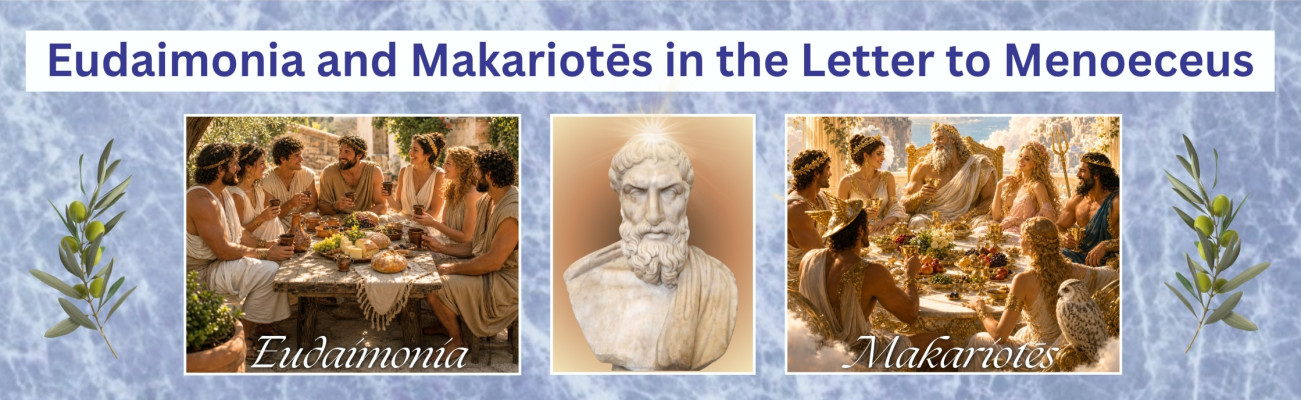
There is lots of good discussion happening here. But I wanted to re-state what and why I titled this thread as: "Neither "ataraxia" nor "not ataraxia" but "Joy as the goal". Perhaps it would have been more clear if I had said "eudiamonia" instead of joy.
My primary intention is for us to get out of our heads the common mantra put forward by the internet search engines (and by many philosophy scholars) that the end-all, be-all goal of Epicureanism is ataraxia. It's like this: Let's say you have a goal of having an omlet for breakfast. But then you state: "My goal is eggs". And you ignore that there is something much bigger (the omlet) which contains cheese and all the veggies, plus milk (and butter and the use of a hot frying pan) that go into the omlet and the making of the omlet.
Don I am grateful to read your your very good and helpful input on this thread.
Matteng and wbernys I think it is important to consider that the teachings of Epicurus are not presented in a linear fashion - and you need to look at the whole picture.
We see in PD27, it says: "Of all the things which wisdom acquires to produce the blessedness of the complete life, far the greatest is the possession of friendship."
This PD brings in the idea of "the blessedness of the complete life".
The primary ancient Greek word for the blessedness of a complete (fortunate) life is makarios (μακάριος), often used to describe the enviable state of the gods or the self-sustained blessedness of a life where all needs are met. Another crucial term for the enduring, flourishing "good life" is eudaimonia (εὐδαιμονία), representing lasting happiness and prosperity.
At the end of the Letter to Menoeceus we see:
"Meditate therefore on these things and things akin to them night and day by yourself; and with a companion like to yourself, and never shall you be disturbed waking or asleep, but you shall live like a god among men. For a man who lives among immortal blessings is not like unto a mortal being."
For me, it seems clear in my imagination that the gods are living in a state of joy.
In my research today, I just found this first chapter on the Letter to Menoeceus, from a new book just published February 2026, by Solmeng-Jonas Hirschi. (Written as a scholarly/academic examination).
It looks like it will have special interest for those who are studying ancient Greek language. Bryan Don @Eikadistes
This gives you 40 seconds of the opening of the Letter to Menoeceus:
It certainly illustrates something but i am not sure exactly what!
It shows how the gods have lots to see and do in their blessed and immortal realm. 
...and this one:
