


Thank you for finding that so we don't have to search it out! I guess we can ask Martin to pronounce them both for us and maybe we'll hear something we don't expect. My German is almost as bad as my Greek 
Thank you for finding that so we don't have to search it out! I guess we can ask Martin to pronounce them both for us and maybe we'll hear something we don't expect. My German is almost as bad as my Greek
Martin - Today I was using this graphic noticed near the end where Nietzsche says "Nihilist and Christian - they rhyme in German....." I wonder if, when you have time, you might comment on that for us. I presume it is true if we find exactly the right words, but I am thinking it is possible that we might learn something from comparing the root words to each other to see if it appears that the two words don't just rhyme, but arose in a similar context or have other parallels. Obviously not a big issue but if you have time at some point would appreciate your thought!
Full graphic:
My text I am going to use to circulate this around:
Epicurus regularly warned against the hazards of skepticism, including viewpoints which allege that confidence in knowledge is impossible. Skepticism comes in too many different forms to list here, but ranging from the very simple "Nothing can be known" (an issue dealt with in Lucretius Book 5) to "Anything Is Possible" to the pseudo-scientific "We don't have any evidence now, but we might in the future." I would submit that it is far more important to understand these issues than it is to understand Epicurus' views on pleasure, because Epicurus could have never had confidence in his conclusions on ethics if he did not have a position on what it means to have confidence in anything. These views of Epicurus formed the basis of his "Canon of Truth," which is evidence-based rather than logic-based, and every student of Epicurus needs to think closely about Doctrines 22-25 and why abstract logic is not the central aspect of his method.
This can be a complex subject to discuss, but from time to time we come across videos that are not explicitly Epicurean but which help explain the issues, involved. Thanks to a reader (Camotero) at EpicureanFriends this video by physicist Sabine Hossenfelder came to my attention today and I think it's well worth ten minutes. Please be sure at least to catch the part around the six minute mark where she labels the "Multiverse" theory as "nonscientific" and attributes the problem to the fact that "many physicists are Platonists... they believe that their math is real."
This is a very helpful video for orienting new students of Epicurus to his perspective on many aspects of science: Here's the youtube link:
This is a thread to compile links to videos that give background information on issues relevant to general viewpoints toward physics. Let's use it to compile a list rather than discuss the details of each video.
If you see a video that should be included here, please post a thread for it in the Physics General Discussion forum or somewhere else, as Camotero did below, and then as we evaluate the video as to how it compares with the others we have we can make a sorted list in order of desirability to view first, second, etc.
Right now the Number One Video would be
1. Sabine Hossenfelder - Can Physics Be Too Speculative. Thanks to Camotero for posting this and suggesting this video in this post: Not all research is scientific, or involves critical thinking.
See particularly the discussion of the Multiverse and Plato around the six minute mark:
This can be clarifying of the concept that reason alone is not sufficient to know the truth, and I'm guessing you'll enjoy it:
This post is currently a placeholder but it will be used to post general advise on navigating the topics related to Physics.
On thing that new readers should be sure to check out is this thread on "Best Videos Explaining The Limits of Speculation In Physics"
Also: This video has zoomed to the topic of my mental list of "best videos" that discusses the limits of speculation in physics. I'm going to spread this video around and it would be great if over time we could compile a list of "Best Videos Discussing Epicurus' Attitude Toward Speculation In Science" or something like that.
Here is a physics video very relevant to this topic, thanks to Camotero!

Thank you! You guessed correctly! And as you would expect the reference to Plato in regard to the multiverse at about the six minute mark is especially welcome. This video is an excellent introduction to some of the issues relevant to the comment here:
I have never heard of that person and look forward to reading more about her (Sabine Hossenfelder)
Same FB Poster:
I'm not convinced that religion "crushes" us. Take a look at the situation in the USA, which trendily abandoned its traditional religion over the last 50 years. With that religion went a stable common morality, and when that went, as we are seeing now, so did civic peace in the USA. Religion is one of the ways of dealing with the problem of death. It has its vices and its virtues.
Cassius Amicus
I think Epicurus was all in favor of a stable common morality as indicated in the last PDs about living among friends, but as for the possibility that religion can provide that, I think Epicurus was right that there's no way that standard supernatural religion is an acceptable substitute, and as Diogenes of Oinoanda said, those nations which are most religious can be among the most contemptible:
Fr. 20
[So it is obvious that wrong-doers, given that they do not fear the penalties imposed by the laws, are not] afraid of [the gods.] This [has to be] conceded. For if they were [afraid, they] would not [do wrong]. As for [all] the others, [it is my opinion] that the [wise] are not [(reasoning indicates) righteous] on account of the gods, but on account of [thinking] correctly and the [opinions] they hold [regarding] certain things [and especially] pains and death (for indeed invariably and without exception human beings do wrong either on account of fear or on account of pleasures), and that ordinary people on the other hand are righteous, in so far as they are righteous, on account of the laws and the penalties, imposed by the laws, hanging over them. But even if some of their number are conscientious on account of the laws, they are few: only just two or three individuals are to be found among great segments of multitudes, and not even these are steadfast in acting righteously; for they are not soundly persuaded about providence. A clear indication of the complete inability of the gods to prevent wrong-doings is provided by the nations of the Jews and Egyptians, who, as well as being the most superstitious of all peoples, are the vilest of all peoples.
On account of what kind of gods, then, will human beings be righteous? For they are not righteous on account of the real ones or on account of Plato’s and Socrates’ Judges in Hades. We are left with this conclusion; otherwise, why should not those who disregard the laws scorn fables much more?
So, with regard to righteousness, neither does our doctrine do harm [not does] the opposite [doctrine help], while, with regard to the other condition, the opposite doctrine not only does not help, but on the contrary also does harm, whereas our doctrine not only does not harm, but also helps. For the one removes disturbances, while the other adds them, as has already been made clear to you before.
That not only [is our doctrine] helpful, [but also the opposite doctrine harmful, is clearly shown by] the [Stoics as they go astray. For they say in opposition to us] that the god both is maker of [the] world and takes providential care of it, providing for all things, including human beings. Well, in the first place, we come to this question: was it, may I ask, for his own sake that the god created the world [or for the sake of human beings? For it is obvious that it was from a wish to benefit either himself or human beings that he embarked on this] undertaking. For how could it have been otherwise, if nothing is produced without a cause and these things are produced by a god? Let us then examine this view and what Stoics mean. It was, they say, from a wish to have a city and fellow-citizens, just as if [he were an exile from a city, that] the god [created the world and human beings. However, this supposition, a concoction of empty talking, is] self-evidently a fable, composed to gain the attention of an audience, not a natural philosopher’s argument searching for the truth and inferring from probabilities things not palpable to sense. Yet even if, in the belief that he was doing some good [to himself, the god] really [made the world and human beings], .................

to coming up with enough plausible, physical explanations that would rule out the need for any supernatural intervention.
I think that's another way of getting at something we need to articulate better - describing the "degree of confidence" that is involved in "ruling out" something. It is very easy for radical skeptics to say "You haven't been everywhere / You haven't been around forever / You don't know everything" therefore it COULD be possible that supernatural intervention is real.
I think a large part of what Epicurus was after was developing a "system" for being able to answer that kind of skepticism, which means giving us a framework to know when to have confidence and when not to -- meaning, when we can "rule out" something and when we can't.
It's not simply a matter of "reason" or "rationality" either, since those are necessarily based on the senses, and our ultimate standard of truth is not "reason" or "logic" or "rationality." Articulating that is tricky but it's an important part of the system.
FB Poster:
Alas, the ineluctable presence of death, looming always over our lives, drives religion. Against the massive pressure of that great terror, all that mankind can do is occasionally open up little spaces for rational living, as Epicurus did.
Cassius Amicus:
The "all that mankind can do" part may be (hopefully) unduly pessimistic, but as to the "massive pressure" part absolutely yes. I would say today almost as bad as 2300 years ago, and the majority of humanity still "lays prostrate upon the earth, crushed down under the weight of religion." And it's going to remain that way until the views that Epicurus taught (which aren't uniquely his, but which he deserves credit for being among the first to popularize) become more widespread. Interestingly I think we have plenty of proof now too that it's not "science" or "knowledge" that saves the day, because religion is infinitely capable of adjusting to argue that all science comes from god. The key is the confidence - the philosophic view or attitude - that there are indeed natural answers that explain the questions we have. If we simply say "I don't know" to ultimate questions of whether there are gods behind everything then we never dispel the lingering doubt which will always contribute to that "massive pressure" to conform to religion.
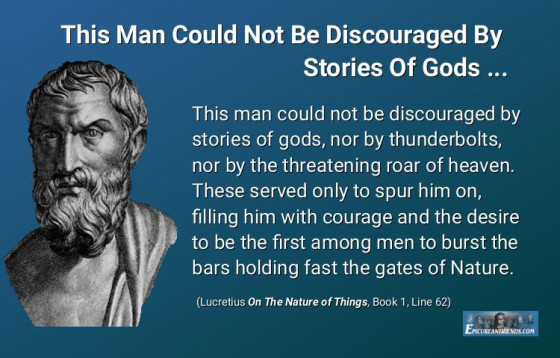
This man could not be discouraged by stories of gods, nor by thunderbolts, nor by the threatening roar of heaven. These served only to spur him on, filling him with courage and the desire to be the first among men to burst the bars holding fast the gates of Nature. (Lucretius Book 1, Line 62)
It appears to me that this passage in Lucretius is emphasizing that Epicurus wasn't discouraged either by the stories of the gods that he heard from other men, or by the phenomena of the sky that he could not explain. To the contrary, he used those to build his own enthusiasm for finding out the truth and responding to them, rather than allowing them to wear him out and get discouraged.
I'd also say that he probably wasn't primarily motivated to "be the first among men" to do this, but at the same time we can also be sure that he wasn't seeking knowledge for the sake of knowledge, but knowledge for the pleasures that knowledge brings, and Epicurus would not have been oblivious to, and indeed would have welcomed the reward, of the joy and delight and peace of mind that he would gain for himself and his friends by doing so.
Thank you for your comments. We're now in the process of recording the final book, and it is definitely motivational to hear that we've been of assistance to people!
Here is the link to join the EpicureanFriends Telegram channel. Please be sure to use this link rather than searching within Telegram, because due to the way Telegram seems to work there are some older and now unused channels of the same name. The links below are the best way to get to the right place:
Update 2-6-22: As with Matrix, this account is still there, but I am not signing in very often. I have cooled off toward Telegram just like Matrix, mainly that they too seem to be getting a lot of mysterious funding that no doubt has strings attached. They are not fully open source, nor are they fully encrypted, so they are considerably less secure even than matrix.
[Note: This information was previously listed in the forum header. Probably it is easier to find and more logically placed as a pinned post at the top of the forum. This format probably works better, and would be a good thing for each forum to have. Provisionally we'll call them "Navigator" as a way of labeling them guides to posting in the particular form - since the Epicureans seemed to like oceanic analogies.]
This forum lists locations on other websites, such as Facebook, Reddit, Twitter, etc., where Epicurean groups exist. If you have an account on one of these services and would like to be found by other users of the EpicureanFriends website, please add your user information in the appropriate thread.
If you have an account on another service and would like other Epicureans to be able to find it there, please start a new thread with the title in the format: "Social Media - [Platform Name]" Sites which allow free speech are generally acceptable, but please do not submit sites which are explicitly political in nature or engage in controversy in these threads regarding any site which does not itself censor participation. Public posts for the purpose of raising political objections to the participation of any group member on any site will be considered violations of the "no politics" rule and subject to removal of both the post and poster. Any concerns about this policy or sites which are listed should be addressed directly to Cassius Amicus by private message on this board.
NOTE: Many of these accounts are essentially placeholders and are infrequently used by Cassius Amicus, so communications at those locations may go unanswered for extended periods of time. To contact CassiusAmicus always come first to the EpicureanFriends.com forum. if you are using one of these platforms actively and would like to cooperate with other Epicureans in those locations please let us know by posting in the appropriate thread below.
Thanks Don - those appear to be reasonably priced and/or free. I will investigate.
I haven't figured out how to automate this and so it's going to be sporadic, but here is an early sample of what I'd like to set up for rotation:
RE: Foundations 001 - The First To Stand Up To Religion, Face to Face
Social Media Postings - I am going to try to do this as a series - go through the quotes that are pulled out and included in the "Foundations" video and produce a series of basic graphics which link back here to the discussion of each one at EpicureanFriends.com. This is the source that I will work to expand to put these in final format and provide a citation.
I need to find a way to automate this but to get started they can be done manually.
https://twitter.com/NewEpicurean (Twitter)
https://epicureanworldview.com/@cassius (Fediverse / Mastodon / Pleroma / etc.) This is the new "fediverse" server that I've set up experimentally. Because it is the open source activitypub format, it can be accessed with many free phone apps such as Fedilab for Android and any "mastodon" app for IOS. The fediverse has far fewer participants than Twitter, but the big advantage is that the site is owned by EpicureanFriends and can't be deplatformed if Twitter decides one day it doesn't like hard-hitting Epicurean philosophy.
https://www.facebook.com/groups/Epicure…27836567265272/ (Facebook Epicurean Philosophy Group)
At a time when human life - before the eye of all - lay foully prostrate upon the Earth, crushed down under the weight of Religion, which showed its head from the quarters of heaven with hideous aspect, glowering down upon men, it was a man of Hellas who was the first to venture to lift up his mortal eyes, and stand up to Religion, face to face. (Lucretius Book 1, Line 62)
It's interesting how that little bit of natural science speculation in Lucretius (that fire could be produced by trees rubbing together) could "spark' so much interest.
I'm trying to think of what other almost offhand comments are similarly memorable -
We've recently had that interesting comment in the middle of the discussion of using fighting animals in war, all of a sudden turning to how that same thing might have happened on some other planet elsewhere in the universe.
Maybe we'll also find something similarly memorable when we finally get to the discussion of magnetism which must be coming up pretty soon, in the first half of book six, unless I somehow missed it in what we've covered already. At any rate I am certainly looking forward to Martin 's thoughts on that section when we get to it, as even today magnetism seems almost like magic. I glanced at the wikipedia article on magnetism and its seems a lot more like 'description' rather than an explanation of the mechanism, even today, suggesting that it will be interesting to discuss what Lucretius had to say in comparison with this: https://en.wikipedia.org/wiki/Magnetism…in_of_magnetism