

Here are some of my notes from my preparation for the episode. The first cache:
Why do I keep harping on the inadequacy on the word "happy"?
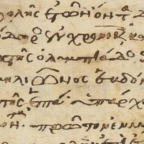
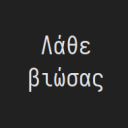
To me, "happy" implies "tra-la-la, skipping through the daisies, fizzy, effervescent feelings." There's nothing wrong with feeling happy!! "Happy" to me is a fleeting of-the-moment feeling. "Happy" gets used for sooooo many words in Greek and Latin that, to me, it obscures what is actually going on. Translators just seem to go "We'll throw that in the 'happy' basket. Done!" Even the "Call no man "happy"" episode with Croesus recounted by Herodotus used ὀλβιώτατος (olbiotatos) and ὄλβιος (olbios) - not eudaimonia, not khara, not makarios - a whole new word! But in the famous quote usually translated as "Call no man happy until he's dead, it doesn't refer to the kind of feeling I get when I hear "happy" (Herodotus 1.32.7 )
QuoteQuote
[7] If besides all this he ends his life well, then he is the one whom you seek, the one worthy to be called fortunate. But refrain from calling him fortunate before he dies; call him lucky.
‘ [7] εἰ δὲ πρὸς τούτοισι ἔτι τελευτήσῃ τὸν βίον εὖ, οὗτος ἐκεῖνος τὸν σὺ ζητέεις, ὁ ὄλβιος κεκλῆσθαι ἄξιος ἐστί: πρὶν δ᾽ ἂν τελευτήσῃ, ἐπισχεῖν, μηδὲ καλέειν κω ὄλβιον ἀλλ᾽ εὐτυχέα. ’
olbios and olbiotatos (the superlative form) " is defined in Liddell & Scott as "happy, blessed, blest; (of things) rich, prosperous" which reminds me more of makarios (the description of the happiness of the gods and the "blessed life") than English "happy." The words come from olbos "wealth, prosperity, riches; happiness, bliss, fortune."
Which to me also echoes eudaimonia. The Stanford philosophy site gave an explanation of eudaimonia as “The term is perhaps best understood in connection with the success or good fortune a person would enjoy when under the protection of a guardian angel." To me, the concept is better understood as "fortunate, having an inner sense of well-being, resilient, "rich" in the metaphorical sense, confident in one's self-reliance, content (BUT not milquetoast doormat-y contentment), able to appreciate "the little things" and so on. To me, "happy" doesn't fit that semantic hole neatly. Maybe "happiness" or a "sense of happiness." If we can agree that *that* is what "happy" means, I can use the word... but I won't be "happy" about it ![]()
So, Epicurus was not "happy happy skipping through daisies" on his last day. He was content with the way his life had gone. He was satisfied that he had lived a "good" life. He took enjoyment in recollecting the path he had taken, in the friends he had made, and in the pleasures he had experienced. In his letter to Idomeneus, Epicurus calls his last day "blessed" (makarion). And "But the cheerfulness (χαῖρον khairon) of my mind, which arises from the recollection of all our philosophical contemplations, counterbalances all these afflictions." (Yonge's translation with amending "our" instead of "my philosopical...") khairon is a form of the word used for the kinetic pleasure of "joy" khara. And Epicurus doesn't say the "joy" outweighs or conquers the pain of his condition. The word used is Ἀντιπαρατάσσομαι (antiparatassomai) which conveys "holding one's ground against, and in drawing up troops in battle order, side by side, ready to do battle against an enemy." He can do battle with the physical pain with the kinetic "joy" he can experience. I don't want to do down a kinetic/katastematic rabbit hole but there you go.
That's part of the reason I dislike saying things like "Epicurus was 'happy' on his last day" or "Call no many 'happy' until he dies." It glosses over too much and paints a skewed picture of what is actually being conveyed by the texts.