


Fret not, Don , my sad emoji was in jest. I'm just over here humming my favorite triumph-song, "Eye of the Tiger.'
I need to stop taking things so literally! 
And  on your choice of "triumph-song"!
Fret not, Don , my sad emoji was in jest. I'm just over here humming my favorite triumph-song, "Eye of the Tiger.'
I need to stop taking things so literally!
And on your choice of "triumph-song"!
ἅπαξ
I like that this is the same word used in the phrase hapax legomenon - a word that only occurs once in an existing corpus of texts. That connotation of a unique and singular existence seems appropriate.
αὔριονκύριος "Master of Tomorrow" is a great word, too!
PS... And ΓΕΓΟΝΑΜΕΝ ΑΠΑΞ is the next Epicurean T-shirt we need 
By Zeus, this thread along with the thread on VS47 makes me think a systematic review of Usener's "fragments" would turn up multiple problematic Epicurean attributions. It seems to me he and his colleagues may have been playing fast and loose. I have no doubts about Usener's scholarship and erudition (just as I respect DeWitt's qualities), but it seems to me he may have got a little full of himself that led to some hubris.
(PS: Some may say that I have hubris to even question Usener or Bailey or even DeWitt, and maybe that's true. I would defend myself by saying that I'm not questioning Usener, Bailey, etc al. on a whim. I find a troubling number of their citations lacking in relevance to their assertions. I find their "corrections" and "reconstrctions" to be more flights of fancy in some places than reasoned well-founded scholarship. All this might mean that we have less extant Epicurean texts than we're led to believe, but maybe we need to concentrate on what we clearly have than what we like to have. )
That's great, Bryan ! You da man!! 
I just found that quote in that saying is from the Iliad, I.70:
When he had thus spoken he sat down, and among them arose Calchas son of Thestor, far the best of bird-diviners, who knew the things that were, and that were to be, and that had been before,

even if the line *didn't* end that way, it *could* have ended that way
And I'm more than fine with that! It's a nice use of classical themes and allusions. Coming up with new metaphors and sayings would be a fine exercise!
I just think it's disingenuous to pass off one's "brilliant emendation" as the actual ancient text.
Usener's "correction" appears to have really stuck in my craw.

Always the killjoy here at the forum
VS47 - Source in Vat.gr.1950 and elsewhere
This saying is attributed to Metrodorus.
Here is the manuscript of VS47
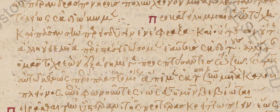
(Source: Vat.gr.1950, part 2, 403verso)
And here is the text in Metrodori Epicurei Fragmenta collegit scriptoris incerti Epicurei Commentarium moralem, subiecit Alfredus Koerte (p.561)

That famous word "triumph-song" does not appear in the manuscript! It is a "correction" by Usener, clearly shown in the manuscript itself and in Note (5) in Metrodori...: 5) πλειονος V[atican]., corr[ected by] Us[ener]. Usener…DonMay 23, 2024 at 6:46 AM
I'll admit I feel bad I made Little Rocker sad (see emoticons). In the end, I agree with Cassius about the need for accuracy. When we have access to the manuscripts themselves - the same ones examined by scholars of the past and present - we don't have to just accept the "brilliant emendations" they give. Trying to get to an accurate transcription and reconstruction of texts is one thing. Being clever and trying to outsmart or "correct" an ancient scribe is another, in my opinion.
If so, then that helps further to understand Usener's point.
I think Usener was being clever and trying to show off. Occam's Razor tells me that if πλειονος is viable and that's what the manuscript shows with no other conflicting manuscript evidence to the contrary, I'm not impressed by Usener's "brilliant emendation."
Yeah, Aristophanes ended his plays like that a lot.
.ἄπιμεν ἐκ τοῦ ζῆν μετὰ καλοῦ πλείονος ἐπιφωνοῦντες ὡς εὖ ἡμῖν βεβίωται.
...we shall depart from life with more [of] good, proclaiming that we have lived well.
Yes. With the "more nobly" going with the departing?
Anyone familiar with the reference to Aristophanes?
Assuming it's referring to the cast of the play singing and dancing their way off the stage at the end of his plays.
But επιφωνουντες doesn't imply singing or dancing, just "call out, proclaim, exclaim"
I did a Google search for "μετά πλειονος" alone and came up with numerous examples from numerous texts. For example, "μετὰ πλείονος ἡδονῆς, μετὰ πλείονος εὐφροσύνης" "More happily and comfortably" just with the other genitive after and not before, but Greek word order was flexible to a degree.
πλειονος is a neuter singular genitive of πλειον (Attic form of πλειων). As such, it looks like it usually means something like "more"
καλού is neuter singular of καλος with all its various connotations: beauty, nobility, good, etc.
So, I guess I'm leaning toward something like "more nobly; more beautifully; more honorably, etc" with the "more than those who don't follow pleasure as their guide" implied.
Cursive Greek is not easy to parse!
For example...
That's πλειονος... And that's a relatively straightforward one!
PS... And...
Προκατείλημμαί ... This one has a few more ligatures just for fun. I particularly like the connected ρο rho-omicron with the loop near the beginning.
Don can you tell how that proclaiming/exclaiming compares with Martin Ferguson Smith's translation of Diogenes of Oenoanda's "shouting" in fragment 32?
Diogenes uses ενβοων < βοαω "call, shout, roar, howl, etc." No singing implied.
Cursive Greek is not easy to parse!
VS47 begins with the read Π (pi) halfway across the first line. I'll need to go letter for letter, but the transcription in Metrodori looked generally correct... Except for that πλειονος!
I'm primarily curious if anyone can suggest translations using πλειονος instead of Usener's "correction."
Always the killjoy here at the forum ... I just made a post on the VS47 thread that the word "triumph-song" is not in the original manuscript... that's a "correction" by Usener. Feel free to continue the conversation over there:
This saying is attributed to Metrodorus.
Here is the manuscript of VS47
(Source: Vat.gr.1950, part 2, 403verso)
And here is the text in Metrodori Epicurei Fragmenta collegit scriptoris incerti Epicurei Commentarium moralem, subiecit Alfredus Koerte (p.561)
That famous word "triumph-song" does not appear in the manuscript! It is a "correction" by Usener, clearly shown in the manuscript itself and in Note (5) in Metrodori...: 5) πλειονος V[atican]., corr[ected by] Us[ener]. Usener corrected the manuscript's πλειονος (more, comparative degree of πολύς (polys)) to the more dramatic παιωνος (a song of triumph after victory; a choral song addressed to Apollo or Artemis)
Epicurus Wiki has a nice breakdown of the saying (including Usener's "correction") that is helpful in providing context and appreciation of Metrodorus's contribution to our surviving texts.
I'd be curious what Bryan or @Twentier or others make of the manuscript's πλειονος versus Usener's "correction." If we take the manuscript at its word, something like: we shall depart from life with/in the midst of/along with more beauty/nobility (μετα καλου πλειονος), exclaiming/proclaiming that we have lived well.
Or something like: We shall depart from life proclaiming that we have lived with more nobility (than others who didn't pursue pleasure?). ? Thoughts welcomed!
when it is time for me to go, spitting contempt on life and on those who vainly cling to it, I will leave life crying aloud a glorious triumph-song that I have lived well.
That's a good one. I have always interpreted this as being indicative of not clinging to life at the end. There's palliative care at the end of life; and there's "keep me alive at all costs" (literally and figuratively). If I have (decades and decades in the future ) a terminal dagnosis from a disease, I hope I can do what's feasible; then, at some point, help me with the pain and go out on my own terms... Knowing I lived well.
68. Nothing is enough to one for whom enough is very little.
I've always taken this one to simply mean "Don't go through life consistently dissatisfied with your life. Enjoy what you have!" I read this along with 35. "Don't ruin the things you have by wanting what you don't have, but realize that they too are things you once did wish for."
This one is nice simple Greek, too.
οὐδὲν ἱκανὸν ᾧ ὀλίγον τὸ ἱκανόν.
ἱκανὸν "sufficient, adequate, enough, satisfactory"
https://www.perseus.tufts.edu/hopper/text?do…04.0057:entry=i(kano/s
ὀλίγον (where we get oligarchy = "rule by the few"
Of small amount: few, little
Of small size: little, small
Of small degree: slight
https://www.perseus.tufts.edu/hopper/text?do…04.0057:entry=o)li/gos
We're lucky to have On Piety, but Obbink's reconstruction of the text is speculative at best in some areas of the papyrus. Even the parts of the papyrus that are more complete often provide citations without much context. Obbink et al are more than happy to provide commentary, but much of that appears speculative. However, all that said, I need to dig deeper into Obbink's translation and commentary. One paragraph that caught my eye this morning was:
I suppose what puzzles me about the idea that we should aim to be like the gods is that it might seem perfectly sufficient to aim to be like the *sage.* If, for example, the sage expresses gratitude, but the gods do not (KD 1), then shouldn't I want to be like the sage because I am human?
Great question. LOL! Maybe it's all marketing. "Be an Epicurean. Live the life of the gods!"
In a slightly more serious vein, maybe it's the self-sufficiency (autarkeia) aspect of the gods. By Epicurean definition, they neither expect praise nor dispense random punishment. They are always "blessed" and have an unshakable (incorrupible) blessed life. So a sage can live a god-like life in the here and now?
I'll have to give this one some more thought 🤔